
Prelims + Mains Integrated Current Affairs | GS Paper I, II, III & IV
BRICS 2026 • Global South • Dryland Agriculture • Circular Economy • Wildlife Trade • Defence Diplomacy • Indigenous Cattle Conservation • Steel Slag Technology • North-East Connectivity • Emerging Science & Technology
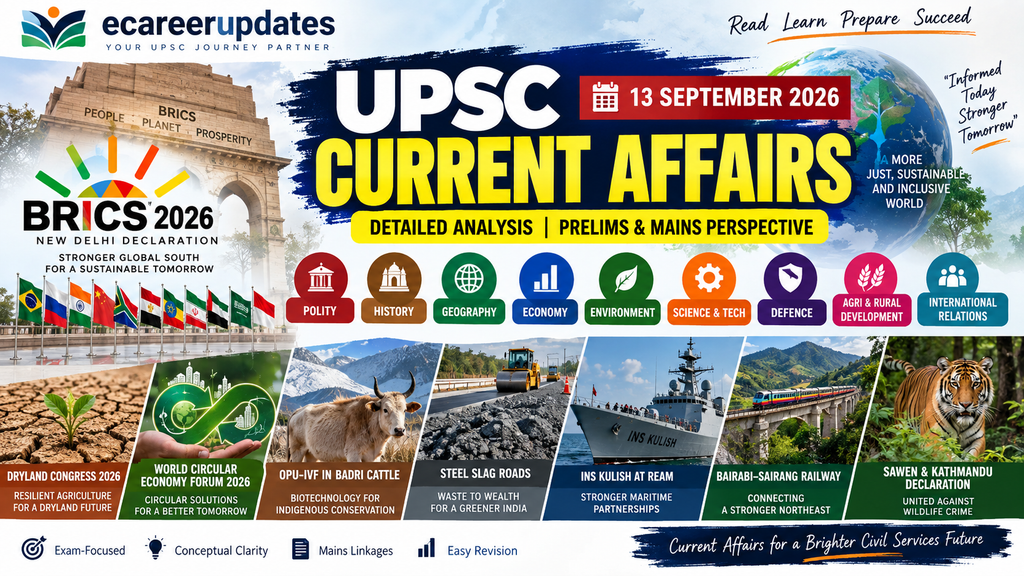
1. TODAY’S UPSC CURRENT AFFAIRS AT A GLANCE
| विषय | प्रमुख घटना | UPSC Relevance |
|---|---|---|
| International Relations | 18th BRICS Summit & New Delhi Declaration | GS-II, Prelims |
| Global Governance | BRICS reforms & Global South | GS-II |
| Agriculture | Dryland Congress & Delhi Declaration on Drylands | GS-III |
| Environment | World Circular Economy Forum 2026 | GS-III |
| Environment | SAWEN & Kathmandu Declaration | GS-III |
| Defence | INS Kulish at Ream Naval Base, Cambodia | GS-II |
| Science & Tech | OPU-IVF in Badri cattle | GS-III |
| Infrastructure | Steel Slag Road Technology | GS-III |
| Geography | Bairabi–Sairang Railway, Mizoram | GS-I/III |
| Health/Biotech | Indigenous cattle germplasm conservation | GS-III |
| Economy | Circular economy, resource efficiency & industrial by-products | GS-III |
| Agriculture + Climate | Dryland resilience and regenerative agriculture | GS-III |
2. INTERNATIONAL RELATIONS
18th BRICS SUMMIT – NEW DELHI DECLARATION
Why in News?
The 18th BRICS Summit was held in New Delhi on 12–13 September 2026, under India’s chairship.
India’s 2026 BRICS presidency focused on:
“Building for Resilience, Innovation, Cooperation and Sustainability.”
The New Delhi Declaration represents one of the most important international-relations developments for UPSC preparation.
BRICS – BASIC FACTS
BRICS began as BRIC, consisting of:
- Brazil
- Russia
- India
- China
South Africa joined in 2010, converting BRIC into BRICS.
The grouping has subsequently expanded.
Current BRICS members
| Country | Region |
|---|---|
| Brazil | South America |
| Russia | Europe/Asia |
| India | South Asia |
| China | East Asia |
| South Africa | Africa |
| Egypt | Africa |
| Ethiopia | Africa |
| Iran | West Asia |
| UAE | West Asia |
| Saudi Arabia | West Asia |
| Indonesia | Southeast Asia |
UPSC Trap: BRICS is not a formal military alliance like NATO.
It is primarily a platform for political, economic and development cooperation.
Why BRICS matters for India
BRICS has become an important platform through which India seeks:
- Greater representation for developing countries.
- Reform of global governance institutions.
- Greater voice for the Global South.
- Alternative mechanisms for development finance.
- Cooperation in technology and digital economy.
- Energy and food-security cooperation.
- Greater resilience against global supply-chain disruptions.
Major 2026 BRICS Themes
The Indian presidency emphasised four broad pillars:
1. Resilience
The idea is to make economies and societies capable of absorbing shocks.
Examples:
- pandemics
- climate disasters
- supply-chain disruptions
- food insecurity
- energy shocks
- geopolitical conflicts
A major initiative is the proposed BRICS Integrated Early Warning System for infectious diseases.
2. Innovation
Important initiatives include:
- BRICS Incubator Network
- Startup Innovation Fund
- Science and Research Repository
- Digital Agriculture cooperation
3. Cooperation
Cooperation is being expanded in:
- trade
- logistics
- customs
- MSMEs
- health
- agriculture
- urban mobility
- technology
4. Sustainability
Focus areas include:
- smart grids
- energy storage
- regenerative agriculture
- agro-ecology
- climate-resilient infrastructure
- sustainable urban mobility
BRICS and Digital Agriculture
One particularly important initiative is the:
BRICS Network on Digital Agriculture
It aims to combine:
- Artificial Intelligence
- Geospatial Technology
- Internet of Things
- Data analytics
- Digital Public Infrastructure
with agricultural decision-making.
UPSC Linkage
This connects directly with:
Agriculture + AI + climate resilience + precision farming + food security
Potential applications:
- weather prediction
- crop-health monitoring
- irrigation management
- pest prediction
- yield forecasting
- market intelligence
BRICS and Critical Minerals
India highlighted the concern regarding the “weaponisation” of technology and critical minerals.
This is extremely important for UPSC.
Why?
Modern industries depend on minerals such as:
- Lithium
- Cobalt
- Nickel
- Rare Earth Elements
- Graphite
These are important for:
- EV batteries
- semiconductors
- renewable energy
- defence technology
- electronics
- energy storage
Therefore:
Critical minerals → technological sovereignty → national security → strategic autonomy
BRICS and Global South
The expansion of BRICS represents the changing structure of global power.
Traditional structure
Global governance was heavily influenced by:
- USA
- Europe
- G7
- Bretton Woods institutions
Emerging structure
Increasing importance of:
- BRICS
- G20
- Global South
- emerging economies
Mains Linkage
GS-II: Reform of global institutions
GS-III: Global economic fragmentation
Essay: Multipolarity and the future of global governance
Prelims Corner – BRICS
Remember:
| Statement | Correct? |
|---|---|
| BRICS is a military alliance | ❌ |
| South Africa was the first expansion beyond BRIC | ✅ |
| BRICS promotes cooperation among emerging economies | ✅ |
| BRICS has discussions on finance, trade, health and climate | ✅ |
| BRICS and G7 are identical institutions | ❌ |
3. ENVIRONMENT + AGRICULTURE
DRYLAND CONGRESS 2026 & DELHI DECLARATION ON DRYLANDS
Why in News?
The Dryland Congress 2026 concluded in New Delhi with adoption of the:
Delhi Declaration on Drylands (3D)
The declaration emphasises:
- science
- innovation
- partnerships
- robust data systems
- resilient agricultural systems
- South–South cooperation
What are Drylands?
Drylands are regions where:
potential evapotranspiration is significantly greater than precipitation.
They are characterised by water scarcity and high climatic variability.
Broadly, drylands include:
- arid regions
- semi-arid regions
- dry sub-humid regions
Why are drylands important for India?
Large parts of India have dryland characteristics.
Important regions include parts of:
- Rajasthan
- Gujarat
- Maharashtra
- Karnataka
- Telangana
- Andhra Pradesh
- Madhya Pradesh
Drylands are highly vulnerable to:
- drought
- land degradation
- soil erosion
- desertification
- rainfall variability
- groundwater stress
- declining agricultural productivity
Dryland Agriculture
Dryland agriculture generally depends heavily on:
- rainfall
- soil-moisture conservation
- drought-resistant crops
- watershed management
- efficient irrigation
Suitable approaches
- millets
- pulses
- oilseeds
- agroforestry
- rainwater harvesting
- micro-irrigation
- conservation agriculture
- regenerative agriculture
Important UPSC Linkage
Climate Change → Rainfall Variability → Dryland Stress → Crop Failure → Rural Distress → Migration
Therefore dryland management is not merely an agricultural issue.
It is simultaneously:
Environment + Agriculture + Economy + Poverty + Migration + Food Security
South–South Cooperation
The Dryland Congress also highlights cooperation among developing countries.
This is important because many countries in:
- Africa
- Asia
- Latin America
face similar problems of:
- drought
- land degradation
- food insecurity
- climate vulnerability
India can share:
- agricultural technology
- millet-based farming models
- watershed-management practices
- digital agriculture
- drought-resilient crops
4. ENVIRONMENT + ECONOMY
WORLD CIRCULAR ECONOMY FORUM 2026
India is hosting the World Circular Economy Forum 2026 at Gandhinagar, Gujarat.
Theme:
“Circular Economy: Transition for People and Prosperity”
The event is particularly important because it is the first WCEF hosted in South Asia.
What is Circular Economy?
The traditional economic model is:
Take → Make → Use → Dispose
This is a:
Linear Economy
Circular economy attempts to transform this into:
Reduce → Reuse → Repair → Recycle → Recover → Regenerate
Circular Economy vs Linear Economy
| Linear Economy | Circular Economy |
|---|---|
| Extract resources | Minimise virgin resource extraction |
| Produce | Design for durability |
| Consume | Reuse |
| Dispose | Recycle/recover |
| Waste generation | Waste minimisation |
| Resource intensive | Resource efficient |
Why is Circular Economy important?
India faces:
- rapid urbanisation
- increasing waste
- resource scarcity
- growing industrial production
- rising e-waste
- plastic pollution
- construction waste
Circular economy can simultaneously support:
Environment
Less waste and pollution.
Economy
Efficient resource utilisation.
Employment
Repair, recycling and remanufacturing sectors.
Climate
Lower resource extraction and potentially lower emissions.
UPSC Linkage
Circular economy is closely related to:
- Sustainable Development Goals
- Sustainable Consumption and Production
- Extended Producer Responsibility
- Waste management
- Resource efficiency
- Green economy
- Mission LiFE
5. ENVIRONMENT
SOUTH ASIA WILDLIFE ENFORCEMENT NETWORK – KATHMANDU DECLARATION
The South Asia Wildlife Enforcement Network (SAWEN) adopted the Kathmandu Declaration to strengthen regional cooperation against illegal wildlife trade.
What is SAWEN?
SAWEN is an intergovernmental regional mechanism focused on combating:
- wildlife trafficking
- illegal wildlife trade
- related organised crime
Its members include the eight South Asian countries:
Afghanistan, Bangladesh, Bhutan, India, Maldives, Nepal, Pakistan and Sri Lanka.
Why is regional cooperation necessary?
Wildlife trafficking is increasingly transnational.
Example:
Poacher → local transporter → international trafficking network → border crossing → destination market
Therefore one country’s enforcement agency cannot deal with the entire chain.
Cooperation is required in:
- intelligence sharing
- border control
- investigation
- financial tracking
- customs cooperation
- criminal justice
- digital surveillance
UPSC Concept
Wildlife crime is no longer merely an environmental crime.
It can overlap with:
Organised crime + corruption + money laundering + illegal trade + border security
This is an excellent GS-III mains linkage.
Prelims Fact Box
| Question | Answer |
|---|---|
| SAWEN headquarters | Kathmandu, Nepal |
| Region | South Asia |
| Main purpose | Wildlife law enforcement cooperation |
| Member countries | 8 South Asian countries |
| Key recent development | Kathmandu Declaration |
6. SCIENCE & TECHNOLOGY
OPU-IVF IN BADRI CATTLE
A significant achievement in indigenous cattle conservation involved the birth of a Badri female calf through OPU-IVF technology.
The calf was born in Uttarakhand.
What is OPU-IVF?
OPU
Ovum Pick-Up
Oocytes are collected from a genetically valuable female animal.
IVF
In Vitro Fertilisation
The collected oocyte is fertilised with sperm outside the body under controlled laboratory conditions.
Embryo Transfer
The resulting embryo can then be transferred into a recipient female.
Why is this important?
Traditional breeding is relatively slow.
Advanced reproductive technologies can help:
- multiply elite genetics
- conserve indigenous breeds
- improve productivity
- preserve genetic diversity
- accelerate breeding programmes
Badri Cattle
Badri cattle are an indigenous cattle genetic resource associated with Uttarakhand.
The achievement is therefore important not simply as an IVF experiment, but as:
Biotechnology + Livestock Conservation + Indigenous Germplasm
Important UPSC Trap
Do NOT confuse:
IVF
with
Cloning
They are fundamentally different.
IVF: fertilisation occurs outside the body.
Cloning: genetically near-identical organism is produced without conventional fertilisation.
7. SCIENCE + ENVIRONMENT + INFRASTRUCTURE
STEEL SLAG ROAD TECHNOLOGY
India has been promoting the use of processed steel slag as road construction aggregate.
A road project in Raigarh, Chhattisgarh has received a Guinness World Record for the world’s longest road built using processed steel slag aggregates.
What is Steel Slag?
Steel slag is a by-product generated during steel manufacturing.
Instead of treating it only as waste, it can be:
processed → engineered → tested → used as construction aggregate
Why is it important?
The technology can potentially:
- reduce dependence on natural aggregates
- reduce waste from steel production
- reduce construction cost
- improve road durability
- support resource efficiency
Reported estimates indicate substantial cost savings and higher strength in suitable applications.
Circular Economy Connection
This is one of the best examples of:
Waste → Resource
Steel industry
↓
Steel slag
↓
Processing
↓
Engineered aggregate
↓
Road construction
↓
Reduced demand for natural aggregate
This is industrial symbiosis / circular resource utilisation.
UPSC Prelims Trap
Do not confuse:
Steel slag ≠ Fly ash
| Steel Slag | Fly Ash |
|---|---|
| Steel industry by-product | Thermal power by-product |
| Generated during steelmaking | Generated from coal combustion |
| Can be processed as aggregate | Used in cement, bricks, roads etc. |
8. DEFENCE + INTERNATIONAL RELATIONS
INS KULISH AT REAM NAVAL BASE, CAMBODIA
Indian Navy’s INS Kulish arrived at Ream Naval Base, Cambodia, as part of the Eastern Fleet’s operational deployment.
The visit aims to strengthen:
- India–Cambodia maritime cooperation
- naval professional linkages
- interoperability
- Indo-Pacific maritime outreach
Why is Ream important?
The Ream Naval Base is located on Cambodia’s coast along the Gulf of Thailand.
Its geographical location makes it relevant to:
- Gulf of Thailand
- South China Sea
- ASEAN maritime connectivity
- Indo-Pacific geopolitics
India’s Strategic Linkage
The deployment is connected with:
Act East Policy
India’s effort to deepen engagement with Southeast Asia and the wider Indo-Pacific.
and
MAHASAGAR
Mutual and Holistic Advancement for Security and Growth Across Regions
The concept emphasises India’s broader maritime engagement and security cooperation.
UPSC Map-Based Question Possibility
Locate:
India → Andaman & Nicobar → Strait of Malacca → Gulf of Thailand → Cambodia → South China Sea
This entire chain is highly relevant to India’s maritime strategy.
9. GEOGRAPHY + INFRASTRUCTURE
BAIRABI–SAIRANG RAILWAY LINE
The Bairabi–Sairang railway line completed one year of operation.
It is an important infrastructure development in Mizoram.
Why is this important geographically?
The Northeast is strategically important because it connects India with:
- Bangladesh
- Myanmar
- China
- Southeast Asia
Rail connectivity can improve:
- market access
- movement of goods
- tourism
- strategic mobility
- regional integration
Geography Linkage
Northeast India
↓
Connectivity
↓
Act East Policy
↓
ASEAN integration
↓
Economic development
Prelims Map Focus
Remember:
Mizoram → Bairabi → Sairang → Aizawl region
The Bairabi–Sairang line is particularly important because Sairang provides railway connectivity closer to Aizawl.
10. POLITY & GOVERNANCE
India’s Expanding Multilateral Governance Role
The 2026 BRICS presidency also highlights a broader governance issue:
Reform of Global Institutions
India has consistently advocated greater representation for developing countries in institutions such as:
- UN Security Council
- IMF
- World Bank
- WTO-related governance structures
Why is this important for UPSC?
The question is not simply:
“What happened at BRICS?”
The deeper question is:
Why do emerging economies demand reform of global governance institutions?
Reasons
- changed global economic weight
- under-representation of developing countries
- emerging multipolarity
- new geopolitical realities
- Global South concerns
11. ECONOMY
SUPPLY-CHAIN RESILIENCE
A major theme emerging from BRICS discussions is the need for resilient global supply chains.
Recent global disruptions have demonstrated vulnerability caused by:
- wars
- pandemics
- trade restrictions
- shipping disruptions
- energy shocks
- geopolitical tensions
India and Supply Chain Resilience
India’s policy objective is increasingly focused on:
Diversification
Avoid excessive dependence on one country.
Domestic manufacturing
Strengthen domestic production.
Strategic reserves
Especially in areas such as energy and critical minerals.
Logistics infrastructure
Ports + railways + roads + warehouses.
Digitalisation
Tracking and optimising supply chains.
Mains Linkage
Geopolitical instability → supply-chain disruption → inflation → industrial slowdown → employment impact
This can become a strong GS-III answer framework.
12. HISTORY & CULTURE
BRICS AS AN EVOLUTION OF GLOBAL ECONOMIC HISTORY
Although BRICS is a contemporary issue, UPSC can connect it with economic history.
2001
The term BRIC was coined by Goldman Sachs economist Jim O’Neill.
2009
First BRIC summit.
2010
South Africa joined.
2024 onwards
Expansion accelerated with new members.
2026
India chairs BRICS and hosts the 18th Summit.
Why UPSC may ask this?
UPSC frequently converts current affairs into static-history/economy questions.
For example:
Consider the following statements regarding BRICS:
- The term BRIC originally included South Africa.
- South Africa joined later.
- BRICS originated as a military alliance.
Candidates must distinguish:
Origin → Evolution → Present structure
13. ENVIRONMENTAL GEOGRAPHY
DRYLANDS + DESERTIFICATION
Dryland agriculture also connects with the problem of:
Land Degradation and Desertification
Important processes include:
- soil erosion
- salinisation
- vegetation loss
- overgrazing
- unsustainable irrigation
- groundwater depletion
- climate variability
India’s Vulnerability
Dryland regions can experience a vicious cycle:
Low rainfall
↓
Low soil moisture
↓
Low crop productivity
↓
Reduced farm income
↓
Land degradation / distress
↓
Migration
Therefore, dryland policy should not focus only on irrigation.
It should combine:
- soil conservation
- water harvesting
- crop diversification
- drought-resilient crops
- agroforestry
- livestock
- local employment
14. MAINS ANSWER LINKAGE
Possible GS-III Question
“Climate change is transforming India’s dryland agriculture from a productivity challenge into a broader livelihood and ecological resilience challenge. Discuss.”
Answer Framework
Introduction
Drylands are ecosystems characterised by limited water availability and high climatic variability. A significant portion of India’s agriculture is dependent on rainfall and therefore vulnerable to climate variability.
Challenges
- Erratic monsoon
- Rising temperatures
- Soil degradation
- Groundwater depletion
- Small landholdings
- Low irrigation coverage
- Market vulnerability
Way Forward
- climate-resilient crops
- millets and pulses
- watershed development
- micro-irrigation
- agroforestry
- regenerative agriculture
- weather-based advisories
- digital agriculture
- crop insurance
- farmer producer organisations
Conclusion
India needs to move from “drought management” to “dryland resilience.”
15. PRELIMS SPECIAL – STATEMENT-BASED QUESTIONS
MCQ 1
Consider the following statements regarding BRICS:
- BRICS originated as BRIC.
- South Africa was a founding member of BRIC.
- BRICS cooperation extends beyond economic issues.
Which of the above statements is/are correct?
Answer: 1 and 3 only
MCQ 2
With reference to drylands, consider the following:
- Drylands are characterised by water scarcity.
- All drylands are deserts.
- Dryland agriculture can benefit from drought-resistant crops and watershed management.
Which is correct?
Answer: 1 and 3 only
MCQ 3
Consider the following pairs:
| Technology | Application |
|---|---|
| OPU-IVF | Livestock breeding |
| Steel slag | Road construction |
| Digital agriculture | AI and geospatial technology |
Which pairs are correctly matched?
Answer: All three
MCQ 4
SAWEN is primarily associated with:
A. Marine conservation
B. Wildlife law enforcement
C. Climate finance
D. Disaster management
Answer: B
MCQ 5
The Bairabi–Sairang railway line is associated with:
A. Nagaland
B. Manipur
C. Mizoram
D. Tripura
Answer: C
MCQ 6
Which of the following best represents circular economy?
A. Maximum extraction and disposal
B. Continuous consumption of virgin resources
C. Keeping materials and resources in productive use for longer
D. Complete elimination of industrial production
Answer: C
MCQ 7
Ream Naval Base, recently visited by INS Kulish, is located in:
A. Thailand
B. Cambodia
C. Vietnam
D. Philippines
Answer: B
16. UPSC PRELIMS – WHAT TO MEMORISE?
HIGH PRIORITY
BRICS
- Members
- Origin
- Expansion
- India’s chairship
- New Delhi Declaration
- Global South
- Critical minerals
- Digital agriculture
- Local currencies/payment systems
Environment
- Drylands
- Desertification
- SAWEN
- Wildlife trafficking
- Circular economy
Science
- OPU
- IVF
- Embryo transfer
- Germplasm conservation
Infrastructure
- Steel slag
- Circular economy
- Bairabi–Sairang
Defence
- INS Kulish
- Ream Naval Base
- Act East
- MAHASAGAR
17. UPSC MAINS – GS PAPER-WISE LINKAGES
| GS Paper | Topics |
|---|---|
| GS-I | Northeast geography, drylands, regional geography |
| GS-II | BRICS, Global South, multilateralism, Act East |
| GS-III | Circular economy, agriculture, biotechnology, critical minerals, infrastructure |
| GS-IV | Global cooperation, sustainability, technology ethics |
| Essay | Multipolarity, climate resilience, sustainable development, technology |
18. MOST IMPORTANT MAPS TO REVISE
Before sleeping, locate these on a blank map:
Asia
- India
- China
- Cambodia
- Thailand
- Vietnam
- Myanmar
- Strait of Malacca
- Gulf of Thailand
- South China Sea
India
- Mizoram
- Sairang
- Bairabi
- Gujarat
- Gandhinagar
- Chhattisgarh
- Raigarh
- Uttarakhand
- Rajasthan
- Maharashtra
South Asia
- Nepal
- Bhutan
- Bangladesh
- Sri Lanka
- Maldives
- Pakistan
- Afghanistan
19. CURRENT AFFAIRS → STATIC SYLLABUS LINKAGE
This is the most important way to study today’s news.
| Current Affair | Static Topic |
|---|---|
| BRICS | International Organisations |
| New Delhi Declaration | Global Governance |
| Critical Minerals | Economic Geography |
| Digital Agriculture | Agriculture + Technology |
| Dryland Congress | Agriculture + Geography |
| SAWEN | Biodiversity + International Cooperation |
| Circular Economy | Environmental Economics |
| Steel Slag | Industrial Geography + Environment |
| OPU-IVF | Biotechnology |
| Badri cattle | Animal Husbandry + Genetic Resources |
| INS Kulish | Indian Ocean/Indo-Pacific |
| Ream Naval Base | Southeast Asian Geography |
| Bairabi–Sairang | Northeast Geography |
| Supply Chain Resilience | Indian Economy |
20. ONE-PAGE REVISION SHEET
13 SEPTEMBER 2026 – TOP 15 FACTS
- BRICS 2026 Chair: India
- 18th BRICS Summit: New Delhi
- BRICS theme: Resilience, Innovation, Cooperation and Sustainability
- Major BRICS concern: Global governance and Global South
- Important emerging issue: Critical minerals
- Dryland event: Dryland Congress 2026
- Outcome: Delhi Declaration on Drylands
- Wildlife network: SAWEN
- Recent declaration: Kathmandu Declaration
- Circular economy event: World Circular Economy Forum 2026
- WCEF venue: Gandhinagar, Gujarat
- Biotech: OPU-IVF in Badri cattle
- Waste-to-wealth: Steel slag road technology
- Defence diplomacy: INS Kulish at Ream Naval Base
- Northeast connectivity: Bairabi–Sairang railway line



21. EDITORIAL THINKING – WHAT SHOULD AN ASPIRANT ACTUALLY THINK?
The most important lesson from today’s current affairs is that individual news stories are interconnected.
BRICS
is not merely an international organisation.
It represents:
Multipolarity + Global South + economic diversification + technology + critical minerals + climate cooperation
Dryland Congress
is not merely an agriculture conference.
It represents:
Climate change + food security + water stress + rural livelihoods + land degradation
Circular Economy
is not merely waste management.
It represents:
Resource efficiency + industrial policy + employment + climate action + sustainable consumption
OPU-IVF
is not merely veterinary biotechnology.
It represents:
Genetic conservation + food security + indigenous breeds + biotechnology
Steel Slag Roads
are not merely road construction.
They represent:
Waste-to-wealth + industrial ecology + circular economy + infrastructure innovation
INS Kulish
is not merely a naval port visit.
It represents:
Act East + ASEAN + Indo-Pacific + maritime security + strategic outreach
22. FINAL UPSC TAKEAWAY
The 13 September 2026 current affairs demonstrate a clear trend in UPSC preparation:
The examination is increasingly rewarding candidates who can connect a current event with multiple static concepts.
Instead of memorising:
“BRICS Summit happened.”
Think:
BRICS → Global South → Multipolarity → Global Governance Reform → Critical Minerals → Digital Economy → Climate Cooperation
Instead of:
“Dryland Congress happened.”
Think:
Drylands → Climate Change → Water Stress → Agriculture → Food Security → Rural Livelihoods → Land Degradation
Instead of:
“Steel slag is being used in roads.”
Think:
Steel Industry → Industrial Waste → Circular Economy → Resource Efficiency → Infrastructure → Sustainable Development
This is the UPSC Prelims + Mains integrated approach that converts current affairs into actual marks.
🔥 30-SECOND REVISION MANTRA
BRICS = Global South + Multipolarity
Drylands = Climate + Agriculture + Water
SAWEN = Wildlife + Transnational Crime
Circular Economy = Reduce + Reuse + Recycle + Resource Efficiency
OPU-IVF = Biotechnology + Germplasm Conservation
Steel Slag = Waste to Wealth
INS Kulish = Act East + Indo-Pacific
Bairabi–Sairang = Northeast Connectivity
Sources to prioritise for revision
For this edition, the highest-value primary sources are PIB releases concerning the BRICS Summit, Dryland Congress, WCEF, INS Kulish, steel-slag technology and Mizoram rail connectivity, supplemented by established UPSC-oriented coverage for cross-checking and examination framing.