
Prelims + Mains Integrated Daily Current Affairs
GS-I | GS-II | GS-III | GS-IV | Essay | Prelims Revision
Today’s Core Themes: BRICS & Global Governance • Critical Minerals • AI & Digital Public Infrastructure • Circular Economy • Climate-Resilient Agriculture • Moth Bean • Lumpy Skin Disease • Wildlife & Eastern Ghats • Maritime Security • Indian Art & Culture • Waste-to-Wealth
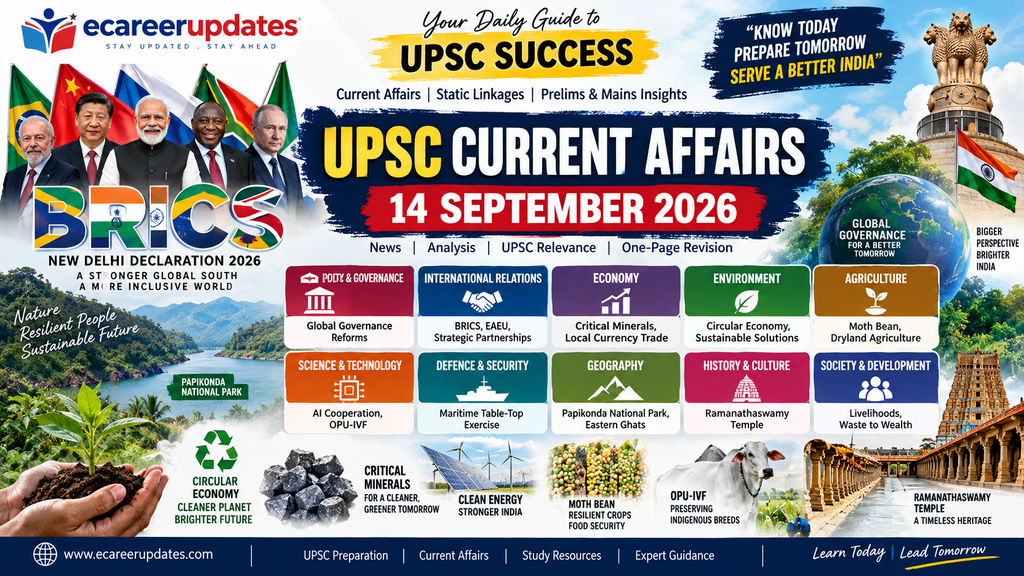
🔥 1. TODAY’S CURRENT AFFAIRS – AT A GLANCE
| Category | News/Event | UPSC Relevance |
|---|---|---|
| 🌐 IR | BRICS New Delhi Declaration | GS-II + Prelims |
| 🌐 IR | BRICS & Global Governance Reform | GS-II |
| 💰 Economy | BRICS local-currency payments | GS-II/III |
| 💎 Economy | Critical minerals & resilient supply chains | GS-III |
| 🤖 S&T | BRICS AI cooperation | GS-III |
| 🌱 Environment | World Circular Economy Forum 2026 | GS-III |
| 🌾 Agriculture | Moth Bean & El Niño resilience | GS-III + Geography |
| 🌾 Agriculture | Dryland Agriculture | GS-III |
| 🐄 Animal Husbandry | Lumpy Skin Disease | GS-III |
| 🛡️ Defence | Maritime Table-Top Exercise | GS-II/III |
| 🌊 Geography | Papikonda National Park | GS-I/III |
| 🎨 Culture | Ramanathaswamy Temple | GS-I |
| ♻️ Innovation | Grass Mache Technique | GS-III |
| 🌏 IR | India–EAEU FTA discussions | GS-II/III |
| 🇮🇳 Northeast | Regional connectivity & development | GS-I/II/III |
🌐 2. INTERNATIONAL RELATIONS
BRICS NEW DELHI DECLARATION 2026
The 18th BRICS Summit, held in New Delhi on 12–13 September 2026, adopted the New Delhi Declaration.
The summit was held under India’s chairship with the theme:
“Building for Resilience, Innovation, Cooperation and Sustainability.”
The declaration emphasised strengthening BRICS cooperation under three broad pillars:
- Political and security cooperation
- Economic and financial cooperation
- Cultural and people-to-people cooperation
It also called for a more representative and reformed multilateral system.
Why is BRICS important for UPSC?
Do not study BRICS merely as a list of countries.
Think of it as:
BRICS → Emerging economies → Global South → Multipolarity → Global governance reform
This makes it a high-value GS-II topic.
BRICS – Evolution
| Year | Development |
|---|---|
| 2001 | Term “BRIC” coined |
| 2009 | First BRIC Summit |
| 2010 | South Africa joined |
| 2024 onward | Major expansion |
| 2026 | India chairs BRICS |
🧠 UPSC Prelims Trap
Statement 1:
BRICS was originally formed as a military-security alliance.
❌ Incorrect
Statement 2:
BRICS cooperation includes economic and financial issues.
✅ Correct
Statement 3:
BRICS seeks greater representation for emerging and developing economies in global governance.
✅ Correct
3. BRICS & REFORM OF GLOBAL GOVERNANCE
This is arguably more important for Mains than the summit itself.
The New Delhi Declaration reiterates the need for a more:
- representative
- democratic
- legitimate
- accountable
- effective
- equitable
international system.
Why do developing countries demand reform?
Because institutions created after World War II do not completely reflect today’s economic and demographic realities.
Key institutions
- United Nations
- IMF
- World Bank
- WTO
India’s position
India advocates:
greater representation of developing countries in global decision-making.
Mains Linkage
GS-II Question
“The rise of BRICS reflects the transition from a Western-centric global order towards a more multipolar system. Discuss.”
Answer keywords
Multipolarity | Global South | Institutional reform | Strategic autonomy | Inclusive multilateralism | Representation
💎 4. CRITICAL MINERALS – A MAJOR BRICS ISSUE
BRICS leaders highlighted the importance of reliable, diversified and resilient supply chains for critical minerals required for zero- and low-emission technologies.
This is an extremely important Prelims + GS-III topic.
What are Critical Minerals?
These are minerals that are:
- economically important, and
- vulnerable to supply disruption.
Examples include:
- Lithium
- Cobalt
- Nickel
- Graphite
- Rare Earth Elements
- Copper
Why are they critical?
Because they are required for:
| Sector | Minerals/Resources |
|---|---|
| EV batteries | Lithium, cobalt, nickel |
| Wind turbines | Rare earths |
| Solar technology | Silicon and other minerals |
| Semiconductors | Several specialised minerals |
| Defence | Rare earths and strategic metals |
| Grid storage | Lithium, nickel etc. |
🔗 UPSC Linkage
Critical Minerals
↓
Energy Transition
↓
EVs + Renewable Energy
↓
Reduced Fossil Fuel Dependence
↓
Energy Security
↓
Geopolitical Competition
This is why critical minerals are simultaneously:
Environment + Economy + Geography + National Security
5. BRICS & LOCAL-CURRENCY PAYMENTS
Another important economic dimension is the continued discussion around:
Local-currency trade settlement
The objective is to reduce excessive dependence on a single international currency in bilateral trade.
Why is this important?
International trade generally involves:
Importer → Foreign Currency → Banking System → Exporter
Greater use of local currencies can potentially reduce:
- currency-conversion costs
- foreign exchange dependence
- exposure to financial sanctions
- transaction vulnerabilities
However, this does not automatically mean that BRICS has created a common currency.
🚨 UPSC Trap
BRICS cooperation ≠ BRICS common currency
These are two very different concepts.
6. BRICS & ARTIFICIAL INTELLIGENCE
AI cooperation is increasingly becoming part of BRICS economic diplomacy.
Recent discussions include greater cooperation in:
- AI
- digital economy
- open-source technologies
- digital infrastructure
- responsible AI
This is important because AI is becoming a component of:
economic competitiveness + national security + digital sovereignty
AI Governance – UPSC Angle
The important question isn’t:
“What is Artificial Intelligence?”
It is:
How should countries govern AI while encouraging innovation?
Key challenges
- privacy
- algorithmic bias
- misinformation
- deepfakes
- employment displacement
- intellectual property
- cyber security
- autonomous systems
7. ECONOMY
INDIA–EAEU FREE TRADE AGREEMENT
India and the Eurasian Economic Union (EAEU) have gained momentum in discussions over a potential Free Trade Agreement.
The issue received renewed attention around the BRICS summit and India-Russia industrial engagements.
What is EAEU?
The Eurasian Economic Union is an economic integration organisation centred on Eurasia.
Key members include:
- Russia
- Belarus
- Kazakhstan
- Armenia
- Kyrgyzstan
Why does India care?
Potential benefits:
Trade diversification
India can expand markets beyond traditional partners.
Connectivity
Eurasian connectivity is important for India’s:
- Central Asian engagement
- INSTC
- Eurasian trade routes
Energy
Russia and Central Asia remain important energy partners.
UPSC Linkage
India → Russia → Central Asia → EAEU → Eurasian connectivity
This connects directly with:
- Act East
- Connect Central Asia policy
- INSTC
- Chabahar
- Eurasian geopolitics
8. ENVIRONMENT + ECONOMY
WORLD CIRCULAR ECONOMY FORUM 2026
India is hosting the World Circular Economy Forum 2026 at Gandhinagar from 15–18 September 2026.
Theme:
“Circular Economy: Transition for People and Prosperity.”
PIB lists the event among India’s major environmental/economic initiatives.
Linear Economy vs Circular Economy
| Linear | Circular |
|---|---|
| Extract | Reduce extraction |
| Produce | Design efficiently |
| Consume | Reuse |
| Dispose | Repair |
| Waste | Recycle |
| Resource intensive | Resource efficient |
Circular Economy = 5R Framework
R1 – Refuse
Avoid unnecessary consumption.
R2 – Reduce
Use fewer resources.
R3 – Reuse
Use products multiple times.
R4 – Repair
Extend product life.
R5 – Recycle
Recover material for further use.
Why is this important for India?
India faces increasing:
- municipal waste
- plastic waste
- e-waste
- construction waste
- industrial waste
Circular economy can support:
Resource efficiency + employment + sustainability + climate mitigation
9. ♻️ GRASS MACHE TECHNIQUE – WASTE TO WEALTH
An interesting innovation highlighted in current-affairs coverage is the Grass Mache Technique, which converts aquatic weeds from Dal Lake into sustainable handicrafts and livelihood opportunities.
Why is this important?
This is a classic:
Waste → Resource → Livelihood
Aquatic weed
↓
Removal from water body
↓
Processing
↓
Handicraft production
↓
Income generation
↓
Lake ecosystem improvement
UPSC Concept
This is an example of:
Circular Economy + Blue/Green Economy + Livelihood + Environmental Restoration
10. 🌾 AGRICULTURE
MOTH BEAN – CLIMATE-RESILIENT AGRICULTURE
The Central Arid Zone Research Institute (CAZRI) has highlighted the resilience of moth bean varieties during an El Niño year.
This is a classic example of how UPSC converts a small agricultural news item into a conceptual question.
What is Moth Bean?
Scientific name:
Vigna aconitifolia
It is a drought-tolerant pulse crop.
It is particularly associated with:
- Rajasthan
- Gujarat
- arid and semi-arid regions
Why is it important?
Moth bean is adapted to:
- low rainfall
- high temperatures
- dry conditions
Therefore it has potential significance for:
Climate-resilient agriculture
Prelims Table
| Feature | Moth Bean |
|---|---|
| Type | Pulse |
| Scientific name | Vigna aconitifolia |
| Climate | Arid/semi-arid |
| Major region | Western India |
| Major advantage | Drought tolerance |
| Importance | Food + nutrition + climate resilience |
🔥 UPSC Linkage
El Niño
↓
Rainfall variability
↓
Drought
↓
Crop stress
↓
Climate-resilient crops
↓
Food security
Therefore, the Moth Bean story is actually about:
Climate change adaptation.
11. DRYLAND AGRICULTURE
The Dryland Congress 2026 concluded with the Delhi Declaration on Drylands, emphasising science, innovation, data systems and South–South cooperation.
Drylands – Basic Concept
Drylands are regions where water availability is limited and climatic variability is high.
Broad categories include:
- arid
- semi-arid
- dry sub-humid
Why does India need dryland strategies?
Large portions of India’s agriculture remain vulnerable to:
- monsoon variability
- drought
- soil degradation
- water scarcity
- rising temperature
Way Forward
| Problem | Solution |
|---|---|
| Water scarcity | Watershed development |
| Drought | Drought-resistant crops |
| Soil erosion | Conservation agriculture |
| Low productivity | Precision agriculture |
| Climate variability | Weather advisories |
| Income instability | Crop diversification |
| Land degradation | Agroforestry |
12. 🐄 ANIMAL HUSBANDRY
LUMPY SKIN DISEASE
The Department of Animal Husbandry reviewed the Lumpy Skin Disease (LSD) situation in Delhi.
As of 13 September, around 584 active cases were reported, while more than 45,950 animals had been vaccinated during 2026. The disease was described as sporadic and under control in Delhi.
What is Lumpy Skin Disease?
LSD is a viral disease primarily affecting cattle and buffaloes.
It belongs to the:
Poxviridae family
and is associated with:
Capripoxvirus
Transmission
It can spread through:
- mosquitoes
- biting flies
- ticks
- direct/indirect contact in some circumstances
Symptoms
Typical symptoms include:
- fever
- nodules on skin
- swelling
- reduced milk production
- weakness
Control
Important measures:
- Vaccination
- Vector control
- Surveillance
- Isolation
- Movement control
- Biosecurity
UPSC Prelims Trap
Lumpy Skin Disease is:
❌ not a human viral disease
❌ not primarily a poultry disease
❌ not a bacterial disease
It is an important livestock viral disease.
13. 🌊 GEOGRAPHY + ENVIRONMENT
PAPikonda NATIONAL PARK
Papikonda National Park is an important biodiversity site in the Eastern Ghats and lies along the Godavari river system.
It is therefore important for both:
Geography
and
Biodiversity
Current-affairs mapping has highlighted Papikonda National Park as an area aspirants should locate.
MAP MEMORY
Think:
Eastern Ghats → Godavari → Papikonda
This is a classic UPSC map-based association.
Why Eastern Ghats matter?
Compared with the Western Ghats, the Eastern Ghats are:
- discontinuous
- lower in elevation generally
- dissected by major rivers
Important rivers crossing/breaking the Eastern Ghats include:
- Mahanadi
- Godavari
- Krishna
- Pennar
14. 🛡️ DEFENCE & MARITIME SECURITY
MARITIME TABLE-TOP EXERCISE
A Table-Top Exercise (TTX) is a discussion-based simulation used to test decision-making and coordination during hypothetical crises.
It can involve:
- military agencies
- civilian agencies
- coast guards
- disaster-management agencies
- intelligence agencies
Why is TTX important?
Unlike a field exercise, it generally does not require large-scale deployment of troops and equipment.
It tests:
Coordination + communication + decision-making + preparedness
UPSC Concept
Table-top exercise ≠ military war exercise
It is primarily a:
simulation-based planning and coordination exercise.
15. 🎨 HISTORY & CULTURE
RAMANATHASWAMY TEMPLE
The Ramanathaswamy Temple at Rameswaram, Tamil Nadu is significant for both culture and architecture.
It is famous for its enormous corridors and numerous pillars.
Architectural Linkage
The temple is associated with:
Dravidian architecture
Important features include:
- massive gopurams
- long pillared corridors
- temple tanks
- elaborate stone architecture
UPSC Map Link
Rameswaram → Tamil Nadu → Palk Strait → Sri Lanka
This location has both:
Cultural significance
and
Geostrategic significance
16. POLITY & GOVERNANCE
GLOBAL GOVERNANCE – WHY REFORM MATTERS
The BRICS declaration again raises the fundamental issue:
Who gets to make global rules?
This is a governance question at the international level.
India’s position
India’s approach can be summarised as:
Strategic autonomy + multilateralism + Global South leadership
India does not necessarily seek replacement of existing institutions.
Instead, it generally argues for:
Reform + greater representation + effectiveness
17. SOCIETY + DEVELOPMENT
CIRCULAR ECONOMY & EMPLOYMENT
Circular economy has an often-overlooked social dimension.
It can generate employment in:
- repair
- recycling
- remanufacturing
- waste collection
- refurbishment
- resource recovery
Therefore:
Circular Economy
is not only an environmental strategy.
It can also become:
Employment + MSME + informal-sector formalisation strategy.
18. SCIENCE & TECHNOLOGY
OPU-IVF – BADRI CATTLE
A Badri female calf was successfully born using Ovum Pick-Up and In Vitro Fertilisation (OPU-IVF).
The embryo was transferred into a Sahiwal recipient cow. Badri cattle are an indigenous genetic resource and the state animal of Uttarakhand.
How OPU-IVF Works
Step 1
Oocytes are collected from a genetically superior female.
↓
Step 2
Oocytes mature in laboratory conditions.
↓
Step 3
Fertilisation occurs in vitro.
↓
Step 4
Embryo develops under controlled conditions.
↓
Step 5
Embryo transferred to recipient cow.
Why is this important?
It can accelerate:
- multiplication of elite germplasm
- breed conservation
- genetic improvement
- livestock productivity
UPSC Concept
OPU-IVF ≠ Cloning
IVF: sperm + egg → embryo
Cloning: genetic copy produced without conventional fertilisation.
19. ECONOMY + INDIA–CHINA TRADE
India and China have recently discussed ways to address bilateral trade concerns, including:
- trade imbalance
- market access
- supply-chain issues
India’s merchandise trade deficit with China remains significant.
Why does this matter?
India’s challenge is not simply:
“India imports too much from China.”
The deeper structural issue is:
Import dependence on intermediate and capital goods.
These include:
- electronics
- industrial machinery
- chemicals
- pharmaceutical inputs
- components
- minerals
Mains Linkage
India therefore needs:
Import substitution + export competitiveness
rather than simply restricting imports.
20. 🔥 PRELIMS SPECIAL – 10 STATEMENT-BASED QUESTIONS
Q1.
Consider the following statements:
- BRICS was originally known as BRIC.
- South Africa was part of the original BRIC grouping.
- BRICS discusses political, economic and people-to-people cooperation.
Which statements are correct?
Answer: 1 and 3 only
Q2.
Moth Bean is particularly significant because it:
A. Requires extremely high rainfall
B. Is a drought-resilient pulse
C. Is primarily a plantation crop
D. Is a temperate fruit crop
Answer: B
Q3.
Lumpy Skin Disease is:
A. A bacterial disease of poultry
B. A viral disease affecting cattle
C. A fungal disease of crops
D. A parasitic disease of humans
Answer: B
Q4.
Circular economy primarily seeks to:
- Extend product life
- Reduce resource wastage
- Increase dependence on virgin resources
Correct answer:
1 and 2 only
Q5.
Consider:
| Pair | Correct? |
|---|---|
| OPU-IVF – Livestock reproduction | ✅ |
| Moth Bean – Drought resilience | ✅ |
| Papikonda – Eastern Ghats | ✅ |
| Lumpy Skin Disease – Human viral disease | ❌ |
Q6.
The EAEU is primarily associated with:
A. Military alliance
B. Economic integration
C. Climate convention
D. Maritime security
Answer: B
Q7.
A Table-Top Exercise primarily involves:
A. Actual deployment of entire armed forces
B. Simulation-based discussion and decision-making
C. Weapon testing
D. Nuclear testing
Answer: B
Q8.
Which of the following is most closely associated with critical minerals?
A. Energy transition
B. Only traditional agriculture
C. Ancient architecture
D. Monsoon formation
Answer: A
Q9.
Ramanathaswamy Temple is located at:
A. Madurai
B. Rameswaram
C. Thanjavur
D. Kanchipuram
Answer: B
Q10.
Papikonda National Park is associated with:
A. Eastern Ghats and Godavari
B. Western Ghats and Narmada
C. Himalayas and Ganga
D. Aravallis and Luni
Answer: A
21. 🗺️ MAP WORK – MUST REVISE TODAY
Mark these on an India/Asia map:
India
- Rameswaram
- Palk Strait
- Papikonda National Park
- Godavari
- Eastern Ghats
- Rajasthan
- Gujarat
- Uttarakhand
- Gandhinagar
International
- Russia
- Kazakhstan
- Belarus
- Armenia
- Kyrgyzstan
- China
- Iran
- UAE
- Cambodia
- Gulf of Thailand
- South China Sea
22. CURRENT AFFAIRS → STATIC SYLLABUS LINKAGE
| Current News | Static UPSC Topic |
|---|---|
| BRICS | International organisations |
| Global governance reform | UN + multilateralism |
| Local currencies | International economics |
| Critical minerals | Economic geography |
| AI cooperation | Science & Technology |
| Circular economy | Environment |
| Moth Bean | Agriculture |
| Drylands | Geography + Agriculture |
| LSD | Animal husbandry |
| Papikonda | Biodiversity + Mapping |
| Ramanathaswamy Temple | Indian architecture |
| TTX | Defence |
| Grass Mache | Sustainable development |
| India–EAEU FTA | International trade |
23. 📝 MAINS ANSWER FRAMEWORK
Question
“Critical minerals are emerging as the new strategic resource in the global energy transition. Discuss the challenges and suggest a way forward for India.”
Introduction
Critical minerals are economically important minerals vulnerable to supply disruptions and are increasingly essential for renewable-energy, digital and defence technologies.
Challenges
- Geographical concentration of reserves
- Processing concentration
- Geopolitical tensions
- Rising demand due to energy transition
- Recycling limitations
- Environmental impacts of mining
- Import dependence
India’s Strategy
- National Critical Mineral Mission
- domestic exploration
- overseas mineral assets
- recycling
- urban mining
- strategic partnerships
- technology development
- mineral processing capacity
- diversification of suppliers
Conclusion
India’s energy transition must be accompanied by a “mineral security transition” to ensure strategic autonomy and resilient clean-energy supply chains.
24. 🧠 TODAY’S MOST IMPORTANT CONCEPTUAL LINKAGES
Linkage 1
BRICS → Global South → Multipolarity → Global Governance Reform
Linkage 2
Critical Minerals → EVs → Renewable Energy → Energy Security → Geopolitics
Linkage 3
Moth Bean → Drought → Climate Change → Crop Resilience → Food Security
Linkage 4
Circular Economy → Waste Reduction → Resource Efficiency → Employment → Sustainability
Linkage 5
Lumpy Skin Disease → Livestock → Agriculture → Rural Economy → Biosecurity
Linkage 6
Papikonda → Eastern Ghats → Godavari → Biodiversity → Mapping
Linkage 7
OPU-IVF → Biotechnology → Indigenous Breeds → Genetic Conservation
🔥 25. HIGH-VALUE PRELIMS FACTS
Remember these before moving to tomorrow’s newspaper:
BRICS 2026: India Chairship
BRICS Summit: New Delhi
BRICS Theme: Building for Resilience, Innovation, Cooperation and Sustainability
Critical Minerals: Strategic for clean-energy technologies
Moth Bean: Vigna aconitifolia
Moth Bean: Drought-resilient pulse
LSD: Viral cattle disease
OPU-IVF: Advanced livestock reproductive biotechnology
Badri cattle: Indigenous cattle of Uttarakhand
Circular Economy: Resource efficiency + waste reduction
Papikonda: Eastern Ghats
Ramanathaswamy Temple: Rameswaram
EAEU: Eurasian economic integration
📌 26. ONE-PAGE REVISION SHEET
14 SEPTEMBER 2026 – 15 THINGS TO REMEMBER
| No. | Fact |
|---|---|
| 1 | BRICS 2026 chaired by India |
| 2 | New Delhi Declaration adopted |
| 3 | BRICS focuses on Global South & governance reform |
| 4 | Critical-mineral supply chains gaining strategic importance |
| 5 | BRICS discussing digital/AI cooperation |
| 6 | Local-currency trade is an important economic theme |
| 7 | WCEF 2026 hosted in Gandhinagar |
| 8 | Circular economy = resource efficiency |
| 9 | Moth Bean is drought resilient |
| 10 | Dryland Congress produced Delhi Declaration |
| 11 | LSD affects cattle and buffaloes |
| 12 | OPU-IVF supports indigenous cattle conservation |
| 13 | Papikonda is associated with Eastern Ghats |
| 14 | Ramanathaswamy Temple is at Rameswaram |
| 15 | EAEU is a Eurasian economic integration bloc |
🎯 27. WHAT UPSC MAY ACTUALLY ASK
Today’s news can potentially generate questions on:
Prelims
“Consider the following pairs…”
- Moth Bean – Arid agriculture
- Papikonda – Eastern Ghats
- EAEU – Economic integration
- OPU-IVF – Livestock biotechnology
- LSD – Cattle disease
or:
Statement-based
Consider the following statements regarding critical minerals…
or:
With reference to BRICS, consider the following…
or:
Which of the following best describes a circular economy?
✍️ 28. POSSIBLE MAINS QUESTIONS
GS-II
“BRICS represents both an opportunity and a challenge for India’s strategic autonomy. Discuss.”
GS-III
“Critical mineral security is becoming as important as energy security for India. Examine.”
GS-III
“Climate-resilient agriculture requires diversification towards crops suited to local agro-climatic conditions. Discuss with reference to dryland agriculture.”
GS-III
“Circular economy can simultaneously address environmental degradation and resource insecurity. Examine its potential in India.”
GS-I
“Discuss the ecological and geographical significance of the Eastern Ghats with reference to river systems and biodiversity.”
🏆 FINAL UPSC TAKEAWAY
The biggest lesson from 14 September 2026 is that UPSC current affairs should never be studied as isolated news.
For example:
Don’t remember:
“Moth Bean was in the news.”
Remember:
Moth Bean → arid agriculture → drought tolerance → El Niño → climate adaptation → food security
Similarly:
Don’t remember:
“Critical minerals were discussed at BRICS.”
Remember:
Critical minerals → clean energy → EVs → supply-chain concentration → geopolitics → strategic autonomy
And:
Don’t remember:
“World Circular Economy Forum is happening in India.”
Remember:
Circular economy → reduce resource extraction → reuse → repair → recycling → waste-to-wealth → employment → sustainable development
That multi-dimensional linkage approach is exactly what makes current affairs useful for both UPSC Prelims elimination and GS Mains answer enrichment.
🔥 Today’s Priority Ranking
⭐⭐⭐⭐⭐ BRICS + Global Governance
⭐⭐⭐⭐⭐ Critical Minerals
⭐⭐⭐⭐⭐ Circular Economy
⭐⭐⭐⭐ Climate-Resilient Agriculture + Moth Bean
⭐⭐⭐⭐ OPU-IVF + Indigenous Germplasm
⭐⭐⭐⭐ Lumpy Skin Disease
⭐⭐⭐ Papikonda + Eastern Ghats Mapping
⭐⭐⭐ EAEU
⭐⭐⭐ Ramanathaswamy Temple
⭐⭐⭐ Table-Top Exercise
For today’s preparation, the top five topics to revise twice are BRICS, critical minerals, circular economy, dryland agriculture/Moth Bean, and OPU-IVF. The official PIB releases confirm the key developments on BRICS, drylands, circular economy, livestock biotechnology and LSD; these should be preferred over secondary summaries for factual revision.