
UPSC Prelims + Mains | MPSC | GPSC | KPSC/KAS | APSC | State PSCs
UPSC 2026-style approach:
Current News → Core Concept → Static Linkage → Prelims Trap → Mains Dimension → Possible Question
The most important development today is the 18th BRICS Summit in New Delhi, alongside the New Delhi Declaration, India–China and India–Russia bilateral engagements, farmer social-security policy, urban housing, public-health infrastructure and India’s emerging Blue Economy/coastal-security framework. The BRICS grouping now has 11 full members, after its 2024–25 expansion.
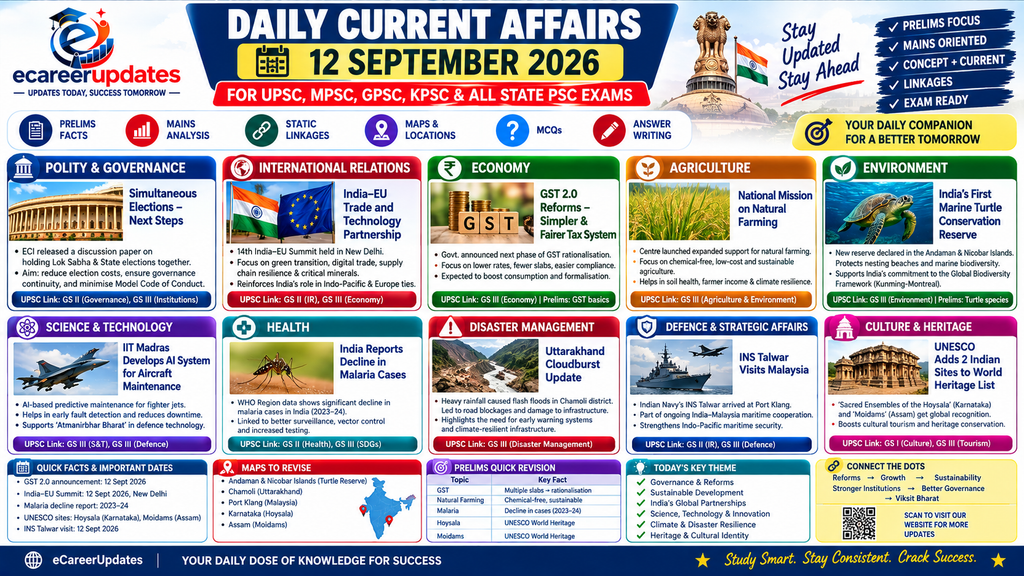
🔥 TODAY’S TOP 15 — QUICK REVISION
| Priority | Current Affair | GS | UPSC Relevance |
|---|---|---|---|
| ⭐⭐⭐⭐⭐ | 18th BRICS Summit & New Delhi Declaration | GS-II/III | Global South, UN reform, trade, finance |
| ⭐⭐⭐⭐⭐ | Modi–Xi meeting | GS-II | India-China relations, LAC, trade imbalance |
| ⭐⭐⭐⭐ | India–Russia strategic partnership | GS-II/III | Energy, defence, nuclear, critical minerals |
| ⭐⭐⭐⭐ | BRICS Grain Exchange proposal | GS-II/III | Food security, agricultural trade |
| ⭐⭐⭐⭐ | Seafarers’ Emergency Support Network | GS-II/III | Maritime security, Indian seafarers |
| ⭐⭐⭐⭐ | PM-Kisan Maandhan Yojana completes 7 years | GS-II/III | Farmer social security |
| ⭐⭐⭐⭐ | PMAY-U 2.0 — 18.77 lakh houses sanctioned | GS-II | Urbanisation & welfare |
| ⭐⭐⭐⭐ | Critical Care Blocks & IPHLs | GS-II/III | Health security & pandemic preparedness |
| ⭐⭐⭐ | India’s integrated coastal approach | GS-I/III | Blue Economy + coastal ecology |
| ⭐⭐⭐ | BRICS local-currency trade & payment systems | GS-II/III | De-dollarisation, fintech |
| ⭐⭐⭐ | BRICS agriculture & climate-resilient farming | GS-III | Agroecology & food security |
| ⭐⭐⭐ | BRICS Digital Health | GS-II/III | DPI + health technology |
| ⭐⭐ | India-UAE strategic economic partnership | GS-II/III | Investment, energy, technology |
| ⭐⭐ | India’s maritime workforce | GS-III | Shipping, trade & labour |
| ⭐⭐ | Road-safety / Safe System approach | GS-II/III | Governance & urban safety |
1. 🌏 INTERNATIONAL RELATIONS
1.1 18th BRICS SUMMIT — NEW DELHI
Why in News?
The 18th BRICS Summit is being held in New Delhi on 12–13 September 2026 under India’s chairship.
India’s 2026 theme is:
“Building for Resilience, Innovation, Cooperation and Sustainability.”
BRICS currently has 11 full members:
Brazil, Russia, India, China, South Africa, Egypt, Ethiopia, Iran, UAE, Saudi Arabia and Indonesia.
BRICS Evolution
| Year | Development |
|---|---|
| 2009 | First BRIC Summit |
| 2011 | South Africa joined → BRICS |
| 2024 | Egypt, Ethiopia, Iran, Saudi Arabia, UAE joined |
| 2025 | Indonesia became 11th full member |
| 2026 | India chairs BRICS |
Partner Country Category
Ten countries joined the BRICS Partner Country framework in 2025:
- Belarus
- Bolivia
- Cuba
- Kazakhstan
- Malaysia
- Nigeria
- Thailand
- Uganda
- Uzbekistan
- Vietnam
1.2 New Delhi Declaration
The declaration emphasises:
- Global South
- Multilateralism
- UN reform
- Inclusive growth
- Sustainable development
- Trade and investment
- Health
- Agriculture
- Climate action
- Technology
- Financial cooperation
The declaration reiterates support for a more representative and reformed UN system, including greater representation of developing countries in the UN Security Council.
🧠 Why UPSC?
BRICS is no longer simply an economic grouping.
It now operates across:
Politics + Security + Economy + Finance + Health + Climate + Agriculture + Technology + People-to-People relations.
Prelims Trap
BRICS is NOT a treaty-based military alliance.
It is a multilateral grouping/forum for cooperation.
1.3 BRICS — THREE PILLARS
| Pillar | Examples |
|---|---|
| Political & Security | Peace, terrorism, global governance |
| Economic & Financial | Trade, finance, payment systems |
| Cultural & People-to-People | Health, education, tourism, exchanges |
The New Delhi Declaration reaffirmed these three broad pillars.
2. 🇮🇳🇨🇳 INDIA–CHINA RELATIONS
Modi–Xi Meeting on BRICS Sidelines
Prime Minister Narendra Modi met Chinese President Xi Jinping in New Delhi on 12 September 2026.
The two sides discussed:
- Border peace and tranquillity
- Boundary question
- Trade imbalance
- Supply-chain issues
- Market access
- People-to-people relations
India emphasised three principles:
Mutual Respect + Mutual Sensitivity + Mutual Interest
Why Important?
This meeting should be studied through three interconnected dimensions:
1. Security
LAC → Border peace → Military confidence → Strategic stability
2. Economy
Trade imbalance → Supply chains → Market access → Economic interdependence
3. Diplomacy
BRICS + SCO + bilateral mechanisms → Strategic engagement
🗺️ Map Work
Revise:
- LAC
- Arunachal Pradesh
- Ladakh
- Tibet
- Eastern Himalayas
- Western Himalayas
⚠️ Prelims Trap
LAC ≠ International Boundary
The LAC is the line separating areas under actual control; the India-China boundary remains unresolved.
Mains Question
“India-China relations require simultaneous management of security competition and economic interdependence.” Discuss.
3. 🇮🇳🇷🇺 INDIA–RUSSIA RELATIONS
Modi–Putin Bilateral Engagement
Prime Minister Modi met Russian President Vladimir Putin on the sidelines of BRICS.
The leaders reviewed cooperation in:
- Defence
- Energy
- Nuclear power
- Space
- Trade
- Industrial cooperation
- Skill mobility
- Critical minerals
They also discussed regional conflicts and maritime security.
Putin invited Modi for the 24th India-Russia Annual Summit, which India accepted.
India–Russia Relationship: UPSC Framework
| Area | Importance |
|---|---|
| Defence | Major historical supplier & strategic cooperation |
| Energy | Oil, nuclear, hydrocarbons |
| Nuclear | Civil nuclear cooperation |
| Space | Long-standing cooperation |
| Critical minerals | Supply-chain security |
| Agriculture | Fertilisers |
| Skilled mobility | Labour cooperation |
| Multilateral | BRICS + SCO |
Mains Dimension
India’s Russia policy demonstrates:
Strategic autonomy + issue-based alignment + diversified partnerships
India seeks relations with Russia while simultaneously expanding partnerships with the US, EU, Japan and other Indo-Pacific countries.
4. 🌾 BRICS GRAIN EXCHANGE
One of the particularly important agricultural proposals emerging around BRICS is the development of a BRICS Grain Exchange.
The New Delhi Declaration recognises the importance of addressing:
- Food-price volatility
- Fertiliser shortages
- Supply disruptions
- Food availability
- Food affordability
- Climate-resilient agriculture
It supports further discussions on a BRICS grain-trading platform and stronger national food reserves and climate-adaptive seed systems.
Why Important?
Food security is increasingly becoming a:
Strategic + economic + geopolitical issue
Conceptual Chain
Climate Change
      ↓
Crop Shocks
      ↓
Supply Disruption
      ↓
Food Price Volatility
      ↓
Inflation + Social Stress
      ↓
Food Security Challenge
UPSC Mains
“Food security is increasingly becoming an instrument of strategic resilience in a fragmented global economy.” Discuss.

5. 🚢 SEAFARERS’ EMERGENCY SUPPORT NETWORK
India proposed a Seafarers’ Emergency Support Network at BRICS.
Why?
Because seafarers often operate in conflict-prone maritime zones and remain vulnerable when:
- Ships are attacked
- Shipping routes are disrupted
- War affects commercial vessels
- Evacuation becomes difficult
- Ports become inaccessible
The proposal highlights the importance of the global maritime workforce and India’s significant role as a source of trained seafarers.
🌊 Static Linkage: Maritime Security
Seafarers → Merchant Shipping → SLOCs → Ports → Global Trade → Energy Security
Map Work
Revise:
- Strait of Hormuz
- Bab-el-Mandeb
- Suez Canal
- Red Sea
- Gulf of Aden
- Indian Ocean
- Arabian Sea
Mains Dimension
India’s maritime security is not only about naval warfare.
It includes:
Commercial shipping + ports + energy flows + seafarers + undersea infrastructure + piracy + maritime domain awareness.
6. 💰 BRICS LOCAL-CURRENCY TRADE & PAYMENT SYSTEMS
India has advocated greater cooperation among BRICS members to:
- Link payment systems
- Promote trade in local currencies
- Reduce transaction barriers
- Strengthen digital trade
The Commerce Minister highlighted India’s UPI and broader Digital Public Infrastructure capabilities as potential areas of cooperation.
🧠 UPSC Concept
This does not automatically mean BRICS is creating a common currency.
Important Distinction
| Concept | Meaning |
|---|---|
| Local-currency trade | Bilateral/multilateral trade settled using national currencies |
| Common currency | Shared currency used by members |
| Payment-system linkage | Interoperability between payment infrastructures |
| CBDC | Central Bank Digital Currency |
| De-dollarisation | Reducing dependence on USD in certain transactions |
⚠️ Prelims Trap
BRICS cooperation on local currencies ≠ creation of a BRICS common currency.
7. 🌱 BRICS & AGRICULTURE
The New Delhi Declaration emphasises agricultural productivity and sustainability.
Key themes include:
- Agroecology
- Regenerative agriculture
- Climate resilience
- Digital agriculture
- Food security
- Sustainable inputs
- Climate-adaptive seeds
Agroecology vs Conventional Agriculture
Agroecology applies ecological principles to agricultural systems.
Potential benefits:
- Soil health
- Biodiversity
- Reduced input dependence
- Water efficiency
- Climate resilience
Regenerative Agriculture
Focuses on restoring:
- Soil organic matter
- Soil biodiversity
- Ecosystem functions
- Water retention
UPSC Linkage
Agriculture → Climate Change → Soil → Food Security → Rural Income
8. 👨🌾 FARMERS’ SOCIAL SECURITY
PM-Kisan Maandhan Yojana Completes 7 Years
The Pradhan Mantri Kisan Maandhan Yojana (PM-KMY) was launched on 12 September 2019.
It is a voluntary, contributory pension scheme for eligible small and marginal farmers.
Core Features
| Feature | Details |
|---|---|
| Launch | 12 September 2019 |
| Nature | Voluntary + contributory |
| Pension | ₹3,000/month from age 60 |
| Target | Small & marginal farmers |
| Government contribution | Matching contribution |
| Pension fund manager | LIC |
| Family pension | 50% of subscriber pension to eligible spouse |
As of February 2026, enrolment was about 24.96 lakh farmers.
Why Important?
Agricultural policy often focuses on:
Production + income
But rural welfare also requires:
Old-age security + social protection + pension coverage.
Mains Linkage
Farmer income security → social security → ageing rural population → informal employment → inclusive growth
9. 🏠 URBANISATION & HOUSING
PMAY-U 2.0 — 18.77 Lakh Houses Approved
The Government has approved 18.77 lakh houses under Pradhan Mantri Awas Yojana–Urban 2.0.
The latest approvals include around 29,000 additional houses under:
- Beneficiary-Led Construction (BLC)
- Affordable Housing in Partnership (AHP)
covering Assam, Bihar, Gujarat, Telangana, Tripura and Uttar Pradesh.
PMAY-U 2.0 — Four Verticals
| Vertical | Meaning |
|---|---|
| BLC | Beneficiary-Led Construction |
| AHP | Affordable Housing in Partnership |
| ARH | Affordable Rental Housing |
| ISS | Interest Subsidy Scheme |
The scheme targets one crore additional eligible urban families over five years.
🔥 UPSC Trap
PMAY-U 2.0 is not restricted to home ownership.
It also includes:
Affordable Rental Housing
This is important because India’s urban population includes migrants and mobile workers.
10. 🏥 HEALTH & SOCIAL SECTOR
Critical Care Blocks + Integrated Public Health Laboratories
The Union Health Minister inaugurated 10 Critical Care Blocks and 12 Integrated Public Health Laboratories in Andhra Pradesh.
These are linked to the PM-ABHIM — Pradhan Mantri Ayushman Bharat Health Infrastructure Mission.
The scheme seeks to strengthen India’s capacity to respond to:
- Pandemics
- Public-health emergencies
- Disease outbreaks
- Critical-care needs
The Government has sanctioned 631 Critical Care Blocks across States and Union Territories under PM-ABHIM.
🧠 Understand the Architecture
Prevention
   ↓
Primary Healthcare
   ↓
Secondary Healthcare
   ↓
Tertiary / Critical Care
   ↓
Emergency Response
Why IPHLs Matter?
Laboratories enable:
Detection → Diagnosis → Surveillance → Response
This is particularly important for emerging infectious diseases.
Mains
India’s pandemic preparedness must move from crisis response towards permanent health-system resilience. Discuss.
11. 🌊 GEOGRAPHY + ENVIRONMENT
India’s Coastline — Integrated Coastal Approach
India’s coastline is increasingly being viewed not as merely a geographical boundary but as an integrated space involving:
- Ecology
- Security
- Economy
- Technology
- Human development
The Ministry of Earth Sciences has highlighted India’s approximately 11,000–12,000 km coastline and its significance for the Blue Economy.
Blue Economy
Broadly:
Sustainable economic use of ocean resources while maintaining ocean ecosystem health.
Major Components
| Component | Examples |
|---|---|
| Fisheries | Marine fisheries, aquaculture |
| Shipping | Ports & logistics |
| Tourism | Coastal tourism |
| Energy | Offshore wind, ocean energy |
| Minerals | Deep-sea resources |
| Biotechnology | Marine biotechnology |
| Conservation | Mangroves, coral reefs |
Deep Ocean Mission Linkage
India’s Deep Ocean Mission seeks to develop capabilities for:
- Deep-sea exploration
- Marine resource assessment
- Technology development
- Ocean science
Prelims Trap
Blue Economy ≠ unrestricted exploitation of marine resources.
The sustainability component is fundamental.
12. 🌐 BRICS & GLOBAL GOVERNANCE
Global South Representation
The New Delhi Declaration calls for reform of global institutions and greater representation of developing countries.
Why?
Institutions such as:
- UN Security Council
- IMF
- World Bank
- Global economic governance mechanisms
were largely designed in a very different geopolitical era.
India’s Position
India seeks:
Greater representation + reform + more inclusive multilateralism
Mains Framework
Problem:
- Under-representation
- Historical power structures
- Changing economic weight
Need:
- Institutional reform
- Greater developing-country voice
- Better representation
Challenge:
- Consensus
- Geopolitical rivalry
- Divergent interests within Global South
13. 🇦🇪 INDIA–UAE RELATIONS
Prime Minister Modi held bilateral discussions with the UAE leadership on the sidelines of BRICS.
The India-UAE Comprehensive Strategic Partnership spans:
- Trade
- Investment
- Energy
- Defence
- Technology
- Space
- Nuclear cooperation
- People-to-people relations
A major investment discussed was an USD 11.5 billion integrated greenfield aluminium project in Odisha, described as India’s largest integrated aluminium investment.
Why Aluminium?
Aluminium is important for:
- Transport
- Aerospace
- Renewable energy
- Power transmission
- Packaging
- Defence
Strategic Linkage
UAE capital → Indian manufacturing → Minerals → Energy → Infrastructure → Exports
14. 📊 ECONOMY — BRICS TRADE & INDIA
India’s Commerce Minister highlighted the need for:
- Greater intra-BRICS market access
- Reduced non-tariff barriers
- Simplified regulations
- Supply-chain diversification
- Local-currency trade
- Digital payment connectivity
- Services-market access
India’s strengths include:
Engineering + Electronics + Pharmaceuticals + Automobiles + Services + Startups.
Key Concept
Tariff ≠ Non-Tariff Barrier
| Tariff | Non-Tariff Barrier |
|---|---|
| Tax/duty on imports | Regulation/restriction other than tariff |
| Directly affects price | May affect market access |
| Easier to quantify | Often more complex |
Examples of NTBs:
- Standards
- Certification
- Quotas
- Licensing
- Sanitary & phytosanitary requirements
UPSC Mains
India’s export competitiveness increasingly depends on reducing non-tariff barriers and improving standards compliance. Discuss.
15. 🏛️ HISTORY & CULTURE — WHY STATIC STILL MATTERS
Today’s news is dominated by international relations and economy, but the BRICS summit offers several static linkages.
Revise:
BRICS origins → BRIC → South Africa → expansion → Global South
Also revise:
- Cold War and post-Cold War global order
- Bretton Woods institutions
- UN Security Council structure
- Non-Aligned Movement
- Strategic autonomy
- India’s historical relationship with Russia
UPSC Strategy
Don’t study BRICS as:
“11 countries + summit date.”
Study it as:
Changing global order → Global South → institutional reform → multipolarity → India’s strategic autonomy
🧠 PRELIMS MASTER REVISION TABLE
| Topic | Must Remember |
|---|---|
| BRICS full members | 11 |
| Indonesia | 11th full member, 2025 |
| BRICS 2026 Chair | India |
| 2026 BRICS theme | Building for Resilience, Innovation, Cooperation and Sustainability |
| Summit | New Delhi, 12–13 Sept |
| BRICS partner countries | 10 |
| New Delhi Declaration | Global South + multilateral reform |
| BRICS Grain Exchange | Agricultural/food security initiative under discussion |
| Seafarers Network | Maritime emergency support |
| Modi–Xi | 12 Sept, New Delhi |
| India–China principles | Mutual respect, sensitivity, interest |
| Modi–Putin | BRICS sidelines |
| PM-KMY | Launched 12 Sept 2019 |
| PM-KMY pension | ₹3,000/month from 60 |
| PMAY-U 2.0 | Four verticals |
| PMAY-U 2.0 sanctions | 18.77 lakh |
| PM-ABHIM | Health infrastructure |
| Critical Care Blocks | 631 sanctioned nationally |
| IPHL | Disease detection/surveillance |
| Blue Economy | Sustainable use of ocean resources |
| India’s coastline | ~11,000–12,000 km |
| India-UAE project | $11.5 bn aluminium project in Odisha |
⚠️ PRELIMS TRAP ZONE
🔴 Trap 1
BRICS ≠ Military alliance
🔴 Trap 2
BRICS local-currency trade ≠ BRICS common currency
🔴 Trap 3
BRICS partner country ≠ Full BRICS member
🔴 Trap 4
LAC ≠ International Boundary
🔴 Trap 5
PM-KMY ≠ PM-KISAN
PM-KMY is a pension/social-security scheme.
🔴 Trap 6
PMAY-U 2.0 ≠ Only home ownership
It includes rental housing.
🔴 Trap 7
Blue Economy ≠ exploitation of oceans
Sustainability is central.
🔴 Trap 8
Critical Care Block ≠ Public Health Laboratory
One primarily expands critical-care capacity; the other strengthens disease detection and public-health surveillance.
🔴 Trap 9
Tariff barrier ≠ Non-tariff barrier
🔴 Trap 10
New Delhi Declaration ≠ legally binding treaty
🗺️ MAP WORK — 12 SEPTEMBER
India
📍 New Delhi
📍 Odisha — aluminium investment
📍 Andhra Pradesh — critical-care/public-health infrastructure
📍 Arunachal Pradesh
📍 Ladakh
📍 Arabian Sea
📍 Bay of Bengal
📍 Indian coastline
World
📍 Russia
📍 China
📍 UAE
📍 Brazil
📍 South Africa
📍 Egypt
📍 Ethiopia
📍 Iran
📍 Saudi Arabia
📍 Indonesia
Strategic Maritime Locations
📍 Strait of Hormuz
📍 Bab-el-Mandeb
📍 Red Sea
📍 Suez Canal
📍 Gulf of Aden
📍 Indian Ocean
🧩 NEWS → CONCEPT → STATIC LINKAGE
1. BRICS
BRICS Summit
↓
Global South
↓
Multilateralism
↓
UN Reform
↓
Multipolar World Order
↓
India’s Strategic Autonomy
2. Modi–Xi
Bilateral meeting
↓
LAC
↓
Border management
↓
Trade imbalance
↓
Supply chains
↓
India-China strategic competition + cooperation
3. PM-KMY
Farmer pension
↓
Social Security
↓
Informal employment
↓
Old-age vulnerability
↓
Inclusive Growth
↓
Human-centred development
4. PMAY-U 2.0
Urban housing
↓
Urbanisation
↓
Migration
↓
Rental housing
↓
Affordable cities
↓
Inclusive urbanisation
5. Blue Economy
Coastline
↓
Marine ecosystems
↓
Shipping
↓
Fisheries
↓
Security
↓
Technology
↓
Sustainable Blue Economy
🎯 UPSC-STYLE MCQs
Q1. With reference to BRICS, consider the following statements:
- Indonesia is the 11th full member of BRICS.
- BRICS is a military alliance.
- BRICS has a Partner Country framework.
Which is/are correct?
Answer: 1 and 3 only
Q2. Consider the following statements:
- Local-currency trade necessarily requires a common currency.
- Payment-system interoperability can facilitate cross-border transactions.
- BRICS cooperation on local currencies is the same as creation of a BRICS currency.
Answer: 2 only
Q3. With reference to PM-Kisan Maandhan Yojana:
- It is voluntary and contributory.
- It provides a minimum pension of ₹3,000 per month from age 60.
- It is primarily a crop-insurance scheme.
Answer: 1 and 2 only
Q4. Which of the following are components of PMAY-U 2.0?
- Beneficiary-Led Construction
- Affordable Housing in Partnership
- Affordable Rental Housing
- Interest Subsidy Scheme
Answer: All four
Q5. Consider the following:
- Blue Economy
- Deep Ocean Mission
- Maritime security
- Coastal ecosystem conservation
Which can be linked to India’s integrated coastal-development approach?
Answer: All four
Q6. With reference to the BRICS Grain Exchange, consider:
- It relates to agricultural trade.
- It can contribute to food-security resilience.
- It is equivalent to a single common agricultural policy for BRICS.
Answer: 1 and 2 only
✍️ MAINS ANSWER WRITING — TODAY’S BEST QUESTIONS
GS-II — International Relations
“BRICS represents both an opportunity and a challenge for India’s pursuit of a multipolar world order.” Discuss.
Answer framework
Introduction: Evolution from BRIC to expanded BRICS.
Opportunities:
- Global South voice
- Trade
- Finance
- Technology
- Development cooperation
- Institutional reform
Challenges:
- China dominance
- Divergent interests
- Geopolitical conflicts
- Economic asymmetry
- Limited institutionalisation
Conclusion: India should use BRICS as a platform for issue-based cooperation while retaining strategic autonomy.
GS-II — India-China
“Stability along the India-China border is a prerequisite for a broader stabilisation of bilateral relations.” Examine.
Include:
LAC + CBMs + military dialogue + trade imbalance + supply chains + trust deficit
GS-II — Social Justice
Old-age social security remains a major gap in India’s predominantly informal rural economy. Discuss with reference to farmer pension schemes.
Use:
PM-KMY + informal economy + ageing + income volatility + contributory pensions + financial inclusion
GS-II — Urbanisation
Affordable rental housing should form an integral part of India’s urbanisation strategy. Discuss.
Include:
- Migrant workers
- Informal employment
- Land affordability
- Housing shortage
- Rental mobility
- Urban infrastructure
GS-III — Environment
India’s coastline must be governed as an integrated ecological, economic and security space. Discuss.
Use:
Blue Economy + coastal regulation + mangroves + fisheries + ports + maritime security + climate resilience
GS-III — Economy
BRICS cooperation on local currencies and payment systems reflects the search for greater resilience in the global financial architecture. Examine its opportunities and limitations.
📚 STATIC TOPICS TO REVISE TONIGHT
| Current Affair | Static Chapter |
|---|---|
| BRICS | International organisations/groupings |
| New Delhi Declaration | UN reform |
| Modi–Xi | India-China boundary |
| Modi–Putin | India-Russia relations |
| Grain Exchange | Food security |
| Local currencies | International monetary system |
| Seafarers | Maritime security |
| PM-KMY | Social security |
| PMAY-U | Urbanisation |
| Critical Care Blocks | Public health |
| Coastline | Indian geography |
| Blue Economy | Ocean resources |
| Aluminium | Mineral resources & industry |
⏱️ 30-MINUTE RAPID REVISION
🔴 FIRST 10 MINUTES — MUST KNOW
- BRICS 11 members
- New Delhi Declaration
- Global South + UN reform
- Modi–Xi meeting
- India–Russia strategic partnership
🟠 NEXT 10 MINUTES
- BRICS Grain Exchange
- Local-currency trade
- Seafarers Emergency Support Network
- PM-KMY
- PMAY-U 2.0
🟢 FINAL 10 MINUTES
- Blue Economy
- India’s coastline
- PM-ABHIM
- India-UAE
- Map revision
🏆 TODAY’S 7 GOLDEN TAKEAWAYS
1. BRICS is evolving from an economic grouping into a broad platform for Global South cooperation.
2. India’s BRICS strategy is closely linked to reforming—not abandoning—the existing multilateral order.
3. India-China relations have two simultaneous tracks: security competition and economic interdependence.
4. Farmer welfare must include social security, not merely production and income support.
5. Urban housing policy must account for rental housing and migrant mobility.
6. India’s coastline represents an intersection of ecology, economy, technology and national security.
7. Local-currency payment cooperation should not be confused with creation of a common BRICS currency.
🚨 THE BIGGEST UPSC TAKEAWAY OF 12 SEPTEMBER
Today’s news demonstrates exactly why UPSC Prelims cannot be prepared through headline memorisation alone.
A single headline—
“BRICS Summit in New Delhi”
can generate questions from:
International Relations
↓
Global South
↓
UN Security Council reform
↓
International financial institutions
↓
Local-currency trade
↓
Digital payments
↓
Food security
↓
Climate-resilient agriculture
↓
Maritime security
↓
Seafarers
↓
India’s strategic autonomy
That is the 2026-style preparation model:
NEWS → CONCEPT → STATIC → INTERLINKAGE → PRELIMS TRAP → MAINS ARGUMENT
🌟 ECareerUpdates Daily Mantra
“Don’t collect current affairs. Build connections between them.”
Read → Understand → Connect → Revise → Eliminate → Apply
For UPSC CSE | MPSC | GPSC | KPSC/KAS | APSC | All State PSCs
📚 UPDATES TODAY • SUCCESS TOMORROW