
UPSC Prelims + Mains
UPSC CSE | MPSC | GPSC | KPSC/KAS | APSC | State PSCs | Group A/B/C
Today’s Exam Formula:
Current News → Static Concept → Why Important → Prelims Facts → Prelims Trap → Mains Dimension → Interlinkages
The current-affairs trend visible around the 2026 UPSC Prelims continues to favour statement-based and analytical questions where a contemporary event is connected with a static constitutional provision, scientific concept, geographical location, institution or policy mechanism. Therefore, today’s compilation focuses on conceptual linkages rather than mere headlines.
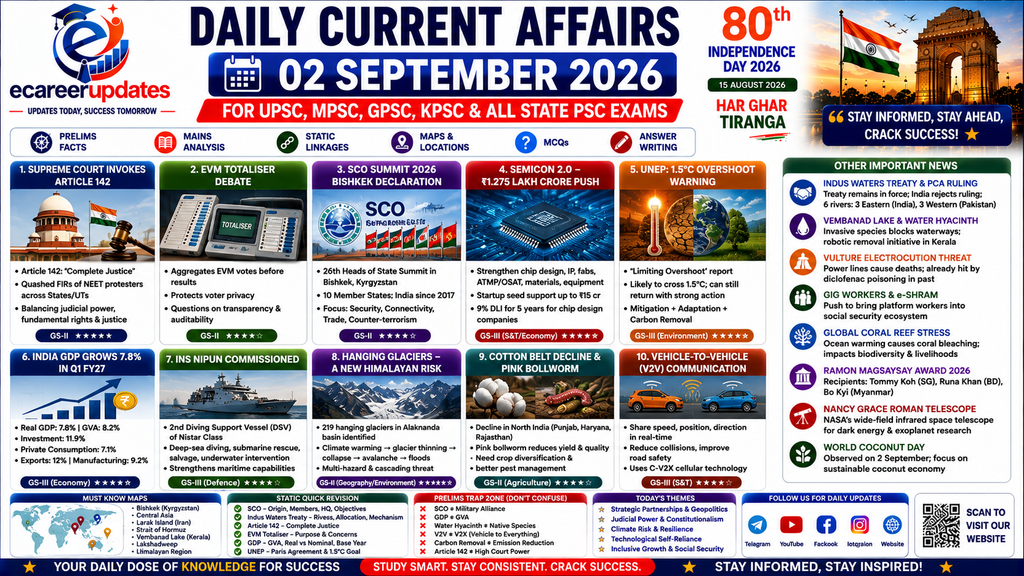
🔥 TODAY’S TOP PRIORITY
| Priority | News | Subject | Prelims | Mains |
|---|---|---|---|---|
| 🔴 1 | Semicon 2.0 — ₹1.275 lakh crore | S&T/Economy | ⭐⭐⭐⭐⭐ | ⭐⭐⭐⭐⭐ |
| 🔴 2 | Article 142 & NEET protest FIRs | Polity | ⭐⭐⭐⭐⭐ | ⭐⭐⭐⭐⭐ |
| 🔴 3 | SCO Bishkek Declaration | IR | ⭐⭐⭐⭐⭐ | ⭐⭐⭐⭐⭐ |
| 🔴 4 | UNEP: 1.5°C overshoot | Environment | ⭐⭐⭐⭐⭐ | ⭐⭐⭐⭐⭐ |
| 🔴 5 | GDP 7.8% + methodology debate | Economy | ⭐⭐⭐⭐⭐ | ⭐⭐⭐⭐⭐ |
| 🟠 6 | EVM Totaliser | Polity | ⭐⭐⭐⭐⭐ | ⭐⭐⭐⭐ |
| 🟠 7 | Global coral reef stress | Environment | ⭐⭐⭐⭐ | ⭐⭐⭐⭐ |
| 🟠 8 | Vembanad Lake & water hyacinth | Geography/Environment | ⭐⭐⭐⭐ | ⭐⭐⭐⭐ |
| 🟠 9 | Gig workers & e-Shram | Economy/Social Justice | ⭐⭐⭐⭐ | ⭐⭐⭐⭐ |
| 🟠 10 | Nancy Grace Roman Space Telescope | S&T | ⭐⭐⭐⭐ | ⭐⭐⭐⭐ |
🏛️ POLITY & GOVERNANCE
1. ⚖️ SUPREME COURT INVOKES ARTICLE 142
Why in News?
The Supreme Court invoked its extraordinary powers under Article 142 to quash FIRs registered against students and protesters associated with demonstrations following the NEET-UG 2026 paper-leak controversy. The relief was extended across States and Union Territories.
What is Article 142?
Article 142 empowers the Supreme Court to pass orders necessary for doing “complete justice” in any matter pending before it.
Static Concept
| Article | Significance |
|---|---|
| Article 32 | Constitutional remedies |
| Article 136 | Special Leave Petition |
| Article 141 | Law declared by SC binding on all courts |
| Article 142 | Complete justice |
| Article 144 | Authorities must act in aid of SC |
Important cases associated with Article 142
- Bhopal Gas Tragedy
- Ayodhya
- Chandigarh Mayor case
- Other cases involving extraordinary remedial directions
The Court has also clarified that Article 142 cannot be used in a manner inconsistent with constitutional provisions and fundamental rights.
Why UPSC may ask?
The question may not mention today’s NEET case at all.
Instead:
Consider the following statements regarding Article 142…
This is the classic current → static conversion UPSC approach.
Mains dimension
The issue raises the balance between:
Judicial discretion
vs.
Separation of powers
vs.
Fundamental rights
vs.
Need for complete justice
Related Fundamental Right
Peaceful protest is linked to Article 19, subject to constitutionally permitted reasonable restrictions.


2. 🗳️ EVM TOTALISER — VOTER PRIVACY vs TRANSPARENCY
The Supreme Court has sought the Centre’s response on the possible use of totaliser machines for counting EVM votes.
What is a totaliser?
A totaliser can aggregate votes from multiple EVMs before displaying the result.
The idea is to prevent the disclosure of booth-wise voting patterns.
Why?
If a small locality’s voting preference becomes identifiable, there may be concerns about:
- political victimisation
- social pressure
- intimidation
- targeting of communities
The debate
| Argument for Totaliser | Concern |
|---|---|
| Protects voter privacy | May reduce booth-level transparency |
| Reduces possibility of victimisation | Individual-machine problems could become harder to identify |
| Aggregates results | Auditability concerns |
| Protects secrecy of voting patterns | Requires appropriate legal framework |
The Law Commission’s 255th Report had supported selective use of totalisers.
🚨 Prelims Trap
Totaliser = replacement for EVM
❌ Incorrect.
It is an additional counting mechanism/interface for aggregating results.
Mains linkage
Electoral reform should protect both the secrecy of voting and the transparency/auditability of election results.
3. 👨⚖️ ARTICLE 124(3) — “DISTINGUISHED JURIST”
The issue of the unused constitutional route for appointing a distinguished jurist to the Supreme Court has again come into focus.
Article 124(3)
A person may qualify to become an SC judge if the person:
- has been a High Court judge for at least five years, or
- has been an advocate of a High Court for at least ten years, or
- is, in the President’s opinion, a distinguished jurist.
Important point
The “distinguished jurist” route exists constitutionally but has historically not been used for Supreme Court appointments.
UPSC Link
Constitutional text vs constitutional practice
This is a highly probable conceptual Prelims area.
🌏 INTERNATIONAL RELATIONS
4. 🇮🇳 SCO SUMMIT — BISHKEK DECLARATION
The 26th SCO Summit was held in Bishkek, Kyrgyzstan, with India participating at the highest level. The summit adopted the Bishkek Declaration.
India stressed the importance of dialogue and diplomacy in resolving conflicts and highlighted cooperation against terrorism.
SCO — STATIC REVISION
| Feature | Fact |
|---|---|
| Full form | Shanghai Cooperation Organisation |
| Origin | Shanghai Five |
| Established | 2001 |
| Headquarters | Beijing |
| India joined | 2017 |
| Pakistan joined | 2017 |
| Iran | Member since 2023 |
| Belarus | Member since 2024 |
| 2026 Summit | Bishkek, Kyrgyzstan |
Current members
India, China, Russia, Pakistan, Iran, Kazakhstan, Kyrgyzstan, Tajikistan, Uzbekistan and Belarus.
Why important for India?
SCO provides India a platform to simultaneously engage with:
- Central Asia
- Russia
- China
- Iran
- Pakistan
India’s strategic interests
Security
→ terrorism
→ extremism
→ regional stability
Connectivity
→ Central Asia
→ Chabahar
→ International North-South Transport Corridor
Economy
→ energy
→ trade
→ investment
UPSC linkage
SCO → Central Asia → Eurasia → China/Russia → Energy → Connectivity → Terrorism
🚨 Prelims Trap
❌ SCO is equivalent to NATO.
Wrong.
SCO is a broader regional political, security and economic cooperation organisation, not a conventional collective-defence alliance.
💻 SCIENCE & TECHNOLOGY + ECONOMY
5. 🇮🇳 SEMICON 2.0 — INDIA’S ₹1.275 LAKH CRORE CHIP PUSH
Why in News?
The operational framework for Semicon 2.0 / India Semiconductor Mission 2.0 has been notified, with an outlay of approximately ₹1,27,500 crore.
This is one of today’s highest-value Prelims + Mains topics.
What is different about Semicon 2.0?
India’s earlier semiconductor push concentrated significantly on:
- fabrication
- assembly
- testing
- packaging
Semicon 2.0 expands the focus to the entire semiconductor ecosystem, especially domestic chip design and intellectual property.
Six broad pillars / ten categories
The framework covers areas including:
- fabless chip design
- silicon wafer fabrication
- compound semiconductors
- ATMP/OSAT
- semiconductor equipment
- materials
- specialty chemicals
- R&D
- talent development
Important financial features
| Component | Support/Feature |
|---|---|
| Total outlay | ₹1.275 lakh crore |
| Strategic chip design | Government-supported |
| Startup/MSME seed support | Up to ₹15 crore / 50% project cost |
| DLI | 9% of net sales for 5 years, subject to caps |
| Large silicon wafer fabs | Up to 40% fiscal support |
| Equipment/material ecosystem | Capex support |
| Talent | Large-scale semiconductor skill development |
Key terminology
Fab
→ Factory that physically manufactures semiconductor chips.
Fabless
→ Designs chips but outsources physical fabrication.
ATMP
→ Assembly, Testing, Marking and Packaging.
OSAT
→ Outsourced Semiconductor Assembly and Test.
SoC
→ System-on-Chip.
EDA
→ Electronic Design Automation software used in chip design.
Why strategically important?
Semiconductors are critical for:
- smartphones
- automobiles
- AI
- defence
- telecom
- satellites
- renewable-energy systems
- data centres
Thus:
Semiconductor security = economic security + technological security + national security
Mains angle
India has significant chip-design talent but historically limited domestic ownership of semiconductor IP and manufacturing capability.
Therefore, the challenge is to move:
Talent → IP → Design → Manufacturing → Packaging → Commercialisation → Exports
6. 🔬 RDI FUND — ₹1 LAKH CRORE
The government is pushing wider awareness of the Research, Development and Innovation (RDI) Fund, with an overall corpus of ₹1 lakh crore.
Why important?
India’s R&D ecosystem faces challenges including:
- low private-sector R&D intensity
- weak industry-academia linkages
- insufficient commercialisation
- limited domestic IP creation
- uneven research infrastructure
RDI Fund aims to strengthen
Research
↓
Technology development
↓
Innovation
↓
Commercialisation
↓
Economic growth
Link with Semicon 2.0
This is an important conceptual linkage:
RDI Fund = broader innovation financing
Semicon 2.0 = sector-specific semiconductor ecosystem
💰 ECONOMY
7. 📈 GDP GROWTH — 7.8% AND THE NEW GDP SERIES
India’s real GDP grew 7.8% in Q1 FY2026–27.
The government has defended the estimate amid discussion over the revised methodology and data sources used in the new GDP series.
Important numbers
| Indicator | Q1 FY27 |
|---|---|
| Real GDP growth | 7.8% |
| Real GVA growth | 8.2% |
| GFCF growth | 11.9% |
| Private consumption | 7.1% |
| Manufacturing | 9.2% |
| Services | 10% |
| Nominal GDP growth | 10.3% |
Why the GDP methodology debate matters
The current GDP series has:
2022–23 as the base year.
The revised methodology also incorporates newer data sources and more detailed price-deflator information.
Important concept
Real GDP
→ removes price effects using constant-price methodology.
Nominal GDP
→ measured at current prices.
GDP vs GVA
GDP = GVA + Net Taxes on Products
Therefore:
GDP growth ≠ necessarily GVA growth.
8. 🧾 GST COLLECTIONS — AUGUST 2026
Gross GST collections rose approximately 14.8% year-on-year to around ₹1.99 lakh crore in August 2026.
Net GST revenue rose around 8.3%, partly reflecting a significant increase in refunds.
Why UPSC relevant?
GST collections can provide clues about:
- consumption
- formalisation
- economic activity
- tax compliance
- import activity
But remember
GST revenue is not equivalent to GDP growth.
It is one economic indicator among many.
🌱 ENVIRONMENT
9. 🌡️ UNEP — WORLD MAY CROSS 1.5°C
A major new UNEP report, “Limiting Overshoot”, warns that global warming is likely to cross the 1.5°C threshold in the coming years.
However, UNEP argues that the magnitude and duration of the overshoot can still be limited and that returning below 1.5°C remains possible under a strong “overshoot, peak and decline” pathway.
Key message
The objective is not simply:
“Stay below 1.5°C forever.”
The current scientific-policy challenge increasingly involves:
Limit overshoot → peak warming → reduce temperatures through sustained mitigation and carbon removal.
What does overshoot mean?
If global temperature temporarily rises above 1.5°C before declining:
Below 1.5°C
↓
Temporary exceedance
↓
Peak
↓
Temperature decline
This is called an overshoot pathway.
Why dangerous?
Above 1.5°C, risks of:
- extreme heat
- ecosystem loss
- sea-level rise
- food insecurity
- water stress
- tipping points
increase with additional warming.
Carbon removal
UNEP highlights carefully governed Carbon Dioxide Removal (CDR) as one component of returning temperatures downward.
Examples include:
- afforestation
- ecosystem restoration
- technological carbon removal
🚨 Prelims Trap
Carbon removal = emission reduction
❌ Not exactly.
Emission reduction prevents/reduces new emissions.
Carbon removal removes existing CO₂ from the atmosphere and stores it.
10. 🪸 GLOBAL CORAL REEFS UNDER STRESS
Global coral reefs are experiencing severe stress due to ocean warming and marine heat stress, with coral bleaching becoming more frequent and recovery periods shrinking.
What is coral bleaching?
When environmental stress, especially unusually warm seawater, causes corals to expel or lose their symbiotic algae, corals become pale/white.
Why are symbiotic algae important?
Corals have a mutualistic relationship with microscopic algae, commonly called zooxanthellae.
The algae provide much of the coral’s energy through photosynthesis.
Consequences
Ocean warming
↓
Bleaching
↓
Loss of symbiotic algae
↓
Reduced energy
↓
Coral mortality if stress persists
Why important for India?
Coral ecosystems are important around:
- Lakshadweep
- Andaman & Nicobar Islands
- Gulf of Mannar
- Gulf of Kachchh
Linkage
Climate change → Ocean warming → Coral bleaching → Fisheries → Coastal protection → Blue Economy
🌊 GEOGRAPHY + ENVIRONMENT
11. VEMBANAD LAKE — WATER HYACINTH PROBLEM
Vembanad Lake in Kerala is in the news because of the spread of water hyacinth, an invasive aquatic plant that can obstruct waterways and affect fisheries, tourism and ecological functioning. A robotic removal initiative has been reported around Kumarakom.
Static Geography
Vembanad is associated with the famous Kerala backwater system and is a Ramsar wetland.
Water hyacinth
Scientific name:
Eichhornia crassipes
It is a rapidly growing aquatic invasive plant.
Problems
- blocks waterways
- reduces light penetration
- alters oxygen conditions
- affects aquatic biodiversity
- interferes with fishing
- affects navigation
- affects tourism
Prelims Trap 🚨
Water hyacinth is native to India.
❌ False.
It is an invasive alien aquatic plant.
👷 SOCIAL JUSTICE & ECONOMY
12. GIG WORKERS + e-SHRAM
The government is seeking to bring more gig and platform workers into the formal welfare ecosystem through e-Shram.
Who are gig workers?
Workers who undertake work outside a traditional long-term employer-employee arrangement.
Examples:
- delivery workers
- ride-hailing drivers
- online freelancers
- platform-based service workers
e-Shram
Launched in 2021 by the Ministry of Labour & Employment.
It is an Aadhaar-seeded National Database of Unorganised Workers.
Why important?
Gig workers face:
- income volatility
- absence of conventional employer benefits
- accident risks
- weak bargaining power
- limited pension coverage
- healthcare gaps
Mains linkage
Digital economy must be accompanied by digital social security.
🏭 INFRASTRUCTURE + ENVIRONMENT
13. INDIA’S DATA CENTRE BOOM vs CLIMATE REALITY
India’s data-centre ecosystem is expected to attract massive investment, with government estimates pointing to nearly $200 billion of investment over the coming decade.
But data centres require substantial:
- electricity
- cooling
- water
- land
- transmission capacity
The central policy dilemma
Digitalisation
⬇️
More data
⬇️
More data centres
⬇️
More electricity + cooling
⬇️
Higher resource demand
UPSC Mains linkage
Digital infrastructure must also be climate-resilient infrastructure.
Way forward
- renewable energy procurement
- energy-efficient cooling
- water-use disclosure
- recycled water
- efficient server utilisation
- low-carbon electricity
- heat management
- grid planning
🚗 ROAD SAFETY & GOVERNANCE
14. MOTOR VEHICLES (AMENDMENT) ACT, 2019 — SEVEN YEARS
The implementation of the Motor Vehicles (Amendment) Act, 2019 has again come under review amid India’s continuing road-safety challenge. Road deaths were reported at nearly 1.77 lakh in 2024.
Major features of the 2019 amendment
- higher penalties
- electronic enforcement
- vehicle recall
- automated fitness testing
- Good Samaritan protection
- Golden Hour trauma-care provisions
- accountability for defective road engineering
Important conceptual shift
The law reflects movement toward a Safe Systems approach.
Instead of assuming:
“Road accidents happen because drivers make mistakes.”
the approach recognises that:
Road design + vehicle design + enforcement + emergency response + human behaviour all affect safety.
Mains linkage
Infrastructure + governance + public health + behavioural change
🚀 SPACE & ASTRONOMY
15. 🔭 NANCY GRACE ROMAN SPACE TELESCOPE
NASA’s Nancy Grace Roman Space Telescope is an important astronomy topic for Prelims.
It is designed primarily for large-scale surveys of the universe, including research into:
- dark energy
- dark matter
- exoplanets
- galaxy formation
Roman vs Hubble vs James Webb
| Telescope | Major strength |
|---|---|
| Hubble | UV + visible observations |
| James Webb | Infrared, deep universe |
| Roman | Wide-field near-infrared surveys |
Key Prelims point
Roman is particularly designed for wide-field astronomical surveys, complementing rather than simply replacing Hubble or JWST.
🧪 SCIENCE — PLASMA WAKEFIELD ACCELERATOR
A plasma wakefield accelerator is being studied as a route to significantly more compact particle accelerators.
Conventional accelerator
Particles are accelerated through electric fields in large accelerator structures.
Plasma wakefield concept
A strong laser or particle beam passes through plasma and generates a wake.
Charged particles can “surf” this wake and gain very high energies over much shorter distances.
Why important?
Potential applications include:
- high-energy physics
- compact accelerators
- medical technologies
- advanced scientific instruments
Prelims concept
Plasma ≠ ordinary gas
It is an ionised state of matter containing charged particles.
🧑🎨 HISTORY & CULTURE
16. RANI AVANTIBAI LODHI
Rani Avantibai Lodhi is being revisited in the context of India’s history of resistance during the Revolt of 1857.
Remember
- Associated with Ramgarh, present-day Madhya Pradesh
- Participated in resistance against the British during 1857
- Represents the contribution of regional/local leaders to the uprising
UPSC angle
UPSC may connect:
1857 Revolt → regional leaders → local centres → causes → nature of resistance
Prelims Trap
Do not reduce the Revolt of 1857 to only Delhi, Kanpur, Lucknow and Jhansi.
It had multiple regional centres and local leaderships.
🏆 17. RAMON MAGSAYSAY AWARD 2026
The 2026 Ramon Magsaysay Award recipients include Tommy Koh of Singapore, Runa Khan of Bangladesh and Bo Kyi of Myanmar.
Why important for Prelims?
| Feature | Fact |
|---|---|
| Award | Ramon Magsaysay Award |
| Established | 1958 |
| Named after | Ramon Magsaysay |
| Country | Philippines |
| Award Foundation | Manila |
| Broad focus | Public service, social leadership, human development |
UPSC linkage
This is a classic “person + country + contribution” Prelims area.
🇮🇳 18. WORLD COCONUT DAY
2 September is observed as World Coconut Day, associated with the establishment of the Asian and Pacific Coconut Community.
Agriculture linkage
Coconut is important for:
- coastal livelihoods
- food
- oil
- fibre
- coir
- agro-processing
- export earnings
Map linkage
Major Indian coconut-producing regions include:
Kerala → Karnataka → Tamil Nadu → Andhra Pradesh
🌐 OTHER IMPORTANT NEWS — QUICK CAPSULE
| News | What to Remember |
|---|---|
| 🇦🇫 India–Afghanistan Trade JWG | Trade facilitation, customs, pharma, agriculture, connectivity and investment discussed |
| 🇸🇨 India–Seychelles parliamentary ties | Parliamentary diplomacy and Indian Ocean relationship |
| 🇧🇷 BRICS IP Offices | India hosted 18th meeting of Heads of IP Offices |
| 🏢 Data centres | $200bn potential investment; energy/water sustainability issue |
| 🛡️ 16th Aero India | Scheduled in Bengaluru, 8–12 Feb 2027 |
| 🚢 INS Sudarshini | Naval sailing/training diplomacy; arrived in Barcelona |
| 🔬 RDI Fund | ₹1 lakh crore innovation ecosystem |
| 📮 India Post Payments Bank | Digital financial inclusion / DakPay |
| 🌾 PM Dhan-Dhaanya Krishi Yojana | Agriculture productivity and district-level intervention |
| ⚖️ PM-AJAY | Integrated development/economic empowerment of SC communities |
🔗 STATIC + CURRENT AFFAIRS MASTER LINKAGE
| Today’s News | Static Topic to Revise | Possible UPSC Dimension |
|---|---|---|
| Article 142 | Supreme Court | Judicial powers |
| Totaliser | Election Commission/EVM | Electoral reforms |
| Distinguished Jurist | Article 124 | Judicial appointments |
| SCO | International organisations | Eurasian geopolitics |
| Semicon 2.0 | Electronics/technology | Strategic autonomy |
| RDI Fund | R&D ecosystem | Innovation-led growth |
| GDP | National accounts | Growth quality |
| GST | Indirect taxation | Fiscal federalism |
| UNEP 1.5°C | Paris Agreement | Climate governance |
| Coral bleaching | Marine ecology | Climate change |
| Vembanad | Wetlands | Invasive species |
| Gig workers | Labour/social security | Inclusive growth |
| Data centres | Digital infrastructure | Sustainable development |
| Motor Vehicles Act | Road safety | Governance |
| Roman Telescope | Astronomy | Space science |
| Plasma accelerator | Physics | Emerging technology |
| Rani Avantibai | 1857 Revolt | Modern Indian history |
| Magsaysay Award | Awards/Asia | International affairs |
🗺️ MAPS TO REVISE TODAY
Asia
📍 Bishkek — Kyrgyzstan
📍 Uzbekistan
📍 Kazakhstan
📍 Tajikistan
📍 Iran
📍 Afghanistan
West Asia
📍 Larak Island
📍 Strait of Hormuz
📍 Persian Gulf
📍 Gulf of Oman
India
📍 Vembanad Lake — Kerala
📍 Alaknanda/Garhwal Himalayas
📍 Lakshadweep
📍 Andaman & Nicobar
📍 Gulf of Mannar
📍 Gulf of Kachchh
📍 Bengaluru
🚨 PRELIMS TRAP ZONE
1.
Article 142 is available to every High Court.
❌ No. It is a constitutional power of the Supreme Court.
2.
Totaliser reveals booth-wise voting patterns.
❌ Its purpose is essentially the opposite — to aggregate votes and protect booth-level secrecy.
3.
SCO is a NATO-like military alliance.
❌ No.
4.
GDP = GVA.
❌ No.
5.
GDP base year = 2011–12.
❌ Current GDP series uses 2022–23.
6.
Water hyacinth is native to India.
❌ It is an invasive alien species.
7.
Carbon removal and emission reduction are identical.
❌ No.
8.
Roman Space Telescope is primarily a replacement for JWST.
❌ No. Its major strength is wide-field surveys.
9.
Semicon 2.0 focuses only on semiconductor fabrication.
❌ It covers the wider semiconductor value chain, with stronger emphasis on design/IP.
10.
Article 124(3) has no provision for distinguished jurists.
❌ It explicitly does.
🎯 UPSC PRELIMS MCQs
Q1. Consider the following statements regarding Article 142:
- It empowers the Supreme Court to do complete justice.
- It is available as an ordinary statutory power to all High Courts.
- The Supreme Court has used it in several important constitutional cases.
Which is/are correct?
A. 1 and 3 only
B. 1 only
C. 2 and 3 only
D. 1, 2 and 3
Answer: A
Q2. With reference to Semicon 2.0, consider:
- It supports semiconductor design.
- It supports fabrication and packaging.
- It seeks to strengthen domestic semiconductor IP.
- It is restricted exclusively to government-owned companies.
Answer: 1, 2 and 3 only
Q3. Which one of the following pairs is correctly matched?
| Organisation | Location |
|---|---|
| SCO | Bishkek |
| Ramon Magsaysay Award Foundation | Manila |
| UNEP | Geneva |
| Vembanad Lake | Karnataka |
Answer: Ramon Magsaysay Award Foundation — Manila
Q4. Coral bleaching is most directly associated with:
A. Ocean warming
B. Increased soil salinity
C. Excessive nitrogen fixation
D. Glacier formation
Answer: A
Q5. Consider the following:
- GDP
- GVA
- IIP
- GST collections
Which can be used as indicators/measurements relevant to assessing economic activity?
A. 1 and 2 only
B. 1, 2 and 3 only
C. 1, 2, 3 and 4
D. 2 and 4 only
Answer: C
Q6. Which of the following is correctly associated with a plasma wakefield accelerator?
A. Acceleration of charged particles using plasma-generated wakefields
B. Production of electricity from ocean tides
C. Satellite navigation using gravitational waves
D. Nuclear fusion through chemical combustion
Answer: A
✍️ UPSC MAINS QUESTIONS
GS-II — Polity
Q1. “Article 142 represents a constitutional mechanism for achieving substantive justice, but its exercise must remain consistent with constitutionalism.” Discuss.
GS-II — Electoral Reforms
Q2. What are the potential advantages and limitations of introducing EVM totalisers in India? How can voter secrecy and electoral transparency be balanced?
GS-II — International Relations
Q3. Examine the significance of the SCO for India’s strategic autonomy in an increasingly fragmented Eurasian geopolitical order.
GS-III — Economy
Q4. India’s semiconductor strategy is moving from manufacturing capacity towards an integrated design-to-commercialisation ecosystem. Examine the opportunities and challenges.
GS-III — Environment
Q5. The prospect of temporarily crossing the 1.5°C threshold does not eliminate the need for climate action; rather, it makes rapid mitigation and adaptation more urgent. Discuss.
GS-III — Environment
Q6. Coral reefs are simultaneously biodiversity hotspots, coastal protection systems and livelihood-supporting ecosystems. Examine the implications of increasing marine heat stress.
GS-III — Science & Technology
Q7. Discuss the potential of plasma wakefield acceleration and the challenges involved in developing compact high-energy particle accelerators.
📝 MAINS ANSWER FRAMEWORK
“India’s semiconductor strategy is important for both economic and national security.” Discuss.
Introduction
Semiconductors are foundational technologies underlying modern digital, industrial, defence and strategic systems.
Body
Economic importance
- electronics manufacturing
- automobiles
- telecom
- AI
- data centres
- exports
- high-skilled employment
Strategic importance
- defence electronics
- satellites
- secure communications
- critical infrastructure
- technological sovereignty
Semicon 2.0 opportunity
- chip design
- domestic IP
- fabs
- ATMP/OSAT
- materials
- equipment
- R&D
- talent
Challenges
- high capital requirements
- water/energy requirements
- advanced manufacturing technology
- global competition
- supply-chain dependence
- shortage of specialised talent
- EDA/IP dependence
- uncertain commercial scale
Way Forward
Design + IP + Manufacturing + Packaging + R&D + Talent + Global partnerships
Conclusion
India’s objective should move beyond “making chips in India” towards building an Indian-owned semiconductor ecosystem capable of designing, manufacturing, protecting and exporting critical technologies.
🔥 02 SEPTEMBER — 5 BIG CONCEPTUAL LINKAGES
1️⃣ Article 142
Complete Justice → Fundamental Rights → Judicial Activism → Separation of Powers
2️⃣ Semicon 2.0
Chip Design → IP → Manufacturing → Strategic Autonomy → National Security
3️⃣ 1.5°C Overshoot
GHG emissions → Warming → Extreme events → Tipping risks → Mitigation + CDR + Adaptation
4️⃣ Coral Reefs
Ocean warming → Bleaching → Biodiversity loss → Fisheries → Coastal livelihoods
5️⃣ Data Centres
AI/Digitalisation → Data demand → Electricity + Water → Infrastructure → Climate sustainability
📚 ONE-PAGE REVISION CAPSULE
| Topic | Remember |
|---|---|
| Article 142 | Complete justice |
| Totaliser | Aggregated EVM counting |
| Article 124(3) | Distinguished jurist |
| SCO Summit | Bishkek |
| SCO | 10 members |
| Semicon 2.0 | ₹1.275 lakh crore |
| RDI Fund | ₹1 lakh crore |
| GDP Q1 FY27 | 7.8% |
| GVA | 8.2% |
| GDP Base Year | 2022–23 |
| UNEP report | Limiting Overshoot |
| 1.5°C pathway | Overshoot → Peak → Decline |
| Vembanad | Kerala |
| Water hyacinth | Invasive alien species |
| Gig workers | e-Shram/social security |
| Roman Telescope | Wide-field infrared surveys |
| Coral bleaching | Ocean warming |
| Rani Avantibai | 1857, Ramgarh |
| Magsaysay Award | Philippines / Manila |
| World Coconut Day | 2 September |
🧠 HOW TO STUDY TODAY’S CURRENT AFFAIRS FOR UPSC 2027
Don’t memorise:
“Semicon 2.0 = ₹1.27 lakh crore.”
Instead remember:
Semicon 2.0
→ Semiconductor ecosystem
→ Chip design
→ Indian IP
→ Fabless companies
→ Fabs
→ ATMP/OSAT
→ Critical minerals/materials
→ R&D
→ National security
→ Strategic autonomy
Similarly:
UNEP 1.5°C
→ Paris Agreement
→ temperature goal
→ overshoot
→ tipping points
→ mitigation
→ carbon removal
→ adaptation
→ climate justice
And:
SCO
→ Central Asia
→ Russia
→ China
→ Iran
→ connectivity
→ terrorism
→ energy
→ strategic autonomy
This is the 2026-style Prelims approach:
Don’t prepare the headline. Prepare the ecosystem around the headline.
The recent UPSC-oriented analyses specifically highlight the importance of linking current events with static concepts, maps, institutions and analytical elimination rather than treating current affairs as a standalone subject.
⭐ ECAREERUPDATES FINAL TAKEAWAY
If you have only 30 minutes today:
10 min → Semicon 2.0 + RDI Fund
5 min → Article 142 + Totaliser + Article 124
5 min → SCO + map
5 min → UNEP 1.5°C + coral reefs
5 min → GDP + GVA + base year + GST
Today’s golden chain:
NEWS → STATIC → MAP → INSTITUTION → DATA → PRELIMS TRAP → MAINS ISSUE → WAY FORWARD
That is how today’s 02 September 2026 current affairs become usable across UPSC Prelims, GS-II, GS-III, Essay, MPSC/GPSC/KPSC/APSC and other State PSC examinations.