
1 September 2026 | UPSC Prelims + Mains Current Affairs
UPSC CSE | MPSC | GPSC | KPSC/KAS | APSC | State PSCs | Group A/B/C
Today’s approach: News → Why in News → Static Concept → Prelims Facts → Prelims Trap → Mains Dimension → Interlinkages
The UPSC Prelims 2026 reinforced a very important trend: questions are increasingly statement-based, conceptual and interdisciplinary, with current events being integrated into static subjects rather than being tested as isolated facts. Analysis of the 2026 paper also points to the importance of elimination, conceptual clarity and application of static knowledge to contemporary issues.
So, today’s current affairs are organised accordingly.
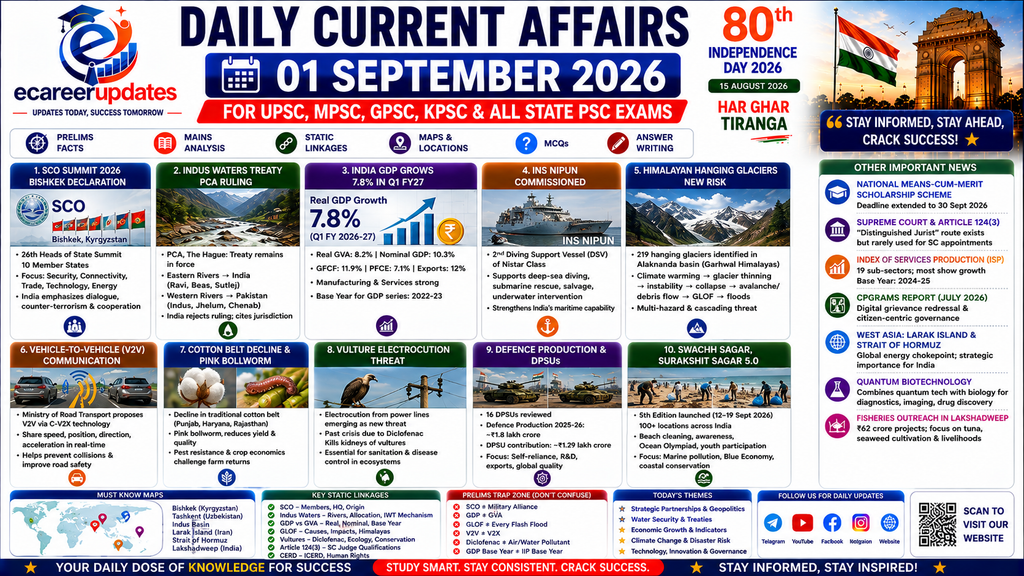
🔥 1 SEPTEMBER — TOP PRIORITY REVISION
| Priority | Current Affair | Subject | Prelims | Mains |
|---|---|---|---|---|
| 🔴 1 | SCO Summit 2026 – Bishkek | IR | ⭐⭐⭐⭐⭐ | ⭐⭐⭐⭐⭐ |
| 🔴 2 | Indus Waters Treaty & PCA ruling | IR/Geography | ⭐⭐⭐⭐⭐ | ⭐⭐⭐⭐⭐ |
| 🔴 3 | India GDP growth 7.8% | Economy | ⭐⭐⭐⭐⭐ | ⭐⭐⭐⭐⭐ |
| 🔴 4 | INS Nipun | Defence/S&T | ⭐⭐⭐⭐⭐ | ⭐⭐⭐⭐ |
| 🔴 5 | Himalayan hanging glaciers | Geography/Environment | ⭐⭐⭐⭐⭐ | ⭐⭐⭐⭐⭐ |
| 🟠 6 | Vehicle-to-Vehicle communication | S&T | ⭐⭐⭐⭐ | ⭐⭐⭐⭐ |
| 🟠 7 | Cotton belt decline & pink bollworm | Agriculture | ⭐⭐⭐⭐ | ⭐⭐⭐⭐ |
| 🟠 8 | Vulture electrocution threat | Environment | ⭐⭐⭐⭐ | ⭐⭐⭐⭐ |
| 🟠 9 | Defence production & DPSUs | Economy/Defence | ⭐⭐⭐ | ⭐⭐⭐⭐ |
| 🟠 10 | Swachh Sagar, Surakshit Sagar 5.0 | Environment | ⭐⭐⭐⭐ | ⭐⭐⭐ |
🌏 INTERNATIONAL RELATIONS
1. 🇮🇳 SCO SUMMIT 2026 — BISHKEK DECLARATION
Why in News?
The 26th Meeting of the Council of Heads of State of the Shanghai Cooperation Organisation (SCO) was held in Bishkek, Kyrgyz Republic, on 31 August–1 September 2026.
India participated at the summit and reiterated its emphasis on dialogue, diplomacy, counter-terrorism and regional cooperation.
Why is SCO important for India?
The SCO provides India a platform to engage simultaneously with:
- Central Asia
- Russia
- China
- Iran
- Pakistan
It therefore provides a rare multilateral platform where India interacts with several strategically important Eurasian countries.
🧠 SCO — Static Revision
| Feature | Fact |
|---|---|
| Full form | Shanghai Cooperation Organisation |
| Established | 2001 |
| Headquarters | Beijing |
| Origin | Shanghai Five |
| India joined | 2017 |
| Pakistan joined | 2017 |
| Iran joined | 2023 |
| Belarus joined | 2024 |
| 2026 summit | Bishkek, Kyrgyzstan |
The current SCO has 10 members: India, Iran, Kazakhstan, China, Kyrgyzstan, Pakistan, Russia, Tajikistan, Uzbekistan and Belarus. Afghanistan and Mongolia are observer states.
India’s priorities
Security
→ terrorism
→ extremism
→ separatism
Connectivity
→ Central Asia
→ Chabahar
→ International North-South Transport Corridor
Economy
→ trade
→ energy
→ investment
Technology
→ digital cooperation
→ AI
→ emerging technologies
🎯 UPSC Linkage
SCO → Central Asia → Russia-China → Eurasian geopolitics → Connectivity → Terrorism
🚨 Prelims Trap
❌ SCO is a military alliance like NATO.
Wrong.
It is a broader political, security and economic cooperation organisation.
2. 🇮🇳🇵🇰 INDUS WATERS TREATY — PCA RULING
Why in News?
The Permanent Court of Arbitration (PCA), The Hague, issued decisions concerning the 1960 Indus Waters Treaty (IWT).
The PCA held that the treaty remained in force and that India’s declaration placing it in “abeyance” did not suspend its operation.
India rejected the ruling, arguing that the arbitration mechanism was improperly constituted and lacked jurisdiction over India’s sovereign decision.
🏞️ Indus Waters Treaty — Static
The treaty was signed in 1960 between India and Pakistan and was brokered by the World Bank.
Six rivers
| Eastern Rivers | Western Rivers |
|---|---|
| Ravi | Indus |
| Beas | Jhelum |
| Sutlej | Chenab |
Basic allocation
Eastern Rivers → India
Western Rivers → Pakistan
However, India retains specified rights over the western rivers, including certain uses such as domestic use, irrigation and run-of-river hydropower, subject to treaty conditions.
Dispute-resolution mechanism
The IWT provides different mechanisms depending on the nature of the dispute:
Permanent Indus Commission
↓
Neutral Expert
↓
Court of Arbitration
Why is this important?
This is not merely a water-sharing dispute.
It combines:
International law + sovereignty + water security + hydroelectricity + India-Pakistan relations + climate change
Mains angle
The IWT illustrates the difficulty of maintaining traditional water-sharing arrangements amid:
- climate change
- population growth
- energy demand
- changing hydrology
- technological development
- geopolitical tensions
🗺️ MAP WORK
Trace:
Indus → Jhelum → Chenab → Ravi → Beas → Sutlej
Also locate:
Kashmir → Punjab → Pakistan → Arabian Sea
🏔️ GEOGRAPHY & ENVIRONMENT
3. HANGING GLACIERS — A NEW HIMALAYAN RISK
A recent study identified 219 hanging glaciers in the Alaknanda basin of the Garhwal Himalayas.
What is a hanging glacier?
A hanging glacier is an ice mass located on a steep mountain slope, often above a larger valley glacier.
Because of its unstable position, it can suddenly detach.
Hazard chain
Climate warming
⬇️
Glacier thinning/retreat
⬇️
Slope instability
⬇️
Hanging glacier break-off
⬇️
Avalanche / debris flow
⬇️
Potential GLOF / downstream flooding
Why is this important?
The Himalayan disaster story is no longer just about rainfall.
The risk is increasingly multi-hazard and cascading.
| Hazard | Possible consequence |
|---|---|
| Glacier retreat | Changing water availability |
| Hanging glacier collapse | Avalanche |
| GLOF | Sudden flood |
| Landslide | River blockage |
| Debris flow | Infrastructure destruction |
| Flood | Public-health emergency |
UPSC Mains Link
Climate change → Cryosphere → Disaster management → Himalayan infrastructure → Public health
This is a very strong GS-I + GS-III topic.
🌱 4. VULTURES & ELECTROCUTION
Electrocution from expanding power infrastructure is emerging as an additional threat to India’s vulture populations.
Remember the historic vulture crisis
The population of several Indian vulture species collapsed dramatically due largely to veterinary use of diclofenac.
The drug caused kidney failure in vultures feeding on contaminated livestock carcasses.
Major affected species
- White-rumped vulture
- Indian vulture
- Slender-billed vulture
New conservation challenge
Even after restrictions on harmful veterinary NSAIDs, vultures face:
- electrocution
- collision with power infrastructure
- food availability issues
- habitat change
- poisoning
Ecological importance
Vultures are natural scavengers.
They rapidly remove animal carcasses and therefore help:
- sanitation
- disease control
- nutrient cycling
🚨 Prelims Trap
Diclofenac directly poisons vultures through feeding on treated livestock carcasses.
It is not primarily an air/water pollutant issue.
🌊 5. SWACHH SAGAR, SURAKSHIT SAGAR 5.0
The Ministry of Earth Sciences launched the 5th edition of Swachh Sagar, Surakshit Sagar 2026 on 1 September.
The campaign will run from 12–19 September 2026.
Major features
- Beach-cleaning drives
- 100+ locations
- Ocean conservation pledge
- Youth participation
- Cycling rallies
- Marathons
- Ocean Olympiad
- Citizen participation
Why important?
It connects:
Marine pollution + citizen participation + coastal conservation + Blue Economy
Static linkage
Marine plastic pollution → Coastal ecosystems → Coral reefs → Fisheries → Tourism → Livelihoods
💰 ECONOMY
6. INDIA’S GDP GROWTH — 7.8%
India’s real GDP grew 7.8% in Q1 FY2026–27, with strong contributions from manufacturing and services.
Real GVA grew 8.2%, investment rose 11.9%, household consumption grew 7.1%, and exports grew 12%.
Important numbers
| Indicator | Q1 FY27 |
|---|---|
| Real GDP growth | 7.8% |
| Real GVA growth | 8.2% |
| Investment/GFCF | 11.9% |
| Household consumption | 7.1% |
| Exports | 12.0% |
| Manufacturing | Strong growth |
| Services | Strong growth |
Why is this important?
The important UPSC question is not:
“What was India’s GDP growth?”
It is:
What is driving the growth and how sustainable is it?
Growth composition
Investment
→ infrastructure
→ productive capacity
→ employment potential
Consumption
→ domestic demand
→ business confidence
Manufacturing
→ industrialisation
→ exports
→ supply-chain integration
Services
→ productivity
→ employment
→ external earnings
GDP vs GVA — MUST REVISE
GDP = GVA + Net Taxes on Products
Therefore:
GDP can grow at a different rate from GVA.
Today’s figures provide an excellent example:
GDP → 7.8%
GVA → 8.2%
Prelims Trap 🚨
❌ “GVA includes net product taxes.”
Wrong.
GVA measures value added by producers; GDP adds net taxes on products.
7. DEFENCE PRODUCTION — DPSUs
The Defence Minister reviewed the performance of 16 Defence Public Sector Undertakings (DPSUs).
India’s defence production in 2025–26 was reported at about ₹1.8 lakh crore, with DPSUs contributing approximately ₹1.29 lakh crore.
Why important?
India’s defence strategy is shifting from:
Import dependence → Indigenous production → Export orientation
Focus areas
- Indigenous platforms
- Advanced technologies
- Defence exports
- Supply-chain development
- R&D
- Timely delivery
- Global-quality manufacturing
Mains linkage
Atmanirbhar Bharat
→ Defence manufacturing
→ Technology absorption
→ Private sector
→ MSMEs
→ R&D
→ Exports
→ Strategic autonomy
🛡️ DEFENCE & SCIENCE
8. INS NIPUN — DEEP-SEA CAPABILITY
The Indian Navy commissioned INS Nipun, the second Diving Support Vessel (DSV) of the Nistar class, at the Naval Dockyard, Mumbai.
What is a DSV?
A Diving Support Vessel supports complex underwater operations.
INS Nipun strengthens India’s capabilities in:
- deep-sea diving
- underwater intervention
- submarine rescue
- salvage
- underwater inspection
It can also operate with India’s Deep Submergence Rescue Vessel (DSRV).
Why strategically important?
India has:
- a large coastline
- major maritime trade
- submarine capability
- offshore infrastructure
- strategic sea lanes
Therefore:
Underwater domain awareness + submarine rescue capability = maritime security
Prelims Link
INS Nipun → Nistar class → DSV → DSRV → Submarine rescue
🚗 SCIENCE & TECHNOLOGY
9. VEHICLE-TO-VEHICLE (V2V) COMMUNICATION
The Ministry of Road Transport and Highways is moving toward mandating Vehicle-to-Vehicle communication through proposed amendments to motor-vehicle rules.
How does it work?
Vehicles communicate wirelessly using an onboard unit.
They can exchange information such as:
- speed
- position
- direction
- acceleration
The proposed framework uses cellular Vehicle-to-Everything (C-V2X) technology.
Simple example
Car A suddenly brakes.
⬇️
Car A sends information.
⬇️
Nearby Car B receives warning.
⬇️
Driver gets an alert.
⬇️
Collision risk may be reduced.
V2V vs V2X
| V2V | V2X |
|---|---|
| Vehicle ↔ Vehicle | Vehicle ↔ Everything |
| Direct vehicle interaction | Vehicles + infrastructure + pedestrians + networks |
| Narrower system | Broader ecosystem |
Mains linkage
AI + IoT + telecommunications + transport + road safety + data privacy
🌾 AGRICULTURE
10. NORTH INDIA’S COTTON BELT IS SHRINKING
Cotton cultivation is facing challenges in the traditional cotton belt of:
- Punjab
- Haryana
- Rajasthan
Production has been affected by pest pressure, changing economics and declining attractiveness of cotton compared with alternative crops.
Pink Bollworm
The pink bollworm is a major cotton pest.
It damages cotton bolls and reduces:
- yield
- fibre quality
- farm returns
Bt Cotton linkage
India’s Bt cotton technology was designed primarily around resistance to certain bollworm pests.
However:
Pest resistance + ecological factors + agronomic practices can reduce effectiveness over time.
UPSC linkage
GM crops → Bt cotton → pest resistance → agricultural productivity → farmer income → crop diversification
Prelims Trap
❌ Bt cotton is a herbicide-tolerant crop.
Not the primary purpose.
Bt cotton expresses insecticidal proteins derived from Bacillus thuringiensis.
🏛️ POLITY & GOVERNANCE
11. SPECIAL INTENSIVE REVISION — ELECTORAL ROLLS
The Election Commission’s Special Intensive Revision (SIR) of electoral rolls continues to generate debate regarding verification, deletions and restoration of names.
Reports indicate that more than 13 crore names had been deleted from draft rolls across 30 States/UTs under the process, though draft-stage deletion is subject to claims and objections.
Constitutional foundation
Article 324
→ Election Commission’s superintendence, direction and control of elections.
Article 326
→ Elections to Lok Sabha and State Assemblies based on adult suffrage.
Why important?
The core governance challenge is:
How can electoral rolls remain accurate without excluding legitimate voters?
Balance
Electoral integrity
Inclusion
Due process
Transparency
Mains keywords
- universal adult franchise
- electoral integrity
- procedural fairness
- transparency
- citizen participation
- right to vote
⚖️ 12. “DISTINGUISHED JURIST” — ARTICLE 124(3)
Supreme Court judge Justice Ujjal Bhuyan recently highlighted the largely unused constitutional route for appointing a “distinguished jurist” directly as a Supreme Court judge.
Article 124(3)
A person can qualify for appointment as a Supreme Court judge if they:
- are a citizen of India and have been a High Court judge for at least five years, OR
- have been an advocate of a High Court for at least ten years, OR
- are, in the opinion of the President, a distinguished jurist.
Why interesting for UPSC?
This is an excellent example of:
Constitutional provision vs constitutional practice
Related concepts
Article 124
→ Supreme Court
Article 217
→ High Court judges
Collegium
→ judicially evolved mechanism
Prelims Trap 🚨
The Constitution does contain the “distinguished jurist” route.
The important point is that it has historically remained unused for Supreme Court appointments.
🏦 DIGITAL GOVERNANCE
13. UPI & DIGITAL PUBLIC INFRASTRUCTURE
Digital payments and UPI remain important components of India’s Digital Public Infrastructure ecosystem.
Static-current linkage
UPI
→ NPCI
→ instant bank-account transfers
→ interoperability
→ financial inclusion
→ cross-border digital-payment diplomacy
Why UPSC cares?
The topic links:
Fintech + financial inclusion + data + digital governance + internationalisation of Indian DPI
👥 SOCIAL SECTOR & EDUCATION
14. NATIONAL MEANS-CUM-MERIT SCHOLARSHIP SCHEME
The Ministry of Education has extended the deadline for applications under the National Means-cum-Merit Scholarship Scheme (NMMSS) 2026–27 to 30 September 2026.
Objective
To reduce school dropouts among meritorious students from economically weaker sections and encourage continuation of education.
UPSC linkage
Education → Human capital → Social mobility → Demographic dividend
🌊 GEOGRAPHY + WEST ASIA
15. LARAK ISLAND & STRAIT OF HORMUZ
The ongoing US-Iran conflict again brought Larak Island and the Strait of Hormuz into strategic focus.
US forces struck Iranian launchers on Larak Island, followed by Iranian retaliation against US positions in Jordan.
Why is Hormuz important?
The Strait of Hormuz is a major global energy chokepoint.
It connects:
Persian Gulf
with
Gulf of Oman
and ultimately the Arabian Sea/Indian Ocean.
Why India should care?
Any disruption can affect:
- crude oil prices
- LNG
- shipping costs
- insurance
- inflation
- current account
- rupee
- India’s energy security
🗺️ Map Work
Locate:
Iran → Persian Gulf → Strait of Hormuz → Gulf of Oman → Arabian Sea
Also locate:
Larak Island
📊 IMPORTANT ECONOMIC INDICATORS — QUICK TABLE
| Indicator | What it tells you |
|---|---|
| GDP | Overall economic output |
| GVA | Sectoral value addition |
| IIP | Industrial production |
| CPI | Consumer-level inflation |
| WPI | Wholesale-level price changes |
| GFCF | Investment in fixed assets |
| GST | Indirect-tax revenue/consumption signal |
| ISP | Services production |
Current base years to remember
| Indicator | Base Year |
|---|---|
| GDP | 2022–23 |
| IIP | 2011–12 |
| ISP trial index | 2024–25 |
🔥 Excellent statement-based Prelims area.
🔗 STATIC + CURRENT AFFAIRS LINKAGE MATRIX
| News | Static topic to revise | Mains connection |
|---|---|---|
| SCO | International organisations | India’s Eurasian strategy |
| IWT | River systems + treaties | Water diplomacy |
| Hanging glaciers | Glaciology | Himalayan resilience |
| Vultures | Food chains + conservation | Biodiversity |
| Swachh Sagar | Marine ecosystems | Blue Economy |
| GDP | National income accounting | Growth quality |
| INS Nipun | Naval technology | Maritime security |
| V2V | IoT/C-V2X | Road safety |
| Cotton | GM crops + pests | Farm diversification |
| SIR | Articles 324/326 | Electoral integrity |
| Distinguished jurist | Article 124 | Judicial appointments |
| Hormuz | Chokepoints | Energy security |
🚨 PRELIMS TRAP ZONE — 1 SEPTEMBER
❌ Trap 1
SCO is a military alliance.
→ False
❌ Trap 2
All six Indus rivers are allocated exclusively to Pakistan.
→ False
❌ Trap 3
GDP and GVA are identical concepts.
→ False
❌ Trap 4
A hanging glacier is a glacial lake.
→ False
❌ Trap 5
V2V means vehicle-to-everything.
→ False
V2V = Vehicle-to-Vehicle.
❌ Trap 6
CERD/PCA/SCO are all UN specialised agencies.
→ False
These belong to entirely different institutional categories.
❌ Trap 7
Article 124(3) permits only High Court judges and advocates to become SC judges.
→ False
It also provides for the distinguished jurist route.
🧠 15-MINUTE MAP REVISION
Today, locate these on a blank world map:
Central Asia
- Kyrgyzstan
- Uzbekistan
- Kazakhstan
- Tajikistan
- Turkmenistan
South Asia
- India
- Pakistan
- Nepal
- Afghanistan
West Asia
- Iran
- Persian Gulf
- Strait of Hormuz
- Gulf of Oman
- Larak Island
Himalayas
- Garhwal Himalayas
- Alaknanda
- Nepal
- Tibet
Maritime India
- Mumbai
- Arabian Sea
- Lakshadweep
- Indian Ocean
🎯 UPSC PRELIMS PRACTICE
Q1. Consider the following statements regarding SCO:
- India became a full member of SCO in 2017.
- Iran became a member of SCO in 2023.
- Belarus became a member in 2024.
- SCO is exclusively a military alliance.
Which are correct?
A. 1, 2 and 3 only
B. 1 and 4 only
C. 2 and 4 only
D. 1, 2, 3 and 4
Answer: A
Q2. With reference to the Indus Waters Treaty, consider:
- Ravi, Beas and Sutlej are Eastern Rivers.
- Indus, Jhelum and Chenab are Western Rivers.
- The treaty was brokered by the World Bank.
- India has no rights whatsoever over the Western Rivers.
Answer: A — 1, 2 and 3 only
Q3. Hanging glaciers are best described as:
A. Glacial lakes formed by moraine dams
B. Ice masses perched on steep slopes
C. Underground glaciers
D. Floating glaciers
Answer: B
Q4. Vehicle-to-Vehicle communication primarily involves:
A. Vehicle ↔ satellite only
B. Vehicle ↔ pedestrian only
C. Vehicle ↔ vehicle
D. Vehicle ↔ toll plaza only
Answer: C
Q5. Which of the following is associated with India’s vulture crisis?
A. Diclofenac
B. CFCs
C. Methane
D. Glyphosate
Answer: A
Q6. Article 124(3) of the Constitution relates to qualifications for appointment as:
A. High Court Chief Justice only
B. Supreme Court judge
C. Attorney General
D. Election Commissioner
Answer: B
✍️ MAINS QUESTIONS — 1 SEPTEMBER
GS-II — International Relations
Q1. The SCO provides India with both strategic opportunities and structural limitations in Eurasian geopolitics. Examine.
GS-II — International Relations
Q2. The Indus Waters Treaty has survived decades of India-Pakistan tensions, but contemporary geopolitical and ecological realities are testing its institutional framework. Discuss.
GS-I/GS-III — Geography
Q3. Himalayan disasters are increasingly becoming cascading multi-hazard events. Explain the role of climate change, geological fragility and infrastructure expansion.
GS-III — Environment
Q4. Discuss the ecological importance of vultures in maintaining ecosystem health. What are the emerging threats to their conservation in India?
GS-III — Agriculture
Q5. The changing fortunes of India’s cotton sector demonstrate the challenges of relying on a single technological solution for agricultural productivity. Discuss with reference to Bt cotton and pest resistance.
GS-III — Science & Technology
Q6. How can Vehicle-to-Vehicle communication contribute to road safety in India? Discuss the technological, regulatory and privacy challenges involved.
📝 MODEL MAINS FRAMEWORK
“Himalayan disasters are increasingly becoming cascading multi-hazard events.” Discuss.
Introduction
The Himalayas are young, tectonically active mountains increasingly exposed to climate-induced cryospheric changes.
Body
Natural factors
- young fold mountains
- steep slopes
- seismic activity
- fragile geology
- glacier instability
Climate factors
- glacier retreat
- permafrost degradation
- expanding glacial lakes
- extreme precipitation
Human factors
- roads
- hydropower
- tourism
- urbanisation
- construction in hazard-prone areas
Cascading chain
Glacier instability
→ landslide
→ river blockage
→ sudden release
→ flash flood
→ infrastructure collapse
→ displacement
→ public-health crisis
Way Forward
- satellite monitoring
- early-warning systems
- GLOF risk mapping
- resilient infrastructure
- carrying-capacity assessment
- basin-level planning
- cross-border data sharing
- ecosystem-based adaptation
- disaster-resilient health systems
Conclusion
The Himalayan policy paradigm must shift from disaster response to anticipatory, ecosystem-sensitive and climate-resilient development.
🔥 TODAY’S 5 BIG UPSC LINKAGES
1️⃣ SCO → Central Asia → Connectivity → Energy → Strategic Autonomy
2️⃣ Indus Treaty → Rivers → International Law → Hydropower → India-Pakistan Relations
3️⃣ Hanging Glacier → Climate Change → GLOF → Disaster Management → Public Health
4️⃣ GDP → Investment → Manufacturing → Services → Employment → Inclusive Growth
5️⃣ V2V → AI/IoT → Telecommunications → Road Safety → Data Governance
📚 ONE-PAGE REVISION SHEET
| Topic | Remember This |
|---|---|
| SCO Summit | Bishkek, Kyrgyzstan |
| SCO members | 10 |
| India joined SCO | 2017 |
| IWT | 1960 |
| IWT broker | World Bank |
| Eastern rivers | Ravi, Beas, Sutlej |
| Western rivers | Indus, Jhelum, Chenab |
| GDP Q1 FY27 | 7.8% |
| GVA | 8.2% |
| GFCF | 11.9% |
| INS Nipun | Diving Support Vessel |
| Class | Nistar |
| Hanging glaciers | Alaknanda basin — 219 identified |
| V2V | Vehicle-to-Vehicle communication |
| Cotton pest | Pink bollworm |
| Vulture crisis | Diclofenac |
| Article 124(3) | SC judge qualifications |
| Swachh Sagar 5.0 | 12–19 Sept 2026 |
| Hormuz | Major global energy chokepoint |
🏆 ECAREERUPDATES — EXAM STRATEGY FOR TODAY
Don’t memorise “SCO = Bishkek” and move on.
Instead prepare the chain:
SCO → Central Asia → India → China → Russia → Iran → Connectivity → Energy → Security
Similarly:
IWT → Indus Basin → Six Rivers → Eastern/Western allocation → Hydropower → PCA → International law
And:
Hanging glacier → Cryosphere → Climate change → GLOF → Landslide → Flash flood → Disaster resilience
This is precisely the kind of static + current integration that the recent UPSC Prelims pattern rewards. The 2026 paper was described as lengthy, statement-heavy and analytical, making conceptual understanding and elimination more valuable than rote current-affairs memorisation.
⭐ FINAL TAKEAWAY
If you have only 30 minutes today:
10 min → SCO + Indus Waters Treaty
7 min → GDP + GVA + economic indicators
5 min → Himalayas + hanging glaciers + GLOF
3 min → INS Nipun + V2V
5 min → Prelims traps + map revision
Today’s golden formula:
CURRENT NEWS + STATIC CONCEPT + MAP + INSTITUTION + PRELIMS TRAP = UPSC-READY CURRENT AFFAIRS
This makes the 1 September 2026 current-affairs set useful not only for Prelims facts, but also for GS-II/GS-III answer writing, Essay, Geography and interview preparation.