
UPSC Prelims + Mains
UPSC CSE | MPSC | GPSC | KPSC/KAS | APSC | State PSCs | Group A/B/C
🎯 Today’s Approach
News → Why in News → Static Concept → Prelims Facts → Prelims Trap → Mains Dimension → Interlinkages
The current UPSC pattern increasingly rewards candidates who can connect a current event with static concepts, institutions, maps, constitutional provisions, scientific principles and policy debates rather than merely memorising headlines. The 2026 Prelims analysis similarly highlights statement-based and analytical questioning.
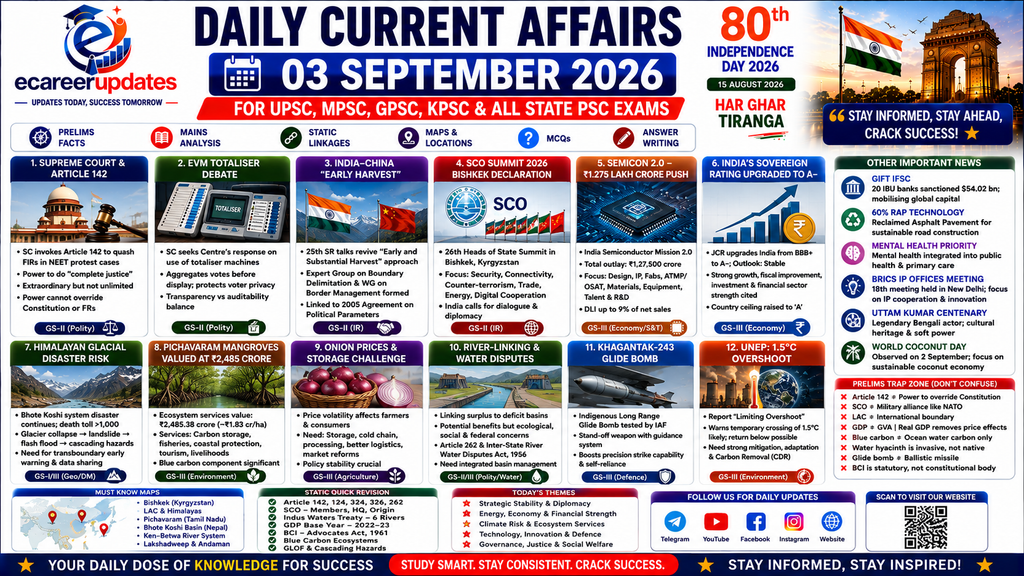
🔥 TODAY’S TOP 12 — PRIORITY LIST
| Priority | Current Affair | Subject | Prelims | Mains |
|---|---|---|---|---|
| 🔴 1 | India–China “Early Harvest” & Boundary Management | IR | ⭐⭐⭐⭐⭐ | ⭐⭐⭐⭐⭐ |
| 🔴 2 | Article 142 & Supreme Court’s judicial powers | Polity | ⭐⭐⭐⭐⭐ | ⭐⭐⭐⭐⭐ |
| 🔴 3 | India’s Sovereign Rating upgraded to A− | Economy | ⭐⭐⭐⭐⭐ | ⭐⭐⭐⭐ |
| 🔴 4 | Himalayan glacier disaster & transboundary risks | Geography/Environment | ⭐⭐⭐⭐⭐ | ⭐⭐⭐⭐⭐ |
| 🔴 5 | Pichavaram Mangroves ecosystem valuation | Environment | ⭐⭐⭐⭐⭐ | ⭐⭐⭐⭐⭐ |
| 🔴 6 | River-linking & inter-State water disputes | Geography/Polity | ⭐⭐⭐⭐ | ⭐⭐⭐⭐⭐ |
| 🟠 7 | Khagantak-243 indigenous glide bomb | Defence/S&T | ⭐⭐⭐⭐⭐ | ⭐⭐⭐⭐ |
| 🟠 8 | Onion prices, storage & agricultural marketing | Agriculture | ⭐⭐⭐⭐ | ⭐⭐⭐⭐⭐ |
| 🟠 9 | UNEP & 1.5°C overshoot | Environment | ⭐⭐⭐⭐ | ⭐⭐⭐⭐⭐ |
| 🟠 10 | GIFT IFSC & foreign-currency mobilisation | Economy | ⭐⭐⭐⭐ | ⭐⭐⭐⭐ |
| 🟠 11 | 60% Reclaimed Asphalt Pavement technology | S&T/Environment | ⭐⭐⭐ | ⭐⭐⭐⭐ |
| 🟠 12 | Mental health as public-health priority | Social Issues | ⭐⭐⭐ | ⭐⭐⭐⭐⭐ |
🏛️ POLITY & GOVERNANCE
1. ⚖️ SUPREME COURT & BAR COUNCIL OF INDIA
Why in News?
The Supreme Court has clarified that the Chairperson of the Bar Council of India (BCI) is functioning only as a pro tem chairperson until fresh elections are held.
The Court also directed the BCI to give prior notice to the Attorney-General and Solicitor-General before taking policy-impacting decisions during the interim period.
What is BCI?
The Bar Council of India is a statutory body constituted under the Advocates Act, 1961.
It deals with matters such as:
- professional standards of advocates
- legal education
- recognition of law degrees/institutions
- disciplinary standards
- regulation of the legal profession
Why UPSC relevant?
This raises an important constitutional-governance question:
How should statutory regulatory bodies function when their internal electoral/administrative mechanisms are disrupted?
Static Linkage
Parliamentary legislation
↓
Statutory body
↓
Autonomy
↓
Judicial oversight
↓
Accountability
Prelims Trap 🚨
BCI is a constitutional body.
❌ Wrong.
It is a statutory body created under the Advocates Act, 1961.
2. ⚖️ ARTICLE 142 — “COMPLETE JUSTICE”
The Supreme Court’s recent use of Article 142 to deal with FIRs arising from the NEET protest controversy continues to generate debate about the scope of its extraordinary powers.
Article 142
It empowers the Supreme Court to pass orders necessary to:
“do complete justice”
in matters pending before it.
Important constitutional comparison
| Article | Key provision |
|---|---|
| Article 32 | Constitutional remedies |
| Article 136 | Special Leave Petition |
| Article 141 | Law declared by SC binding on all courts |
| Article 142 | Complete justice |
| Article 144 | Authorities to act in aid of SC |
Important limitation
Article 142 is not an unlimited power.
The Supreme Court has repeatedly recognised that it cannot:
- override the Constitution
- violate fundamental rights
- rewrite legislation
- adversely affect persons without hearing them
Mains Issue
Judicial innovation vs judicial overreach
The debate is:
Should the Supreme Court have broad remedial powers to fill legal gaps and provide justice, or should such powers be narrowly constrained to preserve separation of powers?
UPSC Linkage
Article 142 → Judicial review → Separation of powers → Constitutional morality
3. 🗳️ ELECTION COMMISSION — BLOs
The Election Commission has emphasised the role of Booth Level Officers (BLOs) as the first point of contact between citizens and the electoral system.
BLO — Remember
A Booth Level Officer works at the grassroots level of electoral-roll administration.
Major functions include:
- verification of electoral information
- assisting with electoral-roll revision
- identifying eligible voters
- field-level verification
Why important?
This connects with the ongoing debate around:
Electoral roll accuracy vs voter inclusion
Static Link
Article 324
→ Election Commission
Article 326
→ Adult suffrage
Representation of the People Acts
→ Electoral administration
🌏 INTERNATIONAL RELATIONS
4. 🇮🇳🇨🇳 INDIA–CHINA: “EARLY HARVEST” RETURNS
Why in News?
The 25th round of India-China Special Representatives (SR) talks has revived the phrase “Early and Substantial Harvest” concerning boundary delimitation and border management.
An eight-point consensus tasked an Expert Group on Boundary Delimitation and a Working Group on Border Management with advancing discussions.
What is the Special Representatives mechanism?
The SR mechanism is the principal political channel for negotiating the India-China boundary question.
Important institutional architecture
| Mechanism | Broad role |
|---|---|
| Special Representatives | Political-level boundary negotiations |
| WMCC | Diplomatic/official-level consultation and coordination |
| Military channels | Ground-level communication |
| Expert/working groups | Technical boundary/border-management issues |
2005 Agreement
The talks are linked to the 2005 Agreement on Political Parameters and Guiding Principles for Settlement of the India-China Boundary Question.
What does “Early Harvest” mean?
It does not mean that the entire India-China boundary dispute is being settled immediately.
Rather, it suggests the possibility of achieving limited, substantial progress in specific areas relating to:
- boundary delimitation
- border management
- areas where agreement may be comparatively easier
Why important for India?
The issue combines:
LAC
→ national security
→ infrastructure
→ Tibet
→ transboundary rivers
→ trade
→ China relations
→ strategic autonomy
🚨 Prelims Trap
LAC = internationally demarcated international boundary.
❌ No.
The Line of Actual Control is the de facto military control line between India and China and is not the same as a mutually settled international boundary.
5. 🇮🇳🇷🇺 INDIA–RUSSIA: PETROLEUM & TRADE
The continued importance of Russian crude in India’s energy basket has again become a major economic and geopolitical issue amid changing sanctions and tariff risks.
India’s dependence on imported crude makes diversification and energy security central to foreign policy. Current analysis also highlights the vulnerability created by possible restrictions connected with Russian oil purchases.
Why important?
India’s energy strategy involves balancing:
Affordable energy
Energy security
Strategic autonomy
External geopolitical pressures
Mains linkage
India’s energy diplomacy increasingly requires supplier diversification, strategic reserves, refining capacity, renewable transition and diplomatic flexibility.
💰 ECONOMY
6. 📈 INDIA’S SOVEREIGN CREDIT RATING UPGRADED TO A−
Why in News?
The Japan Credit Rating Agency (JCR) upgraded India’s long-term foreign- and local-currency issuer ratings from BBB+ to A−, while maintaining a Stable Outlook.
It also raised India’s country ceiling to A.
Why did JCR upgrade India?
The agency highlighted:
- strong economic growth
- private consumption
- public investment
- improved fiscal quality
- stronger financial system
- digital public infrastructure
- GST
- capital expenditure
The Centre’s fiscal deficit reportedly declined from 4.7% of GDP in FY25 to 4.4% in FY26.
What is a sovereign credit rating?
It is an assessment of a country’s:
capacity and willingness to meet its financial obligations.
It can influence:
- borrowing costs
- investor confidence
- capital flows
- international financing conditions
Rating ≠ GDP growth
A country may have:
High GDP growth
but
weak fiscal sustainability
or
high external vulnerability.
Therefore, credit ratings consider a much broader economic picture.
Prelims Trap 🚨
Sovereign credit rating is assigned by RBI.
❌ No.
It is assigned by credit-rating agencies.
7. 🏦 GIFT IFSC — INTERNATIONAL FINANCIAL CENTRE
GIFT IFSC continues to expand as an international financial hub.
Recent data highlighted substantial foreign-currency mobilisation through International Banking Units under RBI’s FCNR(B) swap facility. As of August 31, 20 IFSC Banking Units had sanctioned about $54.02 billion, of which approximately $52.82 billion had been disbursed.
Static revision
GIFT IFSC
→ Gujarat International Finance Tec-City
→ Gujarat
→ International Financial Services Centre
→ regulated by IFSCA
Why important?
It aims to bring international financial activities to India, including:
- banking
- capital markets
- insurance
- fund management
- aircraft leasing
- international finance
Conceptual linkage
GIFT IFSC → Capital mobilisation → Financial deepening → Internationalisation of Indian financial markets
8. 📊 GDP — DON’T STOP AT 7.8%
India’s Q1 FY2026–27 real GDP growth = 7.8%, while real GVA growth was 8.2%.
Other important indicators include:
- GFCF growth → 11.9%
- Private consumption → 7.1%
- Manufacturing → 9.2%
- Services → around 10%
UPSC approach
Instead of remembering only:
“GDP = 7.8%”
ask:
What drove growth?
Investment
→ productive capacity
Manufacturing
→ industrial growth
Services
→ value addition
Consumption
→ domestic demand
Important equation
GDP = GVA + Net Taxes on Products
🌾 AGRICULTURE
9. 🧅 ONION PRICES — THE STORAGE PROBLEM
The continuing debate around onion prices highlights one of India’s classic agricultural-policy dilemmas:
How can government protect consumers from high food prices while ensuring remunerative prices for farmers?
Current analysis argues that repeated interventions such as export restrictions or procurement often occur after farmers have already made production decisions, while inadequate storage and distribution capacity contributes to price volatility.
Why onion is special?
Onion is:
- widely consumed
- highly price-sensitive
- perishable
- important for farm incomes
- politically sensitive
The price cycle
High prices
→ government intervention
→ export restrictions/imports/release of stocks
↓
Supply increases
↓
Prices fall
↓
Farmer distress
↓
Reduced acreage
↓
Supply shortage
↓
Prices rise again
Long-term solution
The issue is not simply:
“Control onion prices.”
It is:
Storage
Cold/controlled storage where appropriate
Warehousing
Processing
Better logistics
Market information
Stable trade policy
UPSC Linkage
Agricultural marketing → Price volatility → Storage → Supply chains → Farmer income → Food inflation
This is especially important because the 2026 UPSC Prelims itself tested agricultural marketing and e-commerce-related concepts.
🌊 GEOGRAPHY + WATER GOVERNANCE
10. 💧 RIVER-LINKING: CAN IT SOLVE INDIA’S WATER PROBLEM?
The proposal to interlink major rivers has again triggered debate involving inter-State water disputes, ecological impacts and the feasibility of large-scale water transfers.
River interlinking — basic idea
Transfer water from:
water-surplus basins
to:
water-deficit basins
through canals, reservoirs and other infrastructure.
Potential advantages
- drought mitigation
- irrigation
- drinking-water supply
- hydropower
- flood moderation in some contexts
Concerns
- ecological disruption
- displacement
- sediment-flow changes
- downstream impacts
- altered riverine ecosystems
- high financial costs
- inter-State disputes
- uncertainty over “surplus” water under climate change
Example: Ken–Betwa Link
A major river-linking project involving:
Ken River + Betwa River
in the Bundelkhand region.
Constitutional dimension
Water is primarily a State List subject, but Parliament has constitutional authority under Article 262 to provide for adjudication of disputes relating to inter-State rivers/water.
Key legislation
Inter-State River Water Disputes Act, 1956
Mains takeaway
Water security cannot be reduced to transferring water; it requires demand management, watershed restoration, groundwater governance, efficiency and basin-level planning.
🏔️ ENVIRONMENT & DISASTER MANAGEMENT
11. 🏔️ HIMALAYAN GLACIAL DISASTER — A CASCADING HAZARD
The Nepal disaster originating in the Bhote Koshi system has reinforced concerns about the vulnerability of the Himalayan cryosphere and transboundary disaster management. Recent reporting places the death toll above 1,000 and highlights continuing search-and-rescue challenges.
Important distinction
A Himalayan flood may result from:
- intense rainfall
- glacier collapse
- GLOF
- landslide
- landslide-dammed lake failure
- sudden release of water/debris
Cascading hazard model
Climate warming
↓
Glacier/permafrost instability
↓
Ice-rock collapse
↓
Landslide/debris flow
↓
River blockage or sudden surge
↓
Flash flood
↓
Infrastructure failure
↓
Humanitarian crisis
Why transboundary cooperation matters?
Himalayan rivers cross political boundaries.
Therefore early warning requires:
- hydrological data
- satellite information
- reservoir data
- glacial-lake monitoring
- rapid communication
- cross-border institutional mechanisms
UPSC Linkage
Geography + Climate Change + Disaster Management + International Relations
12. 🌳 PICHAVARAM MANGROVES — ECOSYSTEM SERVICES VALUED AT ₹2,485 CRORE
A study has valued the ecosystem services of Pichavaram Mangrove Forest in Cuddalore district, Tamil Nadu, at approximately ₹2,485.38 crore, or about ₹1.83 crore per hectare.
Why is this important?
It demonstrates the idea of:
Economic valuation of ecosystem services
Mangroves provide benefits that markets often fail to price adequately.
Services include
- coastal protection
- carbon storage
- fisheries
- biodiversity
- tourism
- livelihood support
- nutrient cycling
Blue Carbon
Blue carbon refers to carbon captured and stored by coastal and marine ecosystems such as:
- mangroves
- salt marshes
- seagrasses
The Pichavaram assessment includes a significant blue-carbon component.
Static Geography
Pichavaram is located in:
Cuddalore district, Tamil Nadu
It is one of India’s important mangrove ecosystems and is recognised as a Ramsar site.
Prelims Trap 🚨
Blue carbon refers only to carbon stored in oceans.
❌ Not exactly.
It particularly concerns carbon captured and stored by coastal and marine ecosystems, including mangroves, salt marshes and seagrasses.
13. 🌡️ UNEP & THE 1.5°C OVERSHOOT
The debate over the 1.5°C temperature threshold continues with UNEP’s Limiting Overshoot framework.
The important idea is that even if the world temporarily exceeds 1.5°C, the magnitude and duration of the overshoot can still be limited through rapid mitigation, adaptation and carbon-removal measures.
Understand the concept
Emissions
↓
Global warming
↓
Possible temporary 1.5°C exceedance
↓
Peak warming
↓
Declining temperatures under strong action
Mitigation vs Carbon Removal
| Mitigation | Carbon Removal |
|---|---|
| Reduces new emissions | Removes CO₂ already in atmosphere |
| Renewable energy | Afforestation |
| Energy efficiency | Direct Air Capture |
| Electrification | Ecosystem restoration |
UPSC Mains
The possibility of overshoot makes rapid mitigation more urgent; it does not make the Paris temperature goal irrelevant.
🪸 14. CORAL REEFS & OCEAN WARMING
Coral ecosystems continue to face severe stress due to rising ocean temperatures and marine heatwaves.
Coral bleaching
Heat stress
↓
Coral expels symbiotic algae
↓
Coral turns white
↓
Energy deficit
↓
Possible mortality if stress persists
India — map revision
Locate:
- Lakshadweep
- Gulf of Mannar
- Gulf of Kachchh
- Andaman & Nicobar Islands
Linkage
Climate change → Ocean warming → Coral bleaching → Fisheries → Coastal protection → Blue Economy
🛡️ DEFENCE & SECURITY
15. ✈️ IAF TESTS INDIGENOUS KHAGANTAK-243 GLIDE BOMB
The Indian Air Force successfully conducted a drop trial of the indigenously designed and developed Khagantak-243 Long Range Glide Bomb.
What is a glide bomb?
Unlike a conventional free-fall bomb, a glide bomb uses aerodynamic lift and guidance systems to travel toward its target after release.
Stand-off weapon
A stand-off weapon allows an aircraft to attack from a distance without necessarily entering the immediate range of enemy air defences.
Why important?
It strengthens:
- precision strike
- stand-off capability
- indigenous weapons development
- reduced import dependence
- operational flexibility
Conceptual chain
Indigenous R&D
→ precision guidance
→ stand-off capability
→ survivability
→ strategic autonomy
Prelims Trap 🚨
A glide bomb is simply a ballistic missile.
❌ No.
A glide bomb relies on aerodynamic glide after release and is different from a conventional ballistic missile trajectory.
🛣️ SCIENCE, TECHNOLOGY & INFRASTRUCTURE
16. ♻️ 60% RECLAIMED ASPHALT PAVEMENT — CIRCULAR ROAD CONSTRUCTION
CSIR-CRRI, OSEPL and Ooms India demonstrated a 60% Reclaimed Asphalt Pavement (RAP) technology on NH-716.
What is RAP?
Reclaimed Asphalt Pavement is old asphalt pavement material recovered from existing roads and reused in new pavement construction.
Why important?
It promotes:
- material recycling
- reduced use of virgin aggregates
- reduced waste
- lower resource intensity
- circular economy
- potentially lower construction costs
Concept
Old road
↓
Milling/removal
↓
Processing
↓
Recovered asphalt material
↓
New pavement
UPSC Link
Circular economy + infrastructure + waste management + climate mitigation
💧 WATER SECURITY
17. NATIONAL DEPARTMENTAL SUMMIT ON WATER
The Prime Minister chaired the valedictory session of the National Departmental Summit on Water, organised by the Ministry of Jal Shakti. The summit emphasised water security, Centre-State cooperation, technology and public participation.
Key ideas
- cooperative federalism
- water conservation
- watershed management
- dam safety
- desilting
- AI and data
- citizen participation
- Jal Utsav
Why important?
India’s water challenge is simultaneously:
Agricultural
- Urban
- Industrial
- Ecological
- Inter-State
- Climate-related
Important linkage
Water security ≠ only creating more dams.
It requires:
Demand management + efficiency + groundwater recharge + wastewater reuse + watershed restoration + data-based governance
🧠 HEALTH & SOCIAL ISSUES
18. 🧠 MENTAL HEALTH AS A PUBLIC-HEALTH PRIORITY
Mental health is increasingly being discussed as an integral component of India’s broader public-health strategy rather than as an isolated medical speciality.
Major challenges
- treatment gap
- shortage of mental-health professionals
- stigma
- inadequate community-based care
- high out-of-pocket expenditure
- urban stress
- adolescent mental-health concerns
Correct policy approach
Primary healthcare
↓
Early detection
↓
Community-based care
↓
Specialised treatment
↓
Rehabilitation
Mains linkage
Mental health → Human capital → Productivity → Education → Employment → Social inclusion
Key policy idea
Mental health should be integrated into primary healthcare and public-health planning, rather than confined to tertiary psychiatric institutions.
🇮🇳 HISTORY, ART & CULTURE
19. 🎬 MAHANAYAK UTTAM KUMAR — BIRTH CENTENARY
The Prime Minister paid tribute to legendary Bengali actor Uttam Kumar on his birth centenary.
UPSC relevance
Although primarily a cultural-current-affairs topic, it can be linked with:
- Indian cinema
- regional cultural identity
- Bengali cultural history
- post-Independence popular culture
- soft power
Prelims point
Uttam Kumar is strongly associated with Bengali cinema and is widely regarded as one of its most influential actors.
Mains/Essay linkage
Cinema is not merely entertainment; it can act as an instrument of cultural identity, social commentary and soft power.
🌐 INTERNATIONAL INSTITUTIONS & INTELLECTUAL PROPERTY
20. 💡 BRICS IP OFFICES MEETING
The 18th Meeting of the Heads of Intellectual Property Offices of BRICS countries is being hosted in New Delhi from 1–3 September 2026 under India’s DPIIT/CGPDTM framework. Around 35 delegates are participating, with discussions on strengthening cooperation in intellectual property.
Why important?
IP is increasingly linked to:
- technological sovereignty
- innovation
- patents
- startups
- traditional knowledge
- technology transfer
- economic competitiveness
UPSC linkage
BRICS → Emerging economies → Innovation → Intellectual property → Technology sovereignty
🔗 STATIC-CURRENT AFFAIRS MASTER TABLE
| Today’s News | Static Concept to Revise | Possible Question |
|---|---|---|
| India-China Early Harvest | LAC + 2005 Agreement | Boundary negotiations |
| BCI | Advocates Act 1961 | Statutory bodies |
| Article 142 | Constitution | Judicial powers |
| Sovereign rating | Public finance | Credit ratings |
| GIFT IFSC | Financial markets | IFSC/IFSCA |
| GDP | National accounts | GDP vs GVA |
| Onion | Agricultural marketing | Storage & price volatility |
| River linking | Article 262 | Inter-State water disputes |
| Himalayan disaster | Cryosphere | GLOF/multi-hazard |
| Pichavaram | Mangroves | Blue carbon |
| UNEP | Climate change | 1.5°C overshoot |
| Coral bleaching | Marine ecology | Ocean warming |
| Khagantak-243 | Defence technology | Glide bomb |
| RAP | Circular economy | Sustainable infrastructure |
| Water Summit | Federalism | Water governance |
| Mental health | Public health | Universal healthcare |
| Uttam Kumar | Indian cinema | Cultural soft power |
| BRICS IP | Intellectual property | Technology sovereignty |
🗺️ MAP WORK — 03 SEPTEMBER
🇨🇳 China
📍 Tibet
📍 LAC
📍 Himalayas
📍 Transboundary river systems
🇰🇬 Central Asia
📍 Kyrgyzstan
📍 Bishkek
📍 Uzbekistan
📍 Kazakhstan
📍 Tajikistan
🇮🇳 India
📍 Pichavaram — Tamil Nadu
📍 Cuddalore
📍 Alaknanda/Garhwal Himalayas
📍 Bhote Koshi
📍 Ken River
📍 Betwa River
📍 Lakshadweep
📍 Gulf of Mannar
📍 Gulf of Kachchh
📍 Andaman & Nicobar
🚨 PRELIMS TRAP ZONE
❌ 1. Article 142 applies to all High Courts.
False. It is an extraordinary power of the Supreme Court.
❌ 2. BCI is a constitutional body.
False. It is a statutory body.
❌ 3. LAC is the internationally settled India-China boundary.
False.
❌ 4. Sovereign rating is the same as GDP rating.
False.
❌ 5. Blue carbon means carbon stored only in open oceans.
False.
❌ 6. All Himalayan flash floods are GLOFs.
False.
❌ 7. River interlinking automatically resolves water scarcity.
False.
❌ 8. RAP means freshly produced asphalt.
False. It involves recovered/reclaimed pavement material.
❌ 9. Glide bombs are ballistic missiles.
False.
❌ 10. GDP = GVA.
False.
🎯 UPSC PRELIMS PRACTICE — 03 SEPTEMBER
Q1. Consider the following statements regarding Article 142:
- It empowers the Supreme Court to do complete justice.
- It can be used to override the Constitution.
- It is an extraordinary constitutional power.
Which are correct?
A. 1 and 3 only
B. 1 only
C. 2 and 3 only
D. 1, 2 and 3
✅ Answer: A
Q2. With reference to India’s relations with China, consider:
- Special Representatives mechanism deals with the boundary question.
- WMCC is an official-level mechanism.
- LAC is the same as an internationally settled boundary.
Answer: 1 and 2 only
Q3. Consider the following pairs:
| Term | Meaning |
|---|---|
| Blue carbon | Carbon stored in coastal/marine ecosystems |
| RAP | Reclaimed pavement material |
| GLOF | Glacial Lake Outburst Flood |
| Sovereign rating | Assessment of creditworthiness of a sovereign |
Which are correctly matched?
A. Only one
B. Only two
C. Only three
D. All four
✅ Answer: D
Q4. Which of the following is most directly associated with Pichavaram?
A. Coral reef
B. Mangrove ecosystem
C. Alpine meadow
D. Cold desert
✅ Answer: B
Q5. Consider the following statements:
- GDP can differ from GVA because of net taxes on products.
- Real GDP attempts to remove the effect of price changes.
- GVA is always higher than GDP.
Which are correct?
A. 1 and 2 only
B. 2 and 3 only
C. 1 and 3 only
D. 1, 2 and 3
✅ Answer: A
Q6. A glide bomb differs from a conventional free-fall bomb mainly because it:
A. is launched only from submarines
B. uses aerodynamic lift and guidance after release
C. can travel only underwater
D. uses nuclear propulsion
✅ Answer: B
Q7. Which of the following can be classified as blue-carbon ecosystems?
- Mangroves
- Seagrass meadows
- Salt marshes
- Tropical rainforests
A. 1 and 2 only
B. 1, 2 and 3 only
C. 2, 3 and 4 only
D. 1, 2, 3 and 4
✅ Answer: B
✍️ UPSC MAINS QUESTIONS
GS-II — Polity
Q1. Article 142 provides the Supreme Court with exceptional remedial powers, but its use must remain within the boundaries of constitutionalism. Discuss.
GS-II — International Relations
Q2. The revival of the “Early and Substantial Harvest” approach in India-China boundary negotiations may facilitate incremental progress, but cannot substitute for a final boundary settlement. Examine.
GS-II + GS-III
Q3. India’s water-security challenge requires a shift from supply-side interventions such as river-linking towards integrated basin-level water governance. Discuss.
GS-III — Environment
Q4. Himalayan disasters increasingly represent cascading interactions between climate change, cryospheric instability, fragile geology and infrastructure. Analyse.
GS-III — Agriculture
Q5. Food-price management policies often address consumer inflation without adequately addressing structural weaknesses in agricultural storage and marketing. Discuss with reference to onion.
GS-III — Economy
Q6. A sovereign credit-rating upgrade reflects improvements in macroeconomic fundamentals, but ratings alone cannot capture the quality and inclusiveness of economic growth. Discuss.
GS-III — Environment
Q7. Ecosystem-service valuation can strengthen conservation by making ecological benefits visible in economic decision-making. Discuss with reference to mangroves.
📝 MAINS ANSWER FRAMEWORK
“India’s water security requires more than river interlinking.” Discuss.
Introduction
India faces increasing water stress due to uneven rainfall, groundwater depletion, urbanisation, agricultural demand and climate variability.
Body
Why river linking is attractive
- irrigation
- drought mitigation
- drinking water
- hydropower
- flood moderation
Limitations
1. Ecological
- riverine ecosystem disruption
- sediment changes
- aquatic biodiversity
2. Federal
- Inter-State water disputes
- upstream/downstream conflicts
3. Economic
- large capital expenditure
- land acquisition
- rehabilitation
4. Climate uncertainty
A basin considered “surplus” today may not remain so under changing rainfall patterns.
Better approach
River linking
Watershed development
Groundwater recharge
Micro-irrigation
Wastewater reuse
Rainwater harvesting
Demand management
Basin-level governance
Conclusion
India needs water resilience rather than merely water transfer — combining ecological restoration, technological efficiency, cooperative federalism and demand-side management.
🔥 TODAY’S 7 BIG UPSC LINKAGES
1️⃣ INDIA–CHINA
LAC → Boundary dispute → Special Representatives → WMCC → Border management → Strategic stability
2️⃣ WATER
River linking → Inter-State disputes → Article 262 → Climate change → Basin management
3️⃣ HIMALAYAS
Warming → Glacier instability → Landslide → GLOF/flash flood → Infrastructure vulnerability
4️⃣ MANGROVES
Mangroves → Blue carbon → Coastal protection → Fisheries → Climate adaptation → Ecosystem valuation
5️⃣ ECONOMY
GDP → GVA → Investment → Manufacturing → Services → Employment → Inclusive growth
6️⃣ DEFENCE
Indigenous R&D → Glide bomb → Stand-off capability → Precision strike → Atmanirbhar defence
7️⃣ AGRICULTURE
Onion → Storage → Marketing → Price volatility → Food inflation → Farmer income
📚 ONE-PAGE MASTER REVISION
| Topic | One-liner to remember |
|---|---|
| Article 142 | Supreme Court’s “complete justice” power |
| BCI | Statutory body under Advocates Act, 1961 |
| Early Harvest | Incremental India-China boundary/border-management progress |
| LAC | Not a mutually settled international boundary |
| JCR | India upgraded from BBB+ to A−, Stable |
| GDP Q1 FY27 | 7.8% |
| GVA | 8.2% |
| GFCF | 11.9% |
| GIFT IFSC | India’s international financial centre |
| Onion | Storage + marketing are crucial to price stability |
| River linking | Cannot alone solve India’s water crisis |
| Pichavaram | Tamil Nadu mangroves; ecosystem value ~₹2,485 crore |
| Blue Carbon | Coastal/marine ecosystem carbon |
| UNEP | Limiting 1.5°C overshoot |
| Khagantak-243 | Indigenous long-range glide bomb |
| RAP | Reclaimed Asphalt Pavement |
| Water Summit | Cooperative federalism + technology |
| Mental Health | Should be integrated into public health |
| Uttam Kumar | Bengali cinema |
| BRICS IP | International cooperation in intellectual property |
🧠 HOW TO PREPARE TODAY’S NEWS — 2026 UPSC STYLE
Don’t study:
“Pichavaram = ₹2,485 crore.”
Study:
Pichavaram
→ Tamil Nadu
→ Mangrove
→ Ramsar site
→ Blue carbon
→ Ecosystem services
→ Coastal protection
→ Fisheries
→ Climate adaptation
→ Economic valuation
Don’t study:
“Khagantak-243 was tested.”
Study:
Khagantak-243
→ Indigenous
→ Glide bomb
→ Aerodynamic lift
→ Precision guidance
→ Stand-off weapon
→ IAF
→ Defence indigenisation
→ Strategic autonomy
Don’t study:
“GDP = 7.8%.”
Study:
GDP
→ Real vs nominal
→ GDP vs GVA
→ GFCF
→ PFCE
→ Manufacturing
→ Services
→ Base year
→ Growth quality
🏆 ECAREERUPDATES EXAM MANTRA
Today’s news can be compressed into five UPSC themes:
🌏 Geopolitical Stability
India–China → LAC → Early Harvest → Border Management
💧 Water Resilience
River Linking → Federalism → Groundwater → Climate Change
🌱 Nature as Economic Capital
Pichavaram → Mangroves → Blue Carbon → Ecosystem Services
💰 Quality of Growth
GDP → Investment → Manufacturing → Services → Fiscal Strength
🛡️ Strategic Self-Reliance
Khagantak → Indigenous R&D → Precision Weapons → Defence Autonomy
The UPSC preparation formula for 03 September 2026:
NEWS → CONCEPT → STATIC → MAP → DATA → TRAP → MAINS ISSUE → WAY FORWARD
That is the difference between reading current affairs and actually preparing current affairs for UPSC.