
UPSC Prelims + Mains | MPSC | GPSC | KPSC/KAS | APSC | State PSCs
Exam Approach: The recent UPSC Prelims trend increasingly rewards candidates who can connect a current event with static concepts, institutions, geography, constitutional provisions, scientific principles and policy frameworks. The objective is therefore not to memorise headlines, but to build the chain:
NEWS → CONCEPT → STATIC → PRELIMS TRAP → MAINS DIMENSION → INTERLINKAGES
The 04 September edition has particularly strong material in Science & Technology, Economy, Environment, Polity/Governance, Defence, International Relations, Social Justice and Infrastructure.
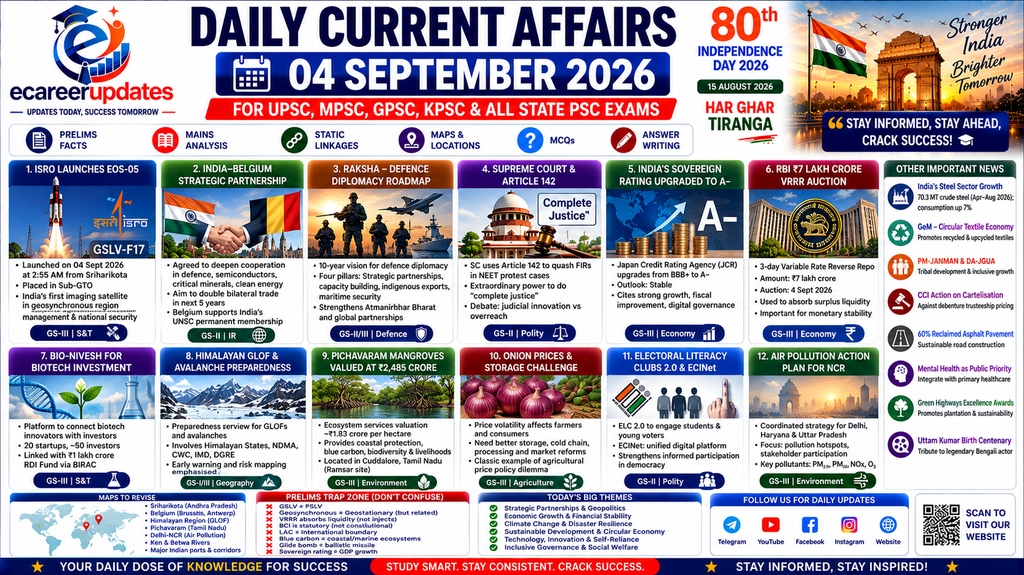
🔥 TODAY’S TOP 12 — HIGH PRIORITY
| Rank | Current Affair | GS | Priority |
|---|---|---|---|
| 🥇 1 | ISRO launches EOS-05 through GSLV-F17 | GS-III | ⭐⭐⭐⭐⭐ |
| 🥈 2 | India–Belgium strategic partnership | GS-II/III | ⭐⭐⭐⭐⭐ |
| 🥉 3 | RAKSHA – Defence Diplomacy Roadmap | GS-II/III | ⭐⭐⭐⭐⭐ |
| 4 | Himalayan GLOF & avalanche preparedness | GS-I/III | ⭐⭐⭐⭐⭐ |
| 5 | RBI ₹7 lakh crore VRRR auction | GS-III | ⭐⭐⭐⭐⭐ |
| 6 | BIO-NIVESH for biotechnology investment | GS-III | ⭐⭐⭐⭐⭐ |
| 7 | India’s steel sector growth | GS-III | ⭐⭐⭐⭐ |
| 8 | Air-pollution action plan for NCR | GS-III | ⭐⭐⭐⭐ |
| 9 | GeM–Textiles Committee circular textile economy | GS-III | ⭐⭐⭐⭐ |
| 10 | PM-JANMAN & DA-JGUA tribal development | GS-II | ⭐⭐⭐⭐ |
| 11 | Electoral Literacy Clubs 2.0 & ECINet | GS-II | ⭐⭐⭐⭐ |
| 12 | CCI action against trusteeship-sector cartelisation | GS-III | ⭐⭐⭐⭐ |
🛰️ 1. SCIENCE & TECHNOLOGY
ISRO successfully launches EOS-05 using GSLV-F17
Why in News?
ISRO successfully launched EOS-05 aboard GSLV-F17 from the Second Launch Pad at the Satish Dhawan Space Centre, Sriharikota, at 2:55 AM on 4 September 2026.
The satellite was placed into its intended Sub-Geosynchronous Transfer Orbit (Sub-GTO) approximately 18 minutes after lift-off. EOS-05 is India’s first imaging satellite designed to operate from the geosynchronous region.
🔑 Prelims Facts
| Feature | Fact |
|---|---|
| Satellite | EOS-05 |
| Launch vehicle | GSLV-F17 |
| GSLV flight | 19th |
| Launch site | Satish Dhawan Space Centre, Sriharikota |
| Launch time | 2:55 AM IST |
| Mass | ~2,367 kg |
| Initial orbit | Sub-Geosynchronous Transfer Orbit |
| Major application | Earth observation |
| Uses | Agriculture, disaster management, environmental monitoring, strategic imagery |
ISRO lists GSLV-F17/EOS-05 as the 19th GSLV mission.
🧠 Static Linkage — Geosynchronous Orbit
A geosynchronous orbit has an orbital period equal to Earth’s rotational period.
A geostationary orbit is a special case of geosynchronous orbit:
- Circular
- Equatorial
- Appears stationary relative to an observer on Earth
- Altitude ≈ 35,786 km
⚠️ UPSC Trap
Do not confuse:
GSLV → Geosynchronous missions
PSLV → Polar/SSO missions
LVM3 → Heavy-lift launch vehicle
Also, Sub-GTO is not the same as the satellite’s final operational geostationary orbit.
Mains Linkage
Space technology → Disaster management → Agriculture → National security → Digital governance → Strategic autonomy
Possible Mains Question:
“Earth-observation satellites are increasingly becoming critical infrastructure for disaster management and national security. Discuss with reference to India’s growing space capabilities.”

🌍 2. INTERNATIONAL RELATIONS
India–Belgium deepen strategic partnership
Why in News?
During Belgian Prime Minister Bart De Wever’s visit to India, India and Belgium agreed to deepen cooperation in:
- Defence
- Semiconductors
- Critical minerals
- Clean energy
- Pharmaceuticals
- Maritime cooperation
- Technology
- Investment
- Research and innovation
The two sides also expressed an ambition to double bilateral trade over the next five years.
Important Diplomatic Dimension
Belgium reaffirmed support for India’s candidature for permanent membership of a reformed UN Security Council.
India and Belgium also agreed to support each other’s candidatures for non-permanent UNSC membership for their respective terms.
🇮🇳 Why Belgium matters to India?
| Area | Strategic importance |
|---|---|
| Antwerp | Major global diamond-trading hub |
| Pharmaceuticals | Technology & market cooperation |
| Semiconductors | Critical technology ecosystem |
| Defence | Co-development/co-production |
| Critical minerals | Supply-chain resilience |
| Ports | Maritime connectivity |
| EU | Gateway to wider European partnership |
UPSC Linkage
India–Belgium → India–EU → FTA → critical minerals → resilient supply chains → strategic autonomy
The India–Belgium relationship should therefore not be studied as an isolated bilateral relationship.
Prelims Trap
Belgium is:
- A federal constitutional monarchy
- Member of the EU
- Member of NATO
- Home to major EU institutions in Brussels
- Closely associated with Antwerp’s diamond ecosystem
🛡️ 3. DEFENCE & SECURITY
RAKSHA — India’s 10-year Defence Diplomacy Roadmap
Why in News?
Defence Minister Rajnath Singh unveiled ‘RAKSHA’, a strategic document outlining India’s defence diplomacy roadmap and vision for the next 10 years.
Four major pillars
| Pillar | Meaning |
|---|---|
| Strategic Partnerships | Bilateral & multilateral security cooperation |
| Capacity Building | Training, exercises, knowledge sharing |
| Indigenous Exports | Make-in-India defence platforms |
| Maritime Security | Net Security Provider & First Responder role |
Why important?
India’s defence diplomacy is shifting from:
Buyer → Producer → Partner → Co-developer → Exporter
This is directly linked with:
- Atmanirbhar Bharat
- Defence exports
- Technology transfer
- Strategic autonomy
- Indian Ocean security
- Defence industrial corridors
Mains Angle
Strategic autonomy does not mean strategic isolation.
India can maintain autonomy while simultaneously expanding defence partnerships and technology collaborations.
🇮🇳 4. India–Belgium Defence Cooperation
India and Belgium are also moving towards defence co-development and co-production.
Potential cooperation areas include:
- Cybersecurity
- AI-enabled unmanned systems
- Underwater systems
- Complex weapon systems
- Military technology
- Defence R&D
India’s defence industrial ecosystem now involves DPSUs, private industry and 16,000+ MSMEs, according to the Defence Ministry release.
FDI in Defence — Static Revision
| Route | FDI limit |
|---|---|
| Automatic route | Up to 74% |
| Government route | Up to 100% |
Important Defence Industrial Corridors
- Tamil Nadu Defence Industrial Corridor
- Uttar Pradesh Defence Industrial Corridor
💰 5. ECONOMY
RBI announces ₹7 lakh crore VRRR auction
Why in News?
The RBI scheduled a 3-day Variable Rate Reverse Repo (VRRR) auction on 4 September 2026 under the Liquidity Adjustment Facility.
| Parameter | Details |
|---|---|
| Instrument | VRRR |
| Amount | ₹7 lakh crore |
| Tenor | 3 days |
| Auction | 4 Sept 2026 |
| Reversal | 7 Sept 2026 |
| Window | 9:30–10:00 AM |
What is VRRR?
VRRR is a monetary-policy liquidity-management operation through which the RBI absorbs surplus liquidity from banks.
Simple understanding
Banks have excess money → RBI takes money temporarily → liquidity falls → short-term money-market conditions are influenced.
Why is this important now?
Recent reports point to a substantial liquidity surplus in the banking system following large foreign-currency deposit/swapping flows, making liquidity absorption important for monetary management.
🔥 Prelims Concept Table
| Instrument | Basic purpose |
|---|---|
| Repo | RBI lends to banks |
| Reverse Repo | RBI absorbs liquidity |
| VRRR | Variable-rate liquidity absorption |
| CRR | Banks keep specified cash reserve with RBI |
| SLR | Banks maintain specified liquid assets |
| OMO | RBI buys/sells government securities |
UPSC Trap
Repo ≠ Reverse Repo
Repo → generally injects liquidity
Reverse Repo/VRRR → absorbs liquidity
🧬 6. SCIENCE & TECHNOLOGY
BIO-NIVESH — Biotechnology meets investment
Why in News?
The Department of Biotechnology/BIRAC launched BIO-NIVESH, a platform designed to connect biotechnology innovators with investors and accelerate:
Laboratory → Innovation → Startup → Investment → Commercialisation → Scale
The first edition brought together 20 biotechnology/deep-tech startups and around 50 investors.
What problem does it address?
Biotechnology often suffers from:
- Long R&D cycles
- High capital requirements
- Regulatory complexity
- Technology-commercialisation gap
- Difficulty in scaling laboratory discoveries
Important linkage
BIO-NIVESH + RDI Fund
The government has a ₹1 lakh crore Research, Development and Innovation Fund, under which BIRAC has been designated as a second-level fund manager for biotechnology and allied sectors.
UPSC Framework
R&D → IP → Venture Capital → Technology Transfer → Manufacturing → Employment → Bioeconomy
🏭 7. ECONOMY & INDUSTRY
India’s Steel Sector Shows Positive Growth
The Ministry of Steel reported continued positive growth during April–August 2026.
Key data
| Indicator | Apr–Aug 2026 |
|---|---|
| Crude steel production | 70.3 MT |
| Hot metal | 40.0 MT |
| Finished steel | 68.1 MT |
| Finished steel consumption | 70.3 MT |
| Finished steel imports | 3.49 MT |
| Finished steel exports | 2.99 MT |
Finished steel consumption grew about 7% year-on-year during April–August.
Interesting Prelims Point
Despite strong production and consumption, India remained a net importer of finished steel by quantity during the period.
Mains linkage
Steel is a classic example of the relationship between:
Infrastructure → Industrialisation → Employment → Trade → Energy → Critical minerals → Decarbonisation
🌱 8. ENVIRONMENT
Himalayan States prepare for GLOFs & avalanches
Why in News?
The Union Home Secretary reviewed preparedness of Himalayan States/UTs for:
- Glacial Lake Outburst Floods (GLOFs)
- Snow avalanches
- Early warning
- Evacuation
- Risk mapping
- Community preparedness
The meeting involved Uttarakhand, Himachal Pradesh, Sikkim, Arunachal Pradesh and Jammu & Kashmir, along with NDMA, CWC, IMD and DGRE.
💧 What is a GLOF?
A Glacial Lake Outburst Flood occurs when water stored in a glacial lake is suddenly released, often due to failure of the natural moraine/ice dam.
Trigger chain
Glacier retreat → glacial lake expansion → unstable moraine/ice dam → sudden breach → flash flood → downstream destruction
Why Himalayan GLOFs are becoming important?
- Climate-induced glacier retreat
- Expansion of glacial lakes
- Unstable terrain
- Hydropower infrastructure
- Settlements in valleys
- Changing precipitation patterns
Institutions to remember
| Institution | Role |
|---|---|
| NDMA | Disaster-management framework |
| CWC | Water resources & hydrological inputs |
| IMD | Weather forecasting |
| DGRE | Avalanche/geospatial expertise |
| State SDMAs | State-level disaster management |
The Centre has asked States/UTs to accelerate GLOF mitigation projects sanctioned in 2024.
Mains Linkage
Climate change + Himalayas + Disaster management + Hydropower + Urbanisation + Early warning systems
🌫️ 9. ENVIRONMENT
NCR strengthens coordinated air-pollution strategy
The Environment Ministry reviewed coordinated action plans of NCR States focusing on:
- Pollution hotspots
- Stakeholder participation
- Behavioural change
- Industrial compliance
- Grassroots communication
- Coordinated implementation
The review involved Delhi, Haryana and Uttar Pradesh authorities.
UPSC Static Linkage
Air pollution should be studied through:
Sources → Pollutants → Atmospheric conditions → Health → Institutions → Policy
Important pollutants
- PM₂.₅
- PM₁₀
- NOx
- SO₂
- CO
- Ozone
Important concept
Secondary pollutants are not emitted directly in the same form but are formed through atmospheric chemical reactions.
Example:
Ground-level ozone
♻️ 10. ENVIRONMENT + ECONOMY
GeM + Textiles Committee: Circular Textile Economy
A new MoU between Government e-Marketplace (GeM) and the Textiles Committee aims to promote procurement of recycled and upcycled textile products.
The initiative creates a:
Waste → Value → Market
ecosystem.
Key components
| Component | Role |
|---|---|
| Textiles Committee | Identification, verification & certification |
| GeM | Dedicated procurement categories |
| Recyclers | Waste processing |
| MSMEs | Production & entrepreneurship |
| Government buyers | Market creation |
Why UPSC should care?
This is a classic example of circular economy through public procurement.
Linear vs Circular Economy
Linear:
Extract → Produce → Use → Dispose
Circular:
Design → Use → Reuse → Repair → Recycle → Recover
Linkages
Circular economy + EPR + Sustainable consumption + Green jobs + MSMEs + Waste management
🏛️ 11. POLITY & GOVERNANCE
Electoral Literacy Clubs 2.0 & ECINet
The Election Commission organised a regional conference in Goa focusing on Electoral Literacy Clubs 2.0 (ELC 2.0) and ECINet.
ELC 2.0
Objective:
Make young citizens informed and meaningful participants in democracy.
It targets schools, colleges and universities and promotes understanding of:
- Electoral registration
- Voting
- Polling
- Counting
- Electoral processes
- Democratic values
ECINet
ECINet is envisioned as a unified digital platform providing election-related services and information.
Static Linkage
Election Commission of India
Constitutional basis:
Article 324
UPSC Trap
Do not confuse:
| Institution | Nature |
|---|---|
| ECI | Constitutional body |
| CAG | Constitutional body |
| UPSC | Constitutional body |
| Finance Commission | Constitutional body |
| CCI | Statutory body |
| NHRC | Statutory body |
⚖️ 12. ECONOMY + COMPETITION LAW
CCI acts against cartelisation in debenture trusteeship
The Competition Commission of India directed the Trustees’ Association of India and certain debenture trustees to cease anti-competitive conduct.
CCI found collective fixing of benchmark prices/fees for debenture trusteeship services and treated it as cartelisation under the Competition Act, 2002.
Static Linkage — Competition Act
Remember:
Section 3
Prohibits anti-competitive agreements.
Section 4
Deals with abuse of dominant position.
Section 27
Provides orders/measures that CCI may pass after finding contraventions.
Section 48
Deals with liability of persons in charge/responsible for contravening companies/entities.
Prelims Trap
Price fixing = anti-competitive conduct
It is not simply a normal association decision if it eliminates independent market-based pricing.
👥 13. SOCIAL JUSTICE
PM-JANMAN & DA-JGUA — Tribal Development
The Ministry of Tribal Affairs reviewed implementation of:
PM-JANMAN
Pradhan Mantri Janjati Adivasi Nyaya Maha Abhiyan
DA-JGUA
Dharti Aaba Janjatiya Gram Utkarsh Abhiyan
The review focused on:
- Convergence
- Fund utilisation
- Decentralised planning
- Implementation bottlenecks
- Tribal livelihoods
- Women’s entrepreneurship
- Local institutions
Important new element
The ITDA/ITDP roadmap and operational guidelines seek stronger institutional mechanisms and decentralised planning for tribal development.
The Adi Darpan was also released as a reference on tribal-development schemes and ground realities.
Article 275(1) — Static Linkage
Article 275(1) provides for grants-in-aid from the Consolidated Fund of India to States requiring assistance, including grants for promoting the welfare of Scheduled Tribes and raising the level of administration in Scheduled Areas.
🚂 14. INFRASTRUCTURE
Railway Safety Review
The Railway Ministry reviewed technical and maintenance deficiencies involving:
- Signalling
- Overhead equipment
- Track maintenance
- Point machines
- Turnouts
- Fasteners
- Coaches
- Wagon wheels
- Fire-safety wiring
- Couplers
Strict action was also emphasised against poor-quality supplies and deliberate negligence.
UPSC Linkage
Infrastructure safety = technology + regulation + maintenance + institutional accountability
This is useful for GS-III questions on transport infrastructure and public safety.
🛣️ 15. GREEN INFRASTRUCTURE
Green Highways Excellence Awards 2026
NHAI announced the Green Highways Excellence Awards 2026 to promote sustainable plantation and landscaping along National Highways.
Three categories include:
- Avenue plantation
- Median plantation
- Plantation in land parcels such as interchanges, toll plazas and service areas.
Why relevant?
Green highways can contribute to:
- Carbon sequestration
- Dust reduction
- Noise buffering
- Microclimate moderation
- Biodiversity corridors
- Landscape restoration
📚 16. HISTORY & CULTURE
Uttam Kumar Birth Centenary
The Prime Minister paid tribute to legendary Bengali actor Uttam Kumar on his birth centenary. PIB listed the tribute among its 4 September releases.
UPSC Static Linkage
Cinema can be studied through:
Regional culture → Language → Performing arts → Social change → Cultural identity
For Prelims, remember the significance of Bengali cinema and the cultural history of post-independence India.
📊 17. ECONOMIC DEVELOPMENT — QUICK DATA REVISION
Steel Sector
| Indicator | Apr–Aug 2026 |
|---|---|
| Crude steel | 70.3 MT |
| Finished steel | 68.1 MT |
| Finished steel consumption | 70.3 MT |
| Imports | 3.49 MT |
| Exports | 2.99 MT |
BIO-NIVESH
| Indicator | Value |
|---|---|
| Startups in first edition | 20 |
| Investors | ~50 |
| RDI Fund | ₹1 lakh crore |
🧠 STATIC + CURRENT AFFAIRS LINKAGE MASTER TABLE
| Current News | Static Topic to Revise |
|---|---|
| EOS-05 | Geosynchronous orbit, GSLV, Earth observation |
| RAKSHA | Defence diplomacy, strategic autonomy |
| India–Belgium | EU, NATO, UNSC reform |
| VRRR | Monetary policy, LAF, liquidity |
| BIO-NIVESH | Biotechnology, BIRAC, RDI Fund |
| GLOF | Glaciers, Himalayas, disaster management |
| NCR pollution | PM2.5, ozone, airshed management |
| Circular textiles | Circular economy, EPR |
| ELC 2.0 | Article 324, ECI |
| CCI cartel case | Competition Act |
| PM-JANMAN | Tribal policy, Article 275 |
| Railway safety | Transport infrastructure |
| Green Highways | Afforestation, carbon sequestration |
🗺️ MAP WORK — MUST REVISE
For today’s current affairs, locate these on an India/world map:
🇮🇳 India
- Sriharikota — Andhra Pradesh
- Delhi-NCR
- Uttar Pradesh
- Haryana
- Uttarakhand
- Himachal Pradesh
- Sikkim
- Arunachal Pradesh
- Jammu & Kashmir
- Tamil Nadu
- Goa
🌍 International
- Belgium
- Brussels
- Antwerp
- North Sea
- European Union
⭐ Prelims Map Question Possibility
Consider the following pairs:
- Sriharikota — Andhra Pradesh
- Antwerp — Belgium
- Brussels — Belgium
- GLOF-prone region — Himalayas
Questions may test location through pairing/matching, rather than directly asking “where is X?”
🚨 UPSC PRELIMS TRAP ZONE
❌ Trap 1
EOS-05 was launched by PSLV
➡️ Incorrect — GSLV-F17
❌ Trap 2
Sub-GTO = final geostationary orbit
➡️ Incorrect
❌ Trap 3
VRRR injects liquidity
➡️ Incorrect — it is used to absorb surplus liquidity.
❌ Trap 4
Geostationary orbit and geosynchronous orbit are identical
➡️ Incorrect — geostationary is a special type of geosynchronous orbit.
❌ Trap 5
CCI is a constitutional body
➡️ Incorrect — CCI is a statutory body.
❌ Trap 6
ECI is a statutory body
➡️ Incorrect — ECI is a constitutional body under Article 324.
❌ Trap 7
GLOF is simply a normal river flood
➡️ Incorrect — it involves sudden release of water from a glacial lake.
❌ Trap 8
Circular economy means only recycling
➡️ Incorrect — it encompasses reduction, reuse, repair, refurbishment, recycling and resource recovery.
📝 UPSC PRELIMS MCQs — DAILY PRACTICE
Q1. Consider the following statements about EOS-05:
- It was launched using GSLV-F17.
- It was placed initially into a Sub-Geosynchronous Transfer Orbit.
- It is an Earth-observation satellite.
- It was launched from Satish Dhawan Space Centre.
Which of the statements given above are correct?
A. 1 and 2 only
B. 1, 2 and 3 only
C. 1, 2, 3 and 4
D. 2 and 4 only
Q2. With reference to VRRR, consider the following:
- It is a liquidity-management operation of RBI.
- It can be used to absorb surplus liquidity.
- It necessarily involves a fixed interest rate.
Which is correct?
A. 1 and 2 only
B. 2 and 3 only
C. 1 and 3 only
D. 1, 2 and 3
Q3. Which of the following is the best description of a GLOF?
A. Sudden release of water from a glacial lake
B. Sudden melting of sea ice
C. Tsunami generated by submarine earthquakes
D. Seasonal monsoon flooding
Q4. Consider the following pairs:
| Institution | Nature |
|---|---|
| Election Commission of India | Constitutional |
| Competition Commission of India | Statutory |
| UPSC | Constitutional |
| NHRC | Statutory |
How many pairs are correctly matched?
A. Only one
B. Only two
C. Only three
D. All four
Q5. BIO-NIVESH is primarily associated with:
A. Biotechnology innovation and investment
B. Agricultural insurance
C. Defence procurement
D. Digital electoral literacy
Answers
| Question | Answer |
|---|---|
| Q1 | C |
| Q2 | A |
| Q3 | A |
| Q4 | D |
| Q5 | A |
✍️ UPSC MAINS QUESTIONS
GS-II — International Relations
“India’s emerging partnerships with European countries are increasingly extending beyond trade to defence, critical minerals, technology and resilient supply chains.” Discuss.
GS-II — Governance
How can electoral literacy improve the quality of democratic participation among young and first-time voters in India?
GS-III — Economy
Explain the role of liquidity management operations such as VRRR in maintaining monetary and financial stability.
GS-III — Science & Technology
How can geospatial and Earth-observation technologies transform disaster management and agricultural planning in India?
GS-III — Environment
Climate change is altering the risk profile of Himalayan disasters. Examine the significance of GLOF early-warning and community preparedness systems.
GS-III — Industry
India’s transition from a linear to a circular economy requires both technological innovation and market creation. Discuss with reference to textile waste.
🧩 MAINS ANSWER FRAMEWORK
Example: Himalayan GLOF
Introduction
Define GLOF and establish the Himalayan context.
Body
Causes
- Glacier retreat
- Glacial lake expansion
- Unstable moraine dams
- Extreme precipitation
- Seismic/landslide triggers
Impacts
- Loss of life
- Infrastructure damage
- Hydropower disruption
- Agricultural losses
- River-system alteration
Challenges
- Remote terrain
- Limited monitoring
- Last-mile communication
- Data gaps
- Rapid onset
Solutions
- Satellite monitoring
- Automated sensors
- Early-warning systems
- Hazard zonation
- Community preparedness
- Climate-resilient infrastructure
- Centre-State coordination
Conclusion
Move from post-disaster response to anticipatory, risk-informed disaster governance.
🔗 TODAY’S BIGGEST INTERLINKAGES
Today’s news is especially useful because several apparently separate stories connect into larger UPSC themes:
1️⃣ Space + Disaster Management
EOS-05 → Earth observation → real-time imagery → GLOF monitoring → agriculture → disaster response
2️⃣ Defence + Diplomacy
RAKSHA → Defence diplomacy → co-development → defence exports → strategic autonomy
3️⃣ Economy + Monetary Policy
Liquidity surplus → RBI absorption → VRRR → money-market conditions → inflation/financial stability
4️⃣ Climate + Geography
Glacier retreat → glacial lakes → GLOF → Himalayan vulnerability → disaster management
5️⃣ Environment + Economy
Textile waste → recycling → GeM procurement → MSMEs → circular economy → green jobs
6️⃣ Technology + Economy
Biotech R&D → BIO-NIVESH → private capital → commercialisation → bioeconomy
7️⃣ Democracy + Digital Governance
ELC 2.0 → electoral literacy → ECINet → informed participation → democratic deepening
🎯 WHAT TO REVISE TONIGHT
🔴 MUST DO
- GSLV vs PSLV vs LVM3
- Geosynchronous vs Geostationary orbit
- GLOF mechanism
- VRRR and LAF
- Article 324
- Competition Act Sections 3, 4, 27
- RAKSHA defence diplomacy
- India–Belgium + India–EU linkage
- BIO-NIVESH + BIRAC + RDI Fund
- Circular economy
🟡 SECOND PRIORITY
- Steel production data
- Green Highways
- PM-JANMAN
- DA-JGUA
- ITDA
- NCR air pollution
- Railway safety
🏆 FINAL UPSC TAKEAWAY
Today’s current affairs demonstrate exactly how UPSC can convert a headline into a conceptual question.
For example:
“ISRO launches EOS-05”
UPSC may not ask only “What is EOS-05?”
Instead, it can ask:
GSLV → cryogenic technology → geosynchronous orbit → Earth observation → disaster management → agriculture → strategic surveillance.
Similarly:
“Himalayan GLOF preparedness meeting”
can become:
Glaciers → climate change → glacial lakes → moraine dams → geomorphology → hydrology → disaster management → early warning → federal coordination.
And:
“RBI conducts VRRR”
can become:
Liquidity → LAF → monetary transmission → repo/reverse repo → CRR → inflation → banking-system liquidity.
🚀 The winning strategy for the 2026–27 UPSC cycle:
Don’t study Current Affairs as news.
Study Current Affairs as a trigger to revise the Static Syllabus.
That is the most important lesson from the recent UPSC Prelims trend: statement-based, conceptual and interdisciplinary questions reward understanding—not headline memorisation. Recent analyses of the 2026 paper similarly highlight deeper static-current integration, analytical framing and close statement-based options.
📌 One-Page Revision Formula
04 SEPTEMBER 2026
🛰️ EOS-05 → GSLV-F17 → Sub-GTO → Earth Observation
🇧🇪 Belgium → EU → Defence → Critical Minerals → Trade
🛡️ RAKSHA → Defence Diplomacy → Strategic Autonomy
💰 VRRR → ₹7 lakh crore → Liquidity Absorption
🧬 BIO-NIVESH → Biotech → Investment → Commercialisation
🏔️ GLOF → Himalayas → Glacier → Early Warning
🌫️ NCR Pollution → PM2.5 → Coordination
♻️ Textiles → GeM → Recycling → Circular Economy
🗳️ ELC 2.0 → ECI → Article 324 → Electoral Literacy
⚖️ CCI → Competition Act → Cartelisation
👥 PM-JANMAN/DA-JGUA → Tribal Development
🏭 Steel → Industrialisation → Infrastructure → Trade
Sources prioritised: PIB/official government releases, ISRO, RBI-linked material and corroborating current-affairs reporting.