
UPSC Prelims + Mains | MPSC | GPSC | KPSC/KAS | APSC | State PSCs
UPSC Strategy: The recent Prelims trend increasingly tests static concepts through current events—especially statement-based questions, conceptual distinctions, institutions, geography, scientific principles and policy linkages. Therefore, today’s edition follows the chain:
NEWS → WHY IMPORTANT → STATIC CONCEPT → PRELIMS TRAP → MAINS LINKAGE → REVISION
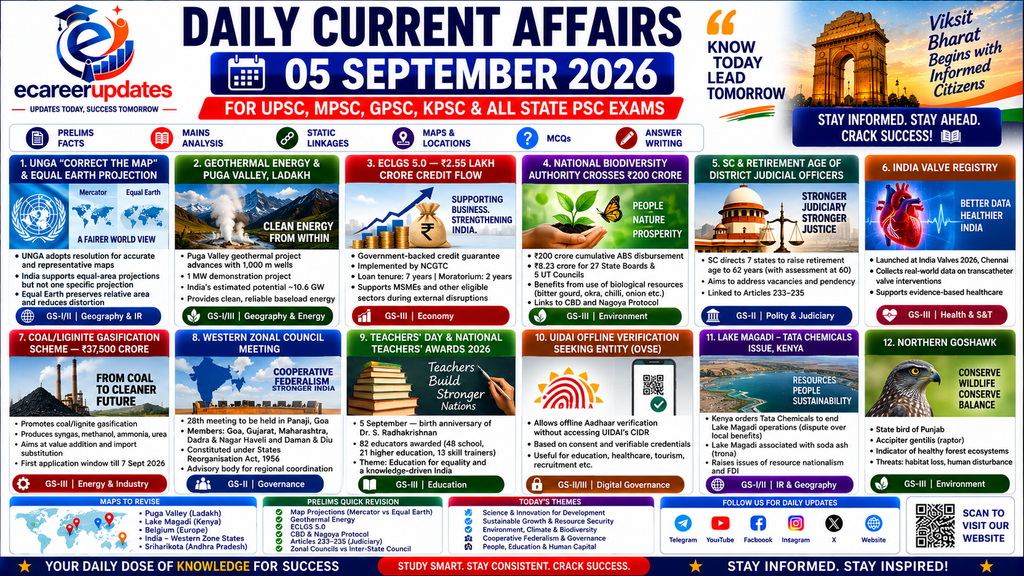
🔥 TODAY’S TOP PRIORITIES
| Rank | News | GS Paper | UPSC Priority |
|---|---|---|---|
| 🥇 1 | UNGA “Correct the Map” & Equal Earth Projection | GS-I/II | ⭐⭐⭐⭐⭐ |
| 🥈 2 | Geothermal Energy & Puga Valley, Ladakh | GS-I/III | ⭐⭐⭐⭐⭐ |
| 🥉 3 | ECLGS 5.0 — ₹2.55 lakh crore credit flow | GS-III | ⭐⭐⭐⭐⭐ |
| 4 | National Biodiversity Authority crosses ₹200 crore ABS disbursement | GS-III | ⭐⭐⭐⭐⭐ |
| 5 | SC & retirement age of district judicial officers | GS-II | ⭐⭐⭐⭐⭐ |
| 6 | India Valve Registry | GS-III | ⭐⭐⭐⭐ |
| 7 | Coal/Lignite Gasification Scheme — ₹37,500 crore | GS-III | ⭐⭐⭐⭐ |
| 8 | Western Zonal Council & Cooperative Federalism | GS-II | ⭐⭐⭐⭐ |
| 9 | Teachers’ Day & National Teachers’ Awards | GS-II/IV | ⭐⭐⭐⭐ |
| 10 | UIDAI Offline Verification Seeking Entity (OVSE) | GS-II/III | ⭐⭐⭐⭐ |
| 11 | Lake Magadi–Tata Chemicals issue, Kenya | GS-I/II | ⭐⭐⭐⭐ |
| 12 | Northern Goshawk | GS-III | ⭐⭐⭐ |
🌍 1. GEOGRAPHY + INTERNATIONAL ORGANISATIONS
UNGA “Correct the Map” Resolution & Equal Earth Projection
Why in News?
The UN General Assembly adopted a resolution encouraging more accurate and representative cartographic practices, popularly associated with the “Correct the Map” initiative.
India supported the objective but specifically clarified that it supports the broader use of equal-area projections rather than endorsing one particular projection such as Equal Earth.
This is an excellent UPSC Prelims topic because it combines map projections + geography + international diplomacy.
🗺️ What is the Equal Earth Projection?
Equal Earth is an equal-area pseudocylindrical map projection.
Its key objective:
Preserve the relative area of continents and countries more accurately.
Compare:
| Feature | Mercator | Equal Earth |
|---|---|---|
| Type | Cylindrical conformal | Equal-area pseudocylindrical |
| Main strength | Direction/shape for navigation | Relative area |
| Area distortion | High, especially at high latitudes | Much lower |
| Africa | Visually underestimated | More proportional |
| Greenland | Appears disproportionately large | More realistic |
| Main application | Navigation/history | Thematic/global representation |
⚠️ UPSC Trap
Equal-area ≠ equal-distance ≠ equal-shape.
No single map projection can preserve area, shape, distance and direction perfectly simultaneously.
🇮🇳 India’s position
India’s UN statement emphasised that equal-area projections can correct perceptions of landmass size but also argued for technological and methodological neutrality, rather than making one specific projection mandatory.
Mains Linkage
Cartography → Geography → colonial knowledge systems → Global South representation → international institutions
Possible Mains Question
“Maps are not merely geographical tools but also influence perceptions of global power and spatial relationships. Discuss.”
♨️ 2. GEOGRAPHY + ENERGY
Geothermal Energy — Puga Valley, Ladakh
Why in News?
India is advancing geothermal energy development, with the Puga Valley geothermal project in Ladakh emerging as an important demonstration project.
Two deep geothermal wells of about 1,000 metres have been developed at Puga, supporting plans for a 1 MW demonstration-scale geothermal power project. India has an estimated theoretical geothermal potential of around 10.6 GW, according to GSI-linked assessments.
🌋 What is geothermal energy?
Geothermal energy is heat derived from Earth’s interior.
Sources include:
- Primordial heat from Earth’s formation
- Radioactive decay of elements such as uranium, thorium and potassium
- Heat associated with geological activity
Basic process
Earth’s internal heat → underground hot water/steam → well → turbine → electricity
In some systems, fluids can be reinjected into the reservoir to maintain pressure and improve sustainability.
📍 Why Puga?
Puga Valley is located in Ladakh’s Changthang region and is part of India’s Himalayan geothermal resource zone.
Important geothermal regions of India
| Region | Example |
|---|---|
| Himalayan | Ladakh, Himachal Pradesh, Uttarakhand |
| Cambay Graben | Gujarat |
| SONATA zone | Central India |
| West Coast | Western India |
| Andaman & Nicobar | Volcanic/geothermal activity |
| Godavari Basin | Telangana–Andhra region |
Advantages
- Renewable
- Low-carbon
- Potentially reliable baseload source
- Small land footprint
- Useful for remote/high-altitude regions
Challenges
- High drilling cost
- Difficult terrain
- Exploration risk
- Reservoir management
- Water/geological concerns
- Technology limitations
UPSC Static Linkage
Geothermal ≠ Solar ≠ Wind
Solar and wind are variable renewable sources; geothermal can provide relatively continuous energy where suitable reservoirs exist.
Mains Linkage
Energy security + decarbonisation + remote-area development + renewable diversification
💰 3. ECONOMY
Emergency Credit Line Guarantee Scheme — ECLGS 5.0
Why in News?
The Government highlighted the progress and design of ECLGS 5.0, introduced to provide government-backed credit support to businesses facing external economic disruptions.
The scheme is implemented by the National Credit Guarantee Trustee Company (NCGTC) and aims to facilitate additional credit flow of up to ₹2.55 lakh crore.
🔑 Key Features
| Feature | ECLGS 5.0 |
|---|---|
| Implementing agency | NCGTC |
| Objective | Credit support during external disruptions |
| Target credit flow | Up to ₹2.55 lakh crore |
| Beneficiaries | MSMEs + eligible non-MSMEs + scheduled passenger airlines |
| Loan tenure | 7 years |
| Moratorium | 2 years |
| Portal | Jan Samarth |
| Operational period | Up to 31 March 2027 or specified guarantee ceiling |
As of 20 August 2026, 6,73,979 guarantees worth ₹2,50,024 crore had been issued; MSMEs accounted for 97.3% of guarantees by number.
🧠 What is a Credit Guarantee?
The government does not necessarily lend directly to the enterprise.
Instead:
Government guarantee → reduces lender’s credit risk → bank/NBFC can extend additional credit → business gets liquidity
Why important?
External shocks can cause:
- Supply-chain disruptions
- Higher logistics costs
- Export difficulties
- Liquidity stress
- Employment losses
Therefore, credit guarantees can act as a counter-cyclical support mechanism.
UPSC Linkage
MSMEs → employment → credit → supply chains → financial stability → economic resilience
🌿 4. ENVIRONMENT
National Biodiversity Authority crosses ₹200 crore in ABS disbursement
Why in News?
The National Biodiversity Authority (NBA) has crossed ₹200 crore in cumulative Access and Benefit-Sharing (ABS) disbursements.
A fresh ₹8.23 crore was sanctioned for 27 State Biodiversity Boards and 5 Union Territory Biodiversity Councils. The amount arose from utilisation of biological resources including:
- Bitter gourd
- Okra
- Chilli
- Onion
🧬 What is Access and Benefit Sharing?
ABS is based on the principle that:
Those who utilise biological/genetic resources and associated traditional knowledge for research or commercial purposes should contribute towards fair and equitable sharing of resulting benefits.
International linkage
Convention on Biological Diversity (CBD)
↓
Nagoya Protocol
↓
Access & Benefit Sharing
India’s framework is also relevant to the Kunming-Montreal Global Biodiversity Framework, particularly benefit-sharing objectives.
🧠 UPSC Static Table
| Term | Meaning |
|---|---|
| CBD | Convention on Biological Diversity |
| Nagoya Protocol | Access & Benefit Sharing |
| NBA | National Biodiversity Authority |
| SBB | State Biodiversity Board |
| BMC | Biodiversity Management Committee |
| PBR | People’s Biodiversity Register |
| ABS | Access and Benefit Sharing |
Why important?
This is not merely an environmental issue.
It connects:
Biodiversity → local communities → traditional knowledge → commercial research → intellectual property → benefit sharing → conservation
Mains Question
“Access and Benefit Sharing can transform biodiversity conservation from a regulatory obligation into a community-centred economic incentive. Discuss.”
⚖️ 5. POLITY + JUDICIARY
Supreme Court & Retirement Age of District Judiciary
Why in News?
The Supreme Court directed seven states that had agreed to enhancement of the retirement age of judicial officers to amend their service rules and raise the superannuation age to 62 years, subject to suitability/performance assessment at age 60.
The seven states include:
- Chhattisgarh
- Karnataka
- Madhya Pradesh
- Maharashtra
- Sikkim
- Tamil Nadu
- West Bengal
The Court also directed other States/UTs to reconsider the issue.
🏛️ Constitutional Linkage
This issue directly connects with:
Article 233
Appointment of district judges.
Article 234
Recruitment of persons other than district judges to judicial service.
Article 235
Control over subordinate courts vested in the High Court.
The Supreme Court’s reasoning also highlighted the need to retain experienced judicial officers amid persistent vacancies in the district judiciary.
Why important?
India faces:
Vacancies + huge pendency + recruitment difficulties → pressure on justice delivery
Increasing retirement age could:
- Retain experienced judges
- Reduce sudden loss of institutional knowledge
- Improve judicial capacity
- Potentially reduce recruitment gaps
But there are counterarguments:
- Slower entry of young officers
- Career progression concerns
- Need for performance assessment
- State-level service-rule differences
Mains Angle
Judicial reform should balance experience, efficiency, accountability and opportunities for younger entrants.
🏛️ 6. POLITY
Western Zonal Council & Cooperative Federalism
Why in News?
The 28th meeting of the Western Zonal Council is scheduled in Panaji, Goa.
The Western Zonal Council includes:
- Goa
- Gujarat
- Maharashtra
- Dadra and Nagar Haveli and Daman and Diu
It operates under Sections 15–22 of the States Reorganisation Act, 1956.
Zonal Councils — Static Revision
India has five Zonal Councils:
| Zonal Council | Broad region |
|---|---|
| Northern | Northern States/UTs |
| Central | Central India |
| Eastern | Eastern India |
| Western | Western India |
| Southern | Southern India |
Important
Zonal Councils are:
- Statutory
- Advisory
- Created under the States Reorganisation Act, 1956
- Not constitutional bodies
The Union Home Minister is the Chairman of each Zonal Council, while the Chief Minister of a member State serves as Vice-Chairman on a rotational basis.
⚠️ Prelims Trap
Zonal Councils ≠ Inter-State Council
| Zonal Council | Inter-State Council |
|---|---|
| States Reorganisation Act, 1956 | Constitution Article 263 |
| Statutory | Constitutional provision |
| Regional | Nationwide |
| Advisory | Advisory/coordinating |
Mains Linkage
Cooperative federalism + inter-State disputes + regional development + Centre-State coordination
🧑🏫 7. SOCIAL SECTOR + EDUCATION
Teachers’ Day & National Teachers’ Awards 2026
Why in News?
5 September is celebrated as Teachers’ Day in India on the birth anniversary of Dr. Sarvepalli Radhakrishnan, philosopher, educationist and India’s second President.
President Droupadi Murmu conferred National Awards on teachers on 5 September 2026.
2026 Award Structure
The 2026 recognition covers:
- 48 school teachers
- 21 teachers/faculty from higher education institutions and polytechnics
- 13 skill trainers
Thus, 82 educators were recognised across the broader National Teachers’ Awards programme.
Why UPSC relevance?
Connect Teachers’ Day with:
- National Education Policy 2020
- Foundational learning
- Skill development
- Human capital
- Constitutional equality of opportunity
- Education as a tool of social mobility
The President emphasised education’s role in achieving equality of opportunity and building a knowledge- and skill-oriented India.
🆔 8. GOVERNANCE + DIGITAL INDIA
UIDAI’s Offline Verification Seeking Entity — OVSE
What is OVSE?
The Offline Verification Seeking Entity (OVSE) framework allows eligible organisations to conduct Aadhaar-based offline identity verification without connecting to UIDAI’s Central Identities Data Repository (CIDR).
It is based on consent-based verification using verifiable credentials.
Applications
- Education
- Healthcare
- Tourism
- Recruitment
- Gig economy
- Government services
- FinTech
- Real estate
Why important?
It attempts to balance:
Digital identity → convenience → privacy → consent → data minimisation
The Punjab School Education Board became the first education board to onboard the framework, while Maharishi Dayanand University became the first university to do so.
Mains Linkage
India’s digital public infrastructure must combine inclusion with privacy-by-design and user consent.
🏭 9. ECONOMY + ENERGY SECURITY
Coal & Lignite Gasification Scheme — ₹37,500 crore
Why in News?
The Ministry of Coal clarified that reports describing the ₹37,500 crore Scheme for Promotion of Surface Coal/Lignite Gasification Projects as having no takers were premature.
The first application window remains open until 7 September 2026.
Objective
Convert domestic coal/lignite into higher-value products such as:
- Syngas
- Methanol
- Ammonia
- Urea
What is Coal Gasification?
Instead of directly burning coal:
Coal → Gasification → Syngas → Chemical/fuel/feedstock products
Why India is interested?
India has substantial domestic coal reserves but also imports several energy and industrial feedstocks.
Gasification can potentially:
- Increase value addition
- Reduce dependence on imported feedstock
- Support chemical/fertiliser production
- Create industrial jobs
- Strengthen energy security
But remember
Coal gasification is not the same as zero-carbon energy.
It remains a fossil-fuel-based pathway and raises questions about:
- Carbon emissions
- Water use
- Pollution
- Carbon capture requirements
Mains Linkage
Energy security vs energy transition
❤️ 10. SCIENCE & TECHNOLOGY + HEALTH
India Valve Registry
Why in News?
The India Valve Registry was launched at India Valves 2026 in Chennai.
It is a collaborative, multicentre initiative designed to collect secure, de-identified real-world data on transcatheter valve interventions across India.
Why is this significant?
Medical evidence generated in one population may not always perfectly represent another population.
Therefore:
Indian patients → Indian clinical data → Indian evidence → better medical decisions
Concept: Medical Registry
A medical registry systematically records:
- Patient characteristics
- Procedures
- Treatments
- Outcomes
- Long-term follow-up
UPSC Linkage
Digital health + medical research + evidence-based medicine + health equity + data governance
🌍 11. INTERNATIONAL RELATIONS + GEOGRAPHY
Lake Magadi — Kenya & Tata Chemicals
Why in News?
Kenya’s President William Ruto ordered Tata Chemicals to end operations associated with Lake Magadi, amid a dispute over local economic benefits and resource utilisation.
Lake Magadi is associated with soda ash production, based on naturally occurring mineral resources such as trona.
Why UPSC relevant?
This is a classic example of:
Natural resources → foreign investment → local communities → resource nationalism → value addition → economic diplomacy
Map Work
Locate:
- Kenya
- Lake Magadi
- Nairobi
- Great Rift Valley
- Tanzania
- Indian Ocean
Mains Linkage
How should developing countries balance foreign investment with local value addition and resource sovereignty?
🦅 12. ENVIRONMENT
Northern Goshawk
The Northern Goshawk, known as Baaj, is the state bird of Punjab and has recently attracted attention in the state.
Prelims Facts
| Feature | Detail |
|---|---|
| Species | Northern Goshawk |
| Scientific name | Accipiter gentilis |
| Group | Raptor |
| Punjab connection | State bird |
| Habitat | Forested regions |
| Ecological role | Predator |
UPSC Approach
Do not memorise only the species.
Study:
Species → habitat → distribution → IUCN status → threats → conservation → state association
🧬 13. SCIENCE & TECHNOLOGY
Nature-Inspired Biomaterials & Molecular Switch
Research has explored a molecular strategy using peptides to develop highly efficient piezoelectric biomaterials.
The research is relevant to the development of self-powered healthcare technologies.
Static Concept — Piezoelectricity
Piezoelectric materials generate an electrical charge when mechanical stress is applied.
Simple chain:
Mechanical pressure/vibration → charge generation → electrical signal
Applications
- Sensors
- Medical devices
- Wearables
- Energy harvesting
- Biomedical technologies
UPSC Trap
Piezoelectricity is not the same as photovoltaic conversion.
| Technology | Input |
|---|---|
| Piezoelectric | Mechanical stress |
| Photovoltaic | Light |
| Thermoelectric | Temperature difference |
📊 14. QUICK ECONOMIC REVISION
ECLGS vs Credit Guarantee vs Direct Subsidy
| Feature | ECLGS |
|---|---|
| Government role | Credit guarantee |
| Actual lender | Banks/eligible financial institutions |
| Primary purpose | Facilitate credit |
| Direct government loan? | ❌ No |
| Target | Businesses |
| Key agency | NCGTC |
| Current version | ECLGS 5.0 |
🧠 STATIC + CURRENT AFFAIRS MASTER LINKAGE
| Current Affair | Static Topic to Revise |
|---|---|
| Equal Earth | Map projections |
| UN “Correct the Map” | UNGA + cartography |
| Puga geothermal | Internal Earth + renewable energy |
| ECLGS 5.0 | Credit guarantee + MSMEs |
| NBA ABS | CBD + Nagoya Protocol |
| Judicial retirement | Articles 233–235 |
| Western Zonal Council | States Reorganisation Act |
| Teachers’ Day | Radhakrishnan + education |
| OVSE | Aadhaar + privacy |
| Coal gasification | Energy security + syngas |
| India Valve Registry | Digital health + medical research |
| Lake Magadi | Resource nationalism |
| Northern Goshawk | Species conservation |
| Piezoelectric biomaterials | Material science |
🗺️ MAP WORK — 05 SEPTEMBER
🇮🇳 India
Mark:
- Puga Valley — Ladakh
- Leh
- Himalayan geothermal belt
- Maharashtra
- Gujarat
- Goa
- Delhi
- Punjab
- Tamil Nadu
🌍 World
Mark:
- Kenya
- Lake Magadi
- Nairobi
- Great Rift Valley
- Indian Ocean
- Belgium
- Africa
🌐 Cartography
Also revise:
Africa → Greenland → Mercator → Equal Earth
🚨 UPSC PRELIMS TRAP ZONE
❌ 1. Equal Earth is an equal-distance projection
Wrong. It is an equal-area projection.
❌ 2. India endorsed only the Equal Earth projection
Wrong. India’s UN position supports the broader principle of equal-area representation without endorsing one particular projection.
❌ 3. Zonal Councils are constitutional bodies
Wrong. They are statutory bodies under the States Reorganisation Act, 1956.
❌ 4. Inter-State Council and Zonal Councils have the same constitutional basis
Wrong.
- Inter-State Council → Article 263
- Zonal Councils → States Reorganisation Act, 1956
❌ 5. ECLGS means government directly lends money
Wrong. It provides credit guarantees to facilitate lending.
❌ 6. Geothermal energy comes only from volcanic regions
Wrong. Geothermal resources occur in several geological settings.
❌ 7. Coal gasification means coal is directly burned
Wrong. Gasification converts coal into syngas under controlled conditions.
❌ 8. ABS is only about wildlife protection
Wrong. It concerns biological resources/genetic resources and associated benefit sharing.
❌ 9. Zonal Councils are permanent dispute-settlement courts
Wrong. They are advisory coordination mechanisms.
📝 UPSC PRELIMS MCQs
Q1. With reference to map projections, consider the following statements:
- Equal Earth is an equal-area projection.
- Mercator projection tends to exaggerate the apparent size of high-latitude regions.
- No single map projection can simultaneously preserve area, shape, distance and direction perfectly.
Which of the statements given above are correct?
A. 1 only
B. 1 and 2 only
C. 2 and 3 only
D. 1, 2 and 3
Q2. Consider the following statements regarding ECLGS 5.0:
- It is implemented by NCGTC.
- It facilitates government-backed credit guarantees.
- It is meant exclusively for micro enterprises.
- It seeks to strengthen business resilience during external disruptions.
Which are correct?
A. 1, 2 and 4 only
B. 1 and 3 only
C. 2 and 3 only
D. 1, 2, 3 and 4
Q3. Access and Benefit Sharing is associated with:
- Convention on Biological Diversity
- Nagoya Protocol
- Kunming-Montreal Global Biodiversity Framework
Select the correct answer:
A. 1 only
B. 1 and 2 only
C. 2 and 3 only
D. 1, 2 and 3
Q4. Consider the following:
| Institution | Legal basis |
|---|---|
| Inter-State Council | Article 263 |
| Zonal Councils | States Reorganisation Act, 1956 |
| Election Commission | Article 324 |
| Competition Commission | Competition Act |
How many pairs are correctly matched?
A. Only one
B. Only two
C. Only three
D. All four
Q5. Coal gasification primarily produces:
A. Oxygen directly from coal
B. Syngas from coal/lignite
C. Hydrogen exclusively without other products
D. Electricity without any intermediate process
Q6. With reference to geothermal energy, consider the following statements:
- It is derived from Earth’s internal heat.
- It can potentially provide relatively continuous power.
- It is geographically distributed uniformly across all regions.
Which is correct?
A. 1 only
B. 1 and 2 only
C. 2 and 3 only
D. 1, 2 and 3
✅ Answer Key
| Q | Answer |
|---|---|
| 1 | D |
| 2 | A |
| 3 | D |
| 4 | D |
| 5 | B |
| 6 | B |
✍️ UPSC MAINS QUESTIONS
GS-I — Geography
“Map projections influence not only cartographic accuracy but also the perception of geographical space.” Discuss with reference to equal-area projections.
GS-II — Polity
Zonal Councils can serve as an important instrument of cooperative federalism despite their advisory character. Examine.
GS-II — Judiciary
Judicial capacity depends not merely on increasing sanctioned posts but also on retaining experienced personnel and improving institutional efficiency. Discuss.
GS-II — Education
Human capital formation is central to India’s transition towards a knowledge economy. Examine the role of teachers and education quality in this transition.
GS-III — Economy
Credit guarantees can improve resilience of MSMEs during external shocks, but they can also create contingent fiscal risks. Discuss.
GS-III — Environment
Explain how Access and Benefit Sharing can strengthen both biodiversity conservation and livelihood security.
GS-III — Energy
Can coal gasification contribute to India’s energy security without undermining its climate commitments? Critically examine.
GS-III — Science & Technology
India-specific medical data can strengthen evidence-based healthcare. Discuss the opportunities and challenges associated with national health registries.
✍️ MAINS ANSWER FRAMEWORK
“Discuss the significance of Access and Benefit Sharing.”
Introduction
Define ABS and link it with CBD/Nagoya Protocol.
Body
Importance
- Fairness to resource providers
- Recognition of community knowledge
- Conservation incentives
- Sustainable commercial utilisation
- Biodiversity-based livelihoods
Challenges
- Identification of benefit providers
- Valuation of biological resources
- Enforcement
- Institutional capacity
- IPR-related complexities
Way Forward
- Strengthen Biodiversity Management Committees
- Improve People’s Biodiversity Registers
- Transparent benefit-sharing mechanisms
- Greater community participation
- Digital tracking of biological-resource utilisation
Conclusion
Biodiversity conservation becomes more durable when communities are not merely treated as custodians but also recognised as legitimate beneficiaries.
🔗 TODAY’S BIGGEST INTERLINKAGES
1️⃣ Geography + Politics
Equal Earth → map projections → spatial perception → Global South → UNGA
2️⃣ Geography + Energy
Himalayan geology → geothermal resources → Puga → clean energy → Ladakh development
3️⃣ Economy + External Shocks
Geopolitical disruption → supply-chain stress → liquidity problems → ECLGS → employment protection
4️⃣ Environment + Economy
Biological resources → commercial utilisation → ABS → community benefits → conservation
5️⃣ Polity + Justice
Judicial vacancies → experienced officers → retirement age → institutional capacity → access to justice
6️⃣ Digital Governance + Rights
Aadhaar → offline verification → consent → privacy → service delivery
7️⃣ Energy Security + Climate
Coal reserves → gasification → syngas/value addition → import substitution → emissions challenge
🎯 15-MINUTE REVISION PLAN
🔴 MUST REVISE
- Equal Earth vs Mercator
- ECLGS 5.0
- ABS + Nagoya Protocol
- Articles 233–235
- Zonal Councils vs Inter-State Council
- Puga geothermal energy
- Coal gasification
- OVSE
- India Valve Registry
🟡 SECOND PRIORITY
- Teachers’ Day
- National Teachers’ Awards
- Lake Magadi
- Northern Goshawk
- Piezoelectric materials
🧠 UPSC 2026–27 CURRENT AFFAIRS FORMULA
Today’s news demonstrates the exact approach aspirants should follow for the new-style Prelims:
Don’t study:
“UN adopted Correct the Map resolution.”
Study:
UNGA → map projection → Mercator → equal-area → Equal Earth → cartographic distortion → Africa → Global South diplomacy
Don’t study:
“Puga geothermal project.”
Study:
Earth’s internal heat → geothermal gradient → hot springs → geothermal reservoir → drilling → baseload renewable → Ladakh → energy security
Don’t study:
“NBA crossed ₹200 crore ABS.”
Study:
Biodiversity → genetic resources → CBD → Nagoya Protocol → ABS → local communities → traditional knowledge → conservation
Don’t study:
“SC raised judicial retirement age.”
Study:
Articles 233–235 → subordinate judiciary → High Court control → vacancies → pendency → judicial capacity → access to justice
🏆 FINAL TAKEAWAY
The 05 September 2026 current-affairs set is especially valuable for UPSC because it contains several high-quality static-current linkages:
🌍 Equal Earth → Map Projections
♨️ Puga → Geothermal Energy
💰 ECLGS 5.0 → Credit & MSMEs
🌿 ABS → Biodiversity + Nagoya Protocol
⚖️ Judicial Retirement → Articles 233–235
🏛️ Zonal Council → Cooperative Federalism
🧑🏫 Teachers’ Day → Human Capital
🆔 OVSE → Aadhaar + Privacy
🏭 Coal Gasification → Energy Security
❤️ Valve Registry → Evidence-based Healthcare
🌍 Lake Magadi → Resource Nationalism
🦅 Northern Goshawk → Species Conservation
🚀 The golden rule for Prelims:
Current Affairs are not a separate subject. Current Affairs are the trigger through which UPSC tests the Static Syllabus.
That is why every important news item should be converted into:
NEWS → CONCEPT → STATIC → LOCATION → INSTITUTION → PRELIMS TRAP → MAINS DIMENSION → INTERLINKAGE
Recent UPSC-oriented analyses similarly emphasise the growing importance of conceptual, interdisciplinary and static-current integration rather than simple headline recall.