National Education Policy (NEP) 2020

Introduction

Education is the foundation of a nation’s development. To transform India’s education system and make it more holistic, flexible, multidisciplinary, skill-oriented, and globally competitive, the Government of India introduced the National Education Policy (NEP) 2020.

Approved on 29 July 2020, NEP 2020 replaced the previous National Policy on Education (NPE) 1986, which had been modified in 1992.

The policy aims to prepare students for the 21st-century economy, promote critical thinking, encourage innovation, and improve access, equity, quality, affordability, and accountability in education.

For UPSC, MPSC, UGC-NET, CTET, TET, SSC, Banking, and other competitive examinations, NEP 2020 is one of the most important topics in Education, Governance, Social Development, and Public Policy.

National Education Policy (NEP) 2020 at a Glance

ParticularDetails
Policy NameNational Education Policy (NEP) 2020
Approved On29 July 2020
Approved ByUnion Cabinet
MinistryMinistry of Education
ReplacedNational Policy on Education (1986)
CoverageSchool Education & Higher Education
ObjectiveTransform India’s education system
Applicable AcrossIndia
Official Websiteeducation.gov.in

What is NEP 2020?

National Education Policy 2020 is a comprehensive education reform policy that introduces major changes in:

  • School Education
  • Higher Education
  • Vocational Education
  • Teacher Training
  • Technology Integration
  • Skill Development
  • Research and Innovation

Unlike traditional government schemes, NEP is a policy framework rather than a direct benefit scheme.

Official Website- https://www.education.gov.in


Vision of NEP 2020

Vision AreaObjective
Holistic EducationOverall development
Multidisciplinary LearningFlexible education
Skill DevelopmentJob readiness
Quality EducationBetter outcomes
Universal AccessEducation for all
Global CompetitivenessInternational standards

Core Principles of NEP 2020

PrincipleDescription
FlexibilityChoice-based learning
Multidisciplinary EducationDiverse subjects
Critical ThinkingAnalytical skills
Conceptual LearningUnderstanding over memorization
InclusivityEqual opportunities
Technology IntegrationDigital education

Key Objectives of NEP

ObjectiveDescription
Universal EducationAccess for all children
Reduce DropoutsImprove retention
Improve Learning OutcomesBetter education quality
Promote ResearchInnovation ecosystem
Skill DevelopmentEmployment readiness
Digital LearningTechnology-enabled education

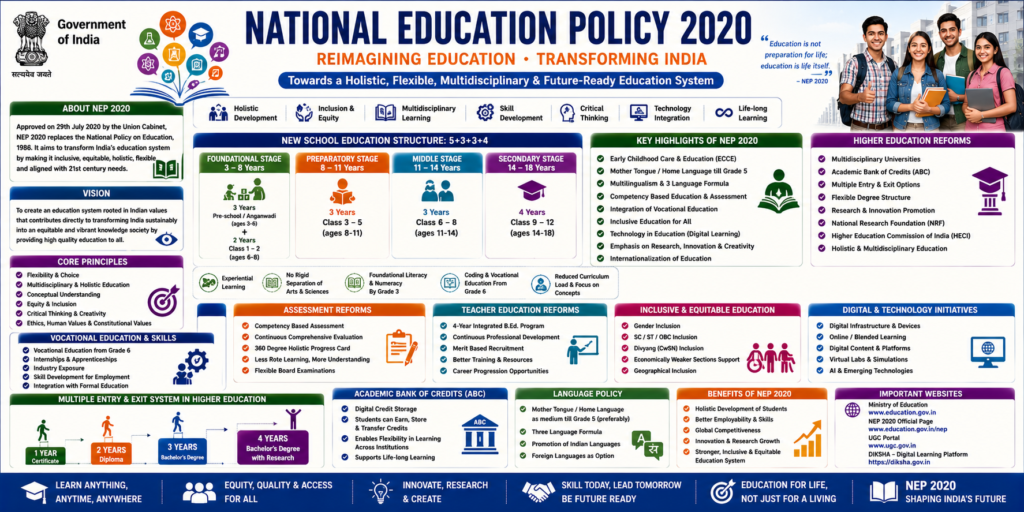
Major Structural Reform: 5+3+3+4 System

The old 10+2 structure has been replaced.

New Educational Structure

StageAge GroupClasses
Foundational Stage3–8 YearsPre-school to Class 2
Preparatory Stage8–11 YearsClass 3–5
Middle Stage11–14 YearsClass 6–8
Secondary Stage14–18 YearsClass 9–12

You Can Also Read About Swachha Bharat Mission At- https://ecareerupdates.com/swachh-bharat-mission-sbm/


Old vs New Education Structure

ParameterOld SystemNEP 2020
Structure10+25+3+3+4
Pre-School CoverageLimitedIncluded
Skill EducationLimitedStrong Focus
Subject FlexibilityLowHigh
Multidisciplinary LearningLimitedExtensive

School Education Reforms

Key Changes

ReformDetails
Early Childhood EducationIncluded
Foundational Literacy & NumeracyPriority
Experiential LearningPromoted
Competency-Based AssessmentIntroduced
Reduced Curriculum LoadFocus on concepts
Coding from Class 6Introduced

Vocational Education Reforms

FeatureDetails
Skill Education from Class 6Yes
InternshipsEncouraged
Industry ExposurePromoted
Practical LearningEnhanced

Language Policy Under NEP

Three Language Formula

ProvisionDetails
Mother Tongue EducationPreferred till Grade 5
Regional LanguagesEncouraged
Multilingual LearningPromoted
Foreign LanguagesOptional

Assessment Reforms

New Examination Approach

FeatureBenefit
Competency-Based AssessmentBetter understanding
Reduced Rote LearningConceptual clarity
Continuous EvaluationHolistic assessment
Flexible Board ExamsReduced stress

Higher Education Reforms

Major Changes

ReformDetails
Multidisciplinary UniversitiesEncouraged
Academic Bank of CreditsIntroduced
Multiple Entry-Exit SystemAvailable
Flexible Degree StructureImplemented
Research PromotionIncreased

Multiple Entry and Exit System

DurationQualification
1 YearCertificate
2 YearsDiploma
3 YearsBachelor’s Degree
4 YearsBachelor’s Degree with Research

Academic Bank of Credits (ABC)

FeatureBenefit
Credit StorageDigital Record
Flexible LearningEasy Transfers
Multiple InstitutionsSupported
Lifelong LearningEncouraged

Higher Education Commission of India (HECI)

NEP proposes a new regulatory structure.

FunctionPurpose
RegulationGovernance
AccreditationQuality Assurance
FundingInstitutional Support
Standards SettingEducational Excellence

National Research Foundation (NRF)

ObjectiveBenefit
Promote ResearchInnovation
Support InstitutionsBetter research ecosystem
Funding SupportResearch grants

Teacher Education Reforms

ReformDetails
4-Year Integrated B.Ed.Standard Qualification
Continuous Professional DevelopmentMandatory
Merit-Based RecruitmentEncouraged

Digital Education Initiatives

InitiativePurpose
Online LearningAccessibility
Digital ContentQuality resources
Virtual LabsPractical learning
Educational TechnologyModern education

Inclusive Education Measures

CategoryFocus
GirlsEqual opportunities
SC/ST StudentsSupport
OBC StudentsInclusion
Divyang StudentsAccessibility
Economically Weaker StudentsAssistance

Major Benefits of NEP

Student Benefits

BenefitImpact
Flexible Subject ChoicesPersonalized learning
Skill DevelopmentBetter employability
Reduced Academic PressureBetter well-being
Practical LearningImproved outcomes

Teacher Benefits

BenefitImpact
Better TrainingEnhanced teaching quality
Professional DevelopmentCareer growth
Modern Teaching MethodsBetter engagement

National Benefits

BenefitImpact
Skilled WorkforceEconomic growth
Innovation EcosystemResearch advancement
Global CompetitivenessInternational recognition

Who is Eligible?

Since NEP is a policy and not a direct financial scheme:

BeneficiaryEligible
StudentsYes
TeachersYes
Educational InstitutionsYes
UniversitiesYes
SchoolsYes
ResearchersYes

Is Registration Required?

ParticularStatus
Individual RegistrationNot Required
Application FormNot Required
Registration FeeNil
Direct Benefit SchemeNo

NEP vs National Policy on Education 1986

ParameterNPE 1986NEP 2020
Structure10+2
Early Childhood EducationLimited
Skill DevelopmentLimited
Technology IntegrationMinimal
Multidisciplinary LearningLimited
FlexibilityLow

NEP and Sustainable Development Goals

SDGRelevance
SDG 4Quality Education
SDG 5Gender Equality
SDG 8Decent Work
SDG 10Reduced Inequalities

Official Websites

PortalPurpose
Ministry of Education IndiaOfficial Information
National Education Policy PortalNEP Details
UGC Official WebsiteHigher Education Updates

Importance for UPSC/MPSC Aspirants

TopicImportance
NEP 2020 Launch YearFrequently Asked
5+3+3+4 StructureVery Important
Academic Bank of CreditsImportant
National Research FoundationFrequently Asked
Multiple Entry-Exit SystemImportant
Skill EducationMains Topic
Education ReformsGovernance Topic

Frequently Asked Questions (FAQs)

QuestionAnswer
When was NEP launched?29 July 2020
Which policy did it replace?NPE 1986
What is the new school structure?5+3+3+4
Is NEP a scheme?No, it is a policy
Is registration required?No
What is ABC?Academic Bank of Credits

Quick Revision Table for Aspirants

ParticularDetails
Policy NameNational Education Policy 2020
Approval Date29 July 2020
MinistryMinistry of Education
Structure5+3+3+4
FocusHolistic Education
Major ReformMultiple Entry-Exit
ABCAcademic Bank of Credits
Research BodyNRF
CoverageSchool & Higher Education
Exam ImportanceExtremely High

Comparison with Major Education Initiatives

InitiativeMain Focus
NEP 2020Education Reform
Skill India MissionSkill Development
Digital IndiaDigital Empowerment
PM eVIDYADigital Education
Samagra ShikshaSchool Education
NIPUN BharatFoundational Literacy

Conclusion

The National Education Policy 2020 is one of the most transformative reforms in India’s education system since independence. By introducing the 5+3+3+4 structure, multidisciplinary learning, skill-based education, Academic Bank of Credits, multiple entry-exit options, and enhanced research opportunities, the policy aims to prepare students for the challenges of the 21st century.

For students and educators, NEP offers flexibility, innovation, and improved learning outcomes. For UPSC, MPSC, UGC-NET, SSC, Banking, and other competitive exam aspirants, NEP 2020 is an essential topic under education reforms, governance, human resource development, and social sector policies, making it highly important for both prelims and mains examinations.

Leave a Comment

Your email address will not be published. Required fields are marked *

Scroll to Top