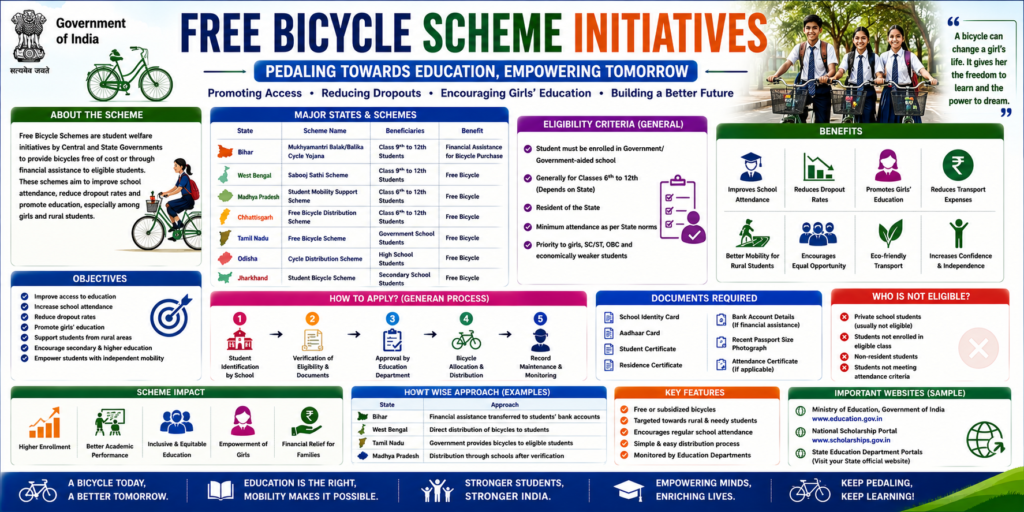
Introduction Education and mobility are closely linked, especially in rural and remote areas where students often travel long distances to reach schools and colleges. To reduce dropout rates, improve school attendance, promote girls’ education, and support economically weaker students, various Central and State Governments have introduced Free Bicycle Schemes .
These schemes provide bicycles either free of cost or through financial assistance to eligible students, helping them access education, improve attendance, and reduce transportation barriers.
For UPSC, MPSC, SSC, Banking, Teaching Exams, and State PSC examinations, Free Bicycle Schemes are important topics under Education, Social Welfare, Women Empowerment, and Inclusive Development.
Free Bicycle Schemes at a Glance Particular Details Scheme Type Student Welfare Initiative Objective Improve educational access Beneficiaries School Students Focus Areas Rural Students, Girls, SC/ST Students Benefit Free Bicycle or Bicycle Assistance Implementing Authority Central/State Governments Coverage Various States Application Mode School-Based/Online/Offline
What are Free Bicycle Schemes? Free Bicycle Schemes are welfare initiatives aimed at providing bicycles to eligible students, particularly those from rural and economically weaker backgrounds.
The schemes help:
Improve school attendance Reduce dropout rates Promote girls’ education Support rural students Encourage secondary education Improve mobility Official Website- https://www.education.gov.in
Objectives of Bicycle Schemes Objective Description Educational Access Easy school transportation Reduce Dropouts Increase retention Girls’ Education Promote enrollment Rural Development Improve connectivity Social Inclusion Support weaker sections Student Empowerment Encourage independence
Why are Bicycle Schemes Important? Challenge Solution Through Bicycle Scheme Long Distance to School Easier commuting High Transport Cost Free transportation support School Dropouts Increased attendance Gender Gap in Education Support for girls Rural Accessibility Issues Better mobility
Major Free Bicycle Scheme Initiatives in India 1. Free Bicycle Scheme (Various States) Many states operate their own bicycle distribution programs.
State Scheme Focus Bihar Student Bicycle Scheme Madhya Pradesh Student Mobility Support Chhattisgarh School Education Support Odisha Girls’ Education Promotion Jharkhand Student Welfare West Bengal Sabooj Sathi Scheme Tamil Nadu Student Bicycle Distribution Karnataka Student Assistance Programs
You Can Also Read About Majhi Ladaki Bahin Yojana At- https://ecareerupdates.com/majhi-ladki-bahin-yojana/
West Bengal’s Sabooj Sathi Scheme One of India’s most successful bicycle schemes.
Particular Details State West Bengal Beneficiaries School Students Classes Covered Generally Classes IX-XII Benefit Free Bicycle Objective Improve attendance
Bihar Mukhyamantri Balak/Balika Cycle Yojana Particular Details State Bihar Beneficiaries School Students Focus Secondary Education Benefit Type Financial Assistance for Bicycle Purchase
Tamil Nadu Free Bicycle Scheme Particular Details State Tamil Nadu Beneficiaries Government School Students Objective Educational Accessibility Benefit Free Bicycle
Typical Eligibility Criteria Eligibility varies by state.
General Eligibility Criteria Requirement Student Status Must be enrolled School Type Government/Government-Aided School Class Level Usually Secondary/Higher Secondary Residence State Resident Attendance Requirement May Apply
Common Beneficiary Categories Category Eligible Government School Students Yes Rural Students Yes Girls Students Yes SC Students Yes ST Students Yes OBC Students Yes Economically Weaker Students Yes
Benefits of Free Bicycle Schemes Educational Benefits Benefit Impact Better Attendance Reduced absenteeism Reduced Dropouts Higher retention Improved Academic Performance Better participation Higher Enrollment Increased access
Social Benefits Benefit Impact Women’s Empowerment Improved mobility Social Inclusion Equal opportunities Rural Connectivity Better access Student Confidence Greater independence
Economic Benefits Benefit Impact Reduced Transport Costs Savings for families Lower Financial Burden Educational support Improved Access to Opportunities Long-term benefits
Who is Eligible? General Student Eligibility Criteria Requirement School Enrollment Mandatory Government School Student Usually Required Class Requirement State Specific Residence Proof Required Student Verification Required
Who May Not Be Eligible? Category Status Private School Students Often Not Eligible Non-Resident Students Usually Not Eligible Ineligible Class Levels Not Covered Students Outside State Criteria Not Eligible
Documents Required Document Required School Identity Card Yes Aadhaar Card Yes Student Certificate Yes Residence Certificate Yes Bank Account Details If Financial Assistance Passport Size Photograph Yes
How to Apply? The process differs among states.
School-Based Distribution Step Process Step 1 School Identifies Eligible Students Step 2 Student Verification Step 3 Beneficiary Approval Step 4 Bicycle Distribution Step 5 Record Maintenance
Online Application (Where Available) Step Process Step 1 Visit State Education Portal Step 2 Register/Login Step 3 Fill Application Form Step 4 Upload Documents Step 5 Verification Step 6 Approval
Application Process Flow Stage Activity Identification Student Selection Verification Eligibility Check Approval Government Approval Distribution Bicycle Handover Monitoring Scheme Review
Is There Any Application Fee? Particular Fee Registration Fee Nil Application Fee Nil Government Charges Nil Beneficiary Fee Free
Free Bicycle Scheme vs Scholarship Scheme Parameter Bicycle Scheme Scholarship Benefit Type Physical Asset Purpose Transportation Cash Benefit Usually No Education Support Yes Attendance Improvement High
Free Bicycle Scheme vs Free Bus Pass Scheme Parameter Bicycle Scheme Bus Pass Scheme Ownership Student Owns Bicycle Recurring Cost No Rural Suitability High Dependence on Transport Network Low
Major Advantages Advantage Benefit Easy Transportation Better school access Reduced Dropouts Continued education Financial Relief Reduced expenses Girls’ Education Increased participation Environmental Benefits Eco-friendly transport
Challenges & Limitations Challenge Observation Maintenance Costs Student Responsibility Distribution Delays Possible Geographic Limitations Some Remote Areas Beneficiary Identification Requires Monitoring
Importance for UPSC/MPSC Aspirants Topic Importance Educational Inclusion Very Important Women Empowerment Frequently Asked Rural Development Important Student Welfare Schemes Frequently Asked Social Justice Governance Topic School Education Mains Topic
Official Sources for Information Frequently Asked Questions (FAQs) Question Answer Are bicycle schemes available across India? Different states run different schemes Is there any application fee? No Are girls given preference? Many schemes prioritize girls Do students receive bicycles directly? Usually Yes Are private school students eligible? Depends on state rules Is Aadhaar required? Generally Yes
Quick Revision Table for Aspirants Particular Details Scheme Type Student Welfare Main Objective Improve Educational Access Beneficiaries School Students Major Focus Rural & Girl Students Benefit Free Bicycle Application Fee Free Coverage Various States Social Impact Reduced Dropouts Educational Impact Improved Attendance Exam Importance High
Comparison with Other Education Welfare Schemes Scheme Main Objective Free Bicycle Schemes Student Mobility National Education Policy Education Reform PM POSHAN Mid-Day Meals Samagra Shiksha School Education NIPUN Bharat Foundational Literacy National Scholarship Schemes Financial Support
Conclusion Free Bicycle Scheme initiatives across India have proven to be highly effective in improving school attendance, reducing dropout rates, promoting girls’ education, and enhancing educational accessibility in rural and underserved regions. By providing a simple yet impactful mobility solution, these schemes help bridge educational gaps and support inclusive development.
For students, bicycles offer independence and easier access to education. For UPSC, MPSC, SSC, Teaching, Banking, and State PSC aspirants, these schemes are important examples of social welfare, educational inclusion, women empowerment, and rural development, making them relevant topics for both objective and descriptive examinations.