
UPSC Prelims + Mains | MPSC | GPSC | KPSC/KAS | APSC | State PSCs
🎯 Today’s UPSC Approach
NEWS → CONCEPT → STATIC → PRELIMS TRAP → MAINS DIMENSION → INTERLINKAGE
The 2026 UPSC Prelims trend makes one thing clear: candidates should not prepare current affairs as isolated facts. A headline about BRICS can become a question on multilateralism, de-dollarisation or the Global South; a fisheries update can become a question on Blue Economy, EEZ or sustainable fishing; and district-level economic data can become a question on GVA, unincorporated enterprises and statistical decentralisation.
So, today’s edition deliberately focuses on conceptual and statement-based preparation.
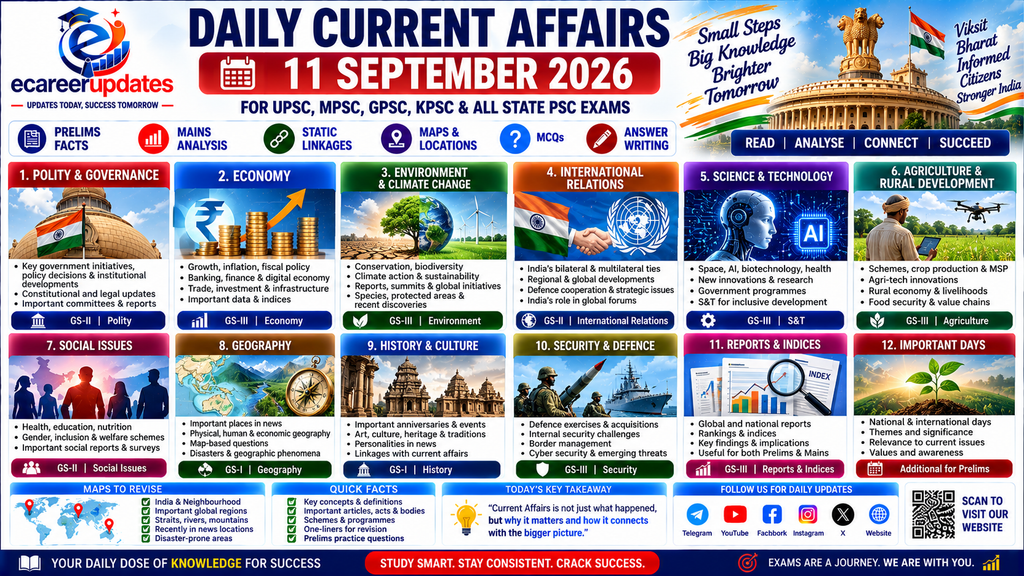
🔥 TODAY’S TOP 15 — QUICK OVERVIEW
| Priority | Current Affair | GS Paper | UPSC Importance |
|---|---|---|---|
| ⭐⭐⭐ | India–China: Modi–Xi meeting ahead of BRICS | GS-II | Very High |
| ⭐⭐⭐ | 18th BRICS Summit 2026 | GS-II/III | Very High |
| ⭐⭐⭐ | First district-level estimates of unincorporated sector | GS-III | Very High |
| ⭐⭐⭐ | International Space Summit & India’s space vision | GS-III | Very High |
| ⭐⭐⭐ | ASEAN–India agriculture cooperation | GS-II/III | High |
| ⭐⭐⭐ | PMMSY & Blue Economy | GS-III | High |
| ⭐⭐⭐ | Forest Rights Act review conference | GS-II/III | High |
| ⭐⭐ | SIP accounts cross 10 crore | GS-III | High |
| ⭐⭐ | India’s 6G leadership & security initiative | GS-III | High |
| ⭐⭐ | Small Hydro Power in clean-energy transition | GS-III | Medium-High |
| ⭐⭐ | Electric cooking — LPG to electricity transition | GS-III | Medium-High |
| ⭐⭐ | Swachhata Hi Seva 2026 | GS-II/III | Medium |
| ⭐⭐ | Fake seeds & seed regulation | GS-III | High |
| ⭐⭐ | Drylands & climate-resilient agriculture | GS-III | High |
| ⭐⭐ | BOCW national conference | GS-II | Medium |
1. 🌏 INTERNATIONAL RELATIONS
India–China: Modi–Xi Meeting Ahead of BRICS
Why in News?
China has confirmed that President Xi Jinping is scheduled to visit India for the BRICS Summit, and China has said that a bilateral meeting between Xi and Prime Minister Narendra Modi is being arranged.
This would be particularly significant because the two countries have been attempting to stabilise bilateral relations following tensions along the LAC.
Why is this important?
The India–China relationship has three simultaneous dimensions:
| Dimension | Key Issue |
|---|---|
| Security | LAC, border management, military confidence |
| Economy | Trade imbalance, investment, supply chains |
| Diplomacy | BRICS, SCO, multilateral cooperation |
The challenge is therefore not simply:
“India-China friendship or rivalry?”
Rather, it is:
Competition + cooperation + risk management
🗺️ Static Geography
Revise:
- LAC
- Arunachal Pradesh
- Ladakh
- Tibet
- Eastern Himalayas
- Karakoram
- Galwan
- Kibithoo/Wacha-Damai
🔥 Prelims Trap
LAC ≠ International Boundary
The LAC represents the line up to which the two sides exercise actual control; it is not a mutually demarcated international boundary.
Mains Linkage
India’s China policy requires simultaneously managing strategic competition, economic interdependence and border security. Discuss.
Keywords:
LAC • CBMs • strategic autonomy • supply-chain resilience • military dialogue • economic diversification
2. 🌐 BRICS 2026 — INDIA’S BIG DIPLOMATIC TEST
18th BRICS Summit — New Delhi, 12–13 September
India is hosting the 18th BRICS Summit in New Delhi on 12–13 September 2026 under its 2026 chairship.
India’s theme is:
“Building for Resilience, Innovation, Cooperation and Sustainability.”
The official PIB backgrounder describes BRICS as a major platform for emerging economies and the Global South, with an agenda covering development, finance, technology, trade and global governance.
Why 2026 is important?
India’s challenge is to make BRICS more practical and development-oriented while managing internal differences.
Major Issues
1. Global South
2. Reform of global institutions
3. Cross-border payments
4. Local-currency settlements
5. Trade and investment
6. AI and technology
7. Climate and sustainable development
8. Food and energy security
💵 BRICS & De-dollarisation
One of the major discussions around BRICS is reducing excessive dependence on dollar-dominated payment systems.
But UPSC aspirants must make an important distinction:
De-dollarisation ≠ immediate replacement of the US dollar
It can mean:
- Greater use of local currencies
- Alternative payment mechanisms
- Cross-border payment interoperability
- Diversification of reserves
- Reduced dependence on particular financial channels
⚠️ Prelims Trap
Do not automatically equate:
BRICS payment cooperation = BRICS common currency.
These are completely different concepts.
BRICS Institutions
| Institution | Purpose |
|---|---|
| New Development Bank (NDB) | Infrastructure & sustainable-development finance |
| Contingent Reserve Arrangement (CRA) | Financial safety mechanism |
| BRICS Business Council | Business cooperation |
| BRICS New Industrial Revolution Partnership | Industrial/technology cooperation |
Important Current Fact
The official PIB backgrounder currently lists 11 BRICS countries and says they collectively account for around 49.5% of global population, 40% of global GDP and 26% of global trade.
🧠 UPSC Strategy
For the examination, focus on:
BRICS → Global South → Multilateral reform → NDB → CRA → local currency → payment systems
rather than memorising only the summit venue.
3. 🇮🇳🇨🇳 BRICS + INDIA–CHINA LINKAGE
This is an excellent example of UPSC’s current-static approach.
News:
Modi–Xi bilateral meeting.
⬇️
Platform:
BRICS Summit.
⬇️
Static:
Emerging-economy multilateralism.
⬇️
Strategic issue:
India-China competition.
⬇️
Larger concept:
Strategic Autonomy
Therefore, one current event can generate questions from:
IR + Geography + Economy + Security + International Organisations
4. 📊 ECONOMY — HISTORIC DISTRICT-LEVEL ECONOMIC DATA
First-Ever District-Level Estimates for Unincorporated Non-Agricultural Sector
Why in News?
The National Statistics Office (NSO) has released, for the first time, district-level estimates from the Annual Survey of Unincorporated Sector Enterprises (ASUSE) 2025.
This is significant because it provides a much more granular picture of India’s small and informal/unincorporated economic activity.
Key findings
- Top 50 districts account for nearly one-third of establishments, workforce and GVA.
- About one-third of districts have more than 1 lakh unincorporated establishments.
- In 237 districts, women constitute at least one-third of the workforce.
- In 280 districts, GVA per worker exceeds the national average.
- The top 50 districts span 12 States.
What is an Unincorporated Enterprise?
Broadly, these are businesses that are not incorporated as companies under the Companies Act.
They form an important part of India’s:
- Informal economy
- Employment ecosystem
- Micro-enterprise sector
- Local manufacturing
- Trade
- Services
Why district-level data matters?
National averages can hide enormous geographical differences.
For example:
India may show one average productivity number, while District A and District B may have completely different economic structures.
Therefore:
National data → State data → District data
provides increasingly granular policymaking.
UPSC Concept
Evidence-based policy + decentralised planning + regional inequality
Prelims Trap
Unincorporated ≠ necessarily illegal
An enterprise can be legally operating while remaining outside the corporate structure.
Mains Question
“Granular district-level economic data can transform India’s approach to regional development.” Discuss.
Way Forward
- District-level industrial policy
- Local skill mapping
- Credit targeting
- Cluster development
- Women entrepreneurship
- Export-oriented district planning
5. 🚀 SCIENCE & TECHNOLOGY
International Space Summit — India’s Next Space Frontier
Prime Minister Narendra Modi addressed the first International Space Summit in Paris through video conference and called for international cooperation in the next phase of space exploration.
India highlighted its growing launch capabilities and its future ambitions, including an indigenous space station by 2035 and a lunar mission by 2040. India has launched hundreds of satellites/payloads for foreign customers, reflecting the country’s expanding commercial space ecosystem.
Why important for UPSC?
Space is no longer only:
Rocket + Satellite
It now includes:
- Space economy
- Commercial launches
- Space debris
- Earth observation
- Navigation
- Space-based communication
- Human spaceflight
- Planetary exploration
- Space diplomacy
- International space law
🌌 Static Linkage — Outer Space Treaty
The Outer Space Treaty, 1967 establishes important principles including:
- Outer space is not subject to national appropriation.
- Celestial bodies cannot be claimed as sovereign territory.
- Space activities should be carried out for peaceful purposes.
- States bear responsibility for national space activities.
🚨 Prelims Trap
A country can own a satellite, but it cannot claim sovereignty over the Moon or another celestial body.
Space Diplomacy
India’s space partnerships increasingly combine:
Science + strategic autonomy + commercialisation + diplomacy
6. 🌾 AGRICULTURE + INTERNATIONAL RELATIONS
ASEAN–India Agriculture Cooperation
The 9th ASEAN–India Ministerial Meeting on Agriculture and Forestry reaffirmed cooperation in:
- Food security
- Sustainable agriculture
- Climate resilience
- Digital agriculture
- AI
- Research
- Forestry
- Supply chains
- Food loss reduction
- Farmer livelihoods.
The cooperation is particularly relevant because climate change and geopolitical disruptions can affect:
fertiliser → seeds → food production → logistics → prices
New Plan: Key Areas
| Area | Focus |
|---|---|
| Food security | Resilient food systems |
| Digital agriculture | AI + IoT |
| Climate | Adaptation & mitigation |
| Soil | Soil health & bio-inputs |
| Crops | Climate-resilient crops |
| Forestry | Restoration + agroforestry |
| Supply chains | Logistics + market connectivity |
UPSC Linkage
ASEAN → Act East Policy → Indo-Pacific → Food security → Climate-resilient agriculture
Prelims
Know the difference:
ASEAN = regional organisation.
ASEAN–India cooperation = bilateral/regional engagement between India and ASEAN.
7. 🐟 BLUE ECONOMY
Six Years of PMMSY
The Pradhan Mantri Matsya Sampada Yojana (PMMSY) completed six years.
The government reports that fish production increased from 141.64 lakh tonnes in 2019–20 to 197.75 lakh tonnes in 2024–25.
Fisheries exports rose from ₹46,663 crore in 2019–20 to ₹73,890 crore in 2025–26. PMMSY received a record ₹2,500 crore allocation in BE 2026–27.
Why important?
Fisheries are simultaneously:
Agriculture + Economy + Nutrition + Employment + Coastal livelihoods + Exports + Ecology
The sector supports livelihoods of nearly three crore people according to the government backgrounder.
🌊 What is Blue Economy?
Blue Economy refers broadly to the sustainable use of ocean and marine resources for economic growth, livelihoods and ecosystem health.
Components
- Fisheries
- Aquaculture
- Shipping
- Ports
- Marine biotechnology
- Offshore renewable energy
- Coastal tourism
- Marine minerals
Important Concept
Blue Economy ≠ exploitation of oceans
The word sustainable is crucial.
UPSC Linkage
Blue Economy → SDG-14 → Coastal communities → EEZ → Marine conservation
8. 🧑🌾 FOREST RIGHTS ACT — TRIBAL GOVERNANCE
First Regional Review Conference on Forest Rights Act
The Ministry of Tribal Affairs held the first regional review conference on implementation of the Scheduled Tribes and Other Traditional Forest Dwellers (Recognition of Forest Rights) Act, 2006 in Bengaluru.
Five southern states participated:
- Andhra Pradesh
- Karnataka
- Kerala
- Tamil Nadu
- Telangana
The discussions included:
- Disposal of claims
- Community Forest Rights
- Habitat Rights
- Time-bound implementation.
🌳 Forest Rights Act — Static
The FRA, 2006 recognises rights of:
1. Forest Dwelling Scheduled Tribes
and
2. Other Traditional Forest Dwellers
subject to statutory conditions.
Types of rights
| Right | Broad meaning |
|---|---|
| Individual Forest Rights | Rights over occupation/use of forest land |
| Community Forest Rights | Community access/use/management rights |
| Minor Forest Produce | Collection/use rights |
| Habitat rights | Particularly important for vulnerable tribal communities |
Why important?
It represents the intersection of:
Tribal rights + forests + livelihoods + conservation + decentralisation
Mains
Recognition of community forest rights can potentially strengthen both tribal livelihoods and participatory forest governance. Examine.
9. 💰 ECONOMY — SIPs CROSS 10 CRORE
Retail Financialisation Deepens
The number of contributing SIP accounts crossed 10 crore in August 2026.
Monthly SIP contributions reached a record ₹32,297 crore, while SIP assets stood at about ₹18.62 lakh crore. Equity mutual fund inflows were about ₹29,329 crore in August.
What is an SIP?
Systematic Investment Plan is a method through which an investor invests a predetermined amount periodically into a mutual fund.
Why UPSC?
This reflects:
- Financialisation of household savings
- Capital-market participation
- Formalisation
- Retail investor growth
- Long-term investment culture
But remember
SIP account ≠ unique investor
One person may have multiple SIPs/accounts.
Also, “contributing SIP accounts” specifically refers to accounts that actually made instalments during the period.
Prelims Trap
10 crore SIP accounts does NOT mean 10 crore individual investors.
Excellent statement-based question possibility.
10. 📡 SCIENCE & TECHNOLOGY
India Endorses Call to Action for 6G Leadership & Security
India has endorsed a Call to Action for 6G Leadership and Security, with the Department of Telecommunications taking the initiative forward.
Why 6G matters?
6G is expected to integrate:
- AI
- Advanced wireless systems
- Sensing
- Edge computing
- Satellite connectivity
- Extremely low latency
- Machine-to-machine communication
Strategic dimension
Future telecom infrastructure is also:
Critical infrastructure
Therefore:
6G → cybersecurity → data sovereignty → national security
Prelims Concept
Do not assume that 6G is merely:
“Faster 5G.”
It represents a broader architecture involving communication, computing, sensing and AI.
11. ⚡ ENERGY
Small Hydro Power & India’s Clean Energy Transition
The government has highlighted the role of Small Hydro Power (SHP) in India’s clean-energy transition.
What is Small Hydro?
Small hydropower projects generally use flowing water to generate electricity on a relatively smaller scale than large hydro projects.
Advantages
- Renewable
- Potentially decentralised
- Useful for remote areas
- Can complement other renewables
- Long operating life
Challenges
- River ecology
- Sediment flow
- Fish migration
- Local livelihoods
- Seasonal water availability
UPSC Linkage
Renewable Energy ≠ Zero Environmental Impact
This is a crucial conceptual point.
12. 🍳 ENERGY + HOUSEHOLD ECONOMY
Electric Cooking — LPG to Electricity Transition
The Bureau of Energy Efficiency has highlighted commercial electric-cooking solutions as India considers a greater transition from LPG toward electricity in cooking.
Why important?
Cooking-energy transition involves:
Energy security + household expenditure + air pollution + women’s health + electricity demand + decarbonisation
LPG vs Electric Cooking
| Parameter | LPG | Electric |
|---|---|---|
| Fuel | Fossil fuel | Depends on electricity mix |
| Indoor combustion | Yes | No direct combustion |
| Emissions inside kitchen | Higher | Lower |
| Infrastructure | Cylinder supply | Electricity connection/grid |
| Climate impact | Fossil fuel dependent | Depends on power generation mix |
Prelims Trap
Electric cooking is not automatically zero-carbon.
Its climate benefit depends partly on the electricity generation mix.
13. 🌾 AGRICULTURE — FAKE SEEDS
Strengthening Seed Quality & Farmer Protection
The Agriculture Ministry has initiated consultations on strengthening the regulatory framework against fake/poor-quality seeds.
Why important?
Seeds are the foundation of agricultural productivity.
Poor-quality seeds can cause:
- Crop failure
- Income loss
- Lower productivity
- Farmer indebtedness
- Regional food-supply impacts
Static Linkage
Revise:
- Seeds Act, 1966
- Seeds Rules, 1968
- Seed certification
- Seed testing
- Variety notification
- Quality control
Mains Link
Input quality → productivity → farmer income → food security
14. 🌍 DRYLANDS & CLIMATE-RESILIENT AGRICULTURE
The Dryland Congress 2026 is bringing together global experts to discuss dryland agriculture, climate resilience and sustainable land management. Government discussions have emphasised the potential of drylands when supported by science, policy and markets.
Why UPSC?
Drylands face:
- Water scarcity
- Desertification
- Land degradation
- Climate variability
- Drought risk
Solutions
Watershed management + drought-resistant crops + soil moisture conservation + agroforestry + efficient irrigation + livelihood diversification
Static Linkage
UNCCD → Land Degradation Neutrality → Desertification → SDG 15 → Climate resilience
15. 🏗️ LABOUR & SOCIAL SECURITY
National Conference on Building & Other Construction Workers
A national conference on Building and Other Construction Workers (BOCW) is scheduled in Mumbai on 11–12 September.
Why important?
Construction workers represent a major segment of India’s informal workforce.
Key concerns include:
- Occupational safety
- Social security
- Migrant labour
- Welfare-board implementation
- Portability of benefits
- Skill development
Static Linkage
Code on Social Security, 2020 + occupational safety + informal employment
Mains
“India’s social-security architecture must become more portable as labour mobility increases.” Discuss.
16. 🏙️ URBAN GOVERNANCE — SWACHHATA HI SEVA
Preparations are underway for Swachhata Hi Seva 2026, with the Union government reviewing preparations with States and UTs.
UPSC Linkage
Swachhata is no longer simply:
“Cleanliness campaign.”
It involves:
- Solid waste management
- Waste segregation
- Circular economy
- Behavioural change
- Urban local bodies
- Sanitation
- Public health
Concept
Waste → Resource
This is the foundation of the circular economy.
17. 📊 ECONOMIC GEOGRAPHY — WHY DISTRICT DATA MATTERS
The new NSO district-level data provides an excellent opportunity to connect Economy + Geography.
Traditional approach
National GDP
      ↓
State GSDP
      ↓
District Economy
New policy relevance
District Data
      ↓
Identify Economic Clusters
      ↓
Skill Mapping
      ↓
Credit & Infrastructure
      ↓
Local Employment
      ↓
Balanced Regional Development
This is precisely the kind of Geography–Economy integration UPSC can test.
📚 HISTORY & CULTURE
There is no single major historical event on 11 September 2026 that warrants displacing the higher-priority developments above.
However, today’s BRICS, space and tribal-governance developments provide useful static-history linkages.
Revise:
- Evolution of BRICS
- 2006 BRIC Foreign Ministers’ meeting
- 2009 first BRIC Summit
- South Africa’s entry
- 2024 expansion
- India’s historical engagement with Africa
- Tribal forest governance
- Evolution of India’s space programme
UPSC Principle
Current affairs often act as a trigger to ask an old static concept.
🗺️ MAP WORK — 11 SEPTEMBER
India
📍 New Delhi — BRICS Summit
📍 Bengaluru — Forest Rights Act review
📍 Arunachal Pradesh — India-China border
📍 Ladakh — LAC
📍 Mumbai — BOCW conference
📍 Lakshadweep — Fisheries/Blue Economy
📍 Gujarat — Industrial/economic clusters
📍 Maharashtra — district-level enterprise concentration
World
📍 China
📍 Tibet
📍 Russia
📍 Brazil
📍 South Africa
📍 Iran
📍 UAE
📍 Indonesia
📍 ASEAN region
📍 France/Paris
📍 Indian Ocean
🧠 PRELIMS MASTER REVISION TABLE
| Topic | One-Liner |
|---|---|
| BRICS 2026 | 18th Summit, New Delhi, 12–13 Sept |
| BRICS theme | Building for Resilience, Innovation, Cooperation & Sustainability |
| BRICS institution | New Development Bank |
| NDB HQ | Shanghai |
| India–China meeting | Ahead of BRICS Summit |
| LAC | Not an internationally demarcated boundary |
| NSO district data | First district-level estimates for unincorporated non-agricultural sector |
| ASUSE | Annual Survey of Unincorporated Sector Enterprises |
| Space Summit | Paris |
| India’s future space station target | 2035 |
| Lunar mission target | 2040 |
| ASEAN–India agriculture | Food security + climate resilience + digital agriculture |
| PMMSY | Fisheries/Blue Economy |
| PMMSY allocation 2026–27 | ₹2,500 crore |
| Fish production 2024–25 | 197.75 lakh tonnes |
| FRA | Forest Rights Act, 2006 |
| FRA review | Five southern States |
| SIP accounts | >10 crore contributing accounts |
| SIP August inflow | ₹32,297 crore |
| 6G | Telecom + AI + security + critical infrastructure |
| Small hydro | Renewable but not impact-free |
| BOCW | Construction workers’ welfare |
⚠️ UPSC PRELIMS TRAP ZONE
Trap 1
BRICS common currency ≠ BRICS payment cooperation
Trap 2
SIP accounts ≠ number of individual investors
Trap 3
LAC ≠ International Boundary
Trap 4
Blue Economy ≠ only fisheries
Trap 5
PMMSY ≠ only fishing boats
Trap 6
Forest Rights Act ≠ only individual land rights
Community and habitat rights are important components.
Trap 7
Unincorporated enterprise ≠ illegal enterprise
Trap 8
Electric cooking ≠ automatically zero-carbon
Electricity generation mix matters.
Trap 9
6G ≠ simply faster 5G
Trap 10
Forest cover ≠ legally recorded forest area
🧩 UPSC-STYLE STATEMENT QUESTIONS
Q1. With reference to BRICS, consider the following statements:
- BRICS provides a platform for cooperation among emerging economies.
- The New Development Bank is headquartered in Shanghai.
- BRICS is a formal military alliance.
Answer: 1 and 2 only
Q2. With reference to India’s SIP ecosystem:
- One individual may have more than one SIP account.
- Contributing SIP accounts necessarily represent unique individuals.
- SIPs contribute to the financialisation of household savings.
Answer: 1 and 3 only
Q3. Consider the following statements:
- The LAC is an internationally demarcated boundary between India and China.
- The Forest Rights Act recognises community rights.
- Blue Economy includes sustainable utilisation of marine resources.
Answer: 2 and 3 only
Q4. District-level economic data can assist in:
- Identifying regional economic clusters
- Local skill planning
- Evidence-based development policy
- Understanding geographical concentration of enterprises
Answer: All four
Q5. With reference to electric cooking:
- It eliminates direct combustion inside the kitchen.
- Its climate impact depends partly on the electricity generation mix.
Answer: Both 1 and 2
✍️ MAINS ANSWER WRITING — TODAY’S BEST QUESTIONS
GS-II — International Relations
“BRICS is evolving from an emerging-economy grouping into an important platform for Global South cooperation, but internal differences limit its strategic coherence.” Discuss.
Answer framework
Introduction: Evolution of BRIC → BRICS → expansion.
Body:
- Global South representation
- NDB
- Trade
- Development finance
- Payment cooperation
- Global governance reform
Challenges:
- China-Russia vs India/Brazil positions
- Different economic interests
- Geopolitical conflicts
- Divergent relations with West
- Internal political differences
Way forward:
- Development-focused cooperation
- Payment interoperability
- NDB strengthening
- Consensus-based agenda
- Avoid excessive geopolitical polarisation
GS-II — India-China
“India-China relations demonstrate the coexistence of strategic competition and multilateral cooperation.” Examine.
Use:
LAC + BRICS + SCO + trade + supply chains + strategic autonomy
GS-II — Tribal Governance
Recognition of Community Forest Rights can strengthen both tribal livelihoods and participatory forest conservation. Discuss.
Use:
FRA 2006 + Gram Sabha + CFR + MFP + conservation + tribal autonomy
GS-III — Economy
“Granular economic data is essential for addressing India’s spatially uneven development.” Discuss with reference to recent district-level estimates.
Use:
ASUSE + district data + informal sector + GVA + employment + regional planning
GS-III — Agriculture
Climate-resilient agriculture requires regional cooperation in addition to domestic policy interventions. Discuss.
Use:
ASEAN + food supply chains + climate + AI + digital agriculture + resilient crops
GS-III — Space
India’s space ambitions are increasingly shifting from national capability-building to global space diplomacy and commercialisation. Examine.
Use:
ISRO + IN-SPACe + NSIL + private sector + foreign satellite launches + space station + lunar mission
🔗 TODAY’S MOST IMPORTANT LINKAGES
1. BRICS
BRICS
↓
Global South
↓
Multilateral Reform
↓
NDB + CRA
↓
Local Currency/Payments
↓
Strategic Autonomy
2. District Data
ASUSE
↓
Unincorporated Enterprises
↓
Employment + GVA
↓
District-Level Data
↓
Targeted Policy
↓
Balanced Regional Development
3. Blue Economy
Fisheries
↓
Livelihoods
↓
Nutrition
↓
Exports
↓
Coastal Economy
↓
Marine Conservation
↓
Blue Economy
4. Space
Space Technology
↓
Earth Observation
↓
Navigation
↓
Communication
↓
Commercialisation
↓
Space Diplomacy
↓
Strategic Autonomy
5. Forest Rights
FRA 2006
↓
Tribal Rights
↓
Community Forest Rights
↓
Gram Sabha
↓
Participatory Governance
↓
Sustainable Forest Management
📌 TODAY’S 20-MINUTE REVISION PLAN
🔴 MUST REVISE
- BRICS 2026
- Modi–Xi meeting
- BRICS → NDB → CRA → de-dollarisation
- District-level ASUSE data
- International Space Summit
- Forest Rights Act
- PMMSY & Blue Economy
🟠 SECOND PRIORITY
- ASEAN–India agriculture
- SIP 10 crore
- 6G
- Fake seeds
- Dryland agriculture
🟢 QUICK REVISION
- Small Hydro
- Electric cooking
- BOCW
- Swachhata Hi Seva
🎯 11 SEPTEMBER — 10 GOLDEN TAKEAWAYS
1. BRICS is more useful for UPSC when understood as a platform for Global South cooperation rather than simply a list of countries.
2. De-dollarisation does not automatically mean creation of a common BRICS currency.
3. India-China relations combine competition, cooperation and risk management.
4. District-level economic statistics can reveal inequalities hidden by national averages.
5. SIP accounts crossing 10 crore reflects increasing financialisation, but accounts are not the same as unique investors.
6. India’s space programme is becoming an instrument of diplomacy as well as science and technology.
7. Blue Economy requires balancing economic utilisation with marine ecosystem sustainability.
8. Forest Rights Act links tribal justice with decentralised forest governance.
9. Climate-resilient agriculture increasingly requires regional cooperation and resilient supply chains.
10. UPSC is more likely to test the concept behind today’s headline than the headline alone.
🏆 ECareerUpdates UPSC FORMULA
Don’t Memorise Current Affairs — Build Connections.
TODAY’S NEWS
⬇️
WHAT IS IT?
⬇️
WHY IS IT IMPORTANT?
⬇️
STATIC CONCEPT
⬇️
PRELIMS TRAP
⬇️
MAINS DIMENSION
⬇️
MAP / DATA / INSTITUTION
⬇️
POSSIBLE UPSC QUESTION
This is the approach that makes daily current affairs useful for both Prelims and Mains, rather than creating a huge collection of disconnected facts.
📚 For UPSC CSE | MPSC | GPSC | KPSC/KAS | APSC | All State PSCs
“Updates Today, Success Tomorrow.”