
UPSC CSE Prelims + Mains | MPSC | GPSC | KPSC/KAS | APSC | State PSCs | Group A/B/C
Exam Approach: News → Concept → Static → Prelims Trap → Mains Dimension → Interlinkages
The UPSC Prelims 2026 trend strongly reinforces that current affairs should not be studied as an isolated subject. Questions increasingly connect contemporary events with static concepts through statements, conceptual combinations, geography, institutions, science and application-based reasoning.
So, today’s compilation deliberately follows this approach: every important news item is linked to the underlying static syllabus.
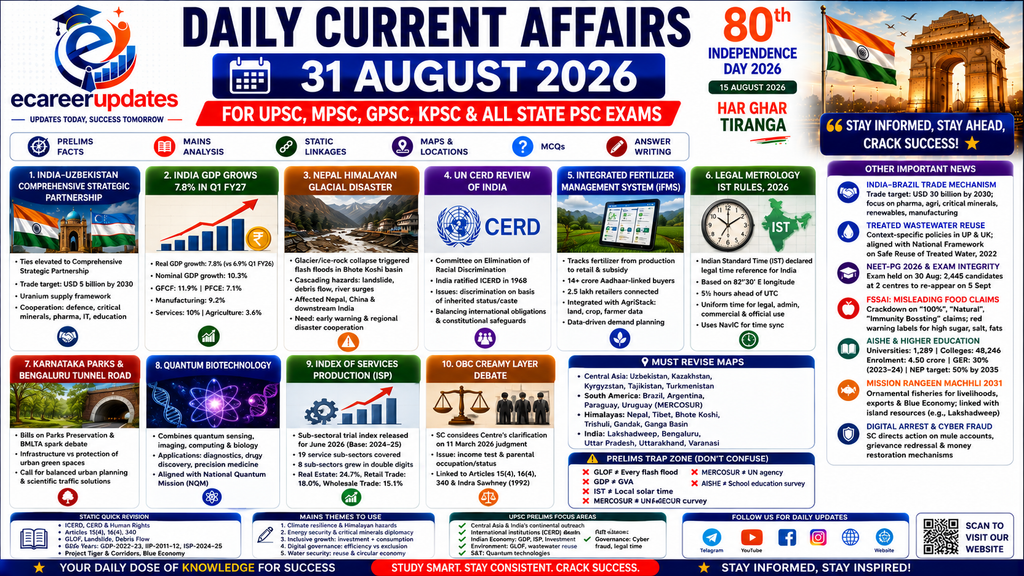
🔥 TODAY’S TOP 10 — QUICK REVISION
| Priority | News | Subject | UPSC Relevance |
|---|---|---|---|
| ⭐⭐⭐⭐⭐ | India–Uzbekistan Comprehensive Strategic Partnership | IR | GS-II + Prelims |
| ⭐⭐⭐⭐⭐ | India GDP grows 7.8% in Q1 FY27 | Economy | GS-III + Prelims |
| ⭐⭐⭐⭐⭐ | Nepal Himalayan glacier-related disaster | Geography/Environment | GS-I + GS-III |
| ⭐⭐⭐⭐⭐ | UN CERD review of India | Polity/IR | GS-II |
| ⭐⭐⭐⭐ | India–Brazil trade mechanism | IR/Economy | GS-II + III |
| ⭐⭐⭐⭐ | Treated wastewater reuse | Environment | GS-III |
| ⭐⭐⭐⭐ | Karnataka Parks & Bengaluru mobility laws | Polity/Urbanisation | GS-II + III |
| ⭐⭐⭐⭐ | Quantum Biotechnology | S&T | GS-III |
| ⭐⭐⭐⭐ | Index of Services Production | Economy | Prelims + GS-III |
| ⭐⭐⭐⭐ | OBC creamy-layer issue | Polity/Social Justice | GS-II |

1. 🌏 INTERNATIONAL RELATIONS
🇮🇳🇺🇿 India–Uzbekistan: Comprehensive Strategic Partnership
Why in News?
India and Uzbekistan have decided to elevate their existing Strategic Partnership to a Comprehensive Strategic Partnership.
The two countries also established a USD 5 billion bilateral trade target by 2030 and discussed a framework for long-term uranium supply from Uzbekistan to India.
Major areas of cooperation
- Trade and investment
- Defence and security
- Critical minerals
- Uranium and civil nuclear cooperation
- Pharmaceuticals
- Agriculture
- IT and Digital Public Infrastructure
- UPI
- Education
- Tourism
- Space cooperation
Why is this important for India?
1. Central Asia strategy
Uzbekistan is strategically located at the heart of Central Asia.
India seeks stronger connectivity and economic engagement with Central Asian republics despite the geographical constraint of no direct land connectivity.
2. Energy security
Long-term uranium supply can help diversify India’s nuclear fuel sources.
Static linkage:
Nuclear energy → Energy security → Uranium supply → Strategic autonomy
3. Critical minerals
Modern economies require minerals for:
- batteries
- semiconductors
- renewable energy
- defence technology
- electric vehicles
Therefore, India’s Central Asian engagement is increasingly moving from traditional diplomacy toward resource and technology diplomacy.
🧠 Prelims Facts
| Fact | Remember |
|---|---|
| Uzbekistan | Central Asia |
| Capital | Tashkent |
| Currency | Uzbekistani Som |
| Major geographic feature | Amu Darya & Syr Darya basins |
| India-Uzbekistan relationship | Strategic → Comprehensive Strategic Partnership |
| Trade target | $5 billion by 2030 |
| Important resource | Uranium + critical minerals |
UPSC Linkage
GS-II: India and Central Asia
GS-III: Energy security, critical minerals
Prelims: Map + uranium + Central Asian geography
2. 🇧🇷 INDIA–BRAZIL TRADE & GLOBAL SOUTH
India–Brazil Trade Monitoring Mechanism
The 8th India–Brazil Trade Monitoring Mechanism meeting was held in Brasília on 31 August.
Both countries targeted USD 30 billion bilateral trade by 2030, compared with USD 15.07 billion in 2025–26.
Key areas
- Pharmaceuticals
- Chemicals
- Engineering goods
- Machinery
- Agriculture
- Critical minerals
- Renewable energy
- Digital services
- Logistics
- Advanced manufacturing
India and Brazil also discussed the India–MERCOSUR Preferential Trade Agreement and greater pharmaceutical market access.
Static Linkage: MERCOSUR
MERCOSUR = Southern Common Market
Core members include:
- Argentina
- Brazil
- Paraguay
- Uruguay
Why UPSC may ask?
A possible statement-based question:
Consider the following:
- Brazil is a member of MERCOSUR.
- India has a preferential trade agreement with MERCOSUR.
- India and Brazil are members of BRICS.
The candidate must know all three institutional linkages.
3. 💰 ECONOMY
India’s GDP grows 7.8% in Q1 FY 2026–27
🔥 Most Important Economy News Today
MoSPI released the first-quarter GDP estimates for FY 2026–27.
Real GDP growth = 7.8%
against 6.9% in Q1 FY 2025–26.
Important numbers
| Indicator | Q1 FY26 | Q1 FY27 |
|---|---|---|
| Real GDP growth | 6.9% | 7.8% |
| Nominal GDP growth | 8.1% | 10.3% |
| Real GVA growth | 7.0% | 8.2% |
| GFCF growth | 5.8% | 11.9% |
| Private consumption | 6.8% | 7.1% |
| Services | 8.0% | 10.0% |
| Manufacturing | 8.3% | 9.2% |
| Agriculture & allied | 4.4% | 3.6% |
Real GDP in Q1 FY27 was estimated at ₹81.36 lakh crore, while nominal GDP was ₹88.27 lakh crore.
Why is 7.8% growth important?
The most important point is not simply the headline number.
Look at the composition.
Growth drivers
Investment ↑
GFCF grew 11.9%.
Consumption ↑
PFCE grew 7.1%.
Manufacturing ↑
Manufacturing grew 9.2%.
Services ↑
Tertiary sector grew 10%.
Thus:
Investment + consumption + manufacturing + services = broad-based growth
But there are concerns
Agriculture grew only 3.6%, while mining remains a potential weak spot.
Therefore, UPSC Mains should not simply write:
“India is growing rapidly.”
Instead:
“The growth performance is robust, but sustaining high growth requires stronger agriculture, employment generation, productivity improvement and investment-led expansion.”
🧠 GDP vs GVA — MUST KNOW
| GDP | GVA |
|---|---|
| Measures output from economy after accounting for net product taxes | Measures value added by producers/sectors |
| GDP = GVA + Net Taxes on Products | Sector-oriented measure |
| Used for overall economic growth | Useful for understanding sectoral performance |
Prelims Trap 🚨
GDP growth and GVA growth need not be identical.
Today:
GDP = 7.8%
GVA = 8.2%
4. 📊 NEW INDEX — INDEX OF SERVICES PRODUCTION
MoSPI released the Sub-Sectoral Trial Index of Services Production (ISP) for June 2026 with 2024–25 as the base year.
It covers 19 service sub-sectors.
Important figures
- 18 of 19 sub-sectors showed positive growth.
- 8 recorded double-digit growth.
- Real Estate: 24.7%
- Retail Trade: 18.0%
- Wholesale Trade: 15.1%
- Administrative & Support Services: 14.4%
- IT & Computer Services: 13.5%
Why important?
India’s economy is increasingly service-driven.
The ISP can help policymakers monitor short-term service-sector activity rather than depending only on broader GDP data.
Prelims Link
IIP ≠ ISP
| IIP | ISP |
|---|---|
| Industrial production | Services production |
| Mining, manufacturing, electricity | Service sub-sectors |
| Current base year 2011–12 | New trial ISP uses 2024–25 |
5. 🌏 GEOGRAPHY + DISASTER MANAGEMENT
Nepal Himalayan Glacier Disaster
The catastrophic Himalayan event in Nepal continued to dominate regional disaster-management discussions.
The disaster involved glacier/ice-rock collapse, sudden river surging, debris movement and flash flooding, demonstrating how multiple Himalayan hazards can combine into a single cascading disaster.
Understand the hazard chain
Climate warming
⬇️
Glacier instability / ice-rock collapse
⬇️
River blockage or sudden displacement of water
⬇️
Flash flood + debris flow
⬇️
Bridge/road/hydropower destruction
⬇️
Landslides + secondary hazards
This is exactly the kind of conceptual linkage UPSC increasingly favours.
🏔️ Why is the Himalaya vulnerable?
1. Young fold mountains
The Himalayas are geologically young and tectonically active.
2. Steep slopes
Steep gradients increase:
- landslide risk
- debris flow
- flash-flood velocity
3. Climate change
Warming affects:
- glaciers
- snow cover
- permafrost
- glacial lakes
- slope stability
4. Infrastructure pressure
Rapid construction of:
- hydropower projects
- roads
- tunnels
- tourism facilities
can increase exposure.
GLOF vs Flash Flood vs Landslide
| Hazard | Meaning |
|---|---|
| GLOF | Sudden release of water from glacial lake |
| Flash flood | Rapid rise of water in a short time |
| Landslide | Downward movement of rock/soil/debris |
| Debris flow | Water + rock + sediment moving rapidly |
| Glacier collapse | Sudden movement/failure of glacier mass |
🚨 Prelims Trap
Every Himalayan flash flood is NOT necessarily a GLOF.
A flash flood can result from:
- intense rainfall
- landslide-dammed lake failure
- glacier collapse
- GLOF
- sudden snow/ice melt
6. 🌱 ENVIRONMENT
Treated Wastewater Reuse — From “Waste” to Resource
Uttar Pradesh and Uttarakhand have recently moved toward context-specific policies for reuse of treated wastewater, aligned with India’s National Framework on Safe Reuse of Treated Water (SRTW), 2022.
Why does it matter?
India faces:
- groundwater depletion
- urban water stress
- agricultural demand
- industrial demand
- climate-induced water variability
Instead of treating wastewater only as waste:
Treat → Reuse → Reduce freshwater demand → Improve water security
Possible uses
- Agriculture
- Industrial processes
- Urban landscaping
- Construction
- Ecological restoration
Key concept: Fit-for-purpose reuse
Water need not always be treated to drinking-water standards.
It should be treated according to its intended use and required quality.
Mains linkage
Water security + circular economy + climate resilience + urban governance
This makes wastewater reuse a GS-II + GS-III + Essay topic.
7. ⚖️ POLITY & GOVERNANCE
OBC Creamy Layer — Supreme Court vs Implementation Concerns
The Supreme Court is considering the Centre’s request for clarification regarding its March 11, 2026 judgment on the OBC creamy-layer income test.
Static foundation
Important constitutional provisions:
- Article 15(4) — special provisions for socially and educationally backward classes
- Article 16(4) — reservation in public employment
- Article 340 — Backward Classes Commission
- Indra Sawhney case, 1992 — creamy-layer principle
Core issue
The debate concerns how income and parental occupation/status should be considered while determining whether an OBC candidate falls within the creamy layer.
Why UPSC cares?
This connects:
Reservation → substantive equality → social justice → judicial review → constitutional interpretation
Mains dimensions
Arguments for exclusion criteria
- benefits should reach genuinely disadvantaged groups
- prevents concentration of reservation benefits
Concerns
- income alone may not capture social disadvantage
- occupational status can be difficult to equate across sectors
- implementation must avoid arbitrary classification
8. ⚖️ URBAN GOVERNANCE + STATE LEGISLATURE
Karnataka Parks & Bengaluru Tunnel Road Controversy
Two Karnataka Bills concerning:
- Government Parks (Preservation)
- Bengaluru Metropolitan Land Transport Authority
have generated controversy over urban infrastructure and the protection of green spaces.
The debate is particularly significant because of the proposed Bengaluru tunnel-road project.
UPSC angle
This is much larger than one road project.
It raises the question:
How should cities balance infrastructure expansion with ecological commons?
Static linkage
Urbanisation → Urban transport → Green spaces → Environmental governance → State legislation
Mains framework
Problem
Traffic congestion + inadequate transport capacity
↓
Solution
Mass transit + multimodal transport + tunnel/road infrastructure
↓
Risk
Loss of urban green spaces + environmental externalities
↓
Way forward
- public transport
- transit-oriented development
- environmental impact assessment
- scientific traffic modelling
- protection of urban commons
- citizen participation
9. 🌐 HUMAN RIGHTS & INTERNATIONAL INSTITUTIONS
UN CERD Review of India
The UN Committee on the Elimination of Racial Discrimination (CERD) issued findings after reviewing India.
India’s last review by the Committee was in 2007.
What is CERD?
CERD = Committee on the Elimination of Racial Discrimination
It monitors implementation of:
International Convention on the Elimination of All Forms of Racial Discrimination (ICERD).
India ratified the Convention in 1968.
Important conceptual issue
One significant debate concerns the relationship between:
race-based discrimination
and
caste/inherited social status.
CERD has taken a broader interpretation of discrimination based on inherited status, while India has maintained that caste is not synonymous with race and has highlighted its constitutional safeguards.
UPSC relevance
This connects:
- Human rights
- International conventions
- Constitutional safeguards
- SC/ST protection
- Minority rights
- Treaty obligations
- Sovereignty vs international monitoring
10. 🧪 SCIENCE & TECHNOLOGY
Quantum Biotechnology
A National Conference on Quantum Biotechnology was held in alignment with India’s National Quantum Mission (NQM).
The field combines:
Quantum sensing + quantum imaging + quantum computing + biotechnology
with applications in:
- diagnostics
- biomedical imaging
- drug discovery
- biosensing
- precision medicine
Why important?
Traditional instruments have limits in detecting extremely small biological signals.
Quantum technologies can potentially provide:
- higher sensitivity
- greater measurement precision
- advanced biosensing
- improved imaging
Static linkage
National Quantum Mission → Quantum sensing → Quantum computing → Quantum communication → Quantum biotechnology
Prelims Trap 🚨
Quantum biotechnology is not the same as biotechnology using only quantum computers.
It can involve quantum sensing and quantum measurement as well.
11. 🛰️ SPACE + WOMEN IN STEM
Mission ShakthiSAT 2026
Mission ShakthiSAT was highlighted during the recent Mann Ki Baat episode.
It aims to connect approximately 12,000 girls from 108 countries with satellite technology, STEM education and lunar exploration.
Why important?
It connects:
Space diplomacy + STEM education + women empowerment + global cooperation
Mains linkage
India’s space sector is increasingly moving from a government-only model toward a broader ecosystem involving education, startups, private industry and international collaboration.
12. 🐟 BLUE ECONOMY
Fisheries Outreach in Lakshadweep
A fisheries outreach programme in Lakshadweep focused on sustainable fisheries, tuna harvesting and seaweed cultivation, with new projects worth ₹62 crore reported by PIB’s 31 August feed.
Why Lakshadweep matters?
Lakshadweep provides an excellent case study for:
- Blue Economy
- island development
- marine biodiversity
- tuna fisheries
- seaweed cultivation
- sustainable livelihoods
- coastal ecosystem conservation
Prelims Map Work
Locate:
Lakshadweep → Arabian Sea → west of Kerala
13. 🌳 ENVIRONMENT + URBAN GOVERNANCE
Tiger Landscapes — Conservation Beyond Protected Areas
An international workshop focused on Tiger Landscapes: Conservation, Bioeconomy and Ecotourism for Livelihood and Income Generation.
Key concept
Tiger conservation should not be limited to:
Tiger Reserve = Tiger Conservation
It increasingly requires:
Landscape approach
Protected area
- corridors
- buffer zones
- community livelihoods
- ecological connectivity
UPSC linkage
Project Tiger → Wildlife corridors → Human-wildlife conflict → Landscape conservation → Community participation
14. 📈 ECONOMY — ANOTHER IMPORTANT DEVELOPMENT
National Accounts Revision
The latest GDP series uses 2022–23 as the base year.
This is extremely important for Prelims.
Remember
Current GDP series base year = 2022–23
The revision also incorporates newer price/production indices and updated administrative data.
Prelims Trap
Do not confuse:
- GDP base year
- IIP base year
- ISP base year
| Indicator | Base Year |
|---|---|
| GDP | 2022–23 |
| IIP | 2011–12 |
| ISP trial index | 2024–25 |
🔥 Very high probability statement-based area.
15. 🏛️ GOVERNANCE — CPGRAMS
The Department of Administrative Reforms and Public Grievances released its monthly reports on CPGRAMS for July 2026.
CPGRAMS
Centralised Public Grievance Redress and Monitoring System
Purpose:
- citizen grievance registration
- monitoring
- departmental accountability
- feedback
- grievance redressal
Mains linkage
This is an example of:
Digital governance + citizen-centric administration + accountability
🧠 STATIC-CURRENT AFFAIRS LINKAGE MAP
| Current News | Static Concept You Must Revise |
|---|---|
| India–Uzbekistan | Central Asia + critical minerals + nuclear energy |
| India–Brazil | BRICS + MERCOSUR + Global South |
| GDP 7.8% | GDP vs GVA + real/nominal + national accounts |
| ISP | Services sector + economic indicators |
| Nepal disaster | Himalayas + GLOF + landslides + disaster management |
| Wastewater | Water security + circular economy |
| OBC creamy layer | Articles 15(4), 16(4) + Indra Sawhney |
| UN CERD | ICERD + human rights institutions |
| Karnataka tunnel road | Urban governance + environment |
| Quantum biotech | National Quantum Mission |
| Lakshadweep fisheries | Blue Economy + coral islands |
| ShakthiSAT | Space + women in STEM |
🗺️ MAP WORK — 31 AUGUST
Must locate on map
Asia
- Uzbekistan
- Tashkent
- Amu Darya
- Syr Darya
- Afghanistan
- Kyrgyzstan
South America
- Brazil
- Brasília
- Argentina
- Paraguay
- Uruguay
- MERCOSUR region
Himalayas
- Nepal
- Tibet
- Bhote Koshi region
- Langtang region
- Trishuli basin
India
- Lakshadweep
- Bengaluru
- Uttar Pradesh
- Uttarakhand
🚨 PRELIMS TRAP ZONE
Trap 1
GDP = GVA
❌ Wrong.
GDP incorporates net taxes on products over GVA.
Trap 2
GLOF and flash flood are synonymous.
❌ Wrong.
GLOF is a specific type of sudden flood associated with glacial lakes.
Trap 3
MERCOSUR is a UN specialised agency.
❌ Wrong.
It is a South American regional integration/trade bloc.
Trap 4
CERD is a court.
❌ Wrong.
It is a UN treaty-monitoring committee.
Trap 5
National Quantum Mission deals only with quantum computing.
❌ Wrong.
It encompasses broader quantum technologies including:
- computing
- communication
- sensing/metrology
- materials/devices
Trap 6
GDP and IIP have the same base year.
❌ Wrong.
GDP → 2022–23
IIP → 2011–12
🎯 UPSC PRELIMS — PRACTICE MCQs
Q1. Consider the following statements regarding India’s GDP estimates:
- Real GDP is measured at constant prices.
- GVA measures value added by producers/sectors.
- GDP is always equal to GVA.
- India’s current GDP series uses 2022–23 as the base year.
Which of the above are correct?
A. 1 and 2 only
B. 1, 2 and 4 only
C. 2 and 3 only
D. 1, 2, 3 and 4
Answer: B
Q2. Consider the following pairs:
| Institution/Grouping | Region |
|---|---|
| MERCOSUR | South America |
| CERD | United Nations human-rights treaty system |
| Uzbekistan | Central Asia |
| Lakshadweep | Arabian Sea |
Which pairs are correctly matched?
A. Only one
B. Only two
C. Only three
D. All four
Answer: D
Q3. Which of the following can contribute to Himalayan flash floods?
- Glacial lake outburst
- Glacier collapse
- Landslide-dammed lake failure
- Intense rainfall
A. 1 and 2 only
B. 1, 2 and 3 only
C. 1, 2, 3 and 4
D. 2 and 4 only
Answer: C
Q4. With reference to quantum biotechnology, consider:
- Quantum sensing can have biomedical applications.
- Quantum imaging may contribute to diagnostics.
- Quantum biotechnology is completely unrelated to the National Quantum Mission.
A. 1 only
B. 1 and 2 only
C. 2 and 3 only
D. All three
Answer: B
Q5. Consider the following:
- Article 15(4)
- Article 16(4)
- Article 340
- Indra Sawhney judgment
Which are relevant to the OBC reservation/creamy-layer debate?
A. 1 and 2 only
B. 1, 2 and 3 only
C. 1, 2, 3 and 4
D. 2 and 4 only
Answer: C
✍️ MAINS PRACTICE
GS-II
Q1. India’s engagement with Central Asia is increasingly being shaped by energy security, critical minerals and connectivity rather than traditional diplomacy alone. Discuss with reference to India–Uzbekistan relations.
GS-II
Q2. What are the constitutional and social-justice dimensions of determining the OBC creamy layer? Discuss the challenges in designing an equitable exclusion criterion.
GS-II + GS-III
Q3. Urban infrastructure development often conflicts with ecological conservation. Examine the challenges of balancing mobility requirements with protection of urban green commons.
GS-III
Q4. Himalayan disasters increasingly demonstrate the interaction of climate change, fragile geology and infrastructure expansion. Suggest a comprehensive disaster-risk reduction framework for the Indian Himalayas.
GS-III
Q5. “India’s water security will increasingly depend on recycling water rather than merely finding new sources.” Discuss the potential and challenges of treated wastewater reuse.
📝 MAINS ANSWER FRAMEWORK
For today’s Nepal disaster question:
Introduction
Mention the Himalayan region’s geological fragility and growing climate-linked cryospheric risks.
Body
1. Causes
- glacier instability
- warming
- steep slopes
- extreme weather
- fragile geology
2. Anthropogenic amplification
- hydropower
- roads
- tourism
- unplanned settlements
3. Consequences
- loss of life
- infrastructure damage
- hydropower disruption
- displacement
- transboundary impacts
4. Solutions
- GLOF monitoring
- satellite surveillance
- early-warning systems
- resilient infrastructure
- hazard zonation
- regional data sharing
- ecosystem-based adaptation
Conclusion
The objective should shift from merely responding to Himalayan disasters to building a climate-resilient Himalayan development model.
🔗 THE BIGGEST LINKAGES OF TODAY
Today’s current affairs can actually be compressed into five UPSC themes:
1️⃣ Strategic Autonomy
Uzbekistan → Uranium → Critical minerals → Nuclear energy → Energy security
2️⃣ Resilient Economy
GDP → Investment → Manufacturing → Services → Employment → Productivity
3️⃣ Himalayan Resilience
Climate change → Glacier instability → Flash floods → Infrastructure vulnerability → Disaster governance
4️⃣ Social Justice
Reservation → Creamy layer → Equality → Judiciary → Constitutional safeguards
5️⃣ Sustainable Urbanisation
Wastewater → Water security → Circular economy → Climate resilience → Urban governance
⭐ MASTER REVISION TABLE — 31 AUGUST 2026
| Topic | One-line takeaway | Prelims | Mains |
|---|---|---|---|
| 🇺🇿 Uzbekistan | Strategic partnership upgraded | ⭐⭐⭐⭐⭐ | ⭐⭐⭐⭐⭐ |
| 🇧🇷 Brazil | $30bn trade target | ⭐⭐⭐⭐ | ⭐⭐⭐⭐ |
| 💰 GDP | Q1 growth 7.8% | ⭐⭐⭐⭐⭐ | ⭐⭐⭐⭐⭐ |
| 📊 ISP | 19 service sub-sectors | ⭐⭐⭐⭐ | ⭐⭐⭐ |
| 🏔️ Nepal | Cascading Himalayan hazards | ⭐⭐⭐⭐⭐ | ⭐⭐⭐⭐⭐ |
| 💧 Wastewater | Reuse for water security | ⭐⭐⭐⭐ | ⭐⭐⭐⭐⭐ |
| ⚖️ OBC | Creamy-layer debate | ⭐⭐⭐⭐⭐ | ⭐⭐⭐⭐⭐ |
| 🌐 CERD | Human-rights treaty monitoring | ⭐⭐⭐⭐ | ⭐⭐⭐⭐ |
| 🏙️ Bengaluru | Infrastructure vs green spaces | ⭐⭐⭐ | ⭐⭐⭐⭐ |
| 🧬 Quantum biotech | Quantum + life sciences | ⭐⭐⭐⭐ | ⭐⭐⭐⭐ |
| 🛰️ ShakthiSAT | Women + space technology | ⭐⭐⭐ | ⭐⭐⭐ |
| 🐟 Lakshadweep | Blue Economy | ⭐⭐⭐⭐ | ⭐⭐⭐ |
🧩 WHAT UPSC CAN DO WITH TODAY’S NEWS
The 2026 Prelims pattern suggests that memorising isolated facts is increasingly risky. UPSC can take one current event and build a question around a static concept + two unfamiliar statements + geographical/institutional linkage.
For example:
India–Uzbekistan news
may become a question on Central Asian geography + uranium + critical minerals.
Nepal disaster
may become GLOF vs landslide vs debris flow + Himalayan geography.
GDP
may become GDP vs GVA + real/nominal + base year.
CERD
may become UN treaty bodies + ICERD + human rights.
Wastewater
may become circular economy + water governance + groundwater stress.
Therefore, today’s preparation formula should be:
NEWS
↓
WHY IN NEWS?
↓
STATIC CONCEPT
↓
MAP / INSTITUTION / DATA
↓
PRELIMS STATEMENTS
↓
MAINS ISSUE
↓
WAY FORWARD
That is the approach most aligned with the direction of the recent UPSC Prelims paper.
📌 FINAL 10-MINUTE REVISION
Before closing today’s study session, remember these 10 facts:
- 🇮🇳🇺🇿 India–Uzbekistan → Comprehensive Strategic Partnership
- Uzbekistan → Central Asia
- India–Uzbekistan trade target → $5 billion by 2030
- 🇧🇷 India–Brazil → $30 billion trade target by 2030
- 🇮🇳 Q1 FY27 Real GDP → 7.8%
- GDP base year → 2022–23
- GFCF growth → 11.9%
- Nepal → Himalayan cascading disaster risk
- CERD → International Convention on Elimination of Racial Discrimination
- Treated wastewater → Water security + circular economy + climate resilience
🚀 ECAREERUPDATES EXAM MANTRA
Don’t study today’s news as 20 separate facts.
Study it as 5 interconnected UPSC themes.
Central Asia → Energy → Critical Minerals
GDP → Investment → Manufacturing → Services
Himalaya → Climate → Disaster → Infrastructure
Reservation → Equality → Judiciary
Water → Wastewater → Circular Economy
That is how Current Affairs becomes Prelims knowledge + Mains content + Essay enrichment, rather than just another newspaper-reading exercise.