
UPSC Prelims + Mains | MPSC | GPSC | KPSC/KAS | APSC | State PSCs | Group A/B/C
News → Concept → Static Linkage → Prelims Trap → Mains Dimension → MCQ → Map
UPSC Preparation Principle: The recent Prelims pattern increasingly rewards candidates who can connect a current event with a static concept, institution, geographical location, constitutional provision, scientific principle or economic mechanism. Therefore, today’s compilation focuses on understanding the issue rather than merely memorising headlines.
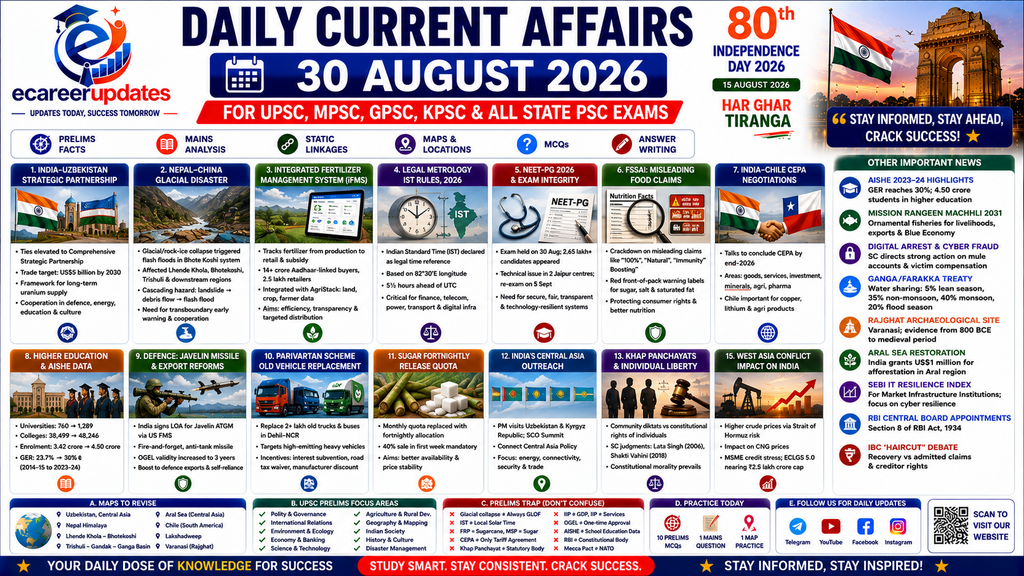
🔥 30 AUGUST 2026 — TOP HIGH-VALUE CURRENT AFFAIRS
| Priority | Topic | GS | Prelims | Mains |
|---|---|---|---|---|
| ⭐⭐⭐⭐⭐ | India–Uzbekistan Comprehensive Strategic Partnership | GS-II | ★★★★★ | ★★★★★ |
| ⭐⭐⭐⭐⭐ | Nepal–China Himalayan Glacial Disaster | GS-I/III | ★★★★★ | ★★★★★ |
| ⭐⭐⭐⭐⭐ | Integrated Fertilizer Management System (iFMS) | GS-III | ★★★★★ | ★★★★★ |
| ⭐⭐⭐⭐⭐ | Legal Metrology — Indian Standard Time Rules | GS-II/III | ★★★★★ | ★★★★ |
| ⭐⭐⭐⭐⭐ | NEET-PG 2026 & Examination Integrity | GS-II | ★★★★ | ★★★★★ |
| ⭐⭐⭐⭐ | FSSAI: Misleading Food Claims & Warning Labels | GS-II/III | ★★★★★ | ★★★★ |
| ⭐⭐⭐⭐ | India–Chile CEPA | GS-II/III | ★★★★ | ★★★★ |
| ⭐⭐⭐⭐ | Higher Education & AISHE | GS-II | ★★★★ | ★★★★★ |
| ⭐⭐⭐⭐ | Mission Rangeen Machhli 2031 | GS-III | ★★★★ | ★★★★ |
| ⭐⭐⭐⭐ | Digital Arrest & Cyber-Fraud Governance | GS-II/III | ★★★★★ | ★★★★★ |
| ⭐⭐⭐⭐ | Ganga/Farakka Water-Sharing Treaty | GS-II/III | ★★★★★ | ★★★★★ |
| ⭐⭐⭐⭐ | Rajghat Archaeological Site | GS-I | ★★★★ | ★★★ |
| ⭐⭐⭐⭐ | SEBI IT Resilience Index | GS-III | ★★★★★ | ★★★★ |
| ⭐⭐⭐ | RBI Central Board Appointments | GS-II/III | ★★★★ | ★★★★ |
| ⭐⭐⭐ | Aral Sea Restoration | GS-I/III | ★★★★ | ★★★★ |
🌏 1. INTERNATIONAL RELATIONS
⭐ India–Uzbekistan: Comprehensive Strategic Partnership
Why in News?
Prime Minister Narendra Modi’s state visit to Uzbekistan on 29–30 August 2026 resulted in a major upgrade of bilateral relations to a Comprehensive Strategic Partnership. The two countries also discussed a framework for long-term uranium supply, set a bilateral trade target of US$5 billion by 2030, and announced several cooperation initiatives.
This is one of today’s highest-value UPSC topics.
Key Outcomes
| Area | Development |
|---|---|
| Bilateral relationship | Elevated to Comprehensive Strategic Partnership |
| Trade | Target of US$5 billion by 2030 |
| Energy | Framework for long-term uranium supply |
| Environment | US$1 million grant for Aral Sea-region afforestation |
| Education | 100 Lal Bahadur Shastri Hindi scholarships |
| Culture | ICCR Sanskrit Chair |
| Security | Cooperation against terrorism and extremism |
| Connectivity | Central Asian connectivity initiatives |
Why Uzbekistan Matters to India
Central Asia is important because of:
1. Energy
- Uranium
- Natural gas
- Hydrocarbons
2. Strategic security
- Afghanistan
- Terrorism
- Extremism
- Regional stability
3. Connectivity
India lacks direct land access to Central Asia.
Therefore:
Iran’s Chabahar Port
International North-South Transport Corridor (INSTC)
are important.
4. Critical minerals
Central Asia possesses significant mineral resources relevant to India’s future technology and energy needs.
🗺️ MAP WORK — Central Asia
Remember the 5 Central Asian Republics:
🇰🇿 Kazakhstan
🇰🇬 Kyrgyzstan
🇹🇯 Tajikistan
🇹🇲 Turkmenistan
🇺🇿 Uzbekistan
Prelims Trap ⚠️
Uzbekistan is doubly landlocked.
It is surrounded by other landlocked countries except that all its neighbours are themselves landlocked.
Mains Linkage
India–Central Asia
→ Energy security
→ Strategic minerals
→ Afghanistan
→ Connectivity
→ Counter-terrorism
→ Eurasian geopolitics
Mains Question
Central Asia is becoming increasingly important to India’s continental strategy. Discuss the opportunities and constraints in India’s engagement with the region.
🌊 2. GEOGRAPHY + ENVIRONMENT + DISASTER MANAGEMENT
⭐ Nepal–China Himalayan Glacial Disaster
The catastrophic Bhote Koshi/Lhende Khola flood disaster continued to dominate regional developments on 30 August.
Nepal’s government reported ongoing search, rescue, relief and recovery operations after the devastating flash floods of 26 August.
The disaster followed a glacial/rock-ice collapse and debris movement in the Himalayan region, producing cascading impacts across the river system.
Disaster Chain
Glacial/ice-rock collapse
↓
Landslide / debris flow
↓
River obstruction / sudden discharge
↓
Flash flood
↓
Infrastructure destruction
↓
Downstream humanitarian crisis
This is an example of a cascading multi-hazard event.
Important River Linkage
Lhende Khola
↓
Bhotekoshi
↓
Trishuli system
↓
Narayani/Gandak
↓
Ganga Basin
UPSC Geography Concept
The Himalayan disaster demonstrates why mountain hazards must be studied at the basin level rather than only within administrative boundaries.
Why This Matters for India
The Himalayas are a connected ecological and geological system.
A disaster in:
Tibet/Nepal
can influence:
Northern India
through:
- river flows
- hydropower systems
- roads
- bridges
- tourism
- pilgrimage
- downstream flood risk.
India has also been involved in rescuing Indian nationals affected by the disaster.
GLOF — Prelims Concept
Glacial Lake Outburst Flood
A GLOF occurs when water stored in a glacial lake is suddenly released.
Possible triggers
- Moraine failure
- Ice avalanche
- Landslide
- Earthquake
- Rapid lake expansion
- Overtopping
⚠️ Don’t confuse
Glacial collapse ≠ automatically GLOF.
The disaster mechanism must involve the sudden release of glacial-lake water to technically qualify as a GLOF.
Mains Framework
Problems
- Fragile Himalayan geology
- Climate-induced cryosphere changes
- Infrastructure exposure
- Poor early warning
- Limited transboundary data sharing
Way Forward
| Measure | Benefit |
|---|---|
| Satellite monitoring | Detect glacier/lake changes |
| Real-time hydrological data | Early warning |
| Cross-border coordination | Faster evacuation |
| Hazard mapping | Safer infrastructure |
| Climate-resilient construction | Reduce losses |
| Community preparedness | Last-mile response |
Mains Question
The Himalayan region requires a shift from disaster response to disaster-risk governance. Discuss with reference to recent glacial disasters.
🏛️ 3. POLITY + GOVERNANCE
⭐ Legal Metrology — Indian Standard Time Rules, 2026
The Department of Consumer Affairs notified the Legal Metrology (Indian Standard Time) Rules, 2026.
The Rules establish Indian Standard Time (IST) as the common time reference across India for legal, administrative, commercial and official purposes. They come into force 180 days after publication.
Why is this important?
Time synchronisation has become critical for:
- Banking
- Stock markets
- Telecommunications
- Digital transactions
- Power grids
- Transport
- Navigation
- Defence systems
- Digital infrastructure
Technology Linkage
India’s indigenous navigation system:
NavIC
can contribute to accurate time synchronisation.
Prelims Facts
| Concept | Remember |
|---|---|
| IST | Common legal time reference |
| Meridian | 82°30′ E longitude |
| Standard meridian | Passes near Mirzapur, Uttar Pradesh |
| Time difference | 5½ hours ahead of UTC |
| Rules | Legal Metrology framework |
Prelims Trap ⚠️
IST ≠ local solar time.
India uses a single standard time despite its large east-west geographical extent.
🗳️ 4. DIGITAL GOVERNANCE + CYBER SECURITY
⭐ Supreme Court & “Digital Arrest” Scams
The Supreme Court’s intervention against digital-arrest scams has made cybercrime governance an important GS-II + GS-III issue.
Fraudsters impersonate:
- Police officers
- CBI/ED officials
- Judges
- Government officials
and force victims to remain on video calls while demanding money.
The Court has directed stronger institutional mechanisms, including RBI action regarding mule accounts, cyber-fraud grievance redressal and money-restoration mechanisms.
What is a Mule Account?
A bank account used to:
- Receive
- Transfer
- Layer
- Launder
proceeds of financial fraud.
Typical cyber-fraud chain
Victim
↓
Money transferred
↓
Mule account
↓
Layering / multiple accounts
↓
Cash-out / crypto / overseas transfer
Why is this a Governance Issue?
It involves:
Cybersecurity
Banking regulation
Police investigation
Data protection
Inter-state coordination
Victim compensation
Constitutional Linkage
The issue also connects with:
Article 21
Protection of life and personal liberty
Article 14
Equality and non-arbitrariness
Due process
A government official cannot legally place a citizen under a fictional “digital arrest” merely through a video call.
Mains Question
Cyber fraud is increasingly exploiting institutional trust rather than technological vulnerabilities alone. Discuss India’s institutional response to digital-arrest scams.
💰 5. ECONOMY + AGRICULTURE
⭐ Integrated Fertilizer Management System — iFMS
This is one of the best Prelims topics of the day.
The Department of Fertilizers is transforming iFMS from a transaction-recording system into a broader data-driven decision-support platform.
What is iFMS?
Integrated Fertilizer Management System
It tracks the fertilizer ecosystem from:
Production
↓
Import
↓
Movement
↓
Stock
↓
Retail
↓
Subsidy
Scale
The system connects:
- 14+ crore Aadhaar-linked fertilizer buyers
- 2.5+ lakh retailers
- Around 7 crore tonnes of annual fertilizer sales transactions
- Nearly ₹2 lakh crore annual fertilizer subsidy administration
🌾 iFMS + AgriStack + Farmer Data
The new framework attempts to link fertilizer purchases with:
- Farmer identity
- Land records
- Crops
- Landholding size
- Fertilizer requirement
Framework for Fertilizer Sale
AgriStack farmer ID
↓
Land/ownership verification
↓
Fertilizer booking
↓
QR code
↓
PoS verification
↓
Actual purchase
Why is this important?
Traditional system
Subsidy → transaction monitoring
New approach
Subsidy + farmer + land + crop + consumption data
This can help identify:
- Abnormal consumption
- Regional shortages
- Overuse
- Diversion
- Crop-wise demand
But there is a governance challenge
Data integration
can improve efficiency.
But:
Incorrect land records
authentication failures
digital exclusion
can prevent genuine farmers from accessing fertilizer.
UPSC Mains Linkage
Digital public infrastructure must combine efficiency with safeguards against exclusion and data misuse.
🌱 6. ENVIRONMENT + BLUE ECONOMY
Mission Rangeen Machhli 2031
The Department of Fisheries announced the Mission Rangeen Machhli 2031 Strategic Action Plan for the development of India’s ornamental fisheries sector. The initiative is linked to sustainable use of island resources and the broader Blue Economy.
What is Ornamental Fisheries?
It involves breeding, rearing, conservation and trade of:
🐠 ornamental fish
🐟 aquarium species
🌿 aquatic plants
Why important?
It can create:
- Rural/coastal livelihoods
- Entrepreneurship
- Export opportunities
- Value addition
- Women’s employment
Blue Economy Linkage
Marine resources
↓
Sustainable utilisation
↓
Employment
↓
Exports
↓
Coastal development
↓
Environmental conservation
Prelims Trap
Blue Economy ≠ only fisheries.
It includes sustainable economic activity related to:
- Oceans
- Coastal areas
- Marine resources
- Shipping
- Renewable ocean energy
- Tourism
- Fisheries
🐟 7. GEOGRAPHY + ENVIRONMENT
Lakshadweep — Why Important?
Mission Rangeen Machhli is associated with Agatti, Lakshadweep.
Map Facts
Lakshadweep is:
- Coral-island/atoll dominated
- Located in the Arabian Sea
- West of Kerala
- India’s Union Territory
UPSC Linkage
Coral reefs → climate change → ocean warming → bleaching → island vulnerability
🎓 8. EDUCATION + SOCIAL SECTOR
⭐ NEET-PG 2026 — Examination Integrity & Digital Testing
NEET-PG 2026 was conducted nationwide on 30 August 2026 across 1,111 centres in 339 cities, with more than 2.65 lakh candidates appearing.
However, a technical disruption at two Jaipur centres affected 2,445 candidates, who were scheduled for a re-examination on 5 September.
Why is this important for UPSC?
The issue is broader than NEET-PG.
It highlights:
High-stakes examination governance
| Challenge | Requirement |
|---|---|
| Paper leaks | Strong security |
| Technical failure | Business continuity |
| Mass examinations | Redundancy |
| Candidate identity | Secure authentication |
| Transparency | Real-time monitoring |
| Grievances | Fast redressal |
Static Linkage
Connect this with:
- NTA
- NBEMS
- Public Examinations Act, 2024
- Digital examination systems
- Data security
- Equal opportunity under Article 14
Mains Angle
Examination reform should not focus only on preventing cheating; it must also ensure reliability, accessibility, transparency and equitable treatment when systems fail.
🍎 9. FOOD SECURITY + CONSUMER PROTECTION
⭐ FSSAI — Misleading Food Claims & Warning Labels
FSSAI has intensified action against misleading food and nutrition claims.
The regulator has been scrutinising claims such as:
- “100%”
- “Natural”
- “Healthy”
- “Immunity boosting”
- exaggerated nutrient comparisons.
FSSAI has also proposed red front-of-pack warning labels for packaged foods high in specified nutrients such as added sugar, salt and saturated fat.
Why is this important?
It connects:
Food regulation
Public health
Consumer rights
Nutrition
Information asymmetry
Information Asymmetry
Consumers often cannot independently verify:
- nutritional claims
- health benefits
- ingredients
- processing methods
Therefore regulation becomes necessary.
Static Linkage
FSSAI
Food Safety and Standards Authority of India
Established under:
Food Safety and Standards Act, 2006
It is responsible for laying down science-based standards for food and regulating manufacture, storage, distribution, sale and import.
⚖️ Mains Dimension
Food regulation should balance:
Consumer protection
with
industry innovation
and
scientific evidence.
📚 10. EDUCATION — AISHE & HIGHER EDUCATION
The government highlighted a decade of expansion in India’s higher-education ecosystem through AISHE data.
Important Numbers
| Indicator | 2014–15 | 2023–24 |
|---|---|---|
| Universities | 760 | 1,289 |
| Colleges | 38,498 | 48,246 |
| Higher education enrolment | 3.42 crore | 4.50 crore |
| GER | 23.7% | 30% |
What is AISHE?
All India Survey on Higher Education
Conducted by:
Ministry of Education
It provides data on:
- Institutions
- Enrolment
- Faculty
- Infrastructure
- Gender
- Social categories
- Higher education participation
NEP 2020 Linkage
NEP target:
GER of 50% by 2035
Therefore the challenge is no longer merely:
“How many institutions?”
but:
Are institutions delivering quality, employability, research and inclusion?
Mains Linkage
Access → Equity → Quality → Employability → Research
💼 11. INTERNATIONAL TRADE
⭐ India–Chile CEPA Negotiations
India and Chile are advancing negotiations for a Comprehensive Economic Partnership Agreement (CEPA), with a target of concluding negotiations by the end of 2026.
Potential Sectors
- Pharmaceuticals
- Healthcare
- Energy
- Minerals
- Agriculture
- Machinery
- Engineering
Why Chile matters?
Chile is strategically important for:
- Copper
- Lithium
- Critical minerals
- Agriculture
- Latin American market access
CEPA vs FTA
| FTA | CEPA |
|---|---|
| Mainly trade liberalisation | Broader economic partnership |
| Goods often central | Goods + services + investment + wider cooperation |
| Tariff reduction | More comprehensive framework |
UPSC Prelims Trap
A CEPA is broader than a conventional goods-only tariff agreement.
🏺 12. HISTORY & ARCHAEOLOGY
⭐ Rajghat Archaeological Site, Varanasi
Rajghat, near the confluence of the Ganga and Varuna rivers, is an important archaeological site in the middle Ganga Valley. Excavations have revealed evidence of settlements extending across several cultural periods, beginning around 800 BCE and continuing into the medieval period.
Why is Rajghat important?
It provides evidence for:
- Urbanisation
- Trade
- Material culture
- Settlement continuity
- Ganga Valley civilisation
Map Linkage
Ganga + Varuna
→ Varanasi region
→ Rajghat
UPSC Approach
Instead of memorising only:
“Rajghat is in Varanasi.”
connect:
Ganga Valley → urbanisation → archaeological cultures → trade networks → historical geography
🌍 13. ENVIRONMENT + HISTORY
⭐ Aral Sea Restoration
India announced a US$1 million grant for afforestation in the Aral Sea region during the Uzbekistan visit.
Why Aral Sea is a Prelims Favourite?
Location
Central Asia
between:
🇰🇿 Kazakhstan
🇺🇿 Uzbekistan
What happened?
Large-scale diversion of rivers, particularly:
- Amu Darya
- Syr Darya
for irrigation dramatically reduced the Aral Sea.
Consequences
- Desertification
- Salinisation
- Fisheries collapse
- Dust storms
- Public health problems
- Local climate changes
UPSC Concept
Aral Sea = classic example of unsustainable water-resource management.
Mains Linkage
It can be used as a case study in:
“Ecological consequences of development without basin-level water governance.”
🏦 14. ECONOMY — SEBI IT RESILIENCE INDEX
SEBI’s IT Resilience Index (ITRI) for Market Infrastructure Institutions remains an important economic current-affairs topic.
It applies to entities such as:
- Stock exchanges
- Clearing corporations
- Depositories
The index evaluates dimensions such as:
- Availability
- Cybersecurity
- Integrity
- Governance
- Reliability
- Business continuity
- Scalability
Availability and security have the highest individual weights at 20% each.
Why is it important?
Financial markets increasingly depend on digital infrastructure.
Therefore:
Cyber attack
→ market disruption
→ investor losses
→ systemic risk
→ financial instability
Mains Linkage
Cybersecurity is now a component of financial stability.
🏦 15. RBI CENTRAL BOARD
The government appointed Annie George Mathew, Janmejaya Kumar Sinha and Syed Akbaruddin as part-time non-official directors on the RBI Central Board for four years.
The appointments are under Section 8 of the RBI Act, 1934.
Prelims Revision
RBI Central Board includes:
- Governor
- Deputy Governors
- Government nominees
- Other directors as provided by the RBI Act
Trap
RBI is a statutory body, established under the Reserve Bank of India Act, 1934, not directly by the Constitution.
🏛️ 16. INSOLVENCY & BANKRUPTCY
IBC “Haircut” Debate
The insolvency proceedings involving Zee Group founder Subhash Chandra revived debate around creditor recovery, valuation and deep “haircuts” under the Insolvency and Bankruptcy Code.
A repayment plan involving approximately ₹6.25 crore against admitted claims of ₹22,006.57 crore became controversial, with creditor challenges and subsequent legal developments.
Important Clarification
The headline percentage should not automatically be interpreted as banks simply writing off ₹22,000 crore.
The case involves personal insolvency/guarantee claims and complex creditor relationships, making it an exceptional case rather than a universal measure of IBC performance.
Static IBC Concepts
Insolvency
Inability to meet financial obligations.
Resolution
Attempt to revive the distressed entity.
Liquidation
Sale of assets and distribution to creditors when resolution fails.
Haircut
Difference between:
Admitted claim
and
actual recovery
🚨 17. FERTILIZER + DIGITAL PUBLIC INFRASTRUCTURE
The iFMS development deserves special attention because it demonstrates a broader transformation in Indian governance:
Earlier
Subsidy management
↓
Now
Data-driven agricultural governance
↓
Future potential
Predictive fertilizer demand
Crop-wise consumption
Landholding-wise requirement
Supply-chain optimisation
This is a powerful GS-III Digital Agriculture case study.
🧠 18. TODAY’S BIGGEST UPSC STATIC LINKAGES
| News | Static Concept |
|---|---|
| India–Uzbekistan | Central Asia + Chabahar + INSTC + SCO |
| Nepal floods | GLOF + Himalayas + transboundary rivers |
| IST Rules | Legal Metrology + 82°30′E + NavIC |
| Digital arrest | Cybercrime + RBI + Article 21 |
| iFMS | Fertilizer subsidy + AgriStack + DBT |
| Rangeen Machhli | Blue Economy + ornamental fisheries |
| NEET-PG | Public examination governance |
| FSSAI | Food Safety Act 2006 |
| AISHE | NEP 2020 + GER |
| India-Chile CEPA | Trade agreements + critical minerals |
| Rajghat | Ganga Valley archaeology |
| Aral Sea | Water diversion + desertification |
| SEBI ITRI | Cybersecurity + financial stability |
| RBI Board | RBI Act 1934 |
| IBC haircut | Insolvency resolution + creditor recovery |
⚠️ PRELIMS TRAP ZONE — 30 AUGUST
| ❌ Don’t confuse | ✅ Correct |
|---|---|
| Uzbekistan is in West Asia | Central Asia |
| Uzbekistan is coastal | Landlocked & doubly landlocked |
| GLOF = any glacier-related flood | GLOF requires sudden release of glacial-lake water |
| IST = local solar time | IST is India’s standard legal time |
| iFMS = only fertilizer subsidy portal | It is evolving into a data-driven fertilizer management platform |
| AgriStack = fertilizer scheme | AgriStack is a broader digital agriculture ecosystem |
| FSSAI = constitutional body | FSSAI is a statutory authority |
| CEPA = only tariff agreement | CEPA is broader |
| AISHE = school education survey | It concerns higher education |
| RBI = constitutional body | RBI is statutory |
| Aral Sea = Black Sea | Aral Sea is in Central Asia |
| Rajghat = Delhi | Rajghat archaeological site is near Varanasi |
| Blue Economy = only fisheries | It covers wider ocean/coastal economic activities |
| Digital arrest = legal police procedure | It is a fraud tactic |
| ITRI = RBI index | It is introduced by SEBI |
🗺️ MAP WORK — 30 AUGUST
Central Asia
📍 Uzbekistan
📍 Kazakhstan
📍 Kyrgyzstan
📍 Tajikistan
📍 Turkmenistan
📍 Aral Sea
📍 Amu Darya
📍 Syr Darya
Himalayas
📍 Tibet
📍 Nepal
📍 Bhote Koshi
📍 Trishuli
📍 Gandak/Narayani
📍 Ganga Basin
Indian Geography
📍 Lakshadweep
📍 Agatti
📍 Varanasi
📍 Ganga
📍 Varuna
Latin America
📍 Chile
📍 Atacama Desert
📍 Andes
📍 Lithium/Copper belt
🎯 UPSC-STYLE PRELIMS MCQs
Q1. Consider the following statements about Uzbekistan:
- It is a Central Asian country.
- It is doubly landlocked.
- It shares a border with Afghanistan.
Which are correct?
Answer: 1, 2 and 3
Q2. With reference to iFMS:
- It tracks fertilizer production and imports.
- It monitors stock and retail sales.
- It is being integrated with farmer and land databases.
- It is restricted only to fertilizer manufacturers.
Answer: 1, 2 and 3 only
Q3. Consider the following:
- Indian Standard Time is based on 82°30′E.
- IST is 5½ hours ahead of UTC.
- India officially maintains multiple legal standard times.
Answer: 1 and 2 only
Q4. FSSAI was established under:
A. Environment Protection Act, 1986
B. Food Safety and Standards Act, 2006
C. Consumer Protection Act, 2019
D. Essential Commodities Act, 1955
Answer: B
Q5. AISHE primarily deals with:
A. Primary education
B. School education
C. Higher education
D. Technical education only
Answer: C
Q6. The Aral Sea is associated with:
A. South America
B. Central Asia
C. Southeast Asia
D. Eastern Europe
Answer: B
Q7. Consider:
- SEBI introduced the IT Resilience Index.
- It applies to Market Infrastructure Institutions.
- It primarily measures agricultural cyber infrastructure.
Answer: 1 and 2 only
Q8. Which of the following is NOT a Central Asian Republic?
A. Uzbekistan
B. Kazakhstan
C. Azerbaijan
D. Kyrgyzstan
Answer: C
Q9. A GLOF is best described as:
A. Seasonal river flooding
B. Sudden release of water from a glacial lake
C. Coastal flooding caused by cyclones
D. Flooding caused exclusively by cloudbursts
Answer: B
Q10. The Reserve Bank of India was established under:
A. RBI Act, 1934
B. Banking Regulation Act, 1949
C. Companies Act, 2013
D. Constitution of India
Answer: A
✍️ MAINS ANSWER-WRITING PRACTICE
GS-II — International Relations
India’s growing engagement with Central Asia is strategically important but constrained by geography. Examine.
GS-I/III — Geography
Recent Himalayan disasters demonstrate the need to treat the Hindu Kush Himalayan region as a single interconnected ecological and disaster-risk system. Discuss.
GS-III — Agriculture
Digitalisation of fertilizer management can improve subsidy efficiency and agricultural resource use, but may also create new exclusion risks. Critically examine.
GS-II — Governance
The fight against digital arrest scams requires coordination between law enforcement, financial regulators, telecom operators and digital platforms. Discuss.
GS-II — Education
Expansion in higher-education enrolment does not automatically translate into human-capital development. Examine the quality and employability challenges facing Indian higher education.
GS-III — Economy
Cyber resilience of financial-market infrastructure has become an integral component of financial stability. Discuss.
🧩 ONE NEWS → MULTIPLE SYLLABUS LINKAGES
🇺🇿 India–Uzbekistan
Bilateral visit
↓
Central Asia
↓
SCO
↓
Afghanistan
↓
Chabahar
↓
INSTC
↓
Energy
↓
Uranium
↓
Critical minerals
↓
Strategic autonomy
One current event → GS-II + GS-III + Map
🌊 Nepal Disaster
Glacial collapse
↓
Geomorphology
↓
Cryosphere
↓
Climate change
↓
Transboundary river
↓
Disaster management
↓
HADR
↓
India-Nepal-China relations
One current event → GS-I + GS-II + GS-III
📊 30 AUGUST MASTER REVISION TABLE
| Theme | One-line takeaway |
|---|---|
| 🇺🇿 Uzbekistan | India upgraded ties to Comprehensive Strategic Partnership |
| 🌊 Nepal | Himalayan cascading disaster remains a major concern |
| 🌾 iFMS | Fertilizer management moving toward data-driven governance |
| ⏱️ IST Rules | One common legal time reference for India |
| 🛡️ Cyber | Digital arrest requires coordinated institutional response |
| 🐠 Rangeen Machhli | Ornamental fisheries + Blue Economy |
| 🎓 NEET-PG | Examination integrity includes technology resilience |
| 🍎 FSSAI | Consumer protection against misleading food claims |
| 🎓 AISHE | Higher education expansion + NEP 2020 |
| 🇨🇱 Chile | CEPA negotiations + critical minerals |
| 🏺 Rajghat | Ganga-Valley archaeological significance |
| 🌊 Aral Sea | Water mismanagement → ecological disaster |
| 💻 SEBI | Cyber resilience = financial stability |
| 🏦 RBI | Central Board appointments under RBI Act |
| 🏢 IBC | Resolution vs recovery + creditor rights |
📝 CURRENT AFFAIRS REVISION — 15 MINUTES
⏱️ 3 Minutes — International Relations
Uzbekistan + Central Asia + Chabahar + SCO
⏱️ 3 Minutes — Geography/Environment
Nepal + GLOF + Himalayas + Aral Sea
⏱️ 3 Minutes — Economy
iFMS + fertilizer subsidy + ITRI + IBC
⏱️ 3 Minutes — Governance
IST Rules + digital arrest + NEET-PG
⏱️ 3 Minutes — Society/Education
AISHE + FSSAI + Blue Economy
🔥 30 AUGUST — THE 7 BIG UPSC TAKEAWAYS
1. 🌏 Central Asia is becoming strategically important
Uzbekistan → uranium → minerals → connectivity → Afghanistan → SCO
2. 🌊 Himalayan disasters are transboundary
Glacial instability → cascading hazards → river basin → regional cooperation
3. 🌾 Agriculture is becoming data-driven
iFMS → AgriStack → farmer/land/crop data → targeted fertilizer management
4. ⏱️ Digital infrastructure needs precise time
IST → financial systems → telecom → transport → NavIC
5. 🛡️ Cybersecurity is now governance
Digital arrest → mule accounts → RBI → police → victim compensation
6. 🎓 Human capital is more than enrolment
AISHE → access → equity → quality → employability → research
7. 🌱 Blue Economy needs sustainability
Ornamental fisheries → livelihoods → exports → island ecology → conservation
🏆 FINAL UPSC TAKEAWAY
The 30 August 2026 news cycle is an excellent example of how UPSC can turn apparently ordinary government announcements into conceptual questions.
Don’t simply memorise:
“India upgraded ties with Uzbekistan.”
Think:
Central Asia → geography → Chabahar → INSTC → Afghanistan → uranium → critical minerals → SCO → strategic autonomy.
Don’t merely remember:
“iFMS was upgraded.”
Think:
Fertilizer subsidy → digital agriculture → AgriStack → land records → farmer authentication → efficient distribution → exclusion risks.
Don’t simply remember:
“IST Rules were notified.”
Think:
Standard time → legal metrology → digital transactions → telecom → financial markets → NavIC → technological sovereignty.
And don’t treat the Nepal disaster as merely a flood story:
Cryosphere → glacier instability → cascading hazards → Himalayan geomorphology → transboundary rivers → early warning → disaster diplomacy.
That is the current UPSC preparation model: current event + static concept + map + institutional framework + analytical dimension rather than isolated factual memorisation. The weekly UPSC review for 24–30 August similarly highlights the importance of Uzbekistan, Nepal floods, Farakka, Rajghat and SEBI’s IT Resilience Index as interconnected Prelims/Mains themes.