
Reflections on Democracy, Accountability, and the Jantar Mantar Protest
Democracy is not measured only by the strength of its institutions but by how those institutions respond when citizens ask difficult questions. The events surrounding today’s march towards Jantar Mantar have reignited an important national conversation—not merely about law and order, but about the relationship between the State and its citizens.
This article is not an attempt to accuse, convict, or justify any individual or institution. Instead, it is an appeal for accountability, dialogue, transparency, and constitutional values that have shaped the Republic of India.
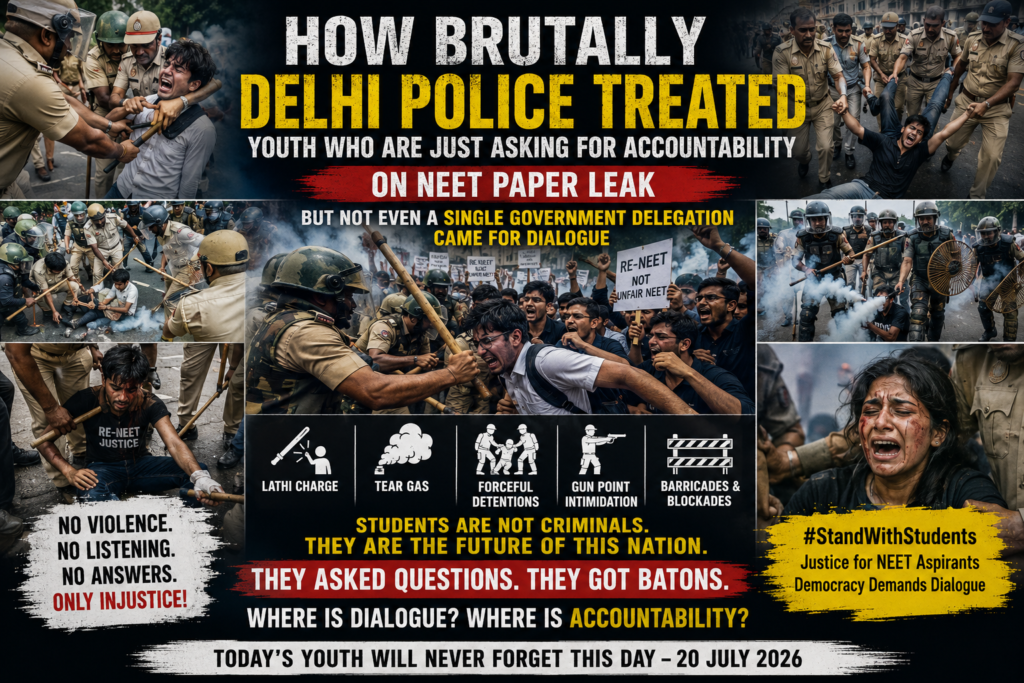
A Protest That Asked Questions
For nearly a month, protesters associated with the movement led by Sonam Wangchuk had reportedly been expressing their concerns through peaceful demonstrations and public engagement. Their demands centered around issues they believed deserved national attention.
When citizens choose democratic methods—peaceful protests, hunger strikes, public marches, and constitutional expression—they expect one thing above everything else: to be heard.
The question that many young Indians are asking today is simple:
Why did a movement that largely relied on peaceful democratic methods ultimately culminate in such a heavy security response?
Whether one agrees with the demands of the protesters or not, the larger concern is whether democratic institutions created sufficient space for dialogue before the situation escalated.
Democracy Is Strongest When It Listens
India’s Constitution gives citizens the right to freedom of speech and peaceful assembly, subject to reasonable restrictions in the interest of public order and security.
Governments undoubtedly have the responsibility to maintain law and order. Police agencies are expected to prevent violence, protect public property, and ensure the safety of Parliament and other sensitive locations.
However, democracy also demands something equally important:
The willingness of those in power to engage before confrontation becomes inevitable.
Many citizens are asking:
- Could meaningful dialogue have taken place much earlier?
- Could negotiations have prevented today’s confrontation?
- Was every peaceful alternative exhausted before force was used?
These questions deserve thoughtful answers rather than political slogans.
The Images That Disturbed the Nation
The visuals circulating today have deeply disturbed many citizens.
Reports and videos appearing across social media show barricades, detentions, deployment of large police forces, use of tear gas in certain areas, and baton charges during attempts to control the march.
While authorities may explain that these measures were necessary to prevent security breaches or unlawful gatherings, the emotional impact on the public cannot be ignored.
For many watching those scenes, one uncomfortable thought emerged:
Why did young citizens carrying questions appear to be treated as security threats?
This perception—whether entirely accurate or not—is something that governments cannot afford to ignore.
Questions That Demand Transparency
In every democracy, the use of force by law enforcement must remain accountable and proportionate.
Several questions have emerged from today’s events:
1. What Was the Operational Threshold for Force?
If force was used, what intelligence assessments or operational criteria led to that decision?
- What specific risks justified baton charges?
- Were de-escalation techniques attempted first?
- Was force used proportionately?
- Were officers following established crowd-control protocols?
These are legitimate questions in any constitutional democracy.
2. Why Were Some Officers Reportedly Seen Without Visible Name Plates, Official Dress Code, Face mask?
Videos circulating online have prompted concerns regarding identification.
If officers removed or concealed identification, citizens naturally ask:
- Was this officially authorized?
- If yes, under what circumstances?
- If not, will accountability mechanisms examine the matter?
Transparency protects both citizens and honest police officers.
3. Why Were Faces Covered?
Many observers noticed officers with cloths or masks covering portions of their faces.
If there were operational reasons—such as protection from tear gas or environmental conditions—those reasons should be clearly communicated.
If not, such visuals inevitably raise concerns about transparency and accountability.
4. Was the Level of Force Necessary?
Crowd management follows internationally accepted principles of necessity and proportionality.
Many citizens are asking:
- Could the situation have been managed with softer methods?
- Could communication teams have prevented escalation?
- Was every non-violent alternative attempted before physical force?
Answering these questions openly would strengthen public trust.
The Silence Before the Confrontation
Perhaps one of the most difficult questions is not about what happened today.
It is about what did not happen during the past month.
If a hunger strike and peaceful demonstrations continued for weeks, why did the nation witness so little visible engagement?
Many citizens wonder:
- Why was there no high-level delegation to initiate dialogue?
- Why were structured negotiations not publicly pursued?
- Why were young protesters left feeling unheard?
Dialogue is not a sign of weakness.
It is one of democracy’s greatest strengths.
Where Was the National Conversation?
Another concern relates to the role of mainstream media.
Many young Indians feel that social media became the primary source of information because they perceived limited discussion of the movement across major television debates and print media.
Whether this perception is fully accurate or not, it reflects a growing trust gap.
The role of journalism is not to amplify only governments or only protesters.
Its role is to inform citizens with fairness, context, and balanced reporting.
A democracy functions best when multiple perspectives are presented honestly.
The Judiciary and Constitutional Expectations
Some citizens have also asked whether earlier judicial intervention could have encouraged dialogue before tensions escalated.
Courts traditionally act within constitutional limits and generally require appropriate legal proceedings before intervening, except in certain exceptional circumstances.
Even so, public expectations remain high whenever fundamental rights and public order intersect.
The broader expectation is that every constitutional institution should help preserve both democratic freedoms and peace.
Accountability Is Not Anti-Government
One misconception repeatedly appears in political discourse:
That questioning the government is somehow equivalent to opposing the nation.
Nothing could be further from the constitutional spirit.
Holding governments accountable is not an act of disloyalty.
It is one of the highest forms of democratic participation.
Every government—regardless of political party—must remain answerable to the people who elected it.
Accountability strengthens governments.
Opacity weakens them.
A Message to the Government
The Government of India today carries the mandate of millions of citizens who voted in successive elections.
With that mandate comes immense responsibility.
This moment does not demand confrontation.
It demands leadership.
Leadership means listening before conflict deepens.
Leadership means accepting that even well-intentioned systems sometimes fail.
Acknowledging shortcomings is not political defeat.
It is democratic maturity.
If communication gaps contributed to today’s events, correcting them swiftly would strengthen public confidence far more than prolonged confrontation.
A Message to the Protesters
Peaceful democratic movements derive their greatest strength from discipline.
When protests remain peaceful, focused, and respectful of constitutional boundaries, they command greater moral authority.
Questions asked peacefully are often more powerful than slogans shouted in anger.
India’s democracy has always evolved because ordinary citizens chose constitutional methods to express extraordinary concerns.
A Generation That Refuses to Be Silent
Something larger than today’s events may be unfolding.
Generation Z has grown up in an age of instant information, digital transparency, and global conversations.
This generation is increasingly demanding:
- Greater accountability
- Faster institutional responses
- Transparency in governance
- Evidence-based policymaking
- Open communication from elected representatives
These expectations are neither unreasonable nor revolutionary.
They are the natural evolution of an informed democracy.
Whether governments embrace this transformation will shape the political culture of the coming decades.
Democracy Is Tested During Disagreement
History rarely remembers nations for the moments when everyone agreed.
History remembers how nations behaved when disagreement emerged.
Did institutions listen?
Did leaders engage?
Did citizens remain peaceful?
Did the rule of law remain proportionate?
These are the questions future generations ask.
Final Thoughts
The events of 20 July 2026 will likely remain in public memory—not merely because of the confrontation itself, but because they have reopened an essential debate about democracy, accountability, public dialogue, and constitutional governance.
Every institution has responsibilities.
The Government must communicate.
The Police must exercise lawful and proportionate force with complete transparency.
The Media must inform fairly.
The Judiciary must continue safeguarding constitutional values within its mandate.
Citizens must continue expressing themselves peacefully and responsibly.
Democracy does not become weaker when difficult questions are asked.
It becomes weaker only when those questions are ignored.
India has overcome far greater challenges throughout its history because dialogue ultimately prevailed over division.
Even now, it is not too late.
The path forward is not more barricades.
It is more conversation.
Not more confrontation.
But more constitutional engagement.
Because the strength of the Republic lies not in how effectively it can silence dissent, but in how confidently it can answer it.