
UPSC Prelims + Mains | MPSC | GPSC | KPSC/KAS | APSC | State PSCs
News → Concept → Static Linkage → Prelims Trap → Mains Dimension → Revision
The UPSC Prelims 2026 trend has made one thing particularly clear: current affairs cannot be prepared as a collection of isolated facts. Contemporary issues are increasingly embedded inside static Geography, Polity, Economy, Environment, Science and International Relations, with statement-based questions testing conceptual understanding and elimination. The 28 August compilation below therefore focuses on high-value linkages rather than news headlines alone.
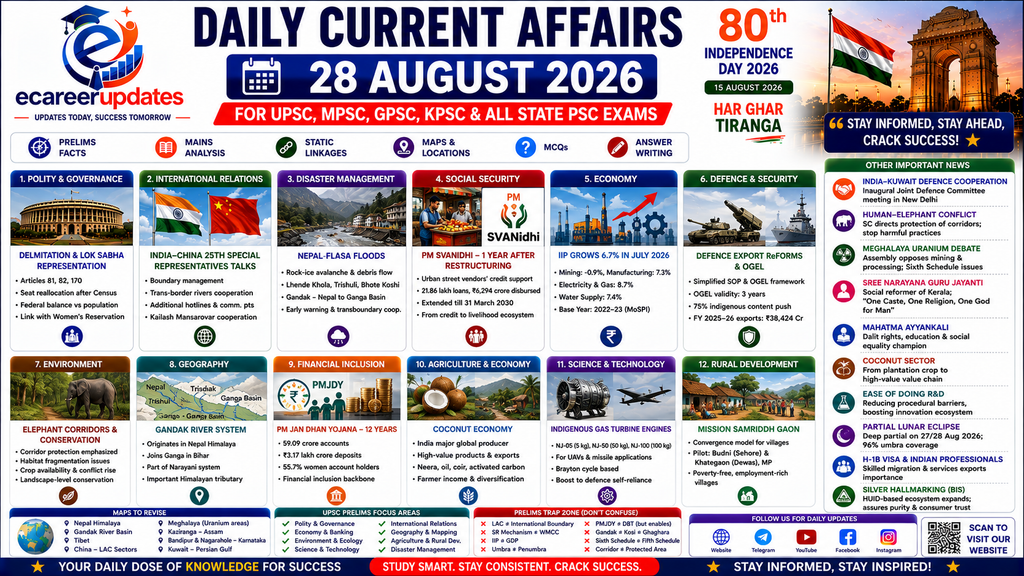
🔥 TODAY’S TOP 15 — HIGH-VALUE CURRENT AFFAIRS
| Rank | Topic | GS | Prelims | Mains |
|---|---|---|---|---|
| ⭐ 1 | India–China Boundary Talks | GS-II | ★★★★★ | ★★★★★ |
| ⭐ 2 | Nepal Himalayan Flash Floods | GS-I/III | ★★★★★ | ★★★★★ |
| ⭐ 3 | Delimitation & Lok Sabha Representation | GS-II | ★★★★★ | ★★★★★ |
| ⭐ 4 | PM Jan Dhan Yojana — 12 Years | GS-II/III | ★★★★ | ★★★★ |
| ⭐ 5 | IIP Growth 6.7% in July | GS-III | ★★★★★ | ★★★★ |
| ⭐ 6 | Defence Export SOP + OGEL Reforms | GS-III | ★★★★ | ★★★★ |
| ⭐ 7 | India–Kuwait Defence Cooperation | GS-II | ★★★ | ★★★★ |
| ⭐ 8 | Human–Elephant Conflict & Corridors | GS-III | ★★★★★ | ★★★★★ |
| ⭐ 9 | Meghalaya Uranium Debate | GS-II/III | ★★★★ | ★★★★★ |
| ⭐ 10 | Sree Narayana Guru & Ayyankali | GS-I | ★★★★★ | ★★★★ |
| ⭐ 11 | Coconut Economy & High-Value Agriculture | GS-III | ★★★★ | ★★★★ |
| ⭐ 12 | Ease of Doing R&D in India | GS-III | ★★★★ | ★★★★ |
| ⭐ 13 | Lunar Eclipse & Astronomy | GS-III | ★★★★ | ★★★ |
| ⭐ 14 | H-1B Visa & Indian Professionals | GS-II | ★★★★ | ★★★★ |
| ⭐ 15 | Silver Hallmarking / BIS | GS-III | ★★★ | ★★★ |
🏛️ 1. POLITY & GOVERNANCE
⭐ Delimitation, Lok Sabha Representation & Women’s Reservation
Why in News?
The issue of delimitation and the future size of the Lok Sabha remained a major political and constitutional debate on 28 August. The debate is closely linked to implementation of women’s reservation and the post-2026 constitutional framework for readjustment of seats.
The issue is particularly important because delimitation is not merely an electoral exercise—it affects:
Representation + Federalism + Population policy + Political equality + Women’s representation.
What is Delimitation?
Delimitation = readjustment/redrawing of electoral constituencies and allocation of seats based on population.
Constitutional linkage
| Provision | Relevance |
|---|---|
| Article 81 | Composition of Lok Sabha |
| Article 82 | Readjustment of seats after Census |
| Article 170 | Composition of State Legislative Assemblies |
| Article 327 | Parliament’s power regarding elections |
| Delimitation Commission | Conducts delimitation exercise |
Why was seat allocation frozen?
The freezing of constituency allocation was intended partly to ensure that states that successfully pursued population stabilisation would not be politically penalised through loss of parliamentary representation.
This creates the classic UPSC dilemma:
Should representation be based primarily on population or should demographic performance also receive weight?
Southern vs Northern States — Core Debate
| Argument for population-based delimitation | Concern |
|---|---|
| Equal representation | Southern states fear relative political weight may decline |
| Democratic principle | Population-control success could be penalised |
| Correct demographic representation | Federal balance may be disturbed |
| More equal constituency size | Need political consensus |
UPSC Mains Linkage
Demographic dividend → population control → federalism → fiscal transfers → parliamentary representation
This is an extremely important GS-II linkage for future Mains.
Prelims Trap ⚠️
Delimitation ≠ simple redrawing of constituency boundaries.
It can involve:
- allocation of seats,
- readjustment of constituencies,
- reservation of constituencies,
- territorial distribution.
🗳️ 2. ELECTORAL REFORMS
Electoral Roll Integrity
Concerns over electoral-roll deletions and the ongoing debate surrounding verification/Special Intensive Revision make electoral roll management another important GS-II area.
Static Concepts to Revise
Article 324
→ Election Commission
Article 325
→ No exclusion from electoral rolls on grounds only of religion, race, caste or sex
Article 326
→ Adult suffrage
Prelims Question Possibility
Which Article provides for elections to the Lok Sabha and State Assemblies on the basis of adult suffrage?
Answer: Article 326
🌏 3. INTERNATIONAL RELATIONS
⭐ India–China Boundary Talks — Eight-Point Consensus
The 25th round of Special Representatives (SR) talks between India and China concluded with an eight-point understanding covering border management, communication mechanisms and the broader boundary settlement process.
Major Elements
- Maintaining peace and tranquillity
- Advancing the boundary settlement framework
- Additional military communication mechanisms
- New hotlines in Eastern and Middle sectors
- Trans-border river cooperation
- Border trade
- Kailash Mansarovar-related cooperation
Why does it matter?
The immediate objective is conflict prevention, while the long-term objective remains boundary settlement.
LAC vs International Boundary
| LAC | International Boundary |
|---|---|
| Line of Actual Control | Legally demarcated international boundary |
| Represents actual control | Represents sovereign territorial boundary |
| India-China context | Normal state-to-state boundary |
| Not mutually demarcated throughout | Delimited/demarcated |
Important Mechanisms
| Mechanism | Function |
|---|---|
| Special Representatives | Political/diplomatic boundary negotiations |
| WMCC | Consultation and coordination |
| Border Personnel Meetings | Military-level communication |
| Expert-Level Mechanism | Transboundary river issues |
Mains Dimension
India-China relations have three simultaneous layers:
Competition
Border management
Cooperation
A mature answer should avoid portraying the relationship as simply “friendship vs conflict.”
🇰🇼 4. INDIA–KUWAIT DEFENCE COOPERATION
India and Kuwait held the inaugural Joint Defence Committee meeting in New Delhi on 28 August.
Areas discussed included:
- Training
- Military exercises
- Military medicine
- Staff talks
- Defence industry
- R&D
The mechanism operationalises the objectives of the India-Kuwait defence cooperation MoU signed during the Indian Prime Minister’s December 2024 Kuwait visit.
Why important?
Connect:
India–Gulf relations
→ Energy security
→ Indian diaspora
→ Maritime security
→ Defence cooperation
→ West Asian geopolitics
Prelims Map
Kuwait → Persian Gulf → Iraq, Saudi Arabia, Iran
🏔️ 5. GEOGRAPHY + DISASTER MANAGEMENT
⭐ Nepal Himalayan Flash Floods
The Nepal disaster is among the most important Geography + Environment + Disaster Management topics of this period.
A major rock-and-ice/debris event in the Himalayan region triggered severe flooding, affecting settlements and infrastructure and raising concerns over cascading Himalayan hazards.
Why are Himalayan regions vulnerable?
| Factor | Consequence |
|---|---|
| Young fold mountains | Geological instability |
| Steep slopes | Rapid runoff |
| Glaciers | GLOF risk |
| Permafrost/ice instability | Rock-ice avalanches |
| Heavy rainfall | Flash floods |
| Hydropower infrastructure | High exposure |
| Roads & tunnels | Slope destabilisation |
| Climate change | Cryosphere changes |
Disaster Chain
Glacial/rock instability
↓
Landslide / avalanche
↓
River blockage or sudden discharge
↓
Debris flow
↓
Flash flood
↓
Hydropower/bridge/road damage
↓
Downstream impact
Transboundary Dimension
Himalayan rivers connect:
Tibet → Nepal → India → Ganga Basin
Therefore disaster management cannot remain purely national.
Required Approach
- Real-time hydrological data sharing
- Joint early-warning systems
- Satellite monitoring
- Glacier inventory
- Hazard mapping
- Climate-resilient infrastructure
- Transboundary disaster protocols
Mains Question
Himalayan disasters are increasingly becoming cascading disasters rather than isolated natural events. Discuss.
🌊 6. GEOGRAPHY — GANDAK RIVER
The Gandak is an important river for today’s mapping revision.
Remember
Gandak = Nepal Himalaya → Bihar → Ganga
The river is also associated with the Narayani system in Nepal.
UPSC Map Work
Locate:
- Nepal
- Gandaki/Narayani
- Gandak
- Ganga
- Bihar
- Trishuli
- Himalayan catchments
Prelims Trap
Do not confuse:
Gandak ≠ Kosi ≠ Ghaghara
All are major Himalayan tributaries of the Ganga system, but they have different source regions and courses.
🌳 7. ENVIRONMENT
⭐ Human–Elephant Conflict & Elephant Corridors
The Supreme Court has directed authorities to strengthen protection of elephant corridors and identify obstructions that interfere with elephant movement. The Court has also addressed harmful practices used to drive elephants away.
A recent study around Bandipur and Nagarahole also found that crop availability and agricultural landscapes can strongly influence human-elephant conflict, particularly around the post-monsoon harvest period.
Why are elephant corridors important?
Elephants need large landscapes because they are:
- Highly mobile
- Social animals
- Seasonal movers
- Dependent on connected habitats
Habitat Fragmentation
Forest
↓
Road/Railway/Mine/Settlement
↓
Fragmentation
↓
Interrupted elephant movement
↓
Crop-raiding
↓
Human-elephant conflict
Conservation Approach
| Traditional approach | Better approach |
|---|---|
| Chase elephants | Maintain corridors |
| Physical barriers everywhere | Strategic barriers |
| Compensation after damage | Prevention + compensation |
| Isolated protected areas | Landscape connectivity |
| Reactive response | Early warning + forecasting |
Static Linkage
Project Elephant — 1992
Revise:
- Elephant ecology
- Corridors
- Human-wildlife conflict
- Wildlife Protection Act
- National Heritage Animal status
☢️ 8. ENVIRONMENT + TRIBAL RIGHTS
Meghalaya Uranium Mining Debate
The Meghalaya Assembly opposed uranium mining and uranium-processing facilities in the state, bringing together questions of strategic minerals, nuclear energy, environmental protection and community rights.
Why Meghalaya?
The issue is linked to uranium-bearing areas such as:
Domiasiat / Wahkaji region
Constitutional Linkage
Meghalaya is a Sixth Schedule State.
The Sixth Schedule deals with administration of tribal areas in:
- Assam
- Meghalaya
- Tripura
- Mizoram
The Policy Conflict
Nuclear Energy
vs
Environmental protection
vs
Tribal/community rights
vs
Mineral resource utilisation
Mains Framework
A balanced answer should argue for:
- scientific environmental assessment,
- community consultation,
- transparent rehabilitation,
- benefit sharing,
- ecological safeguards,
- strategic energy security.
💰 9. ECONOMY
⭐ India’s Industrial Production Grows 6.7%
India’s Index of Industrial Production (IIP) grew 6.7% year-on-year in July 2026.
Sector-wise:
| Sector | Growth |
|---|---|
| Mining & Quarrying | -0.9% |
| Manufacturing | 7.3% |
| Electricity & Gas | 8.7% |
| Water supply etc. | 7.4% |
| Overall IIP | 6.7% |
The latest IIP series uses 2022–23 as the base year.
What is IIP?
IIP measures changes in the volume of industrial production.
Broad sectors include:
Mining
Manufacturing
Electricity & Gas
Water supply/sewerage/waste management
Why UPSC likes IIP
It can test:
- Base year
- Sectoral weights
- Manufacturing
- Mining
- Electricity
- Growth vs index level
- MoSPI
Prelims Trap ⚠️
IIP is not GDP.
| IIP | GDP |
|---|---|
| Industrial production indicator | Overall economic output |
| High-frequency indicator | Broader macroeconomic indicator |
| Compiled by MoSPI | Compiled by NSO/MoSPI |
| Sector-specific | Agriculture + industry + services |
🏦 10. FINANCIAL INCLUSION
⭐ PM Jan Dhan Yojana — 12 Years
PMJDY has completed 12 years and has become a central pillar of India’s financial-inclusion architecture.
By August 2026, the scheme had around 59 crore bank accounts, demonstrating the scale of formal financial inclusion.
JAM Architecture
J — Jan Dhan
A — Aadhaar
M — Mobile
↓
DBT
↓
Reduced leakage
↓
Financial inclusion
↓
Formalisation
Why is PMJDY important?
It provides an entry point into:
- Banking
- DBT
- Insurance
- Pension
- Credit
- Digital payments
Challenges
Financial inclusion ≠ merely opening an account.
Important issues include:
- Dormant accounts
- Financial literacy
- Cyber fraud
- Digital divide
- Access to credit
Mains Question
India has achieved impressive financial-account penetration, but the next challenge is meaningful financial inclusion. Discuss.
🌴 11. AGRICULTURE & ECONOMY
Coconut Sector — From Plantation Crop to Value Chain
India’s coconut sector is important for:
Agriculture + Rural employment + Food processing + Exports + High-value agriculture
India is a major global coconut producer, and government interventions increasingly focus on productivity, rejuvenation, processing and exports.
Why Coconut is called “Kalpavriksha”?
Almost every part has economic utility:
| Part | Use |
|---|---|
| Coconut water | Beverage |
| Kernel | Food/oil |
| Husk | Coir |
| Shell | Charcoal/activated carbon |
| Leaves | Crafts/thatching |
| Sap | Neera/toddy-related products |
Economic Linkage
Primary production
↓
Processing
↓
Value addition
↓
Exports
↓
Farmer income
UPSC Concept
This is a good example of:
Moving from farm production to an integrated agricultural value chain.
🧪 12. SCIENCE & TECHNOLOGY
Ease of Doing R&D in India
A recent policy focus has been on improving India’s environment for research and development, including reducing procedural barriers and improving industry-academia linkages. The issue is relevant because India’s innovation ecosystem depends not only on funding but also on institutional ease of conducting research.
Main Bottlenecks
- Excessive approvals
- Procurement delays
- Weak university-industry links
- Fragmented research funding
- Limited technology transfer
- Low private R&D intensity
Mains Linkage
R&D
→ innovation
→ patents
→ productivity
→ strategic technologies
→ economic competitiveness
→ national security
🛡️ 13. DEFENCE & SECURITY
Defence Export SOP + OGEL Reforms
The Ministry of Defence simplified the Defence Export Standard Operating Procedure (SOP) and Open General Export Licence (OGEL) framework to facilitate exports while retaining safeguards for sensitive destinations and technologies.
What is OGEL?
Open General Export Licence
It allows eligible exporters to undertake multiple authorised consignments of specified defence items without seeking a fresh authorisation for every shipment.
Key Changes
| Earlier | Reform |
|---|---|
| Multiple procedures | Unified OGEL SOP |
| OGEL validity: 2 years | Increased to 3 years |
| Coverage limited | Expanded subject to exclusions |
| Repetitive authorisation | Greater self-generation flexibility |
India’s defence production reached ₹1.78 lakh crore and defence exports ₹38,424 crore in FY 2025–26, according to the Ministry of Defence release.
Why important?
Aatmanirbhar Bharat
Defence manufacturing
MSMEs
Exports
Strategic autonomy
⚓ 14. INDIA–KUWAIT + INDIAN OCEAN/WEST ASIA
India’s defence engagement with Kuwait should be read alongside India’s wider strategic relationship with Gulf countries.
Remember the 4 pillars:
Energy
Diaspora
Trade
Security
Mains Linkage
India’s West Asia policy increasingly involves:
Energy security + maritime security + diaspora diplomacy + defence cooperation + connectivity
👨🎓 15. SOCIAL JUSTICE + HISTORY
⭐ Sree Narayana Guru
28 August marks the birth anniversary of Sree Narayana Guru, the Kerala-based philosopher and social reformer associated with the struggle against caste discrimination and social inequality.
Core Ideas
Education
Organisation
Economic progress
Social equality
Aruvippuram Consecration — 1888
He consecrated a Shiva idol at Aruvippuram, challenging caste-based restrictions over access to religious spaces.
Famous message
“One Caste, One Religion, One God for Man.”
UPSC Linkage
Connect with:
- Social reform movements
- Anti-caste movements
- Kerala Renaissance
- Temple-entry movements
- Vaikom Satyagraha
- Social justice
✊ 16. HISTORY — MAHATMA AYYANKALI
Mahatma Ayyankali was another major social reformer of Kerala associated with the struggle for Dalit rights, education and social equality.
Important Contributions
| Event/Institution | Significance |
|---|---|
| Villuvandi Samaram | Challenged restrictions on movement |
| School for marginalised children | Educational access |
| Agricultural labour strike | Linked labour rights with education |
| Sadhu Jana Paripalana Sangham | Social mobilisation |
| Travancore legislative representation | Political participation |
Prelims Trap
Ayyankali → Kerala social reform
Narayana Guru → Kerala social/spiritual reform
Don’t merge their contributions.
🔭 17. SCIENCE — PARTIAL LUNAR ECLIPSE
A deep partial lunar eclipse occurred on 27–28 August 2026, with about 96% of the Moon’s disk entering Earth’s umbral shadow. It was not visible from India because the relevant phase occurred while the Moon was below India’s horizon/daytime conditions prevailed.
Lunar Eclipse — Static Concept
Sun → Earth → Moon
When Earth comes between the Sun and Moon:
Earth’s shadow falls on Moon
Umbra vs Penumbra
| Umbra | Penumbra |
|---|---|
| Dark central shadow | Lighter outer shadow |
| Stronger obscuration | Partial dimming |
Why does the Moon appear reddish?
Earth’s atmosphere scatters shorter wavelengths and refracts some longer-wavelength red light into the shadowed region.
Prelims Trap ⚠️
A lunar eclipse requires a Full Moon, but every Full Moon does not produce a lunar eclipse because the Moon’s orbital plane is inclined relative to Earth’s orbital plane.
💼 18. INTERNATIONAL ECONOMY — H-1B VISA
Changes/debates surrounding the H-1B visa remain important for India because Indian professionals constitute a major component of the US skilled-worker migration ecosystem.
Why UPSC?
Connect:
Migration
→ skilled labour
→ remittances
→ brain drain/brain gain
→ services exports
→ India-US relations
Mains Angle
Skilled migration should increasingly be viewed as a component of India’s global human-capital diplomacy.
🪙 19. ECONOMY + STANDARDS
BIS Silver Hallmarking & HUID
The Bureau of Indian Standards has been expanding the ecosystem of Hallmark Unique Identification (HUID)-based silver hallmarking.
Why hallmarking matters?
It improves:
- Purity assurance
- Consumer protection
- Traceability
- Market transparency
Prelims Linkage
BIS
→ statutory body
→ BIS Act, 2016
→ standards and conformity assessment
Gold vs Silver
The key exam concept is not simply memorising hallmarking dates but understanding:
Standardisation → certification → consumer protection
🏙️ 20. URBAN GOVERNANCE
Gurugram Urban Flooding
Heavy August rainfall again highlighted the vulnerability of rapidly urbanising regions such as Gurugram to urban flooding.
Urban Flooding ≠ River Flooding
Urban flooding may result from:
- Impervious surfaces
- Drainage failure
- Encroachment of natural drains
- Wetland loss
- Poor land-use planning
- Extreme rainfall
- Solid waste blocking drainage
Mains Linkage
Climate change
unplanned urbanisation
wetland loss
drainage deficit
=
Urban flood risk
Solution
Blue-Green Infrastructure
- Urban wetlands
- Sponge-city principles
- Permeable surfaces
- Rain gardens
- Restored drains
- Floodplain zoning
- Decentralised stormwater management
🧠 21. PRELIMS STATIC LINKAGE — TODAY’S GOLDMINE
| News | Static Topic to Revise |
|---|---|
| Delimitation | Articles 81, 82, 170 |
| India-China | LAC + 1993/1996/2005 agreements |
| Nepal floods | Himalayan geomorphology |
| PMJDY | JAM + DBT |
| IIP | MoSPI + base year + sectoral classification |
| Defence exports | OGEL + defence indigenisation |
| Human-elephant conflict | Project Elephant + corridors |
| Meghalaya uranium | Sixth Schedule |
| Narayana Guru | Kerala Renaissance |
| Ayyankali | Dalit/social reform movements |
| Lunar eclipse | Umbra + penumbra |
| H-1B | Migration + services exports |
| Silver hallmarking | BIS + standards |
| Coconut | Plantation agriculture + value chains |
⚠️ UPSC PRELIMS TRAP ZONE
Don’t confuse these:
| ❌ Confusion | ✅ Correct |
|---|---|
| LAC = International Boundary | LAC is not a fully demarcated international boundary |
| IIP = GDP | IIP is an industrial production index |
| PMJDY = DBT | PMJDY enables/strengthens financial inclusion and DBT |
| OGEL = export ban exemption | OGEL is an export authorisation mechanism |
| Lunar eclipse = New Moon | Lunar eclipse occurs at Full Moon |
| Umbra = Penumbra | Umbra is darker central shadow |
| Gandak = Kosi | Different Himalayan rivers |
| Sixth Schedule = Fifth Schedule | Different constitutional tribal-area frameworks |
| Elephant corridor = protected area | A corridor connects habitats; it need not itself be a National Park |
| Narayana Guru = Ayyankali | Distinct reformers with overlapping social-justice concerns |
🗺️ MAP WORK — 28 AUGUST
India
📍 Meghalaya — uranium regions
📍 Kerala — Sree Narayana Guru / Ayyankali
📍 Assam — elephant landscapes
📍 Bandipur — Karnataka
📍 Nagarahole — Karnataka
📍 Bihar — Gandak basin
📍 Gurugram — urban flooding
International
📍 Nepal
📍 Tibet
📍 China
📍 Kuwait
📍 Persian Gulf
📍 Japan
📍 USA
📊 TODAY’S “NEWS → STATIC” MASTER CHART
| Current Event | Static Concept | Possible UPSC Question |
|---|---|---|
| Lok Sabha delimitation | Federalism & representation | Population vs federal balance |
| India-China talks | Border management | LAC mechanisms |
| Nepal flood | Himalayan geography | Cascading disasters |
| IIP 6.7% | Industrial growth | IIP methodology |
| PMJDY | Financial inclusion | JAM/DBT |
| Defence export reform | Strategic autonomy | Defence exports |
| Elephant corridors | Landscape ecology | Habitat fragmentation |
| Meghalaya uranium | Tribal governance | Sixth Schedule |
| Narayana Guru | Modern Indian history | Kerala Renaissance |
| Lunar eclipse | Astronomy | Umbra/penumbra |
| Coconut | Agriculture | Value-chain diversification |
🎯 10 UPSC-STYLE PRELIMS QUESTIONS
Q1. Consider the following statements regarding delimitation:
- Delimitation involves readjustment of electoral constituencies.
- Article 82 is associated with readjustment after each Census.
- Delimitation is merely an administrative exercise and has no federal implications.
Which are correct?
Answer: 1 and 2 only
Q2. With reference to IIP:
- It is compiled by MoSPI.
- Manufacturing forms an important component.
- IIP directly measures national income.
Answer: 1 and 2 only
Q3. The Gandak is associated with which river system?
A. Narmada
B. Ganga
C. Godavari
D. Mahanadi
Answer: B
Q4. A lunar eclipse occurs when:
A. Moon lies between Sun and Earth
B. Earth lies between Sun and Moon
C. Sun lies between Earth and Moon
D. Earth and Moon are at right angles
Answer: B
Q5. PMJDY is primarily associated with:
A. Universal crop insurance
B. Financial inclusion
C. Urban housing
D. Skill development
Answer: B
Q6. OGEL is associated with:
A. Agriculture exports
B. Defence exports
C. Pharmaceutical imports
D. Fisheries exports
Answer: B
Q7. Consider:
- Meghalaya is covered under the Sixth Schedule.
- Sixth Schedule provides for Autonomous District Councils.
- Sixth Schedule applies to all northeastern states.
Answer: 1 and 2 only
Q8. Which one is correctly matched?
| Reformer | Region |
|---|---|
| Ayyankali | Kerala |
| Sree Narayana Guru | Kerala |
Answer: Both correctly matched
Q9. Which of the following best describes an elephant corridor?
A. A zone exclusively used for tourism
B. A landscape connecting fragmented elephant habitats
C. A marine conservation area
D. A captive elephant breeding centre
Answer: B
Q10. A lunar eclipse requires:
A. New Moon
B. Full Moon
C. First Quarter
D. Third Quarter
Answer: B
✍️ MAINS ANSWER-WRITING PRACTICE
GS-II — 10 Marks
“Delimitation is not merely a technical exercise in redrawing electoral constituencies; it is fundamentally an issue of federal representation.” Discuss.
GS-II — 15 Marks
India-China relations require simultaneous management of territorial disputes and functional cooperation. Examine.
GS-I/III — 10 Marks
Explain the geographical factors responsible for increasing disaster vulnerability in the Himalayas.
GS-III — 15 Marks
Human-elephant conflict reflects the failure of landscape-level conservation. Discuss suitable strategies for balancing conservation with livelihood security.
GS-III — 10 Marks
Industrial growth is an important indicator of economic momentum, but IIP alone cannot provide a complete picture of economic health. Explain.
GS-I — 10 Marks
Discuss the contribution of Sree Narayana Guru and Ayyankali to social reform in Kerala.
📝 ONE MODEL MAINS FRAMEWORK
“Himalayan disasters are becoming increasingly complex.”
Introduction
The Himalayas are a young, tectonically active mountain system characterised by steep slopes, fragile geology and a rapidly changing cryosphere.
Body
1. Natural factors
- seismicity
- steep slopes
- glacial instability
- heavy rainfall
2. Climate factors
- glacier retreat
- changing precipitation
- extreme rainfall
- permafrost instability
3. Human factors
- hydropower
- roads
- tourism
- unplanned settlements
4. Governance gaps
- inadequate hazard mapping
- weak early warning
- fragmented institutions
- limited transboundary cooperation
Way Forward
Risk-sensitive infrastructure + early warning + regional data sharing + ecosystem restoration + community participation
Conclusion
Himalayan development must shift from “build first, respond later” to “assess risk, build resiliently and manage landscapes holistically.”
🔗 THE 5 BIG THEMES OF 28 AUGUST 2026
Instead of memorising 20 unrelated headlines, remember today’s current affairs through five larger UPSC themes:
1️⃣ Democratic Representation
Delimitation → Federalism → Women’s Reservation → Electoral Reform
2️⃣ Himalayan Resilience
Nepal Flood → Glacier/Ice → Rivers → Infrastructure → Disaster Management
3️⃣ Inclusive & Productive Economy
PMJDY → IIP → Coconut → R&D → Defence Manufacturing
4️⃣ Ecological Governance
Elephant Corridors → Human-Wildlife Conflict → Uranium → Climate Resilience
5️⃣ Strategic India
China → Kuwait → Defence Exports → H-1B → Global Economic Engagement
🚀 15-MINUTE REVISION CAPSULE
If you have only 15 minutes, revise these:
🏛️ Polity
Article 81 + Article 82 + Delimitation + Federalism
🌏 IR
25th India-China SR talks + LAC + WMCC + Hotlines
🌊 Geography
Nepal + Himalayas + Gandak + Transboundary Rivers
💰 Economy
IIP = 6.7% + Manufacturing = 7.3% + Electricity/Gas = 8.7%
💳 Social Sector
PMJDY → JAM → DBT → Financial Inclusion
🛡️ Defence
OGEL → Defence exports → Aatmanirbhar Bharat
🌳 Environment
Elephant corridors → Habitat fragmentation → Project Elephant
☢️ Environment/Polity
Meghalaya → Uranium → Sixth Schedule
📜 History
Narayana Guru + Ayyankali → Kerala Renaissance
🔭 Science
Partial Lunar Eclipse → Full Moon → Umbra/Penumbra
🌟 FINAL UPSC TAKEAWAY
The real value of 28 August 2026 current affairs is not in remembering individual headlines. The day offers a remarkably useful UPSC-style web of connections:
Delimitation → Federalism → Representation
Nepal floods → Himalayan geography → Climate change → Disaster management
IIP → Manufacturing → Economic growth → Employment
PMJDY → JAM → DBT → Financial inclusion
Elephant corridors → Habitat fragmentation → Human-wildlife conflict
Uranium → Nuclear energy → Tribal rights → Environmental governance
Narayana Guru/Ayyankali → Kerala Renaissance → Social justice
Defence exports → MSMEs → Aatmanirbhar Bharat → Strategic autonomy
This is precisely the preparation style demanded by the recent UPSC Prelims approach: don’t ask only “What happened?”; ask “What static concept sits behind the news, what statement could UPSC frame, and what wider Mains issue does it connect to?”