UPSC Prelims & Mains | MPSC | GPSC | KPSC/KAS | State PSCs | Group A, B & C
Date: 24 August 2026
Target Exams: UPSC CSE 2027 • MPSC Rajyaseva • GPSC • KPSC/KAS • MPPSC • RPSC • BPSC • Other State PSCs
🎯 Today’s UPSC Approach
Current Affair → Static Concept → Constitutional/Institutional Linkage → Prelims Trap → Mains Dimension → Interlinkage → Way Forward
The UPSC Prelims 2026 trend again reinforces the importance of integrating current affairs with static subjects rather than preparing them as separate compartments. Analyses of the paper highlight conceptual, analytical, statement-based and elimination-oriented questions.
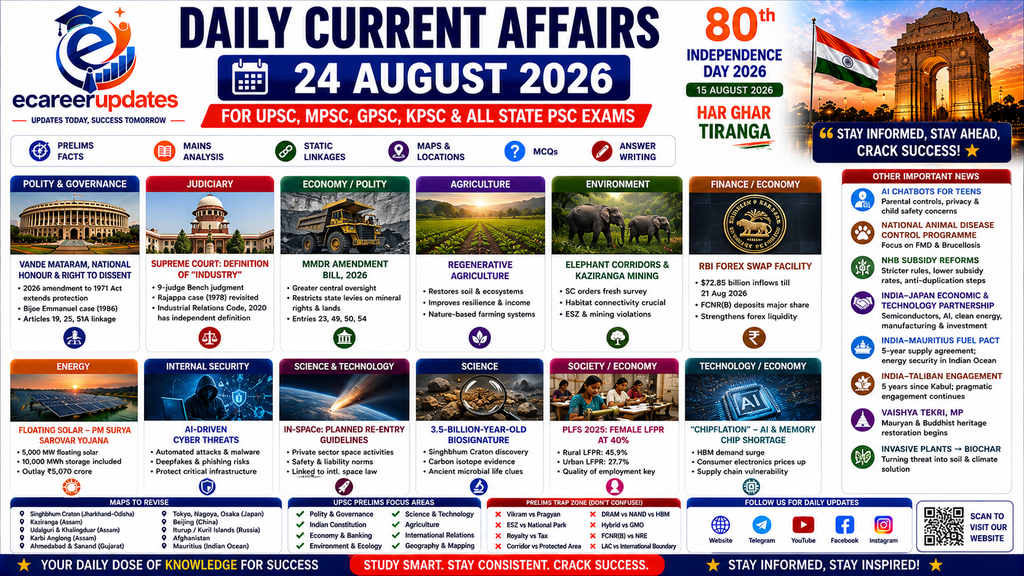
📊 24 AUGUST 2026 — CURRENT AFFAIRS AT A GLANCE
| Category | Today’s Important Topic | GS | Priority |
|---|---|---|---|
| ⚖️ Polity | Vande Mataram, National Honour & Right to Dissent | GS-II | 🔴 ⭐⭐⭐⭐⭐ |
| ⚖️ Judiciary | Supreme Court: Definition of “Industry” | GS-II | 🔴 ⭐⭐⭐⭐⭐ |
| ⛏️ Economy/Polity | MMDR Amendment Bill 2026 | GS-II/III | 🔴 ⭐⭐⭐⭐⭐ |
| 🌾 Agriculture | Regenerative Agriculture | GS-III | 🔴 ⭐⭐⭐⭐⭐ |
| 🌳 Environment | Elephant Corridors & Kaziranga Mining | GS-III | 🔴 ⭐⭐⭐⭐⭐ |
| 🌿 Environment | Invasive Plants → Biochar | GS-III | 🟠 ⭐⭐⭐⭐ |
| ☀️ Energy | Floating Solar + PM Surya Sarovar Yojana | GS-III | 🔴 ⭐⭐⭐⭐⭐ |
| 🛡️ Security | AI-driven Cyber Threats | GS-III | 🔴 ⭐⭐⭐⭐⭐ |
| 🚀 Space | IN-SPACe Planned Re-entry Guidelines | GS-III | 🔴 ⭐⭐⭐⭐⭐ |
| 🧬 Science | 3.5-billion-year-old biosignature — Singhbhum Craton | GS-I/III | 🔴 ⭐⭐⭐⭐⭐ |
| 🤖 AI | ChatGPT for Teens & AI Child Safety | GS-II/III | 🟠 ⭐⭐⭐⭐ |
| 💻 Economy/S&T | “Chipflation” — AI & Memory Chip Shortage | GS-III | 🔴 ⭐⭐⭐⭐⭐ |
| 👩💼 Society | Female Labour Force Participation — PLFS 2025 | GS-II/III | 🔴 ⭐⭐⭐⭐⭐ |
| 🌾 Agriculture | National Horticulture Board subsidy reforms | GS-III | 🟠 ⭐⭐⭐⭐ |
| 🇯🇵 IR/Economy | India–Japan trade & technology push | GS-II/III | 🟠 ⭐⭐⭐⭐ |
| 🐄 Health/Agriculture | National Animal Disease Control Programme | GS-II/III | 🟠 ⭐⭐⭐⭐ |
| 🇦🇫 IR | India–Taliban engagement: five years after Kabul | GS-II | 🟠 ⭐⭐⭐⭐ |
🔥 TOP 15 — MUST READ TODAY
If you have limited time, revise these first:
- MMDR Amendment Bill 2026
- Supreme Court’s Industry Definition judgment
- Vande Mataram & Right to Dissent
- Elephant Corridors + Kaziranga
- Regenerative Agriculture
- Floating Solar / PM-SSY
- AI + Cybersecurity
- IN-SPACe Re-entry Guidelines
- Singhbhum Craton biosignature
- Chipflation
- PLFS 2025 & Female LFPR
- NHB subsidy reform
- India–Japan technology partnership
- NADCP
- India–Taliban engagement
⚖️ 1. POLITY & GOVERNANCE
Vande Mataram, National Honour and the Right to Dissent
⭐⭐⭐⭐⭐ VERY HIGH PRIORITY
The Prevention of Insults to National Honour (Amendment) Act, 2026 has extended statutory protection under Section 3 of the 1971 Act to Vande Mataram, alongside the National Anthem, Jana Gana Mana. Importantly, the law penalises intentional prevention or disruption of their singing; it does not itself make singing Vande Mataram compulsory.
This creates an excellent UPSC linkage between:
National symbols
→ Fundamental Rights
→ Fundamental Duties
→ Freedom of conscience
→ Reasonable restrictions
→ Constitutional morality
📜 Static Background
Vande Mataram
- Composed by Bankim Chandra Chattopadhyay
- Appeared in Anandamath
- Became an important symbol during the freedom movement
- Associated particularly with the Swadeshi movement
- It is India’s National Song, whereas Jana Gana Mana is the National Anthem.
⚖️ Constitutional Linkage
| Provision | Relevance |
|---|---|
| Article 19(1)(a) | Freedom of speech and expression |
| Article 25 | Freedom of conscience and religion |
| Article 26 | Religious denomination rights |
| Article 51A | Fundamental Duties |
| Article 14 | Equality before law |
| Article 21 | Life and personal liberty/dignity |
⭐ Most Important Case
Bijoe Emmanuel v. State of Kerala (1986)
The Supreme Court held that students who respectfully stood during the National Anthem but did not sing because of genuine religious beliefs could not be compelled to sing.
Core principle:
Respect does not necessarily require active participation.
The case is therefore highly relevant when discussing the balance between:
National honour
and
Individual liberty/conscience.
🎯 PRELIMS TRAP
Incorrect assumption:
“The 2026 amendment makes singing Vande Mataram compulsory.”
❌ Incorrect.
The key legal issue is intentional prevention or disturbance, not mere respectful non-participation.
✍️ MAINS QUESTION
“Constitutional patriotism requires respect for national symbols while preserving freedom of conscience.” Discuss.
Answer framework:
National symbols
↓
Unity + national identity
BUT
↓
Individual conscience
↓
Article 19 + Article 25
↓
Constitutional balance
Way Forward
- Prevent deliberate disrespect
- Protect peaceful dissent
- Avoid compelled patriotism
- Follow Bijoe Emmanuel
- Ensure non-discriminatory enforcement
⚖️ 2. JUDICIARY + LABOUR
Supreme Court on the Definition of “Industry”
⭐⭐⭐⭐⭐ MUST READ
A nine-judge Constitution Bench of the Supreme Court has examined the long-standing definition of “industry” arising from the landmark Bangalore Water Supply and Sewerage Board v. R. Rajappa (1978) case.
The Court’s 6:3 majority held that the reference concerning the 1978 judgment was maintainable, while clarifying that the new Industrial Relations Code, 2020 has its own definition and must be interpreted independently. Pending matters under the repealed Industrial Disputes Act continue to be governed by the earlier framework.
🏭 What was the “Triple Test”?
The famous Bangalore Water Supply case adopted a broad approach to determine whether an activity constitutes an “industry.”
For UPSC, remember the broad conceptual elements:
Systematic activity
Organised employer–employee cooperation
Production/distribution of goods or services for human wants
🧠 Why is this judgment important?
It demonstrates a crucial principle:
A judicial interpretation under an old statute cannot automatically be transplanted into a new statutory framework with different wording.
The Industrial Relations Code, 2020 came into force after the repeal of the Industrial Disputes Act framework, and its definition must therefore be examined from its own text and context.
📊 Important Comparison
| Aspect | Old Framework | New Framework |
|---|---|---|
| Main law | Industrial Disputes Act, 1947 | Industrial Relations Code, 2020 |
| Famous case | Bangalore Water Supply, 1978 | Independent interpretation required |
| Status | Repealed framework | Current labour-code framework |
| Triple Test | Relevant to pending old-law matters | Not automatically transplanted |
| Core issue | Meaning of “industry” | New statutory definition |
🎯 PRELIMS TRAP
“The Supreme Court automatically applied the 1978 Triple Test to the Industrial Relations Code, 2020.”
❌ Incorrect.
The Court specifically distinguished the two statutory frameworks.
✍️ MAINS QUESTION
“Judicial interpretation must evolve with changes in statutory frameworks while preserving legal certainty.” Discuss with reference to labour jurisprudence.
⛏️ 3. POLITY + ECONOMY
Mines and Minerals (Development and Regulation) Amendment Bill, 2026
⭐⭐⭐⭐⭐ VERY HIGH PRIORITY
The MMDR Amendment Bill, 2026 was introduced in Lok Sabha on 10 August 2026, passed by Lok Sabha on 12 August and Rajya Sabha on 13 August. It seeks, among other things, to place greater central regulatory control over mineral-bearing land and restrict certain State levies on mineral rights and mineral-bearing lands.
🏛️ Why is this a major UPSC topic?
Because it combines:
Mining
Fiscal federalism
Seventh Schedule
State taxation powers
Centre-State relations
Critical minerals
📜 Constitutional Entries to Memorise
| Entry | Subject |
|---|---|
| Union List Entry 54 | Regulation of mines and mineral development |
| State List Entry 23 | Regulation of mines/mineral development subject to Union law |
| State List Entry 49 | Taxes on lands and buildings |
| State List Entry 50 | Taxes on mineral rights subject to limitations imposed by Parliament |
The 2024 Supreme Court judgment had held that royalty is not a tax and recognised State legislative power to tax mineral rights, subject to constitutional limitations.
🔗 MMDR Issue in One Diagram
Mineral resources
↓
Mining
↓
Royalty + taxes + levies
↓
State revenue
↓
Federal balance
↓
MMDR Amendment
↓
Greater central control/restrictions
⚠️ Why States are concerned
Mineral-rich States may depend significantly on:
- Royalty
- Mineral taxes
- Cesses
- District Mineral Foundation-related flows
- Mining-linked economic activity
Therefore, the Bill raises a fundamental question:
How should India’s mineral wealth be governed while maintaining fiscal federalism?
🎯 PRELIMS TRAP
Do not confuse:
Royalty
with
Tax
The Supreme Court’s 2024 ruling treated royalty as not a tax.
✍️ MAINS QUESTION
“India’s transition to a mineral-intensive economy requires balancing national mineral security with the fiscal autonomy of resource-rich States.” Discuss.
Use examples:
- Critical minerals
- Lithium
- Cobalt
- Rare earth elements
- Coal
- Iron ore
- State revenues
- MMDR framework
🌾 4. AGRICULTURE
Regenerative Agriculture — Rebuilding India’s Farming Systems
⭐⭐⭐⭐⭐
The Government is increasingly emphasising regenerative agriculture as a way of improving soil health, biodiversity, water efficiency and climate resilience.
The approach has become especially relevant because India’s agricultural growth must increasingly be sustained without exhausting soil and water resources. The government has highlighted measures involving natural farming, agroforestry, micro-irrigation, integrated farming and soil-health management.
🌱 What is Regenerative Agriculture?
It is an approach that aims not merely to reduce environmental damage, but to restore ecological functions of agricultural systems.
Core practices
- Cover cropping
- Mulching
- Crop diversification
- Crop rotation
- Green manuring
- Reduced soil disturbance
- Agroforestry
- Integrated livestock
- Biological inputs
- Water conservation
🔄 Traditional vs Regenerative Approach
| Conventional Pressure | Regenerative Response |
|---|---|
| Soil degradation | Soil restoration |
| High chemical dependence | Integrated/natural inputs |
| Water stress | Water conservation |
| Biodiversity loss | Crop/ecosystem diversity |
| Carbon emissions | Soil carbon sequestration |
| Climate vulnerability | Climate resilience |
🧠 Major UPSC Linkage
Regenerative agriculture
↓
Soil organic matter ↑
↓
Water retention ↑
↓
Input dependence ↓
↓
Climate resilience ↑
↓
Farm income stability ↑
🎯 PRELIMS
Don’t confuse:
Regenerative Agriculture
with
Organic Agriculture
They overlap but are not identical.
Organic farming is defined primarily around restrictions on synthetic inputs and production standards, whereas regenerative agriculture focuses strongly on restoring soil and ecosystem functions.
✍️ MAINS QUESTION
“Indian agriculture needs to move from input-intensive productivity to resource-restorative productivity.” Discuss.
🌳 5. ENVIRONMENT
Elephant Corridors + Kaziranga Mining
⭐⭐⭐⭐⭐ MUST REVISE
The Supreme Court has directed a fresh survey of elephant corridors and emphasised that States cannot obstruct traditional elephant movement routes. At the same time, the Central Empowered Committee has raised concerns over mining violations near Kaziranga National Park.
🐘 What is an Elephant Corridor?
A wildlife corridor provides connectivity between fragmented habitats.
Why important?
Habitat fragmentation
↓
Movement barriers
↓
Isolation
↓
Reduced gene flow
↓
Human-wildlife conflict
↓
Population vulnerability
🦏 Kaziranga — Static Revision
| Feature | Fact |
|---|---|
| State | Assam |
| Major river system | Brahmaputra floodplain |
| Famous species | One-horned rhinoceros |
| UNESCO status | World Heritage Site |
| Tiger Reserve | Yes |
| Important ecosystem | Grassland + wetlands + forest |
| Southern landscape | Karbi Anglong hills |
Kaziranga’s southern boundary and the adjoining Karbi Anglong landscape are particularly important because ecological processes extend beyond the formal protected-area boundary.
⚖️ Judicial Linkage
The issue connects:
Supreme Court
Central Empowered Committee
Wildlife Protection Act
Protected Areas
ESZ
Federalism
🎯 PRELIMS TRAP
Corridor ≠ Protected Area
A corridor may include multiple land-use categories and does not necessarily have the same legal status as a National Park or Wildlife Sanctuary.
✍️ MAINS
“Protected-area boundaries are administrative constructs, whereas ecosystems operate as landscapes.” Discuss.
🌿 6. ENVIRONMENT + CIRCULAR ECONOMY
Invasive Plants Converted into Biochar
A project in Khalingduar Reserve Forest, Udalguri, Assam, is converting invasive alien plants into biochar as part of habitat restoration for elephants.
The approach creates an interesting circular model:
Ecological problem → ecological resource
🌱 Invasive Alien Plants
Examples include:
- Lantana camara
- Chromolaena odorata
- Mikania micrantha
These species can suppress native vegetation and alter habitat quality.
🔥 What is Biochar?
Biochar is a carbon-rich material produced through pyrolysis of biomass under low-oxygen conditions.
Potential benefits
- Improves soil structure
- Enhances water retention
- Provides microbial habitat
- Stores carbon
- Converts biomass waste into useful material
🔗 UPSC LINKAGE
Invasive species removal
↓
Biomass
↓
Pyrolysis
↓
Biochar
↓
Soil restoration
↓
Carbon sequestration
↓
Climate resilience
This combines:
Environment + Agriculture + Climate + Circular Economy
☀️ 7. ENERGY & ENVIRONMENT
Floating Solar — Pradhan Mantri Surya Sarovar Yojana
⭐⭐⭐⭐⭐
The Pradhan Mantri Surya Sarovar Yojana (PM-SSY) has an outlay of ₹5,070 crore and aims to develop 5,000 MW of Floating Solar PV projects with at least 10,000 MWh of co-located energy storage. Projects are to be sanctioned from FY 2026–27 to FY 2030–31.
📊 PM-SSY QUICK FACTS
| Parameter | Detail |
|---|---|
| Outlay | ₹5,070 crore |
| Floating Solar Target | 5,000 MW |
| Storage | 10,000 MWh |
| Implementation | FY 2026–27 to FY 2030–31 |
| Estimated national potential | 102.18 GWp |
| Current floating solar capacity | ~700 MW |
| Expected annual CO₂ reduction | ~10 million tonnes |
🌊 Why Floating Solar?
Advantages
Water surface
↓
No large land acquisition
↓
Solar generation
↓
Potentially lower evaporation
↓
Reduced pressure on agricultural/forest land
↓
Renewable electricity
⚠️ Challenges
- Aquatic biodiversity
- Fishing livelihoods
- Water quality
- Anchoring
- Maintenance
- Transmission
- Reservoir-use conflicts
- Storage costs
🧠 Prelims Concept
Floating Solar
= Photovoltaic technology
It is not hydropower.
✍️ MAINS
“Floating solar can help India address the land constraint of renewable-energy expansion, but ecological safeguards are essential.” Discuss.
🛡️ 8. INTERNAL SECURITY
AI-Driven Cyber Threats
⭐⭐⭐⭐⭐
Artificial Intelligence is changing cyber operations by enabling:
- Automated reconnaissance
- Hyper-personalised phishing
- Deepfakes
- Polymorphic malware
- Automated vulnerability discovery
- Autonomous cyber operations
This changes the cyber-threat environment from human-speed attacks to machine-speed attacks.
💻 Cyber Kill Chain + AI
| Stage | AI Advantage |
|---|---|
| Reconnaissance | Automated target profiling |
| Weaponisation | Automated malicious-code generation |
| Delivery | Personalised phishing |
| Exploitation | Vulnerability discovery |
| Installation | Malware deployment |
| Command & Control | Automated adaptation |
| Actions | Data theft/disruption |
🇮🇳 Why India is vulnerable?
India’s digital expansion means increasing dependence on:
- Power grids
- Telecom
- Banking
- Digital payments
- Defence networks
- Nuclear infrastructure
- Transport
- Smart cities
- Industrial control systems
🧠 Static Linkage
Cybersecurity
→ CERT-In
→ Critical Information Infrastructure
→ National Cyber Security Policy
→ Data Protection
→ Cybercrime
→ AI governance
🎯 PRELIMS TRAP
AI ≠ only generative chatbots.
AI can also be used for:
- Pattern recognition
- Autonomous decision support
- Cyber threat detection
- Malware generation
- Image/video manipulation
- Predictive analysis
✍️ MAINS QUESTION
“AI has democratised both cyber defence and cyber offence.” Examine the implications for India’s internal security.
Way Forward
- Sovereign AI capability
- AI-enabled cyber defence
- Skilled workforce
- Secure hardware
- Critical infrastructure protection
- Zero-trust architecture
- International cyber cooperation
- AI safety standards
🚀 9. SCIENCE & TECHNOLOGY
IN-SPACe Planned Spacecraft Re-entry Guidelines
⭐⭐⭐⭐⭐
With India’s private space sector expanding, IN-SPACe has released guidelines dealing with planned spacecraft re-entry.
The issue is important because spacecraft returning to Earth can create risks involving:
- Airspace
- Maritime zones
- Population
- Property
- Environmental damage
- International liability
🛰️ What is IN-SPACe?
Indian National Space Promotion and Authorisation Centre
It was established in 2020 under the Department of Space as an autonomous single-window institution for authorising, promoting and regulating space activities by non-governmental entities.
🌍 International Legal Linkage
Outer Space Treaty, 1967
States bear international responsibility for national activities in outer space, including activities carried out by non-governmental entities.
Liability Convention, 1972
The launching State bears liability for damage caused by its space objects in specified circumstances.
Registration Convention, 1976
States are required to register space objects.
🔗 Space Governance Chain
Private space activity
↓
IN-SPACe authorisation
↓
Safety requirements
↓
Re-entry planning
↓
International responsibility
↓
Space sustainability
🎯 PRELIMS
Remember:
IN-SPACe
→ Department of Space
→ Private space sector
→ Authorisation/regulation/promotion
It is not the same as ISRO.
✍️ MAINS
“Commercialisation of space requires a transition from voluntary international norms to enforceable domestic safety standards.” Discuss.
🧬 10. SCIENCE + GEOLOGY
3.5-Billion-Year-Old Biosignature — Singhbhum Craton
⭐⭐⭐⭐⭐
Researchers have reported evidence of microbial life dating to approximately 3.5 billion years ago in a chert from the Singhbhum Craton region of eastern India.
The research uses multiple lines of evidence, including carbon-isotope signatures and U-Pb dating of associated zircons.
🌍 What is a Craton?
A craton is an ancient, relatively stable portion of continental crust that has remained comparatively undisturbed over geological time.
Singhbhum Craton
→ Jharkhand–Odisha region
→ Ancient continental crust
→ Important geological archive
🔬 How was ancient life investigated?
Step 1
Rock sample
↓
Step 2
Geological dating
↓
Step 3
Carbon-isotope analysis
↓
Step 4
Search for organic/biosignature evidence
↓
Step 5
Cross-check alternative explanations
↓
Evidence for ancient microbial activity
The study reports zircon ages of around 3.5 billion years and biological carbon-isotope signatures.
🎯 PRELIMS CONCEPTS
Zircon
Important because:
- Resistant mineral
- Contains uranium
- Useful for U-Pb radiometric dating
- Acts as a geological “clock”
Chert
Silica-rich, fine-grained rock capable of preserving ancient material.
✍️ MAINS
“Ancient geological archives can provide important clues to the origin and evolution of life on Earth.” Discuss.
Link with:
- Astrobiology
- Origin of life
- Earth evolution
- Radiometric dating
- Search for extraterrestrial life
🤖 11. SCIENCE, GOVERNANCE & CHILD SAFETY
AI Chatbots for Teenagers
A recent development involving AI chatbots designed specifically for 13–17-year-olds has renewed debate about:
- Parental controls
- AI safety
- Emotional dependence
- Age assurance
- Privacy
- Digital wellbeing
- Educational use of AI
🇮🇳 Indian Regulatory Linkage
DPDP Act, 2023
For children’s personal data, the Act provides for safeguards including verifiable parental consent and restrictions related to tracking/behavioural monitoring of children.
The larger issue is that India’s existing framework does not constitute a standalone, comprehensive AI-child-safety law.
🧠 UPSC Governance Question
The challenge:
Innovation
vs
Child protection
vs
Privacy
vs
Freedom
✍️ MAINS
“AI regulation should become risk-based rather than technology-neutral.” Discuss with reference to children and generative AI.
💻 12. ECONOMY + TECHNOLOGY
“Chipflation” — AI Boom and Memory-Chip Shortage
⭐⭐⭐⭐⭐ IMPORTANT
The rapid expansion of AI infrastructure is increasing demand for advanced memory technologies, particularly High Bandwidth Memory (HBM).
This has contributed to shortages in memory-chip supply and rising prices for some consumer electronics — a phenomenon being referred to as “chipflation.”
🧠 Semiconductor Basics
| Type | Characteristic | Common Use |
|---|---|---|
| DRAM | Volatile memory | Working memory |
| NAND Flash | Non-volatile | SSDs, phones |
| HBM | High-bandwidth stacked memory | AI accelerators |
| CPU | Processing | Computers |
| GPU | Parallel computation | AI/graphics |
🔗 AI → Semiconductor Chain
AI data centres
↓
AI accelerators
↓
HBM demand ↑
↓
Memory production capacity constrained
↓
Consumer electronics supply pressure
↓
Prices ↑
↓
Chipflation
🇮🇳 India’s Strategic Challenge
India needs capabilities across:
Design
→ Materials
→ Fabrication
→ Packaging
→ Testing
→ Memory
→ AI hardware
The India Semiconductor Mission is therefore not merely an industrial policy; it is also linked to strategic autonomy and supply-chain resilience.
🎯 PRELIMS
DRAM
Volatile
→ Data lost when power is removed.
NAND
Non-volatile
→ Data retained without power.
✍️ MAINS
“The AI revolution is simultaneously creating a technology opportunity and a semiconductor supply-chain vulnerability for India.” Discuss.
👩💼 13. SOCIETY + ECONOMY
PLFS 2025 — Female Labour Force Participation
⭐⭐⭐⭐⭐
The Periodic Labour Force Survey 2025 reports a significant rise in India’s female labour-force participation rate.
The reported female LFPR for population aged 15+ reached 40% in 2025, compared with about 30% in 2019–20. Rural female LFPR rose more sharply than urban participation.
📊 Key Numbers
| Indicator | 2019–20 | 2025 |
|---|---|---|
| Female LFPR — Overall | ~30% | 40% |
| Rural Female LFPR | ~33% | 45.9% |
| Urban Female LFPR | ~23.3% | 27.7% |
⚠️ Important Analytical Point
A higher LFPR is positive, but:
Higher female labour-force participation does not automatically mean higher-quality employment.
The rise may reflect:
- Better opportunities
- Self-employment
- Agricultural work
- Post-pandemic labour-market changes
- Distress-driven participation
Therefore UPSC may ask about the quality and productivity of employment, not merely the participation rate.
🔗 Women’s Employment Chain
Female participation ↑
↓
Household income ↑
↓
Economic independence ↑
↓
Human capital investment ↑
↓
Demographic dividend ↑
↓
GDP potential ↑
BUT
↓
Unpaid care burden
Safety
Skill mismatch
Wage gap
Informal employment
must also be addressed.
✍️ MAINS QUESTION
“Increasing female labour-force participation is necessary but not sufficient for women’s economic empowerment.” Discuss.
🌾 14. AGRICULTURE + GOVERNANCE
National Horticulture Board — Revised Subsidy Rules
The National Horticulture Board (NHB) has revised eligibility conditions for its commercial horticulture schemes.
The changes include stricter eligibility, an expanded definition of “family”, a one-family-one-assistance principle and reduced subsidy rates.
📊 Revised Framework
| Feature | Revised Position |
|---|---|
| Family definition | Spouse + parents + sons/daughters |
| Multiple family beneficiaries | Restricted |
| General States subsidy | Reduced from 50% to 35% |
| NE/Himalayan States | Reduced from 50% to 45% |
| Misrepresentation | Recovery + applicable interest |
| Certain public office holders/officials | Ineligible for direct assistance |
🧠 UPSC Governance Linkage
This is an excellent example of:
Targeted subsidy reform
Public money
↓
Eligibility
↓
Leakage prevention
↓
Duplication prevention
↓
Transparency
↓
Better targeting
🎯 PRELIMS
NHB
National Horticulture Board
→ Autonomous organisation
→ Ministry of Agriculture & Farmers Welfare
→ Commercial horticulture and post-harvest infrastructure.
✍️ MAINS
“The effectiveness of agricultural subsidies depends not only on their size but also on targeting, transparency and delivery mechanisms.” Discuss.
🐄 15. AGRICULTURE + HEALTH
National Animal Disease Control Programme — NADCP
The National Animal Disease Control Programme, launched in 2019, is one of India’s major livestock-health initiatives.
It focuses particularly on controlling:
- Foot-and-Mouth Disease (FMD)
- Brucellosis
through vaccination and disease surveillance.
🐄 Why is animal disease control important?
Livestock disease
↓
Productivity loss
↓
Farmer income loss
↓
Milk/meat supply disruption
↓
Food-security impact
↓
Export competitiveness
Therefore:
Animal health is also an economic-development issue.
🧠 One Health Linkage
Human Health
Animal Health
Environmental Health
=
One Health
This is an increasingly important UPSC theme.
🎯 PRELIMS
FMD
- Highly contagious viral disease
- Primarily affects cloven-hoofed animals
- Major economic impact
Brucellosis
- Bacterial disease
- Important zoonotic concern
🇯🇵 16. INTERNATIONAL RELATIONS + ECONOMY
India–Japan Economic & Technology Partnership
Commerce and Industry Minister Piyush Goyal began a four-day visit to Japan from 24–27 August 2026, leading a business delegation of more than 200 representatives.
The focus includes:
- Semiconductors
- AI
- Clean energy
- Manufacturing
- Infrastructure
- Automotive
- Healthcare
- Start-ups
- Investment
🇮🇳🇯🇵 Why Japan Matters?
India–Japan cooperation is no longer restricted to traditional diplomacy.
It increasingly covers:
Infrastructure
Defence
Semiconductors
Critical technologies
Clean energy
Supply-chain resilience
🔗 Economic Security
Japan’s technological capability
India’s market + manufacturing capacity
↓
Joint production
↓
Technology transfer
↓
Diversified supply chains
↓
Reduced concentration risk
↓
Economic security
🎯 PRELIMS MAP
Locate:
- Japan
- Tokyo
- Nagoya
- Osaka
- Pacific Ocean
- Sea of Japan
- East China Sea
- Taiwan
✍️ MAINS QUESTION
“India–Japan relations are evolving from strategic cooperation to strategic economic co-production.” Discuss.
🇦🇫 17. INTERNATIONAL RELATIONS
India–Taliban Engagement: Five Years After Kabul
Five years after the Taliban returned to power in Afghanistan, India’s engagement has evolved from cautious contact towards pragmatic engagement focused on:
- Security
- Counter-terrorism
- Humanitarian assistance
- Development
- Trade/connectivity
- Protection of Indian interests
The issue remains complicated by India’s concerns regarding terrorism, women’s rights, political inclusivity and regional security.
🇮🇳 India’s Strategic Interests
Afghanistan
↓
Central Asian connectivity
↓
Chabahar
↓
Terrorism concerns
↓
Pakistan factor
↓
Regional stability
↓
Indian strategic interests
🗺️ Geography
Afghanistan connects:
South Asia
↔
Central Asia
↔
West Asia
Therefore its strategic importance exceeds its territorial size.
✍️ MAINS QUESTION
“India’s Afghanistan policy requires a balance between strategic pragmatism and normative concerns.” Discuss.
🏛️ 18. HISTORY & CULTURE
Vande Mataram — Historical Revision
Because the national-song debate has returned to the public sphere, UPSC aspirants should revise the historical evolution of Vande Mataram, rather than merely memorising its legal status.
| Point | Fact |
|---|---|
| Author | Bankim Chandra Chattopadhyay |
| Language | Sanskritised Bengali |
| Novel | Anandamath |
| Freedom movement | Major nationalist symbol |
| National status | National Song |
| National Anthem | Jana Gana Mana |
| 1937 Congress decision | First two stanzas for official gatherings |
| Key case linkage | Bijoe Emmanuel |
🎯 PRELIMS POSSIBILITY
UPSC could give four statements involving:
- National Song
- National Anthem
- Constituent Assembly
- Freedom movement
- Fundamental Rights
and ask which are correct.
🗺️ 19. PLACES IN NEWS — MAP WORK
🇮🇳 India
| Place | Why revise? |
|---|---|
| Singhbhum Craton | Ancient geology/biosignature |
| Khalingduar | Invasive plant–biochar project |
| Udalguri | Assam/Bodoland region |
| Kaziranga | Wildlife + Brahmaputra floodplain |
| Karbi Anglong | Mining/wildlife corridor issue |
| Kochi | Shipbuilding/INS Mangrol |
| Sanand | Semiconductor ecosystem |
| Gujarat | Female LFPR + semiconductor/industry |
🌏 World
| Place | Why revise? |
|---|---|
| Japan | India-Japan economic partnership |
| Afghanistan | India-Taliban engagement |
| Taiwan | Semiconductor supply chain |
| South Korea | Memory-chip industry |
| Mongolia | UNCCD COP17 |
| USA | AI/cyber + SAVE Act comparison |
🔗 20. CURRENT AFFAIRS → STATIC LINKAGE MASTER TABLE
| News | Static Concept |
|---|---|
| Vande Mataram | Articles 19, 25, 51A + Bijoe Emmanuel |
| Industry judgment | Labour law + judicial review |
| MMDR Bill | Seventh Schedule + fiscal federalism |
| Regenerative agriculture | Soil health + climate resilience |
| Elephant corridors | Wildlife ecology + habitat fragmentation |
| Biochar | Pyrolysis + carbon sequestration |
| Floating solar | Solar PV + energy storage |
| AI cyber threats | Cybersecurity + critical infrastructure |
| IN-SPACe re-entry | Space law + liability |
| Singhbhum biosignature | Craton + radiometric dating |
| AI for teens | DPDP + child protection |
| Chipflation | DRAM/HBM + supply chains |
| PLFS | LFPR + women’s empowerment |
| NHB subsidy | Targeted subsidies |
| NADCP | One Health + zoonoses |
| India-Japan | Supply-chain resilience |
| Taliban | Afghanistan + Central Asia |
| Vande Mataram history | Freedom struggle + nationalism |
🎯 21. PRELIMS PRIORITY MATRIX
| Topic | Static Depth | Current Relevance | Priority |
|---|---|---|---|
| MMDR Amendment | ⭐⭐⭐⭐⭐ | ⭐⭐⭐⭐⭐ | 🔴 Very High |
| Industry Judgment | ⭐⭐⭐⭐⭐ | ⭐⭐⭐⭐⭐ | 🔴 Very High |
| Vande Mataram | ⭐⭐⭐⭐⭐ | ⭐⭐⭐⭐⭐ | 🔴 Very High |
| Elephant Corridors | ⭐⭐⭐⭐⭐ | ⭐⭐⭐⭐⭐ | 🔴 Very High |
| Regenerative Agriculture | ⭐⭐⭐⭐⭐ | ⭐⭐⭐⭐⭐ | 🔴 Very High |
| Floating Solar | ⭐⭐⭐⭐⭐ | ⭐⭐⭐⭐⭐ | 🔴 Very High |
| AI Cybersecurity | ⭐⭐⭐⭐⭐ | ⭐⭐⭐⭐⭐ | 🔴 Very High |
| IN-SPACe | ⭐⭐⭐⭐⭐ | ⭐⭐⭐⭐⭐ | 🔴 Very High |
| Singhbhum Craton | ⭐⭐⭐⭐⭐ | ⭐⭐⭐⭐⭐ | 🔴 Very High |
| Chipflation | ⭐⭐⭐⭐⭐ | ⭐⭐⭐⭐⭐ | 🔴 Very High |
| PLFS | ⭐⭐⭐⭐⭐ | ⭐⭐⭐⭐⭐ | 🔴 Very High |
| NHB | ⭐⭐⭐⭐ | ⭐⭐⭐⭐ | 🟠 High |
| NADCP | ⭐⭐⭐⭐ | ⭐⭐⭐⭐ | 🟠 High |
| India–Japan | ⭐⭐⭐⭐ | ⭐⭐⭐⭐ | 🟠 High |
| India–Taliban | ⭐⭐⭐⭐ | ⭐⭐⭐⭐ | 🟠 High |
⚠️ 22. PRELIMS TRAP ZONE
| Don’t Confuse | Correct Understanding |
|---|---|
| National Song vs National Anthem | Vande Mataram = National Song; Jana Gana Mana = National Anthem |
| Respect vs compulsory participation | Peaceful non-participation ≠ intentional obstruction |
| Article 19 vs Article 51A | Fundamental Right vs Fundamental Duty |
| Royalty vs tax | Royalty is not a tax according to 2024 SC ruling |
| Entry 54 vs Entry 50 | Union mining regulation vs State taxation of mineral rights |
| Industry under ID Act vs IR Code | New Code requires independent interpretation |
| Corridor vs National Park | Corridor provides habitat connectivity |
| Biochar vs charcoal | Biochar is produced through controlled pyrolysis for soil/environmental applications |
| Floating solar vs hydropower | Solar PV on water, not water-driven electricity generation |
| DRAM vs NAND | DRAM volatile; NAND non-volatile |
| HBM vs ordinary DRAM | HBM is specialised high-bandwidth stacked memory |
| Craton vs ordinary rock | Craton = ancient stable continental crust |
| Zircon vs fossil | Zircon is a mineral useful for radiometric dating |
| LFPR vs WPR | LFPR = employed + actively seeking work; WPR = employed population |
| NHB vs NABARD | NHB = horticulture; NABARD = agriculture/rural development finance |
| FMD vs Brucellosis | Viral livestock disease vs bacterial zoonotic disease |
| IN-SPACe vs ISRO | Regulation/authorisation of private sector vs national space agency |
🧠 23. UPSC-STYLE PRELIMS MCQs
Q1. With reference to Vande Mataram, consider:
- It is India’s National Song.
- It was composed by Bankim Chandra Chattopadhyay.
- The 2026 amendment makes singing it compulsory in all public assemblies.
Which is correct?
Answer: 1 and 2 only
Q2. Consider the following constitutional entries:
- Entry 54, Union List
- Entry 49, State List
- Entry 50, State List
Which are relevant to mineral governance and taxation?
Answer: 1, 2 and 3
Q3. With reference to floating solar:
- It uses photovoltaic technology.
- It can reduce competition for land.
- It necessarily generates electricity through hydropower.
Answer: 1 and 2 only
Q4. Consider the following pairs:
| Technology | Characteristic |
|---|---|
| DRAM | Volatile memory |
| NAND Flash | Non-volatile memory |
| HBM | High-bandwidth memory |
Which are correctly matched?
Answer: All three
Q5. Which of the following best describes a craton?
A. Newly formed volcanic island
B. Ancient stable continental crust
C. Active oceanic trench
D. Young fold mountain
Answer: B
Q6. With reference to wildlife corridors:
A. They are always National Parks.
B. They facilitate ecological connectivity between habitats.
C. They prohibit all human activity.
D. They are equivalent to tiger reserves.
Answer: B
Q7. Biochar is generally produced through:
A. Complete combustion
B. Pyrolysis under low-oxygen conditions
C. Photosynthesis
D. Anaerobic digestion only
Answer: B
Q8. Which of the following is the best example of “chipflation”?
A. Decline in agricultural prices
B. Rise in consumer-electronics prices linked partly to memory-chip supply constraints
C. Fall in semiconductor demand
D. Increase in crude-oil production
Answer: B
Q9. Female LFPR measures:
A. Percentage of all women who are employed
B. Percentage of working-age women who are employed or seeking employment
C. Percentage of women receiving government benefits
D. Percentage of women in agriculture
Answer: B
Q10. NADCP is primarily associated with:
A. Human vaccination only
B. Livestock disease control
C. Forest disease control
D. Marine fisheries
Answer: B
✍️ 24. MAINS ANSWER WRITING PRACTICE
GS-II — Constitution
Question:
“Respect for national symbols must coexist with freedom of conscience and peaceful dissent.” Examine.
Framework:
Introduction
National symbols embody collective identity.
Constitutional balance
- Article 19
- Article 25
- Article 51A
- Bijoe Emmanuel
Issue
- Compelled patriotism
- Religious conscience
- National honour
Way Forward
- Penalise deliberate obstruction
- Protect peaceful silence
- Clear enforcement guidelines
- Constitutional morality
GS-II — Judiciary
Question:
“The Supreme Court’s recent industry-definition judgment illustrates the importance of interpreting new legislation according to its own statutory text.” Discuss.
Use:
- Bangalore Water Supply
- Triple Test
- Industrial Relations Code
- Judicial interpretation
- Legal certainty
GS-II/III — Federalism
Question:
“The MMDR Amendment Bill raises important questions about fiscal federalism and the distribution of legislative powers over natural resources.” Discuss.
Use:
Entry 54
Entry 23
Entry 49
Entry 50
↓
Federal balance
GS-III — Agriculture
Question:
“Regenerative agriculture can transform climate vulnerability into an opportunity for sustainable agricultural productivity.” Discuss.
Use:
- Soil organic matter
- Water conservation
- Biodiversity
- Carbon sequestration
- Crop diversification
- Farmer income
GS-III — Environment
Question:
“India’s wildlife conservation policy must shift from protected-area-centric conservation towards landscape-level ecological planning.” Examine.
Use:
- Elephant corridors
- Kaziranga
- ESZ
- Mining
- Infrastructure
- Human-wildlife conflict
GS-III — Internal Security
Question:
“The use of AI in cyber operations is changing the nature of India’s internal-security threat landscape.” Discuss.
Use:
- AI-generated malware
- Deepfakes
- Zero-day vulnerabilities
- Critical infrastructure
- Cyber deterrence
- CERT-In
- Sovereign AI
GS-III — Science & Technology
Question:
“India’s emerging space economy requires a robust regulatory framework for private-sector participation.” Discuss with reference to spacecraft re-entry.
Use:
- IN-SPACe
- Outer Space Treaty
- Liability Convention
- Space debris
- Private space sector
- National security
GS-III — Economy
Question:
“The AI boom is creating a new form of technology-driven supply-side inflation.” Examine the phenomenon of chipflation.
Use:
AI
→ HBM
→ Memory shortage
→ Electronics prices
→ Consumer inflation
→ Supply-chain resilience
GS-II/III — Society
Question:
“An increase in female labour-force participation should be accompanied by an improvement in the quality, productivity and dignity of women’s employment.” Discuss.
🗺️ 25. MAP WORK — 24 AUGUST
🇮🇳 India
Must locate:
- Singhbhum Craton
- Jharkhand
- Odisha
- Kaziranga
- Golaghat
- Nagaon
- Karbi Anglong
- Udalguri
- Bodoland Territorial Region
- Kochi
- Gujarat
- Sanand
🌏 World
- Japan
- Tokyo
- Nagoya
- Osaka
- Taiwan
- South Korea
- Afghanistan
- Pakistan
- Central Asia
- Mongolia
- USA
🔗 26. BIGGEST CURRENT-AFFAIRS LINKAGES
🔗 LINKAGE 1 — MMDR + Critical Minerals + Energy Transition
Energy transition
↓
Solar + EV + batteries
↓
Critical minerals
↓
Mining
↓
MMDR
↓
State revenues
↓
Fiscal federalism
GS-II + GS-III
🔗 LINKAGE 2 — AI + Cybersecurity + Semiconductors
AI
↓
Computational power
↓
Semiconductors
↓
Data centres
↓
Cybersecurity
↓
Critical infrastructure
↓
National security
GS-III + IR + Internal Security
🔗 LINKAGE 3 — Floating Solar + Water + Energy
Reservoirs
↓
Floating solar
↓
Land saving
Reduced evaporation
Renewable energy
↓
Storage
↓
Grid stability
↓
Climate mitigation
GS-III + Geography
🔗 LINKAGE 4 — Elephant Corridors + Mining + Judiciary
Mining
↓
Habitat fragmentation
↓
Elephant movement disruption
↓
Human-wildlife conflict
↓
Judicial intervention
↓
Corridor protection
GS-II + GS-III
🔗 LINKAGE 5 — Regenerative Agriculture + Climate Change
Soil degradation
↓
Lower resilience
↓
Climate shocks
↓
Regenerative agriculture
↓
Soil carbon
↓
Water retention
↓
Resilient farming
GS-III + Essay
🔗 LINKAGE 6 — Chipflation + India Semiconductor Mission
AI boom
↓
HBM demand
↓
Memory supply constraint
↓
Price pressure
↓
Global supply-chain vulnerability
↓
India Semiconductor Mission
↓
Domestic ecosystem
GS-III
🔗 LINKAGE 7 — Female LFPR + Demographic Dividend
Female participation
↓
Employment
↓
Income
↓
Household welfare
↓
Human capital
↓
Productivity
↓
GDP
↓
Demographic dividend
🔗 LINKAGE 8 — Space + International Law
Private space companies
↓
More launches
↓
More satellites
↓
More re-entry
↓
Debris/liability risks
↓
IN-SPACe
↓
Outer Space Treaty
↓
Liability Convention
GS-II + GS-III
🇮🇳 27. SPECIAL MPSC FOCUS
For MPSC Rajyaseva, today’s topics with particularly strong relevance are:
🔴 1. Vande Mataram
- Constitutional values
- Fundamental Rights
- Fundamental Duties
- Maharashtra’s freedom movement history
🔴 2. Female LFPR
Maharashtra is specifically relevant because state-level labour participation varies considerably; current PLFS analysis places Maharashtra among states with below-national-average rural improvement rates.
🔴 3. MMDR
Maharashtra’s mineral-producing regions make mining governance relevant to:
- Vidarbha
- Chandrapur
- Gadchiroli
- Coal
- Iron ore
- Environmental governance
- Tribal rights
🔴 4. Regenerative Agriculture
Useful for:
- Maharashtra drought
- Soil degradation
- Watershed development
- Micro-irrigation
- Cotton/sugarcane regions
- Climate-resilient agriculture
🔵 28. SPECIAL GPSC FOCUS
For GPSC, revise:
Gujarat
Female LFPR
Semiconductor ecosystem
Renewable energy
Industrial development
Japan investment
The PLFS data specifically shows Gujarat among the stronger performers in both rural and urban female LFPR improvement in the current analysis.
Also revise:
- Gujarat’s coastline
- Renewable-energy potential
- Semiconductor ecosystem
- Ports
- Industrial corridors
- Critical minerals
🟢 29. SPECIAL KPSC/KAS FOCUS
Prioritise:
- Cauvery/inter-State water governance
- Regenerative agriculture
- Semiconductor ecosystem
- Female LFPR
- India–Japan economic partnership
- Floating solar
- Livestock health
- AI governance
📚 30. STATIC REVISION CHECKLIST
⚖️ Polity
☐ Article 19
☐ Article 25
☐ Article 26
☐ Article 51A
☐ National Anthem vs National Song
☐ Fundamental Rights vs Duties
☐ Judicial review
☐ Federalism
☐ Seventh Schedule
☐ Parliament’s legislative competence
⚙️ Economy
☐ Royalty vs tax
☐ Mineral taxation
☐ Fiscal federalism
☐ LFPR
☐ WPR
☐ Inflation
☐ Supply-chain resilience
☐ Semiconductor ecosystem
🌾 Agriculture
☐ Regenerative agriculture
☐ Natural farming
☐ Agroforestry
☐ Soil Health Cards
☐ Micro-irrigation
☐ Crop diversification
☐ Horticulture subsidies
🌳 Environment
☐ Wildlife corridors
☐ ESZ
☐ National Parks
☐ Habitat fragmentation
☐ Invasive species
☐ Biochar
☐ Carbon sequestration
🚀 Science & Technology
☐ IN-SPACe
☐ ISRO
☐ Space treaties
☐ Space debris
☐ AI agents
☐ Cybersecurity
☐ DRAM
☐ NAND
☐ HBM
☐ Cratons
☐ Radiometric dating
🌏 International Relations
☐ India–Japan
☐ Afghanistan
☐ Taliban
☐ Central Asia
☐ Indo-Pacific
☐ Semiconductor geopolitics
⏱️ 31. 90-MINUTE REVISION PLAN
| Time | Topic |
|---|---|
| 20 min | Polity: Vande Mataram + Industry judgment |
| 15 min | Economy: MMDR + Chipflation |
| 15 min | Environment: Elephant corridors + Biochar |
| 10 min | Agriculture: Regenerative agriculture + NHB |
| 10 min | Science: IN-SPACe + Singhbhum |
| 10 min | Security: AI cyber threats |
| 5 min | Society: PLFS |
| 5 min | Map: Singhbhum + Kaziranga + Japan + Afghanistan |
⚡ 32. 60-SECOND REVISION SHEET
| Topic | One-Line Recall |
|---|---|
| 🇮🇳 Vande Mataram | National Song; legal protection strengthened in 2026 |
| ⚖️ Bijoe Emmanuel | Respectful silence can be constitutionally protected |
| ⚖️ Industry judgment | Old Triple Test not automatically applicable to new IR Code |
| ⛏️ MMDR | Major Centre-State/fiscal federalism issue |
| 🌾 Regenerative agriculture | Restores soil and ecosystem functions |
| 🐘 Elephant corridors | Maintain habitat connectivity |
| 🌿 Biochar | Pyrolysis product with soil/carbon benefits |
| ☀️ PM-SSY | 5,000 MW floating solar + 10,000 MWh storage |
| 🛡️ AI cyber | AI enables scalable autonomous attacks |
| 🚀 IN-SPACe | Private-space activity authorisation/regulation |
| 🧬 Singhbhum | ~3.5-billion-year-old biosignature claim |
| 🤖 AI teens | Child safety + privacy + responsible AI |
| 💻 Chipflation | AI demand pressures memory-chip supply |
| 👩💼 PLFS | Female LFPR reached 40% in 2025 |
| 🌾 NHB | Stricter subsidy eligibility and family rules |
| 🐄 NADCP | FMD + Brucellosis control |
| 🇯🇵 Japan | Semiconductors, AI, clean energy, manufacturing |
| 🇦🇫 Afghanistan | Strategic engagement with Taliban |
🏆 33. TOP 20 TOPICS TO REVISE TONIGHT
🔴 ABSOLUTE PRIORITY
- MMDR Amendment Bill
- Vande Mataram + Bijoe Emmanuel
- Supreme Court Industry Judgment
- Elephant Corridors
- Kaziranga + ESZ
- Regenerative Agriculture
- PM Surya Sarovar Yojana
- AI Cybersecurity
- IN-SPACe
- Singhbhum Craton
🟠 SECOND PRIORITY
- Chipflation
- PLFS Female LFPR
- NHB Subsidy
- AI Child Safety
- NADCP
- India–Japan
- India–Taliban
- Biochar
- DRAM/NAND/HBM
- Space Treaties
🧠 34. THE MOST IMPORTANT UPSC LESSON FROM TODAY
Today’s current affairs demonstrate exactly why current affairs should not be memorised as isolated news.
Example 1:
MMDR Bill
→ Mining
→ Seventh Schedule
→ Taxation
→ 2024 Supreme Court judgment
→ Fiscal federalism
→ Critical minerals
→ Energy transition
Example 2:
Elephant Corridor
→ Wildlife ecology
→ Habitat fragmentation
→ Protected areas
→ ESZ
→ Mining
→ Supreme Court
→ Centre-State relations
Example 3:
Chipflation
→ AI
→ HBM
→ Semiconductor
→ Supply chain
→ Inflation
→ India Semiconductor Mission
→ Geopolitics
Example 4:
IN-SPACe
→ Private space sector
→ Re-entry
→ Space debris
→ Liability Convention
→ Outer Space Treaty
→ National regulation
This is precisely the static + current + interdisciplinary + elimination-oriented preparation approach highlighted in analyses of the 2026 Prelims.
🎯 35. FINAL UPSC MAINS THEME MAP
| GS | Today’s Themes |
|---|---|
| GS-I | Singhbhum geology, Vande Mataram/freedom movement, mapping |
| GS-II | National symbols, dissent, judiciary, labour, federalism, Japan, Afghanistan, AI governance |
| GS-III | MMDR, agriculture, wildlife, renewable energy, cybersecurity, space, semiconductors, livestock |
| GS-IV | Constitutional morality, conscience, compelled patriotism, responsible AI, public-resource ethics |
| Essay | Technology & sovereignty, environmental restoration, democracy & dissent, women’s empowerment |
📝 36. HIGH-VALUE ESSAY TOPICS
1.
“Constitutional patriotism is stronger when loyalty to the nation coexists with respect for individual conscience.”
2.
“Technological sovereignty is the new dimension of strategic autonomy.”
3.
“A resilient economy is one that can withstand technological and ecological shocks.”
4.
“Development cannot be sustainable if ecosystems are treated merely as geographical boundaries.”
5.
“Women’s participation in the economy is not a social-sector issue alone; it is a growth imperative.”
6.
“Artificial intelligence will transform not only economies but the nature of national security.”
📌 37. MASTER REVISION — 24 AUGUST 2026
24 August 2026 = Vande Mataram–National Honour & Right to Dissent + Supreme Court Industry Definition–Labour Law + MMDR Amendment–Mineral Governance & Fiscal Federalism + Regenerative Agriculture–Soil/Climate Resilience + Elephant Corridors–Landscape Conservation + Invasive Plants–Biochar + PM Surya Sarovar–Floating Solar & Storage + AI Cybersecurity–Critical Infrastructure + IN-SPACe Re-entry–Space Law + Singhbhum Craton–Ancient Biosignature + AI Child Safety–DPDP + Chipflation–HBM & Semiconductor Supply Chains + PLFS–Female LFPR + NHB–Targeted Subsidies + NADCP–One Health + India–Japan–Technology/Investment + India–Taliban–Afghanistan Strategy.