UPSC Prelims & Mains | MPSC | GPSC | KPSC/KAS | State PSC | Group A, B & C
Date: 21 August 2026
Focus: UPSC CSE • MPSC Rajyaseva • GPSC • KPSC/KAS • State PSCs
Coverage: Polity & Governance • Economy • Environment • Science & Technology • Defence • International Relations • History • Geography • Social Issues
UPSC 2026 Strategy: Treat today’s news as a starting point, not the final study material. For every issue, move through Current Event → Static Concept → Institutional/Constitutional Linkage → Prelims Facts → Possible Trap → Mains Dimension → Way Forward. This approach is especially useful because recent Prelims trends increasingly reward conceptual understanding and the ability to connect current events with static subjects.
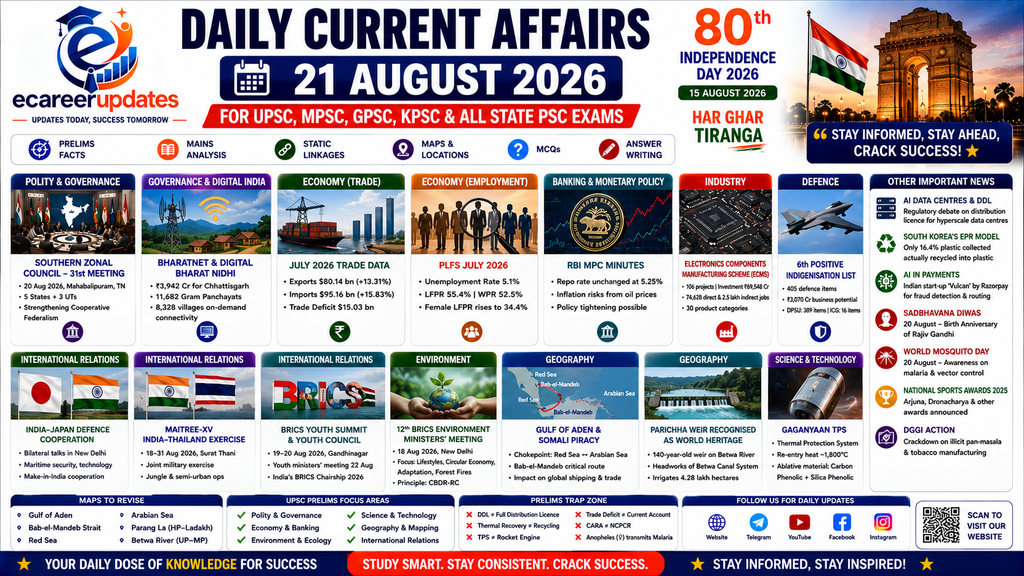
📊 21 AUGUST 2026 — CURRENT AFFAIRS AT A GLANCE
| Category | Today’s Important Topic | GS | Priority |
|---|---|---|---|
| ⚖️ Polity | Deemed Distribution Licence (DDL) for AI Data Centres | GS-II | 🔴 ⭐⭐⭐⭐⭐ |
| 💰 Economy | Centre’s Fiscal Outlook FY 2026–27 | GS-III | 🔴 ⭐⭐⭐⭐⭐ |
| 🌱 Environment | South Korea’s Plastic Waste & EPR Model | GS-III | 🟠 ⭐⭐⭐⭐ |
| 👶 Governance | Central Adoption Resource Authority (CARA) | GS-II | 🔴 ⭐⭐⭐⭐⭐ |
| 🚀 S&T | Gaganyaan Thermal Protection System | GS-III | 🔴 ⭐⭐⭐⭐⭐ |
| 🧪 Food Regulation | FSSAI Advertising & Claims Regulations | GS-II/III | 🟠 ⭐⭐⭐⭐ |
| 📜 History | Vande Mataram Debate | GS-I | 🔴 ⭐⭐⭐⭐⭐ |
| 🚀 Space | China’s Zhuque-3 Y2 Reusable Rocket | GS-III | 🔴 ⭐⭐⭐⭐⭐ |
| 🌊 Geography | Gulf of Aden & Somali Piracy | GS-I/II/III | 🔴 ⭐⭐⭐⭐⭐ |
| 🛡️ Defence | Terrier Cyber Quest 2026 | GS-III | 🔴 ⭐⭐⭐⭐⭐ |
| 🛰️ Space/AI | AI + Space Start-ups | GS-III | 🟠 ⭐⭐⭐⭐ |
| 🏙️ Urban Governance | India–ADB $230 mn Chennai Water Project | GS-II/III | 🔴 ⭐⭐⭐⭐⭐ |
| 🌐 IR/Technology | BRICS Digital/ICT Cooperation | GS-II/III | 🔴 ⭐⭐⭐⭐ |
| 🔬 Science Diplomacy | BRICS STI Ministerial Meeting | GS-II/III | 🟠 ⭐⭐⭐⭐ |
| 🧾 Tax/Governance | DGGI crackdown on illicit pan-masala/tobacco production | GS-III | 🟡 ⭐⭐⭐ |
| 🇮🇳 Governance | PM GatiShakti + granular data intelligence | GS-II/III | 🟠 ⭐⭐⭐⭐ |
🔥 TOP 12 MUST-READ TOPICS
If you have only 60–90 minutes, prioritise:
- Deemed Distribution Licence + Electricity Act
- Centre’s Fiscal Outlook
- CARA + Adoption Regulations
- Gaganyaan Thermal Protection System
- Vande Mataram — constitutional/cultural dimension
- Zhuque-3 reusable launch vehicle
- Gulf of Aden + Bab-el-Mandeb
- Terrier Cyber Quest
- India–ADB Chennai Water Project
- BRICS Science & Technology cooperation
- South Korea’s EPR model
- AI + Space Start-up ecosystem
🧠 THE 2026 PRELIMS APPROACH
Today’s headlines provide an excellent illustration of how UPSC can frame questions.
Example:
News: AI data centres require enormous electricity.
A weak preparation approach:
“Remember Andhra Pradesh’s DDL policy.”
A UPSC-oriented approach:
AI data centres
↓
Electricity demand
↓
Distribution licence
↓
Electricity Act, 2003
↓
Open access
↓
Regulatory role
↓
Public distribution utilities
↓
GS-II + GS-III
That is the difference between news memorisation and UPSC preparation.
⚖️ 1. POLITY + GOVERNANCE + ENERGY
Deemed Distribution Licence (DDL) for AI Data Centres
⭐⭐⭐⭐⭐ TOP PRIORITY
A policy framework proposed by the Andhra Pradesh government for hyperscale AI data centres has triggered debate over the idea of a Deemed Distribution Licence (DDL).
The proposal is particularly relevant because AI data centres can require extremely large and uninterrupted electricity supplies. The framework reportedly seeks DDL status for strategic data centres with a minimum connected load of 300 MW.
🔌 What is a Distribution Licence?
Under India’s electricity framework, a distribution licence generally authorises an entity to distribute electricity within a specified area.
A DDL would effectively treat an eligible entity as an authorised distributor within a designated area without following the conventional licensing pathway.
The Andhra Pradesh proposal would allow eligible hyperscale data centres to:
- Procure electricity directly
- Develop dedicated power networks
- Enter renewable-energy PPAs
- Manage electricity distribution within their designated area
🧠 Why Do AI Data Centres Need Special Treatment?
Modern AI infrastructure involves:
Large GPU clusters
↓
High electricity consumption
↓
Continuous power requirement
↓
Need for reliable grid connection
↓
Need for dedicated infrastructure
The issue therefore lies at the intersection of:
AI + Electricity + Regulation + Infrastructure + FDI + Green Energy
⚠️ THE LEGAL QUESTION
The central concern is whether an entity consuming electricity for its own operations can simultaneously receive a status resembling a distribution licensee.
This raises questions concerning:
- Electricity Act, 2003
- Distribution licensing
- Open access
- Cross-subsidy
- Regulatory oversight
- State electricity distribution companies
- Public utility finances
The current debate specifically highlights concerns about whether the Electricity Act provides a statutory basis for such self-consumption-oriented distribution arrangements.
📊 DDL — ARGUMENTS FOR VS AGAINST
| Arguments FOR | Concerns |
|---|---|
| Reliable power for AI infrastructure | Possible bypass of licensing framework |
| Attract FDI | Impact on public utilities |
| Faster infrastructure creation | Cross-subsidy implications |
| Direct renewable procurement | Regulatory arbitrage |
| Dedicated power networks | Precedent for other large consumers |
🎯 PRELIMS FOCUS
Revise:
- Electricity Act, 2003
- Distribution licence
- Open access
- Power Purchase Agreement
- Renewable Energy
- Electricity Regulatory Commissions
- Cross-subsidy
✍️ MAINS QUESTION
“India’s AI ambitions require massive energy infrastructure, but regulatory innovation must remain consistent with electricity-sector governance.” Discuss.
Way Forward
- Transparent licensing framework
- Regulatory clarity
- Renewable PPAs
- Grid-code compliance
- Independent regulation
- Protection of public-distribution finances
- Environmental impact assessment for large data centres
💰 2. ECONOMY
Centre’s Fiscal Outlook 2026–27
⭐⭐⭐⭐⭐ MUST REVISE
The Centre’s fiscal outlook has come under examination amid:
- Tax-revenue pressures
- Higher subsidy requirements
- Geopolitical risks
- Crude-oil volatility
- Strong capital expenditure
- Higher non-tax revenues
The fiscal deficit target is around 4.6% of GDP, while the debt-to-GDP ratio is projected around 55.8% in the framework discussed.
📊 Fiscal Outlook — Important Numbers
| Indicator | Current Assessment |
|---|---|
| Fiscal deficit target | 4.6% of GDP |
| Debt-to-GDP | 55.8% |
| Q1 GTR growth | 3.7% |
| GST growth mentioned | -11% |
| Personal income tax growth | 6.8% |
| Excise-duty contraction | 22.4% |
| Q1 central capex growth | 23.7% |
| Major subsidy increase in Q1 | 37.4% |
These figures illustrate the tension between fiscal consolidation and the need to cushion the economy against external shocks.
🧠 Fiscal Consolidation
Meaning
Reducing excessive fiscal imbalance while maintaining sufficient expenditure for growth and welfare.
The challenge:
Fiscal consolidation
vs
Growth-supportive expenditure
vs
Welfare subsidies
vs
Infrastructure investment
🔄 Fiscal Transmission Chain
Higher crude prices
↓
Higher import bill
↓
Fuel/fertiliser subsidy pressure
↓
Higher government expenditure
↓
Fiscal pressure
↓
Possible borrowing
↓
Interest-rate implications
📈 Why Capital Expenditure Matters
Government capital expenditure can create:
Infrastructure
↓
Productivity
↓
Private investment
↓
Employment
↓
Demand
↓
Long-term growth
Therefore, simply reducing expenditure is not equivalent to fiscal consolidation.
🎯 PRELIMS
Revise:
- Fiscal deficit
- Revenue deficit
- Primary deficit
- Effective revenue deficit
- Public debt
- Capital expenditure
- Revenue expenditure
- Non-tax revenue
- Cess vs tax
- FRBM framework
✍️ MAINS QUESTION
“Fiscal consolidation should focus on improving the quality of expenditure rather than merely reducing the fiscal deficit.” Examine.
Good answer keywords:
Capex + tax buoyancy + subsidy rationalisation + debt sustainability + fiscal transparency + state finances
♻️ 3. ENVIRONMENT
South Korea’s Plastic Waste Management System
⭐⭐⭐⭐
South Korea provides an important case study in Extended Producer Responsibility (EPR) and the difficulty of measuring actual recycling.
Research cited in current-affairs analysis found that only 16.4% of household plastic collected for recycling in 2021 was actually recycled into plastic, despite much higher reported recycling figures.
♻️ What is EPR?
Extended Producer Responsibility
The producer is made responsible for the environmental impact of a product throughout its life cycle, particularly after consumption.
Basic model:
Producer
↓
Product
↓
Consumer
↓
Waste
↓
Collection
↓
Recycling/disposal
↓
Producer responsibility
⚠️ The Measurement Problem
A country can report:
“73% recycling rate”
while actual material recycling may be much lower if:
- Thermal recovery is counted as recycling
- Plastic is burnt as fuel
- Waste is exported
- Contaminated waste is rejected
- Material is downcycled
South Korea has been separating thermal recycling from material recycling, improving transparency.
🇮🇳 INDIA LINKAGE
India also uses EPR-based plastic waste management.
UPSC can ask:
Which principle shifts responsibility from municipalities alone towards producers/importers/brand owners?
Answer: Extended Producer Responsibility
📊 Circular Economy
Linear
Take → Make → Use → Dispose
Circular
Design → Use → Repair → Reuse → Recycle → Recover
✍️ MAINS QUESTION
“Recycling statistics can create a misleading picture of environmental performance unless material recovery is distinguished from energy recovery.” Discuss.
👶 4. POLITY + SOCIAL JUSTICE
Central Adoption Resource Authority (CARA)
⭐⭐⭐⭐⭐
The Central Adoption Resource Authority (CARA) is reviewing the Adoption Regulations, 2022 to address procedural bottlenecks and improve adoption opportunities for children, including those with special medical needs.
🏛️ What is CARA?
CARA is the statutory apex body responsible for regulating and monitoring adoption of:
- Orphaned children
- Abandoned children
- Surrendered children
It functions under the Ministry of Women & Child Development.
Its statutory status comes through Section 68 of the Juvenile Justice (Care and Protection of Children) Act, 2015.
🌍 International Linkage
CARA is India’s Central Authority for inter-country adoption under the 1993 Hague Convention on Protection of Children and Co-operation in Respect of Intercountry Adoption.
India ratified the Convention in 2003.
💻 CARINGS Portal
CARA operates the:
CARINGS
Child Adoption Resource Information and Guidance System
It provides a centralised digital platform for:
- Registration
- Adoption procedures
- Record management
- Queue tracking
- Transparency
📊 CARA — PRELIMS TABLE
| Feature | Fact |
|---|---|
| Ministry | Women & Child Development |
| Statutory basis | JJ Act, 2015 |
| Section | 68 |
| Inter-country adoption | Yes |
| International framework | Hague Convention, 1993 |
| Digital platform | CARINGS |
| Priority | Child-centric adoption |
🎯 PRELIMS TRAP
CARA is:
❌ Not a constitutional body
❌ Not an NGO
❌ Not under the Ministry of External Affairs
It is a statutory authority under MWCD.
✍️ MAINS QUESTION
“Adoption policy must balance child protection, family formation and procedural efficiency.” Discuss the role of CARA.
🚀 5. SCIENCE & TECHNOLOGY
Gaganyaan Thermal Protection System
⭐⭐⭐⭐⭐ HIGH-VALUE PRELIMS
As India prepares for the uncrewed flight-test sequence of Gaganyaan, attention has focused on the spacecraft’s Thermal Protection System (TPS).
🔥 Why is TPS Required?
During atmospheric re-entry:
Spacecraft returns from orbit
↓
Extremely high velocity
↓
Atmospheric compression + aerodynamic heating
↓
Shock layer
↓
Extremely high temperature
↓
Risk to crew module
Therefore:
Thermal Protection System = spacecraft heat shield
🧪 Ablative TPS
Ablative material works by sacrificing part of itself.
Process:
Extreme heat
↓
Material decomposes
↓
Pyrolysis
↓
Char layer formation
↓
Gas release
↓
Heat carried away
↓
Structure protected
📊 Gaganyaan TPS — Important Facts
| Feature | Detail |
|---|---|
| Mission | Gaganyaan |
| Purpose | Crew safety during re-entry |
| Approx. re-entry heat | ~1,800°C |
| Shield thickness | ~30–35 mm |
| Material | Carbon phenolic + silica phenolic |
| Principle | Ablative heat protection |
| Heritage | CARE/Space Capsule Recovery Experiment |
⚠️ PRELIMS TRAP
TPS does not primarily protect the spacecraft from:
❌ Solar radiation during normal orbit
Its critical function here is:
✅ Atmospheric re-entry heating
✍️ MAINS QUESTION
“Human spaceflight requires not merely launch capability but mastery of atmospheric re-entry technologies.” Discuss with reference to Gaganyaan.
🧬 6. FOOD SAFETY + GOVERNANCE
FSSAI Advertising & Claims Regulations, 2018
⭐⭐⭐⭐
The Maharashtra FDA has issued notices in a case involving alleged surrogate advertising of prohibited pan-masala products.
The issue brings the Food Safety and Standards (Advertising and Claims) Regulations, 2018 into focus.
🏛️ Regulatory Basis
These regulations are framed by FSSAI under the:
Food Safety and Standards Act, 2006
They govern advertising and claims concerning food products.
📊 Important Provisions
| Area | Requirement |
|---|---|
| Truthfulness | Claims should not mislead |
| Health claims | Scientific substantiation |
| Disease claims | Strict restrictions |
| Nutrition claims | Evidence-based |
| Brand descriptors | Conditions apply |
| FSSAI logo | Cannot be used as promotional superiority claim |
| Misleading advertisements | Can attract corrective action/penalties |
🧠 Why UPSC May Ask?
This connects:
Food safety
Consumer protection
Advertising regulation
Public health
Regulatory governance
✍️ MAINS QUESTION
“Consumer protection in the digital and advertising age requires regulation of not only products but also information about products.” Discuss.
📜 7. HISTORY + POLITY
Vande Mataram Debate
⭐⭐⭐⭐⭐
The debate around Vande Mataram provides an excellent opportunity to revise:
- Freedom struggle
- Swadeshi Movement
- National symbols
- Constitutional culture
- National identity
- Communal harmony
The song was written by Bankim Chandra Chattopadhyay and was incorporated into Anandamath. It became an important symbol during the freedom movement, particularly around the Swadeshi Movement following the 1905 Partition of Bengal.
📜 Timeline
| Year | Event |
|---|---|
| 1875 | Composition attributed to Bankim Chandra Chattopadhyay |
| 1882 | Included in Anandamath |
| 1896 | Rabindranath Tagore sang it at INC session |
| 1905 | Associated strongly with Swadeshi movement |
| 1937 | Congress decision regarding first two stanzas |
| 1950 | Recognised as National Song |
🇮🇳 National Anthem vs National Song
| Feature | Jana Gana Mana | Vande Mataram |
|---|---|---|
| Status | National Anthem | National Song |
| Author | Rabindranath Tagore | Bankim Chandra Chattopadhyay |
| Historical role | National movement | Major role in Swadeshi/national movement |
| Constitutional provision | Not expressly named in Constitution | Not expressly named in Constitution |
| Official recognition | Yes | Yes |
🧠 UPSC DIMENSION
This is not merely a “song-related” issue.
It connects:
National symbols + Fundamental Duties + freedom struggle + secularism + cultural diversity + constitutional morality
✍️ MAINS QUESTION
“National symbols can simultaneously embody historical memory and contemporary debates over pluralism.” Discuss.
🚀 8. SCIENCE & TECHNOLOGY
China’s Zhuque-3 Y2 Reusable Launch Vehicle
⭐⭐⭐⭐⭐
China’s private space company LandSpace successfully launched Zhuque-3 Y2, placing the Honghu-03 satellite into orbit and recovering the reusable first stage in Gansu.
🚀 Why Important?
The key technological trend is:
Reusable launch vehicles
Traditional model:
Rocket → launch → stages discarded
Reusable model:
Rocket → launch → recovery → refurbishment → relaunch
This can potentially reduce:
- Launch costs
- Turnaround time
- Material wastage
and increase:
- Launch frequency
- Commercial viability
🧪 Zhuque-3
| Feature | Detail |
|---|---|
| Country | China |
| Company | LandSpace |
| Type | Partially reusable orbital launcher |
| Propellant | Liquid oxygen + methane |
| Recovery | Vertical take-off/vertical landing technology |
| Material | Stainless-steel structure |
| Key orbit | Low Earth Orbit |
🇮🇳 India Linkage
Compare with:
ISRO RLV-TD / RLV-LEX
India is also pursuing reusable launch technologies.
🎯 PRELIMS TRAP
Reusable launch vehicle ≠ reusable satellite.
The primary economic advantage comes from recovering and reusing expensive rocket stages, especially the first stage.
✍️ MAINS QUESTION
“Reusable launch vehicles can transform the economics of the global space industry.” Examine the technological and strategic implications for India.
🌊 9. GEOGRAPHY + INTERNATIONAL RELATIONS
Gulf of Aden & Resurgence of Somali Piracy
⭐⭐⭐⭐⭐ MUST DO MAP
Recent reports indicate renewed Somali piracy activity in and around the Gulf of Aden.
This is an outstanding UPSC map + IR topic.
🗺️ Where is Gulf of Aden?
It lies between:
North
Arabian Peninsula
South
Horn of Africa
It connects:
Red Sea
↓
Bab-el-Mandeb
↓
Gulf of Aden
↓
Arabian Sea
↓
Indian Ocean
🌍 Countries/Regions to Locate
| Location | Why Important |
|---|---|
| Yemen | Northern side |
| Somalia | Southern side |
| Djibouti | Horn of Africa |
| Bab-el-Mandeb | Gateway to Red Sea |
| Socotra | Strategic island |
| Gulf of Tadjoura | Djibouti region |
| Cape Guardafui | Somalia |
| Red Sea | Major shipping route |
| Arabian Sea | Indian Ocean connection |
💰 Economic Importance
Piracy
↓
Insurance premiums ↑
↓
Security costs ↑
↓
Shipping diversion
↓
Cape of Good Hope route
↓
Longer voyage
↓
Fuel cost ↑
↓
Global supply-chain costs ↑
🇮🇳 INDIA LINKAGE
India has strong interests because the region affects:
- Indian Ocean security
- Energy imports
- Maritime trade
- Indian seafarers
- Anti-piracy operations
- Freedom of navigation
✍️ MAINS QUESTION
“Maritime chokepoints are increasingly becoming strategic variables in global economic security.” Discuss with reference to the Gulf of Aden and Bab-el-Mandeb.
🛡️ 10. DEFENCE + CYBER SECURITY
Terrier Cyber Quest 2026
⭐⭐⭐⭐⭐
The Indian Army’s Territorial Army, in collaboration with CyberPeace, has launched Terrier Cyber Quest 2026 (TCQ 3.0).
It is a national-level hackathon aimed at developing indigenous solutions to contemporary:
- Cybersecurity
- Defence
- Information-domain
- AI
- Threat-mitigation challenges.
💻 Three Competition Tracks
| Track | Focus |
|---|---|
| 🐞 Bug Hunting | Finding vulnerabilities |
| 🤖 AI Kavach | AI/ML-based threat intelligence |
| 🎥 Creators Challenge | Deepfakes, phishing, misinformation awareness |
🧠 Why Cybersecurity is a National Security Issue
Modern warfare:
Land
Sea
Air
Space
Cyber
Information
🔗 Cyber Threat Chain
Vulnerability
↓
Intrusion
↓
Data theft/disruption
↓
Critical infrastructure attack
↓
Economic/social disruption
🎯 PRELIMS
Revise:
- Territorial Army
- Cybersecurity
- Critical Information Infrastructure
- CERT-In
- National Cyber Security Coordinator
- Deepfakes
- Phishing
- Ransomware
- Capture-the-Flag
✍️ MAINS QUESTION
“Cybersecurity has transformed national security from a purely territorial challenge into a continuously evolving digital challenge.” Discuss.
🛰️ 11. SPACE + AI
AI in India’s Space Start-up Ecosystem
The Prime Minister interacted with CEOs and founders of space start-ups working in the AI sector on 21 August 2026. The interaction highlighted growing global interest in India’s emerging space-start-up ecosystem.
🤖 AI + SPACE APPLICATIONS
| Area | Application |
|---|---|
| Earth observation | Image analysis |
| Agriculture | Crop monitoring |
| Disaster management | Damage assessment |
| Navigation | Autonomous systems |
| Space debris | Tracking |
| Satellite operations | Predictive maintenance |
| Defence | ISR |
| Climate | Environmental monitoring |
🧠 BIG LINKAGE
Space sector reforms
↓
Private participation
↓
Start-ups
↓
AI
↓
Satellite data
↓
Applications
↓
Commercialisation
↓
Strategic autonomy
✍️ MAINS QUESTION
“India’s space sector can become a strategic technology ecosystem rather than merely a launch-service industry.” Discuss.
🏙️ 12. URBAN GOVERNANCE + ENVIRONMENT
India–ADB $230 Million Chennai Water Project
India and the Asian Development Bank (ADB) signed a $230 million loan agreement for the Chennai Climate-Resilient Water Security and Sewerage Project. The project aims to strengthen water supply, sanitation and climate resilience in Chennai.
💧 Why Chennai?
Chennai faces a combination of:
- Water scarcity
- Urbanisation
- Groundwater stress
- Flooding
- Climate variability
- Wastewater-management challenges
This creates a classic:
“Too much water + too little water”
urban-management problem.
🌧️ Climate-Resilient Urban Water Management
Rainwater harvesting
Stormwater management
Wastewater treatment
Water reuse
Aquifer management
Demand management
=
Water security
🎯 PRELIMS
Revise:
- ADB
- Multilateral Development Banks
- Climate-resilient infrastructure
- Urban water cycle
- AMRUT 2.0
- Urban Challenge Fund
- Jal Jeevan Mission
✍️ MAINS QUESTION
“Urban water security requires a shift from supply augmentation to integrated water-resource management.” Discuss.
🌐 13. INTERNATIONAL RELATIONS + TECHNOLOGY
BRICS Digital / ICT Cooperation
India’s BRICS Chairship 2026 continues to emphasise digital cooperation. The 7th BRICS ICT Working Group Meeting was hosted in Pune, while the Digital BRICS Forum and Expo has also been held in Pune.
💻 Key Areas
- Digital public infrastructure
- Future networks
- AI
- Cybersecurity
- Digital inclusion
- ICT standards
- Emerging technologies
🧠 India’s Opportunity
India can use BRICS to promote:
DPI
UPI-type systems
Digital public goods
Affordable technology
Global South digital cooperation
✍️ MAINS QUESTION
“Digital diplomacy is emerging as an important dimension of India’s Global South engagement.” Discuss.
🔬 14. SCIENCE DIPLOMACY
BRICS Science, Technology & Innovation Cooperation
The 16th BRICS STI Senior Officials’ Meeting concluded in Chennai ahead of the 14th BRICS STI Ministerial Meeting on 21 August 2026.
The meeting reviewed:
- BRICS STI Working Groups
- STI priorities
- BRICS STI Framework Programme
- Young Scientist Forum
- Young Innovator’s Prize
It was held under India’s 2026 BRICS theme:
“Building for Resilience, Innovation, Cooperation and Sustainability.”
🧠 Why Important?
Science diplomacy can help Global South countries collaborate in:
- Climate research
- Health
- AI
- Agriculture
- Space
- Ocean science
- Biotechnology
- Disaster resilience
🎯 PRELIMS
Remember:
BRICS STI ≠ NDB
BRICS STI
→ Science & technology cooperation
NDB
→ Development finance
✍️ MAINS QUESTION
“Science diplomacy can strengthen strategic autonomy while enabling developing countries to pool knowledge and technological capabilities.” Discuss.
📊 15. CURRENT AFFAIR → STATIC LINKAGE MASTER TABLE
| Today’s News | Static Topic |
|---|---|
| DDL | Electricity Act 2003 + distribution licence |
| Fiscal outlook | Fiscal deficit + FRBM + debt |
| South Korea EPR | Plastic Waste Management + Circular Economy |
| CARA | JJ Act + Hague Convention |
| Gaganyaan TPS | Atmospheric re-entry + heat shield |
| FSSAI regulations | Food Safety Act + consumer protection |
| Vande Mataram | Freedom struggle + national symbols |
| Zhuque-3 | Reusable rockets + LEO |
| Gulf of Aden | Bab-el-Mandeb + maritime chokepoints |
| Cyber Quest | Cybersecurity + national security |
| Space start-ups | Space reforms + AI |
| ADB Chennai project | Urban water + MDBs |
| BRICS ICT | Digital diplomacy + Global South |
| BRICS STI | Science diplomacy |
| DGGI action | GST/tax administration |
🎯 16. PRELIMS PRIORITY MATRIX
| Topic | Static Depth | Current Relevance | Priority |
|---|---|---|---|
| DDL | ⭐⭐⭐⭐⭐ | ⭐⭐⭐⭐⭐ | 🔴 Very High |
| Fiscal Outlook | ⭐⭐⭐⭐⭐ | ⭐⭐⭐⭐⭐ | 🔴 Very High |
| CARA | ⭐⭐⭐⭐⭐ | ⭐⭐⭐⭐ | 🔴 Very High |
| Gaganyaan TPS | ⭐⭐⭐⭐⭐ | ⭐⭐⭐⭐⭐ | 🔴 Very High |
| Vande Mataram | ⭐⭐⭐⭐⭐ | ⭐⭐⭐⭐⭐ | 🔴 Very High |
| Zhuque-3 | ⭐⭐⭐⭐⭐ | ⭐⭐⭐⭐⭐ | 🔴 Very High |
| Gulf of Aden | ⭐⭐⭐⭐⭐ | ⭐⭐⭐⭐⭐ | 🔴 Very High |
| Cyber Quest | ⭐⭐⭐⭐ | ⭐⭐⭐⭐⭐ | 🔴 Very High |
| ADB Chennai | ⭐⭐⭐⭐ | ⭐⭐⭐⭐⭐ | 🟠 High |
| EPR | ⭐⭐⭐⭐⭐ | ⭐⭐⭐⭐ | 🟠 High |
| FSSAI | ⭐⭐⭐⭐ | ⭐⭐⭐⭐ | 🟠 High |
| BRICS ICT | ⭐⭐⭐⭐ | ⭐⭐⭐⭐ | 🟠 High |
| BRICS STI | ⭐⭐⭐⭐ | ⭐⭐⭐⭐ | 🟠 High |
| Space + AI | ⭐⭐⭐⭐ | ⭐⭐⭐⭐ | 🟠 High |
🧠 17. UPSC-STYLE PRELIMS MCQs
Q1. Consider the following statements regarding a Distribution Licence:
- It is associated with the distribution of electricity within a specified area.
- The Electricity Act, 2003 provides the statutory framework for electricity distribution.
- A distribution licence is a constitutional institution.
Which is correct?
Answer: 1 and 2 only
Q2. Fiscal deficit represents:
A. Total expenditure minus total receipts excluding borrowings
B. Revenue expenditure minus revenue receipts
C. Total borrowings minus capital expenditure
D. Interest payments minus revenue receipts
Answer: A
Q3. CARA is associated with:
A. Child adoption
B. Juvenile prisons
C. Child nutrition
D. Women entrepreneurship
Answer: A
Q4. Which of the following is correctly matched?
| Technology | Function |
|---|---|
| Helicase | DNA unwinding |
| TPS | Spacecraft thermal protection |
| EPR | Producer responsibility for post-consumer waste |
Answer: All three
Q5. Thermal Protection Systems in spacecraft are particularly important during:
A. Orbital insertion only
B. Atmospheric re-entry
C. Satellite communication
D. Solar-panel deployment
Answer: B
Q6. Vande Mataram was originally written by:
A. Rabindranath Tagore
B. Bankim Chandra Chattopadhyay
C. Sri Aurobindo
D. Subhas Chandra Bose
Answer: B
Q7. The Gulf of Aden connects the:
A. Mediterranean Sea and Black Sea
B. Red Sea and Arabian Sea
C. Persian Gulf and Caspian Sea
D. Bay of Bengal and South China Sea
Answer: B
Q8. Bab-el-Mandeb is located between:
A. Arabian Peninsula and Horn of Africa
B. India and Sri Lanka
C. Africa and Madagascar
D. Europe and North Africa
Answer: A
Q9. Extended Producer Responsibility primarily means:
A. Consumers are solely responsible for waste disposal
B. Producers bear responsibility for managing products’ post-consumption impacts
C. Municipalities must finance all recycling
D. Only exporters are responsible for packaging
Answer: B
Q10. Zhuque-3 is notable for:
A. Being a nuclear-powered satellite
B. Reusable launch technology
C. Being a lunar rover
D. Being a space telescope
Answer: B
✍️ 18. MAINS ANSWER WRITING PRACTICE
GS-II — Governance
Question:
“Regulatory innovation must keep pace with technological innovation, but cannot undermine statutory oversight.” Discuss with reference to AI data centres and electricity distribution.
Suggested structure:
Introduction
AI data centres are emerging as strategic digital infrastructure with very high electricity demand.
Issues
- Electricity demand
- Distribution licensing
- Open access
- Public utilities
- Cross-subsidy
- Regulatory uncertainty
Way Forward
- Transparent framework
- Independent regulation
- Green power procurement
- Grid-code compliance
- Environmental safeguards
Conclusion
India needs regulatory frameworks that enable innovation while protecting public-interest infrastructure.
GS-III — Economy
Question:
“India’s fiscal consolidation challenge is increasingly shaped by external commodity shocks and the quality of expenditure.” Discuss.
Use:
Crude oil
→ Subsidies
→ Revenue pressure
→ Fiscal deficit
but also:
Capex
→ Productivity
→ Crowding-in
→ Growth
GS-III — Science & Technology
Question:
“Reusable launch systems can democratise access to space by lowering launch costs.” Examine.
Use:
- Reusability
- First-stage recovery
- Methane propulsion
- VTVL
- LEO
- Commercial space
- ISRO RLV programme
- Space start-ups
GS-II/III — Environment
Question:
“Extended Producer Responsibility is effective only when environmental accountability is supported by credible measurement.” Discuss.
Use:
EPR + material recycling + thermal recovery + circular economy + data transparency
GS-I — History
Question:
“National symbols emerged from the freedom struggle but acquired constitutional and political meanings after Independence.” Discuss with reference to Vande Mataram.
🌍 19. MAP WORK — 21 AUGUST
🇮🇳 India
Locate:
- Andhra Pradesh
- Visakhapatnam
- Pune
- Chennai
- Maharashtra
- Tamil Nadu
- Gansu-related global comparison only
- Indian Ocean
- Arabian Sea
- Lakshadweep
- Andaman & Nicobar
🌍 World
West Asia / Africa
Mark:
- Yemen
- Somalia
- Djibouti
- Gulf of Aden
- Bab-el-Mandeb
- Red Sea
- Gulf of Tadjoura
- Socotra
- Cape Guardafui
- Horn of Africa
- Arabian Sea
- Suez Canal
- Cape of Good Hope
⚠️ 20. PRELIMS TRAP ZONE
| Don’t Confuse | Correct |
|---|---|
| CARA vs CWC | CARA regulates adoption; CWC handles child-care/protection functions |
| CARA vs NCPCR | Adoption authority vs child-rights commission |
| Fiscal deficit vs revenue deficit | Different concepts |
| EPR vs Polluter Pays | Related but not identical principles |
| TPS vs rocket engine | Heat protection vs propulsion |
| Vande Mataram vs Jana Gana Mana | National Song vs National Anthem |
| Gulf of Aden vs Gulf of Oman | Different locations |
| Bab-el-Mandeb vs Strait of Hormuz | Red Sea gateway vs Persian Gulf gateway |
| Zhuque-3 vs RLV-TD | Chinese reusable launcher vs Indian reusable technology demonstrator |
| BRICS STI vs NDB | Technology cooperation vs development finance |
| AI data centre vs power distributor | Consumer infrastructure vs licensed distribution role |
| Material recycling vs thermal recovery | Not equivalent environmental outcomes |
🔗 21. BIG UPSC LINKAGES FROM TODAY
LINKAGE 1 — AI + Electricity + Environment
AI data centres
↓
Huge electricity demand
↓
Dedicated distribution
↓
Renewable energy PPAs
↓
Grid infrastructure
↓
Environmental impact
↓
Digital growth vs sustainability
LINKAGE 2 — Fiscal Policy + Geopolitics
West Asian conflict
↓
Crude prices
↓
Import bill
↓
Fuel/fertiliser subsidies
↓
Fiscal pressure
↓
Government expenditure
↓
Fiscal consolidation challenge
This connects GS-II IR + GS-III Economy.
LINKAGE 3 — Space + Defence + Private Sector
Space start-ups
↓
AI
↓
Satellite applications
↓
Commercialisation
↓
Defence applications
↓
Strategic autonomy
↓
National security
LINKAGE 4 — Cybersecurity + AI
AI
↓
Deepfakes
↓
Phishing
↓
Automated attacks
↓
Cyber risk
But:
AI
↓
Threat intelligence
↓
Anomaly detection
↓
Automated defence
This creates the classic:
AI as both threat and solution
Terrier Cyber Quest specifically reflects this dual-use character.
LINKAGE 5 — Gulf of Aden + Indian Economy
Piracy
↓
Shipping risk
↓
Insurance ↑
↓
Fuel costs ↑
↓
Cape diversion
↓
Longer supply chains
↓
Import/export costs
↓
Inflationary pressure
This connects:
Geography + IR + Economy + Security
🇮🇳 22. SPECIAL MPSC FOCUS
For MPSC Rajyaseva, today’s Maharashtra-specific linkage is especially important.
🔴 Maharashtra Topics
| Topic | Maharashtra Linkage |
|---|---|
| FSSAI | Maharashtra FDA |
| Cybersecurity | Maharashtra’s digital ecosystem |
| BRICS ICT | Pune |
| BRICS STI | Maharashtra’s science ecosystem |
| Urban governance | Mumbai water/urban planning |
| AI | IT/start-up ecosystem |
| Fiscal policy | State finances + Centre-State transfers |
The FSSAI advertising issue is particularly relevant to Maharashtra because the Maharashtra FDA is involved in the current regulatory action.
🟢 23. KPSC / KAS FOCUS
Prioritise:
- Cybersecurity
- AI data centres
- Space start-ups
- Fiscal policy
- CARA
- Gulf of Aden
- EPR
- BRICS technology cooperation
Karnataka-specific static linkage:
AI
→ Bengaluru
→ Data centres
→ Electricity demand
→ Digital economy
→ Cybersecurity
This can create excellent Mains examples.
🔵 24. GPSC FOCUS
For GPSC, focus on:
- AI infrastructure
- Fiscal policy
- Renewable energy
- Circular economy
- BRICS
- Space start-ups
- Maritime trade
- Gulf of Aden
- Digital governance
Also connect:
Gujarat
→ Ports
→ Logistics
→ International shipping
→ Arabian Sea
→ Global maritime chokepoints
📝 25. ESSAY TOPICS FROM TODAY
Essay 1
“Technological progress without institutional adaptation creates new governance challenges.”
Essay 2
“Digital infrastructure is ultimately physical infrastructure.”
Essay 3
“Fiscal discipline is not austerity; it is the art of choosing the right expenditure.”
Essay 4
“National identity is shaped by history but negotiated in the present.”
Essay 5
“The future of space is reusable, commercial and data-driven.”
Essay 6
“Environmental governance must measure outcomes, not merely activities.”
🏆 26. TOP 15 TOPICS TO REVISE TONIGHT
🔴 MUST REVISE
- DDL + Electricity Act
- Fiscal Outlook
- CARA
- Gaganyaan TPS
- Vande Mataram
- Zhuque-3
- Gulf of Aden
- Terrier Cyber Quest
- ADB Chennai Water Project
🟠 HIGH PRIORITY
- EPR
- FSSAI regulations
- BRICS ICT
- BRICS STI
- AI + Space Start-ups
- PM GatiShakti data intelligence
📚 27. STATIC REVISION CHECKLIST
⚖️ Polity & Governance
☐ Electricity Act, 2003
☐ Distribution licence
☐ Open access
☐ CARA
☐ JJ Act 2015
☐ Hague Convention
☐ FSSAI
☐ Consumer protection
💰 Economy
☐ Fiscal deficit
☐ Revenue deficit
☐ Primary deficit
☐ Public debt
☐ FRBM
☐ Subsidies
☐ Capex
☐ Non-tax revenue
🌱 Environment
☐ EPR
☐ Plastic Waste Management Rules
☐ Circular economy
☐ Material recycling
☐ Thermal recovery
☐ Polluter Pays Principle
🚀 Science & Technology
☐ Gaganyaan
☐ Atmospheric re-entry
☐ Ablative TPS
☐ Reusable rockets
☐ VTVL
☐ LEO
☐ Methalox
🛡️ Security
☐ Cybersecurity
☐ Critical Information Infrastructure
☐ Deepfakes
☐ Phishing
☐ Ransomware
☐ AI threat detection
🌏 International Relations
☐ BRICS
☐ BRICS expansion
☐ Global South
☐ BRICS STI
☐ Digital diplomacy
☐ Maritime security
🌍 Geography
☐ Gulf of Aden
☐ Bab-el-Mandeb
☐ Red Sea
☐ Arabian Sea
☐ Horn of Africa
☐ Socotra
☐ Cape Guardafui
📜 History
☐ Bankim Chandra Chattopadhyay
☐ Anandamath
☐ Swadeshi Movement
☐ Partition of Bengal
☐ Vande Mataram
☐ National symbols
⏱️ 28. 90-MINUTE STUDY PLAN
20 min — Polity + Governance
DDL + CARA + FSSAI
20 min — Economy
Fiscal deficit + subsidies + capex
15 min — Science
Gaganyaan + reusable rockets + AI
15 min — International Relations
BRICS + Gulf of Aden
10 min — Environment
EPR + circular economy
10 min — Maps
Gulf of Aden + Bab-el-Mandeb + Red Sea + Arabian Sea
⚡ 29. 60-SECOND REVISION SHEET
| Topic | One-Line Recall |
|---|---|
| ⚖️ DDL | Special electricity-distribution framework debated for hyperscale AI data centres |
| 💰 Fiscal | Fiscal deficit target ~4.6% GDP |
| 👶 CARA | Statutory adoption authority under JJ Act |
| ♻️ EPR | Producer responsibility for post-consumer waste |
| 🚀 Gaganyaan | TPS protects crew module during re-entry |
| 🧪 FSSAI | Food advertising/claims regulation |
| 🇮🇳 Vande Mataram | National Song; Bankim Chandra |
| 🚀 Zhuque-3 | Chinese partially reusable launch vehicle |
| 🌊 Gulf of Aden | Red Sea ↔ Bab-el-Mandeb ↔ Arabian Sea |
| 🛡️ Cyber Quest | AI + cybersecurity + defence hackathon |
| 🛰️ Space + AI | Emerging Indian space-startup ecosystem |
| 💧 ADB Chennai | Climate-resilient urban water & sanitation |
| 🌐 BRICS ICT | Digital cooperation |
| 🔬 BRICS STI | Science diplomacy |
| 🏗️ GatiShakti | Geospatial/data-driven infrastructure planning |
🎯 30. FINAL UPSC TAKEAWAY
Today’s current affairs are particularly rich because a single headline can produce questions across several GS papers.
AI DATA CENTRES
Technology
→ AI
Economy
→ FDI/investment
Energy
→ Electricity demand
Governance
→ Regulation
Environment
→ Carbon footprint
Mains
→ Balancing innovation and public interest
FISCAL OUTLOOK
Economy
→ Fiscal deficit
IR
→ Crude/geopolitical shock
Welfare
→ Subsidies
Infrastructure
→ Capex
Federalism
→ State finances
GULF OF ADEN
Geography
→ Chokepoint
IR
→ West Asia/Horn of Africa
Security
→ Piracy
Economy
→ Shipping costs
Energy
→ Hydrocarbon routes
GAGANYAAN
Physics
→ Re-entry heating
Engineering
→ TPS
Space
→ Human spaceflight
Industry
→ Indigenous technology
Strategic
→ Space capability
🧠 THE GOLDEN FORMULA FOR UPSC 2027
For every important article, make a 7-column mental table:
| Step | Question |
|---|---|
| 1️⃣ NEWS | What happened? |
| 2️⃣ STATIC | What concept is behind it? |
| 3️⃣ INSTITUTION | Which ministry/body/law? |
| 4️⃣ LOCATION | Where is it? |
| 5️⃣ PRELIMS | What factual trap can UPSC create? |
| 6️⃣ MAINS | What is the larger issue? |
| 7️⃣ WAY FORWARD | What should India do? |
This method turns a 10-minute news article into 30–40 minutes of integrated UPSC preparation.
🏅 FINAL EXAM PRIORITY
🔴 UPSC PRELIMS
DDL + Electricity Act
CARA + JJ Act
Fiscal deficit concepts
EPR
Gaganyaan TPS
FSSAI regulations
Vande Mataram history
Zhuque-3
Gulf of Aden/Bab-el-Mandeb
Terrier Cyber Quest
BRICS STI/ICT
🔴 UPSC MAINS
GS-II
- Regulation of emerging technology
- Adoption governance
- Consumer protection
- Digital governance
- BRICS diplomacy
GS-III
- Fiscal consolidation
- AI infrastructure
- Space technology
- Cybersecurity
- Circular economy
- Urban water security
GS-I
- Vande Mataram
- Freedom struggle
- Gulf of Aden geography
- Maritime chokepoints
📌 ONE-LINE MASTER REVISION
21 August 2026 = DDL–AI Data Centres & Electricity Regulation + Fiscal Outlook–4.6% Deficit + CARA–Child Adoption + EPR–Plastic Circular Economy + Gaganyaan TPS–Re-entry Technology + FSSAI–Advertising Regulation + Vande Mataram–National Movement + Zhuque-3–Reusable Rockets + Gulf of Aden–Maritime Chokepoint + Terrier Cyber Quest–Cybersecurity + Space Start-ups–AI + ADB Chennai–Climate-Resilient Water + BRICS ICT/STI–Digital & Science Diplomacy.