
Prelims + Mains Oriented Analysis | Based on Recent UPSC & State PSC Examination Trends
Ecareerupdates UPSC | MPSC | KPSC | UPPSC | BPSC | GPSC | RPSC Current Affairs Series
The latest UPSC and State PSC examinations increasingly test the ability to connect current developments with static concepts. This edition covers the most relevant themes from 1 July 2026, with emphasis on conceptual clarity, Prelims facts, Mains analysis, interlinkages, and answer-writing value addition.
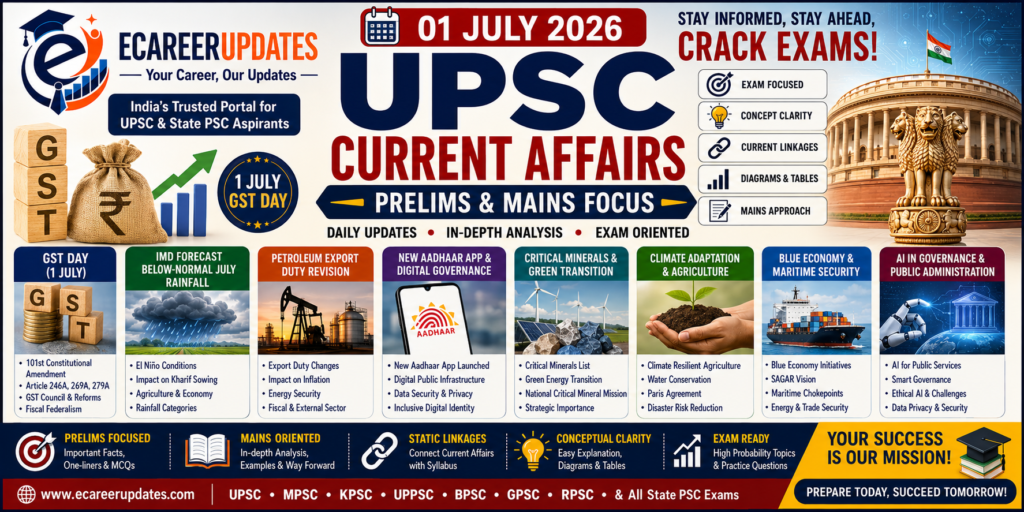
🔥 Top Current Affairs Themes – 01 July 2026
| Topic | GS Paper | Exam Importance |
|---|---|---|
| GST Day & Indirect Tax Reforms | GS-II / GS-III | ★★★★★ |
| IMD Forecast of Below-Normal July Rainfall | Geography + Economy | ★★★★★ |
| Petroleum Export Duty Revision | Economy | ★★★★☆ |
| New Aadhaar App & Digital Governance | Governance + S&T | ★★★★☆ |
| Critical Minerals & Green Transition | Economy | ★★★★★ |
| Climate Adaptation & Agriculture | Environment | ★★★★☆ |
| Blue Economy & Maritime Security | IR + Geography | ★★★★☆ |
| Artificial Intelligence in Public Administration | Governance | ★★★★☆ |
🏛 POLITY & GOVERNANCE
GST Day – 1 July
1 July marks the anniversary of the implementation of the Goods and Services Tax (GST) in India (introduced in 2017), one of India’s most significant indirect tax reforms.
Why Important for UPSC?
GST is frequently asked in:
- Indian Economy
- Fiscal Federalism
- Constitutional Amendments
- Centre-State Relations
- Tax Reforms
Constitutional Provisions
| Provision | Importance |
|---|---|
| Article 246A | Special power to legislate on GST |
| Article 269A | GST on inter-State trade |
| Article 279A | GST Council |
GST Council
| Feature | Details |
|---|---|
| Constitutional Body | Article 279A |
| Chairperson | Union Finance Minister |
| Members | Union MoS (Finance) + State Finance Ministers |
Advantages of GST
| Benefit | Explanation |
|---|---|
| One Nation, One Tax | Unified indirect tax system |
| Ease of Doing Business | Simplified compliance |
| Removal of Cascading Taxes | Input Tax Credit mechanism |
| Common National Market | Promotes trade |
Challenges
- Compensation issues for states
- Multiple tax slabs
- Compliance burden for MSMEs
- Revenue fluctuations
Expected UPSC Mains Question
Evaluate the impact of the Goods and Services Tax (GST) on India’s fiscal federalism and economic integration.
🌾 GEOGRAPHY + ECONOMY
IMD Forecasts Below-Normal Rainfall in July
The India Meteorological Department (IMD) has forecast below-normal rainfall for July 2026, following a significantly dry June. The forecast is linked to the strengthening El Niño conditions, which may affect kharif sowing, food production, and inflation.
Why Important?
July is the most crucial month for sowing major Kharif crops.
Static Concepts
| Concept | Meaning |
|---|---|
| ITCZ | Inter-Tropical Convergence Zone |
| ENSO | Ocean–Atmosphere Interaction |
| El Niño | Warmer Pacific waters, weaker Indian monsoon |
| La Niña | Cooler Pacific waters, stronger monsoon |
| Walker Circulation | East-West atmospheric circulation |
Economic Impact
| Sector | Possible Impact |
|---|---|
| Agriculture | Reduced sowing |
| Food Inflation | Increase |
| Rural Income | Lower growth |
| Reservoir Levels | Water stress |
| Hydropower | Reduced generation |
UPSC Prelims Focus
IMD Classification
| Rainfall Category | Percentage of Long Period Average (LPA) |
|---|---|
| Normal | 96–104% |
| Below Normal | 90–96% |
| Deficient | Less than 90% |
Mains Question
Explain how El Niño affects the Indian monsoon and discuss its implications for agriculture and the economy.
💰 ECONOMY
Revision in Export Duties on Petroleum Products
The Government revised export duties on petroleum products from 1 July 2026, reducing windfall taxes on diesel and aviation turbine fuel while increasing the export duty on petrol in response to changing global oil prices.
Why Important?
This topic links:
- Energy Security
- Fiscal Policy
- Inflation
- External Trade
Key Changes
| Product | Revision |
|---|---|
| Diesel | Export duty reduced |
| Aviation Turbine Fuel (ATF) | Export duty reduced |
| Petrol | Export duty increased |
Static Linkages
Revision:
- Windfall Tax
- Fiscal Deficit
- Current Account Deficit
- Crude Oil Imports
- Strategic Petroleum Reserves
Mains Question
Examine the impact of global crude oil prices on India’s fiscal and external sector stability.
🤖 SCIENCE & TECHNOLOGY
New Aadhaar App and Digital Identity
A new Aadhaar App has replaced the earlier mAadhaar application, aiming to improve digital identity management with enhanced security and user experience. Existing Aadhaar records remain linked to the Aadhaar database, but users need to register on the new app.
UPSC Linkage
This connects with:
- Digital Governance
- Digital Public Infrastructure
- Data Privacy
- Cyber Security
Digital Public Infrastructure (DPI)
| Platform |
|---|
| Aadhaar |
| UPI |
| DigiLocker |
| ONDC |
| ABHA |
Challenges
- Data Privacy
- Cybersecurity
- Digital Literacy
- Authentication Security
Mains Question
Discuss the role of Digital Public Infrastructure in promoting inclusive governance while ensuring data security.
🌱 ENVIRONMENT & ECOLOGY
Climate Adaptation and Water Security
With the possibility of weaker monsoon conditions, water conservation and climate-resilient agriculture become more important.
Adaptation Measures
| Measure | Benefit |
|---|---|
| Rainwater Harvesting | Water Security |
| Micro Irrigation | Water Efficiency |
| Climate-Smart Agriculture | Crop Resilience |
| Drought-Resistant Seeds | Stable Production |
| Early Warning Systems | Risk Reduction |
International Frameworks
| Agreement | Objective |
|---|---|
| Paris Agreement | Climate Action |
| UNFCCC | Climate Governance |
| Sendai Framework | Disaster Risk Reduction |
Mains Question
Discuss the importance of climate adaptation in strengthening India’s agricultural resilience.
⚡ ECONOMY + SCIENCE
Critical Minerals and Green Energy
Critical minerals remain essential for India’s clean-energy transition and manufacturing ambitions.
Important Minerals
| Mineral | Major Use |
|---|---|
| Lithium | EV Batteries |
| Cobalt | Energy Storage |
| Nickel | Battery Manufacturing |
| Copper | Power Infrastructure |
| Rare Earth Elements | Defence & Electronics |
Government Initiatives
- National Critical Mineral Mission
- India Semiconductor Mission
- National Green Hydrogen Mission
- PLI Scheme
Mains Question
Explain the strategic importance of critical minerals in achieving India’s net-zero ambitions.
🌊 INTERNATIONAL RELATIONS + GEOGRAPHY
Blue Economy and Maritime Security
The Strait of Hormuz remains strategically important because of its role in global oil transportation. Any disruption affects India’s energy imports and trade.
Important Maritime Chokepoints
| Strait | Connects |
|---|---|
| Hormuz | Persian Gulf – Gulf of Oman |
| Malacca | Indian Ocean – Pacific Ocean |
| Bab-el-Mandeb | Red Sea – Gulf of Aden |
Government Initiatives
| Initiative | Objective |
|---|---|
| SAGAR | Maritime Cooperation |
| Deep Ocean Mission | Ocean Exploration |
| Indo-Pacific Oceans Initiative | Sustainable Oceans |
Mains Question
Explain the importance of maritime chokepoints in India’s energy and trade security.
🛡 INTERNAL SECURITY
Technology in Border Management
India continues to strengthen border management through:
- Smart fencing
- Drone surveillance
- Satellite monitoring
- AI-based threat detection
Important Forces
| Force | Responsibility |
|---|---|
| BSF | India–Pakistan & Bangladesh Borders |
| ITBP | India–China Border |
| SSB | Nepal & Bhutan Borders |
| Assam Rifles | Northeast Security |
📜 HISTORY & CULTURE REVISION
Important Constitutional Reforms
Since GST is in focus, revise:
| Amendment | Importance |
|---|---|
| 101st Constitutional Amendment | Introduced GST |
| 122nd Constitution Amendment Bill | Precursor to GST |
🎯 PRELIMS RAPID REVISION
| Topic | One-Liner |
|---|---|
| GST Day | 1 July |
| 101st Constitutional Amendment | GST |
| Article 279A | GST Council |
| El Niño | Weakens Indian Monsoon |
| IMD | Weather Forecasting Agency |
| Windfall Tax | Tax on Extraordinary Profits |
| Aadhaar | Digital Identity |
| DPI | Digital Public Infrastructure |
| Hormuz Strait | Global Oil Route |
| National Critical Mineral Mission | Resource Security |
📝 MAINS VALUE ADDITION
GS-II
- GST Council
- Fiscal Federalism
- Digital Governance
GS-III
- Monsoon
- Inflation
- Petroleum Pricing
- Critical Minerals
- Climate Adaptation
- Energy Security
GS-IV
- Responsible Digital Governance
- Data Privacy
- Transparency in Public Administration
⭐ High Probability Topics
| Topic | Probability |
|---|---|
| GST & Fiscal Federalism | ★★★★★ |
| El Niño & Monsoon | ★★★★★ |
| Digital Public Infrastructure | ★★★★★ |
| Critical Minerals | ★★★★★ |
| Petroleum Pricing | ★★★★☆ |
| Climate Adaptation | ★★★★☆ |
| Blue Economy | ★★★★☆ |
| AI in Governance | ★★★★☆ |
✍️ Practice Questions
Prelims MCQ
Q. Which Constitutional Article provides for the establishment of the GST Council?
A. Article 246A
B. Article 269A
C. Article 279A
D. Article 280
✅ Answer: C. Article 279A
GS-II (10 Marks)
Discuss the role of the GST Council in strengthening cooperative federalism in India.
GS-III (15 Marks)
Analyze the impact of below-normal monsoon rainfall on India’s economy. Suggest suitable policy measures to reduce climate-related agricultural risks.
📌 Final UPSC / State PSC Takeaway – 01 July 2026
The five most important examination themes from today’s current affairs are:
- GST Day & Fiscal Federalism
- IMD Forecast of Below-Normal July Rainfall
- Petroleum Export Duty Revisions & Energy Security
- New Aadhaar App & Digital Public Infrastructure
- Critical Minerals, Climate Adaptation & Blue Economy
These topics are highly relevant for UPSC CSE, MPSC, KPSC, UPPSC, BPSC, GPSC, RPSC, and other State PSC examinations, as they integrate Polity, Economy, Geography, Environment, Science & Technology, and International Relations, reflecting the multidimensional approach seen in recent Prelims and Mains papers.
🚀 Ecareerupdates Smart Revision Checklist
✅ GST Day (1 July) & 101st Constitutional Amendment
✅ Articles 246A, 269A & 279A (GST Framework)
✅ IMD Rainfall Categories & El Niño–ENSO Concepts
✅ Windfall Tax & Petroleum Pricing
✅ New Aadhaar App & Digital Public Infrastructure
✅ National Critical Mineral Mission & Green Hydrogen Mission
✅ Paris Agreement & Sendai Framework
✅ Blue Economy & SAGAR Vision
✅ Strait of Hormuz, Malacca & Bab-el-Mandeb
✅ AI, Data Privacy & Digital Governance
📚 Ecareerupdates UPSC | State PSC Current Affairs Series
Learn • Analyze • Revise • Succeed