
The All India Bar Examination (AIBE) is one of the most important examinations for law graduates in India who wish to practice as advocates professionally. Conducted by the Bar Council of India, the examination acts as a qualifying certification test that assesses whether an advocate possesses the minimum professional and analytical skills required for legal practice in Indian courts.
Unlike competitive examinations such as UPSC Judiciary or CLAT PG, the AIBE is not designed to rank candidates. Instead, it determines whether a candidate is competent enough to practice law independently. After qualifying the examination, candidates receive the Certificate of Practice (COP) from the Bar Council, enabling them to appear before courts across India.
For every law graduate enrolled with any State Bar Council, clearing the AIBE has become a critical milestone in establishing a successful legal career.
What is AIBE?
The AIBE is a national-level certification examination organized by the Bar Council of India for:
- Law graduates
- Newly enrolled advocates
- Candidates registered under State Bar Councils
The primary objective of the examination is:
- To evaluate basic legal knowledge
- To assess practical understanding of law
- To ensure minimum professional standards in advocacy
The exam is generally conducted once every year.
Why is AIBE Important?
1. Mandatory for Legal Practice
Without clearing AIBE, an advocate cannot receive the permanent Certificate of Practice.
This means:
- Court appearances become restricted
- Independent practice becomes difficult
- Long-term advocacy careers may suffer
2. Tests Practical Legal Understanding
Unlike university examinations that focus heavily on theory, AIBE focuses on:
- Bare Acts
- Application of law
- Procedural understanding
- Practical legal awareness
3. Enhances Professional Credibility
A qualified advocate with a valid Certificate of Practice gains:
- Professional legitimacy
- Client confidence
- Better opportunities in litigation and consultancy
Eligibility Criteria for AIBE
To appear for AIBE, candidates must:
| Criteria | Requirement |
|---|---|
| Educational Qualification | LL.B Degree (3-year or 5-year) |
| Enrollment | Must be enrolled with State Bar Council |
| Age Limit | No upper age limit |
| Nationality | Indian citizen |
Candidates receive an enrollment number from their State Bar Council, which is mandatory during registration.
AIBE Exam Pattern
| Particulars | Details |
|---|---|
| Mode of Exam | Offline (Pen and Paper) |
| Question Type | Multiple Choice Questions (MCQs) |
| Total Questions | Usually 100 |
| Duration | 3 Hours |
| Negative Marking | No |
| Nature | Qualifying Exam |
One major advantage of AIBE is:
There is generally no negative marking, allowing candidates to attempt maximum questions strategically.
Is AIBE Open Book?
Earlier AIBE examinations allowed candidates to carry books and notes. However, the examination pattern has evolved significantly over recent years.
Currently:
- Bare Acts may be permitted with restrictions
- Notes and handwritten materials are usually prohibited
- Candidates must rely more on conceptual understanding
Therefore, preparation has become more important than before.
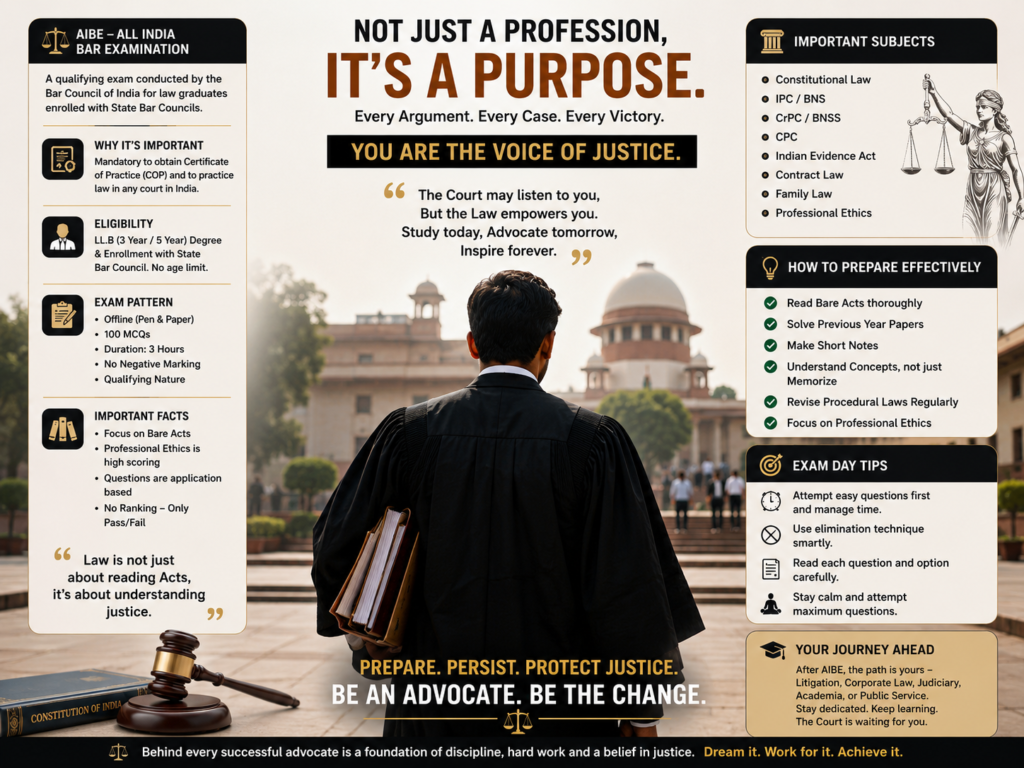
Important Facts About AIBE
1. Professional Ethics Carries High Importance
This section is usually scoring and conceptually straightforward.
2. Bare Acts Are Extremely Important
AIBE questions are often directly framed from statutory language.
Click Below to Buy Bare Acts
3. Previous Year Questions Repeat Concepts
Although exact questions may change, conceptual repetition is common.
4. No Rank System
AIBE only determines:
- Pass
- Fail
Marks are generally not used for merit ranking.
Common Mistakes Made by Candidates
Ignoring Bare Acts
Many students depend only on guidebooks and coaching notes.
This is a major mistake because:
- AIBE questions often use exact statutory wording.
Underestimating Professional Ethics
Many aspirants focus excessively on major subjects and ignore ethics.
Ironically, ethics often becomes one of the highest scoring sections.
Last-Minute Preparation
Although AIBE is qualifying in nature, poor preparation still leads to failure for many candidates.
Ignoring Procedural Laws
CPC, CrPC/BNSS, and Evidence require conceptual clarity.
How to Prepare for AIBE Effectively
Step 1: Start With Bare Acts
Read:
- Constitution
- CPC
- Evidence Act
- IPC/BNS
- CrPC/BNSS
- Contract Act
Focus on:
- Definitions
- Important sections
- Legal terminology
Step 2: Solve Previous Year Papers
This is one of the most important preparation strategies.
Benefits include:
- Understanding question style
- Learning repeated concepts
- Improving speed
- Identifying important topics
Step 3: Prepare Short Notes
Create concise notes for:
- Important sections
- Landmark principles
- Legal maxims
- Professional ethics rules
Step 4: Focus on Conceptual Clarity
AIBE increasingly asks:
- Application-based questions
- Practical legal situations
- Analytical MCQs
Memorization alone is insufficient.
Step 5: Revise Procedural Laws Repeatedly
Many candidates struggle with:
- CPC procedures
- Criminal procedure timelines
- Evidence concepts
Regular revision is essential.
Important Preparation Strategy for Working Advocates
Since many candidates are already practicing or interning:
- Focus on daily revision instead of long study sessions
- Study Bare Acts regularly
- Solve MCQs during travel or court breaks
- Revise procedural subjects on weekends
Consistency matters more than marathon study hours.
Final Thoughts
The AIBE is not merely a qualifying examination. It is the bridge between legal education and professional advocacy.
The examination tests:
- Practical legal understanding
- Ethical awareness
- Procedural knowledge
- Legal reasoning
Candidates who prepare systematically with:
- Bare Acts
- Previous year papers
- Conceptual clarity
- Consistent revision
can clear the examination comfortably.
For aspiring advocates, AIBE should not be viewed as an obstacle but as the first professional milestone in a long and impactful legal journey.
Well covered!
Pingback: AIBE Guide: What to Do After Clearing the Exam - Ecareerupdates