
The Union Public Service Commission conducted the Civil Services Preliminary Examination 2026 on 24 May 2026, and the immediate reaction from aspirants, mentors, and coaching institutes across the country was almost unanimous — the paper was unpredictable, lengthy, analytical, and mentally exhausting.
This year’s examination once again proved one important reality about UPSC:
“UPSC does not reward rote learning anymore; it rewards depth, balance, elimination skills, and conceptual maturity.”
From statement-heavy questions to highly analytical options, from static-current affairs integration to deeper conceptual framing, UPSC Prelims 2026 clearly shifted further away from conventional preparation methods.
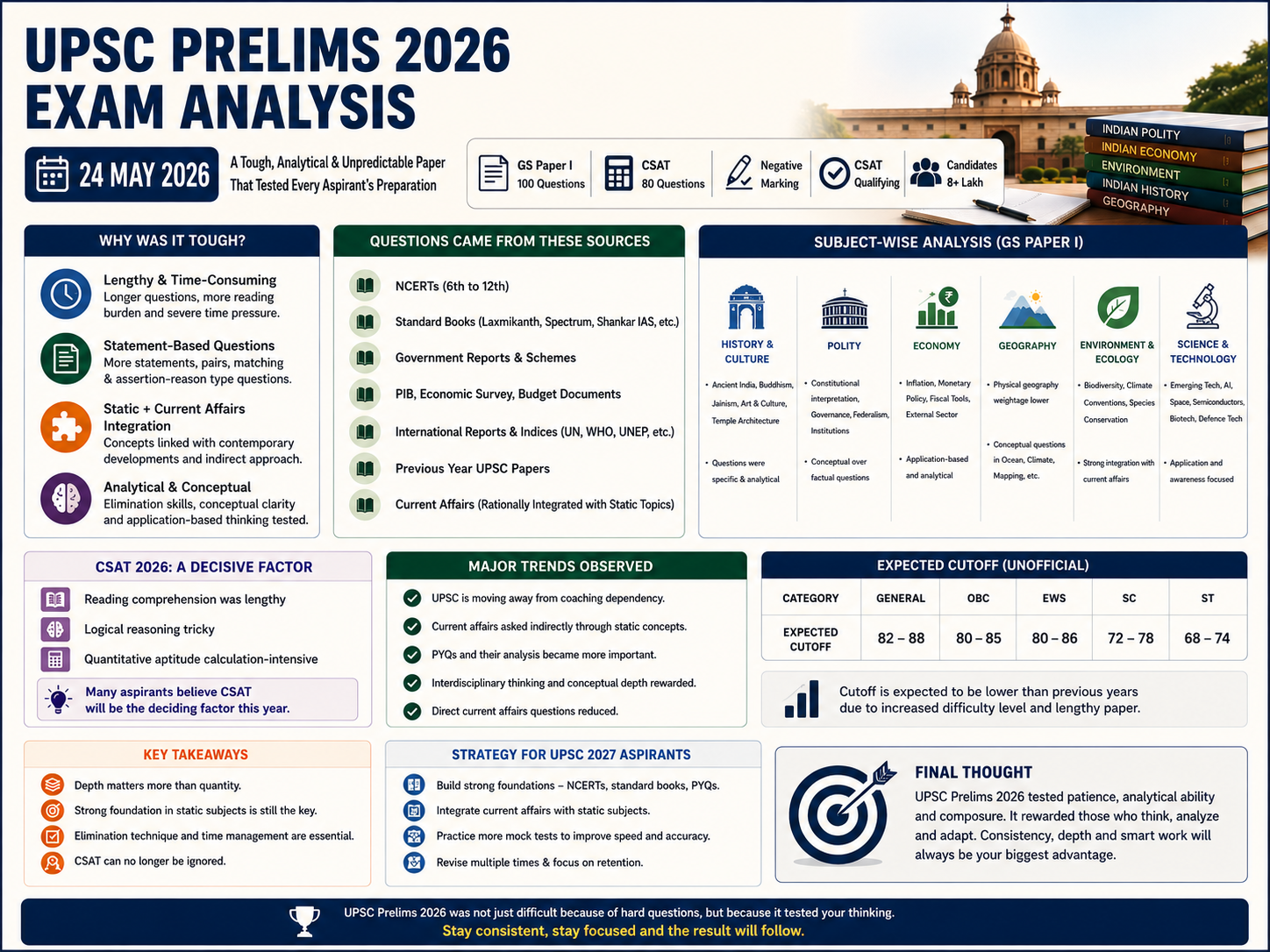
Why Was UPSC Prelims 2026 Considered Tough?
1. Lengthy and Time-Consuming Paper
A major complaint from aspirants was the unusual length of questions. Many questions required:
- Reading multiple statements carefully
- Identifying subtle differences in options
- Applying conceptual understanding rather than factual recall
- Eliminating confusing choices
Reports suggest GS Paper I expanded significantly in structure and reading burden.
This created severe time pressure, especially for candidates attempting 85–95 questions strategically.
2. Statement-Based Questions Dominated
UPSC continued its trend of:
- “Which of the following statements are correct?”
- “Consider the following pairs”
- “Match the following”
- Assertion-reason style questions
This pattern forced aspirants to possess:
- Deep conceptual clarity
- Fine factual precision
- Strong elimination ability
Simple memorization was insufficient.
3. Static + Current Affairs Integration
One of the defining features of UPSC 2026 was the integration of:
- Static subjects
- Contemporary developments
- International affairs
- Government reports
- Environmental conventions
- Economic developments
Rather than directly asking current affairs, UPSC framed questions indirectly through conceptual application.
Example trend:
- Instead of asking about a scheme directly, UPSC linked it with constitutional provisions, governance structures, or environmental implications.
Major Trends Observed in UPSC 2026
UPSC Is Moving Away From Coaching Dependency
The paper clearly indicated:
- Coaching material alone is insufficient
- Standard books alone are insufficient
- Rote current affairs compilations are insufficient
UPSC now rewards:
- Interdisciplinary thinking
- Reading habit
- Conceptual depth
- Consistency
- Analytical temperament
Importance of PYQs Increased Again
Candidates who deeply analyzed Previous Year Questions (PYQs) gained a significant advantage.
UPSC repeated:
- Question framing style
- Elimination logic
- Conceptual approach
- Statement traps
More than direct repetition, UPSC repeated its “thinking pattern.”
Current Affairs Became More Invisible
Direct current affairs questions reduced.
Instead, UPSC asked:
- Static concepts linked to current events
- Contextual understanding
- Applied knowledge
This shift punished candidates dependent only on monthly current affairs PDFs.
Expected UPSC Prelims 2026 Cut-Off
Since the paper was widely regarded as difficult and lengthy, experts predict a comparatively lower cut-off.
Expected Category-Wise Cut-Off (Unofficial)
| Category | Expected Cutoff |
|---|---|
| General | 82–88 |
| OBC | 80–85 |
| EWS | 80–86 |
| SC | 72–78 |
| ST | 68–74 |
These are speculative estimates based on:
- Candidate feedback
- Difficulty level
- Attempt quality
- Historical trends
Pingback: MPSC Rajyaseva Prelims 2026 Paper Analysis - Ecareerupdates
Pingback: Ayushman Bharat Yojana (PM-JAY) 2026 - Ecareerupdates
Pingback: Skill India Mission 2026 - Ecareerupdates
Pingback: MPSC Rajyaseva Mains 2026 Strategy - Ecareerupdates
Pingback: Pradhan Mantri Awas Yojana (PMAY) - Ecareerupdates
Pingback: Stand-Up India Scheme : Complete Guide - Ecareerupdates
Pingback: Beti Bachao Beti Padhao (BBBP) Scheme - Ecareerupdates
Pingback: State Government Schemes in India - Ecareerupdates
Pingback: Atal Pension Yojana (APY) - Ecareerupdates
Pingback: UPSC Current Affairs Digest – 15 June 2026 - Ecareerupdates