Daily Current Affairs – 20 August 2026
UPSC Prelims & Mains | MPSC | GPSC | KPSC | State PSC | Group A, B & C
Date: 20 August 2026
Exam Focus: UPSC CSE • MPSC Rajyaseva • GPSC • KPSC/KAS • Other State PSCs
Coverage: Polity • Governance • Economy • Geography • Environment • Science & Technology • Defence • International Relations • History • Social Issues
UPSC Approach for 2026–27: Today’s current affairs should not be memorised as isolated headlines. Convert every important news item into News → Static Concept → Constitutional/Institutional Linkage → Prelims Trap → Mains Issue → Way Forward. The 2026 Prelims experience has again highlighted the importance of structured, concept-oriented current-affairs preparation.
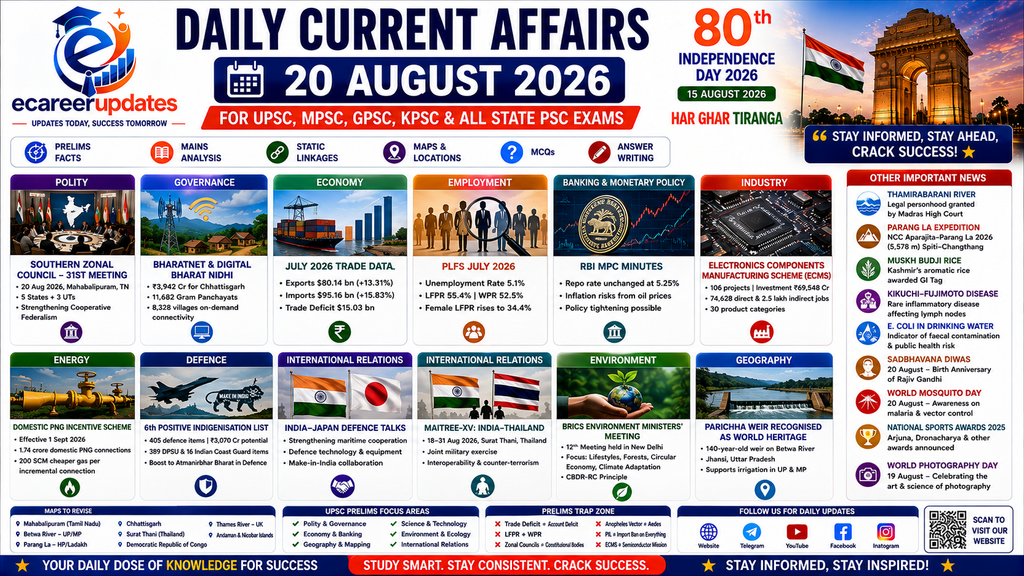
📊 20 AUGUST 2026 — CURRENT AFFAIRS AT A GLANCE
| Category | Important Topic | GS Paper | Priority |
|---|---|---|---|
| 🏛️ Polity | Southern Zonal Council – 31st Meeting | GS-II | 🔴 ⭐⭐⭐⭐⭐ |
| 🏛️ Governance | BharatNet + Digital Bharat Nidhi | GS-II/III | 🔴 ⭐⭐⭐⭐⭐ |
| 💰 Economy | July 2026 Trade Data | GS-III | 🔴 ⭐⭐⭐⭐⭐ |
| 👷 Economy | PLFS July 2026 – Unemployment 5.1% | GS-III | 🔴 ⭐⭐⭐⭐⭐ |
| 🏦 Banking | RBI MPC Minutes – Inflation & Rate Outlook | GS-III | 🔴 ⭐⭐⭐⭐⭐ |
| 🏭 Industry | Electronics Components Manufacturing Scheme | GS-III | 🔴 ⭐⭐⭐⭐⭐ |
| ⚡ Energy | Domestic PNG Incentive Scheme | GS-III | 🟠 ⭐⭐⭐⭐ |
| 🛡️ Defence | Japan–India Defence Cooperation | GS-II/III | 🔴 ⭐⭐⭐⭐⭐ |
| 🛡️ Defence | 6th Positive Indigenisation List | GS-III | 🔴 ⭐⭐⭐⭐⭐ |
| 🌏 IR | BRICS Youth Summit & Youth Council | GS-II | 🔴 ⭐⭐⭐⭐ |
| 🌏 IR | India–Thailand MAITREE-XV | GS-II | 🟠 ⭐⭐⭐⭐ |
| 🌱 Environment | 12th BRICS Environment Ministers’ Meeting | GS-III | 🔴 ⭐⭐⭐⭐⭐ |
| 🏔️ Geography | Parang La Expedition | GS-I/III | 🟠 ⭐⭐⭐⭐ |
| 🌊 Geography | Parichha Weir & Betwa Basin | GS-I/III | 🔴 ⭐⭐⭐⭐⭐ |
| 🤖 S&T | AI in Digital Payments – Razorpay Vulcan | GS-III | 🔴 ⭐⭐⭐⭐ |
| 📜 History | Sadbhavana Diwas & Rajiv Gandhi | GS-I | 🟠 ⭐⭐⭐⭐ |
| 🏅 Sports | National Sports Awards 2025 | GS-I | 🟡 ⭐⭐⭐ |
| 📸 Culture/S&T | World Photography Day | GS-I/III | 🟡 ⭐⭐⭐ |
🔥 TOP 12 MUST-READ TOPICS
If you have only 60 minutes, revise these first:
- Southern Zonal Council
- RBI MPC & inflation
- PLFS – unemployment, LFPR & WPR
- July trade data
- ECMS
- India–Japan defence cooperation
- Positive Indigenisation List
- BRICS Environment Ministers’ Meeting
- BharatNet + Digital Bharat Nidhi
- Parichha Weir
- India–Thailand MAITREE-XV
- Sadbhavana Diwas
🏛️ 1. POLITY & FEDERALISM
Southern Zonal Council – 31st Meeting
⭐⭐⭐⭐⭐ VERY IMPORTANT
The 31st meeting of the Southern Zonal Council (SZC) is being held on 20 August 2026 at Mahabalipuram, Tamil Nadu, under the chairmanship of Union Home Minister Amit Shah. The Council covers Andhra Pradesh, Karnataka, Kerala, Tamil Nadu and Telangana, along with the Union Territories of Puducherry, Andaman & Nicobar Islands and Lakshadweep.
🏛️ What are Zonal Councils?
Zonal Councils were established under the States Reorganisation Act, 1956.
India has:
- Northern Zonal Council
- Central Zonal Council
- Eastern Zonal Council
- Western Zonal Council
- Southern Zonal Council
There is also a North Eastern Council, but it is constitutionally/statutorily distinct from the five Zonal Councils.
📊 Southern Zonal Council — Quick Facts
| Feature | Fact |
|---|---|
| Legal basis | States Reorganisation Act, 1956 |
| Nature | Advisory/consultative |
| Chairman | Union Home Minister |
| Members | Chief Ministers of member States |
| Focus | Inter-State & Centre-State issues |
| Southern Zone | 5 States + 3 UTs |
| 2026 meeting | Mahabalipuram, Tamil Nadu |
The Zonal Councils provide a structured forum for discussing issues involving two or more States or Centre-State coordination, making them an important instrument of cooperative federalism.
🔗 UPSC LINKAGE
Cooperative Federalism
Centre
↓
States
↓
Inter-State issues
↓
Dialogue
↓
Consensus
↓
Cooperative governance
🎯 PRELIMS TRAP
Zonal Councils are not constitutional bodies.
They derive their existence from a Parliamentary law — States Reorganisation Act, 1956.
✍️ MAINS QUESTION
“Zonal Councils can serve as an important institutional mechanism for deepening cooperative federalism in India.” Discuss.
Points to include:
- Inter-State disputes
- Water sharing
- Infrastructure
- Internal security
- Transport
- Border issues
- Economic cooperation
- Centre-State coordination
💻 2. GOVERNANCE + DIGITAL INDIA
Digital Bharat Nidhi & Amended BharatNet
⭐⭐⭐⭐⭐
The Digital Bharat Nidhi (DBN) has entered into an agreement with the Chhattisgarh Government, BSNL and other State-level entities to implement the Amended BharatNet Programme in Chhattisgarh.
The Union Government has approved ₹3,942 crore for the programme, covering 11,682 Gram Panchayats and providing on-demand connectivity to 8,328 villages.
📊 BharatNet — Key Facts
| Parameter | Detail |
|---|---|
| Objective | Rural broadband connectivity |
| Beneficiaries | Gram Panchayats & villages |
| Chhattisgarh coverage | 11,682 GPs |
| On-demand villages | 8,328 |
| Financial support | ₹3,942 crore |
| Implementing model | State-led |
| Earlier USOF | Now Digital Bharat Nidhi |
The programme is expected to strengthen delivery of:
- e-Governance
- Telemedicine
- Online education
- Digital payments
- Citizen services
and support more than three lakh rural home fibre connections.
🧠 IMPORTANT STATIC LINKAGE
Digital divide has three dimensions
Access divide
→ Do people have internet?
Usage divide
→ Can people effectively use it?
Outcome divide
→ Does connectivity actually improve income, education, healthcare and governance?
This is a strong GS-II + GS-III Mains framework.
🎯 PRELIMS
Revise:
- BharatNet
- Digital Bharat Nidhi
- Universal Service Obligation
- Telecommunications Act, 2023
- Digital public infrastructure
- Last-mile connectivity
✍️ MAINS QUESTION
“Digital connectivity is increasingly becoming a prerequisite for inclusive governance rather than merely an infrastructure facility.” Discuss.
💰 3. ECONOMY
India’s July 2026 Trade Data
⭐⭐⭐⭐⭐
India’s overall exports, including merchandise and services, increased 13.31% year-on-year to US$80.14 billion in July 2026. Imports increased faster, by 15.83% to US$95.16 billion, producing a total trade deficit of about US$15.03 billion.
📊 Trade Snapshot
| Indicator | July 2025 | July 2026 | Change |
|---|---|---|---|
| Overall exports | $70.72 bn | $80.14 bn | +13.31% |
| Overall imports | $82.16 bn | $95.16 bn | +15.83% |
| Trade deficit | $11.43 bn | $15.03 bn | Increased |
| Merchandise exports | $36.98 bn | $44.24 bn | +19.63% |
| Merchandise imports | $64.86 bn | $76.22 bn | +17.52% |
Services exports were estimated at $35.89 billion, compared with $33.74 billion a year earlier.
📈 High-Growth Export Categories
| Sector | Growth |
|---|---|
| Iron ore | +78.35% |
| Petroleum products | +67.64% |
| Electronic goods | +57.40% |
| Meat/dairy/poultry | +40.84% |
| Cashew | +25.11% |
| Marine products | +17.83% |
🧠 UPSC CONCEPT
Trade Balance
Exports – Imports = Merchandise Trade Balance
But:
Current Account Balance
includes:
Goods
Services
Primary income
Secondary income/transfers
Therefore:
Trade deficit ≠ necessarily current-account deficit.
✍️ MAINS QUESTION
“Rising exports are necessary but not sufficient for improving India’s external-sector resilience.” Discuss.
Add:
- Export diversification
- Services exports
- Electronics manufacturing
- Energy import dependence
- Logistics costs
- GVC integration
- FTAs
- Rupee exchange rate
👷 4. ECONOMY + EMPLOYMENT
PLFS July 2026: Unemployment Falls to 5.1%
⭐⭐⭐⭐⭐
The National Statistical Office (NSO) released the July 2026 Monthly PLFS Bulletin.
The overall unemployment rate for persons aged 15+ under the Current Weekly Status (CWS) approach fell to 5.1%, from 5.5% in June.
📊 PLFS July 2026
| Indicator | June 2026 | July 2026 |
|---|---|---|
| Overall LFPR | 54.4% | 55.4% |
| Overall WPR | 51.4% | 52.5% |
| Overall UR | 5.5% | 5.1% |
| Rural UR | 5.0% | 4.5% |
| Urban UR | 6.6% | 6.7% |
| Female LFPR | 32.7% | 34.4% |
The overall female LFPR rose significantly from 32.7% to 34.4%, while rural female LFPR reached 38.8%.
🧠 Three Terms UPSC Loves
1. LFPR
Labour Force Participation Rate
= Labour force / working-age population × 100
2. WPR
Worker Population Ratio
= Employed persons / population × 100
3. Unemployment Rate
= Unemployed persons / labour force × 100
⚠️ PRELIMS TRAP
A fall in unemployment rate does not automatically mean a proportional increase in employment.
Why?
Because the unemployment rate denominator is the labour force, not total population.
Therefore UPSC can give a statement such as:
“A fall in unemployment rate necessarily means that the same proportion of the total population has gained employment.”
❌ Incorrect.
✍️ MAINS QUESTION
“India’s employment challenge is increasingly about the quality, productivity and inclusiveness of employment rather than unemployment alone.” Discuss.
Link with:
- Female LFPR
- Informal employment
- Gig economy
- Manufacturing
- Skill mismatch
- Youth unemployment
- Labour productivity
🏦 5. MONETARY POLICY
RBI MPC Minutes Signal Inflation Concerns
⭐⭐⭐⭐⭐ MUST REVISE
The minutes of the August 2026 Monetary Policy Committee meeting indicate growing concern over inflation risks and the possibility of policy tightening later in the year.
The RBI had kept the repo rate at 5.25% at the August meeting. Policymakers highlighted risks from higher oil prices and supply-side pressures.
📊 Monetary Policy Chain
Oil prices rise
↓
Transport cost
↓
Input costs
↓
Food & manufactured goods prices
↓
Headline inflation
↓
Inflation expectations
↓
RBI may tighten monetary policy
🎯 UPSC STATIC
Revise:
- Repo rate
- Reverse repo
- SDF
- MSF
- CRR
- SLR
- Open Market Operations
- MPC
- Inflation targeting
🧠 Why is this important?
This is an excellent GS-III analytical topic:
Growth vs Inflation
If RBI raises rates:
Inflation ↓
but potentially:
Credit ↓ → Investment ↓ → Demand ↓ → Growth ↓
Therefore monetary policy constantly balances:
Price stability + growth considerations
✍️ MAINS QUESTION
“Monetary policy transmission is influenced not merely by the policy rate but also by supply-side shocks and inflation expectations.” Examine.
🏭 6. INDUSTRY + TECHNOLOGY
Electronics Components Manufacturing Scheme — ECMS
⭐⭐⭐⭐⭐ VERY IMPORTANT
The Government’s Electronics Components Manufacturing Scheme (ECMS) is expanding India’s domestic electronics supply chain.
The 106 approved projects involve projected investment of about ₹69,548 crore, with expected direct employment of 74,628 persons and around 2.5 lakh indirect jobs.
📊 ECMS
| Parameter | Current Position |
|---|---|
| Approved projects | 106 |
| Investment | ₹69,548 crore |
| Direct jobs | 74,628 |
| Indirect jobs | ~2.5 lakh |
| States | 15 |
| Products | 30 |
The scheme is intended to move India beyond final assembly toward domestic production of critical components and raw materials.
🔬 Products Include
- Camera modules
- Display modules
- Optical transceivers
- Connectors
- Capacitors
- Antennas
- Coils
- Filters
- Rare-earth permanent magnets
- Anode materials
- Electrolyte additives
- Hermetic terminals
🧠 BIG UPSC LINKAGE
Electronics ecosystem
Raw materials
↓
Components
↓
Sub-assemblies
↓
Devices
↓
Exports
↓
Global Value Chains
This is more important than simply memorising the scheme.
🎯 PRELIMS
Remember:
ECMS ≠ Semiconductor Mission
ECMS focuses substantially on the components and electronics manufacturing ecosystem, while semiconductor policy includes areas such as fabrication, packaging and chip design.
✍️ MAINS QUESTION
“India’s electronics strategy must move from assembly-led growth towards deeper domestic value addition.” Discuss.
⚡ 7. ENERGY
Incentive Scheme for Domestic PNG Connections
The Government has approved an incentive scheme for expanding domestic Piped Natural Gas (PNG) connections, effective from 1 September 2026.
India currently has around 1.74 crore domestic PNG connections. The scheme is designed to encourage City Gas Distribution entities to activate unbilled connections and expand networks.
📊 Scheme Mechanism
Eligible CGD entities can receive an additional allocation of 200 Standard Cubic Metres of lower-priced domestically produced APM gas for each incremental billed domestic PNG connection, subject to the scheme’s conditions.
🧠 Why Important?
PNG can contribute to:
- Cleaner urban cooking fuel
- Reduced dependence on traditional solid fuels
- Better urban air quality
- Gas-based energy transition
- City Gas Distribution expansion
But remember:
Natural gas is a fossil fuel.
So it is better understood as a transition fuel, not a zero-carbon fuel.
✍️ MAINS QUESTION
“Natural gas can play a transitional role in India’s energy transition, but cannot substitute for long-term decarbonisation.” Discuss.
🛡️ 8. DEFENCE
6th Positive Indigenisation List
The Department of Defence Production has notified the 6th Positive Indigenisation List (PIL) comprising 405 strategically important items, with estimated business potential of ₹3,070 crore.
The list contains 389 DPSU-related items and 16 Indian Coast Guard items.
📊 What Does PIL Cover?
It includes:
- Line Replaceable Units
- Sub-systems
- Sub-assemblies
- Spares
- Components
- Raw materials
Items relate to platforms such as:
- ALH
- LUH
- Su-30MKI
- LCA
- T-72
- T-90
- BMP-II
- Missile systems
- Defence electronics
🔗 Defence Indigenisation Chain
Import dependence
↓
Positive Indigenisation List
↓
Domestic procurement
↓
Indian industry
↓
MSMEs + Start-ups
↓
R&D
↓
Employment
↓
Strategic autonomy
🎯 PRELIMS
Revise:
- DDP
- DPSUs
- SRIJAN Portal
- Make-I
- Make-II
- Make-III
- Atmanirbhar Bharat in Defence
✍️ MAINS QUESTION
“Defence indigenisation is both a strategic-security imperative and an industrial-policy instrument.” Examine.
🇯🇵 9. INTERNATIONAL RELATIONS
India–Japan Defence Cooperation
India’s Defence Minister Rajnath Singh is holding bilateral talks with Japan’s Defence Minister Shinjiro Koizumi in New Delhi on 20 August 2026.
The discussions focus on:
- Maritime security
- Defence technology
- Equipment cooperation
- Make-in-India
- Indo-Pacific security
Japan’s revision of its Three Principles on Transfer of Defence Equipment and Technology provides additional context for defence-industrial cooperation.
🌏 Why Japan Matters to India
Strategic
India + Japan
↓
Free & Open Indo-Pacific
↓
Maritime security
↓
Rules-based international order
↓
Supply-chain resilience
📊 Areas of Cooperation
| Area | Importance |
|---|---|
| Maritime security | Indian Ocean–Pacific linkage |
| Defence technology | Indigenous capabilities |
| Supply chains | China+1 diversification |
| Infrastructure | Connectivity |
| Quad | Strategic coordination |
| Indo-Pacific | Regional stability |
🎯 PRELIMS
Revise:
- QUAD
- Indo-Pacific
- Malabar Exercise
- India-Japan defence cooperation
- Japanese defence-export policy
✍️ MAINS QUESTION
“India-Japan relations are increasingly evolving from economic partnership towards a comprehensive strategic-security partnership.” Discuss.
🇹🇭 10. INTERNATIONAL RELATIONS
India–Thailand MAITREE-XV
The 15th India–Thailand Joint Military Exercise MAITREE-XV is being conducted from 18–31 August 2026 at Vibhavadi Rangsit Camp, Surat Thani, Thailand.
Both sides are represented by 85 personnel. The exercise focuses on jungle and semi-urban operations, including interoperability and counter-insurgency/counter-terrorism capabilities.
🗺️ Geography Linkage
Locate:
India
↓
Andaman & Nicobar Islands
↓
Andaman Sea
↓
Thailand
↓
Strait of Malacca
↓
South China Sea
This makes India–Thailand relations important for Act East Policy and maritime connectivity.
🎯 PRELIMS
Remember:
| Exercise | Countries |
|---|---|
| MAITREE | 🇮🇳 India – 🇹🇭 Thailand |
| Malabar | India + US + Japan + Australia |
| Dharma Guardian | India – Japan |
| Garuda | India – France |
🌏 11. INTERNATIONAL RELATIONS
BRICS Youth Council & Youth Summit
India is hosting the BRICS Youth Council Meeting and Youth Summit on 19–20 August 2026 in Gandhinagar, Gujarat, under India’s 2026 BRICS Chairship.
The BRICS Youth Ministers’ Meeting is scheduled for 22 August in Visakhapatnam. India’s BRICS 2026 theme is:
“Building for Resilience, Innovation, Cooperation and Sustainability”
🧑🎓 Youth Agenda
The focus areas include:
- Education
- Entrepreneurship
- Future readiness
- Inclusive development
- Youth wellbeing
- Sustainability
- People-to-people cooperation
🧠 Mains Linkage
Demographic dividend
↓
Skills
↓
Entrepreneurship
↓
Innovation
↓
Employment
↓
Inclusive growth
🌱 12. ENVIRONMENT
BRICS Environment Ministers’ Meeting
India hosted the 12th BRICS Environment Ministers’ Meeting in New Delhi on 18 August 2026 under its BRICS Chairship.
The environmental agenda focused on:
- Sustainable lifestyles
- Afforestation, forest-fire management & disaster resilience
- Circular economy
- Community-based climate adaptation
🌍 Key Concept: CBDR-RC
Common But Differentiated Responsibilities and Respective Capabilities
The basic argument:
All countries have responsibility for climate action, but responsibilities should account for differences in historical contribution, capabilities and developmental circumstances.
This remains a major issue in international climate negotiations.
🔗 Mission LiFE Linkage
Mission LiFE
↓
Behavioural change
↓
Sustainable consumption
↓
Resource efficiency
↓
Lower environmental footprint
The BRICS environmental agenda under India’s chairship linked sustainable lifestyles with India’s Mission LiFE approach.
♻️ Circular Economy
Linear economy
Take → Make → Use → Dispose
Circular economy
Design → Use → Repair → Reuse → Recycle → Recover
✍️ MAINS QUESTION
“Climate negotiations require balancing environmental ambition with equity and developmental justice.” Discuss with reference to CBDR-RC.
🏔️ 13. GEOGRAPHY
Aparajita–Parang La 2026
The NCC’s Aparajita–Parang La 2026 expedition covers approximately 250 km over more than 30 days, crossing Parang La at 5,578 metres, connecting Spiti Valley in Himachal Pradesh with the Changthang region of Ladakh.
🗺️ Geography Revision
Route includes
- Kibber
- Dumla
- Thaltak
- Bongrojen
- Parang La
- Norbu Sumdo
- Kiangdom
- Korzok
The route crosses:
Desert + glacier + snowfield + river valleys
🧠 UPSC Geography Linkage
High-altitude passes are important because they reflect:
- Mountain geomorphology
- Glacial landscapes
- Trans-Himalayan ecology
- Climate change
- Strategic geography
- Border connectivity
🎯 PRELIMS
Parang La
→ Himachal Pradesh–Ladakh region
Changthang
→ High-altitude plateau region
Spiti
→ Cold desert environment
🌊 14. GEOGRAPHY + IRRIGATION
Parichha Weir Recognised as World Heritage Irrigation Structure
The 140-year-old Parichha Weir in Jhansi, Uttar Pradesh, has been recognised by the International Commission on Irrigation and Drainage (ICID) as a World Heritage Irrigation Structure (WHIS).
It serves as headworks of the Betwa Canal System and supports irrigation in Uttar Pradesh and Madhya Pradesh.
📊 Parichha Weir
| Feature | Detail |
|---|---|
| Location | Jhansi, Uttar Pradesh |
| River | Betwa |
| Age | ~140 years |
| Length | 1,174 m |
| Height | 16.8 m |
| Shutters | 318 |
| Basin | Yamuna/Ganga system |
| Role | Irrigation headworks |
The Betwa canal system extends approximately 2,654 km and supports irrigation over about 4.28 lakh hectares across parts of UP and MP.
🧠 STATIC LINKAGE
Betwa
Betwa
↓
Yamuna
↓
Ganga Basin
Therefore:
Betwa is a tributary of the Yamuna, not directly of the Ganga.
🗺️ MAP WORK
Locate:
- Betwa
- Jhansi
- Orchha
- Yamuna
- Chambal
- Ken
- Dhasan
This becomes especially valuable for UPSC + MPPSC + UPPSC + State PSC.
🤖 15. SCIENCE & TECHNOLOGY
AI-Powered Digital Payments — Razorpay Vulcan
Razorpay has launched Vulcan, described as an AI-powered payments foundation model designed to improve transaction reliability, fraud detection and payment routing.
The model was trained using a very large payments dataset and is intended to address:
- Payment failures
- Fraud
- Transaction routing
- Checkout friction
- Risk decisions
🧠 UPSC Concept
AI in financial systems
Data
↓
Pattern recognition
↓
Risk assessment
↓
Fraud detection
↓
Dynamic decision-making
↓
Financial security
⚠️ Important Mains Dimension
AI-based financial systems create benefits but also raise concerns about:
- Data privacy
- Algorithmic bias
- Cybersecurity
- Explainability
- Financial exclusion
- Liability for automated decisions
✍️ MAINS QUESTION
“Artificial intelligence can improve financial inclusion and payment security, but its deployment requires strong data-governance safeguards.” Discuss.
📜 16. HISTORY + SOCIETY
Sadbhavana Diwas – 20 August
20 August is observed as Sadbhavana Diwas, marking the birth anniversary of former Prime Minister Rajiv Gandhi.
In 2026, it marks his 82nd birth anniversary. The observance promotes national integration, communal harmony, peace and goodwill.
📊 Rajiv Gandhi — UPSC Static Revision
| Area | Important Association |
|---|---|
| Birth | 20 August 1944 |
| PM | 1984–1989 |
| Technology | Telecom & modernisation |
| Education | National Policy on Education, 1986 |
| Rural education | Jawahar Navodaya Vidyalayas |
| Telecom | MTNL/PCO expansion |
| Bharat Ratna | Posthumous |
| Sadbhavana Diwas | 20 August |
🧠 Historical Linkage
Rajiv Gandhi’s period is useful for revising:
1980s India
→ Technology
→ Telecom revolution
→ Education reforms
→ Panchayati Raj debates
→ Economic modernisation
→ Sri Lanka/Indo-Lanka Accord
→ Punjab & Assam developments
🎯 PRELIMS TRAP
Sadbhavana Diwas
20 August
Not:
❌ 21 May — Rajiv Gandhi’s death anniversary
🏅 17. SPORTS
National Sports Awards 2025
The Ministry of Youth Affairs & Sports announced the National Sports Awards 2025.
The awards include:
- Arjuna Award
- Arjuna Award (Lifetime)
- Dronacharya Award
- Dronacharya Award (Lifetime)
- Rashtriya Khel Protsahan Puraskar
Interestingly, no athlete was selected for the Major Dhyan Chand Khel Ratna in this cycle.
The Army Paralympic Node, Pune received the Rashtriya Khel Protsahan Puraskar.
🎯 PRELIMS
Remember:
National Sports Day → 29 August
associated with Major Dhyan Chand’s birth anniversary.
📸 18. SCIENCE + CULTURE
World Photography Day
World Photography Day is observed on 19 August.
It commemorates the development of the daguerreotype process associated with Louis Daguerre. The 2026 theme is reported as “HOME.”
🧠 STATIC LINKAGE
Photography can be connected with:
- Remote sensing
- GIS
- Satellite imagery
- Disaster management
- Archaeological documentation
- Wildlife monitoring
- Forensic science
This gives the topic more UPSC relevance than simply remembering an “Important Day”.
🦟 19. SCIENCE + PUBLIC HEALTH
World Mosquito Day
20 August is observed as World Mosquito Day, commemorating Ronald Ross’s discovery in 1897 that mosquitoes transmit malaria parasites between humans.
🦠 Mosquito-Borne Diseases
| Disease | Major Vector |
|---|---|
| Malaria | Anopheles |
| Dengue | Aedes |
| Chikungunya | Aedes |
| Yellow fever | Aedes |
| Japanese Encephalitis | Mainly Culex |
| Filariasis | Several mosquito genera |
⚠️ PRELIMS TRAP
Malaria
Vector:
Female Anopheles mosquito
Not:
❌ Aedes
🧠 20. CURRENT AFFAIR → STATIC LINKAGE MASTER TABLE
| News | Static Concept |
|---|---|
| Southern Zonal Council | Cooperative federalism |
| BharatNet | Digital divide + DPI |
| DBN | USOF + Telecommunications Act |
| Trade data | BoP + current account |
| PLFS | LFPR + WPR + UR |
| RBI MPC | Inflation targeting |
| ECMS | Manufacturing + GVC |
| PNG | Energy transition |
| PIL | Defence indigenisation |
| India-Japan | Indo-Pacific + QUAD |
| MAITREE | Act East Policy |
| BRICS Youth | Demographic dividend |
| BRICS Environment | CBDR-RC + circular economy |
| Parang La | Himalayas + cold desert |
| Parichha Weir | Betwa-Yamuna basin |
| AI Payments | AI + data governance |
| Sadbhavana Diwas | Rajiv Gandhi + 1980s |
| World Mosquito Day | Malaria/vector biology |
🎯 21. PRELIMS PRIORITY MATRIX
| Topic | Static Depth | Current Relevance | Priority |
|---|---|---|---|
| Southern Zonal Council | ⭐⭐⭐⭐⭐ | ⭐⭐⭐⭐⭐ | 🔴 Very High |
| RBI MPC | ⭐⭐⭐⭐⭐ | ⭐⭐⭐⭐⭐ | 🔴 Very High |
| PLFS | ⭐⭐⭐⭐⭐ | ⭐⭐⭐⭐⭐ | 🔴 Very High |
| Trade Data | ⭐⭐⭐⭐⭐ | ⭐⭐⭐⭐⭐ | 🔴 Very High |
| ECMS | ⭐⭐⭐⭐⭐ | ⭐⭐⭐⭐⭐ | 🔴 Very High |
| Positive Indigenisation | ⭐⭐⭐⭐⭐ | ⭐⭐⭐⭐⭐ | 🔴 Very High |
| BRICS Environment | ⭐⭐⭐⭐⭐ | ⭐⭐⭐⭐⭐ | 🔴 Very High |
| BharatNet/DBN | ⭐⭐⭐⭐⭐ | ⭐⭐⭐⭐⭐ | 🔴 Very High |
| India–Japan | ⭐⭐⭐⭐ | ⭐⭐⭐⭐⭐ | 🔴 Very High |
| Parichha Weir | ⭐⭐⭐⭐ | ⭐⭐⭐⭐⭐ | 🟠 High |
| MAITREE-XV | ⭐⭐⭐⭐ | ⭐⭐⭐⭐ | 🟠 High |
| Parang La | ⭐⭐⭐⭐ | ⭐⭐⭐⭐ | 🟠 High |
| Sadbhavana Diwas | ⭐⭐⭐⭐ | ⭐⭐⭐ | 🟠 High |
| AI Payments | ⭐⭐⭐⭐ | ⭐⭐⭐⭐ | 🟠 High |
| World Mosquito Day | ⭐⭐⭐ | ⭐⭐⭐ | 🟡 Moderate |
🧠 22. UPSC-STYLE PRELIMS MCQs
Q1. With reference to Zonal Councils:
- They were established under the States Reorganisation Act, 1956.
- They are constitutional bodies.
- The Union Home Minister is the Chairman of each Zonal Council.
Which is correct?
Answer: 1 and 3 only
Q2. Consider the following pairs:
| Indicator | Meaning |
|---|---|
| LFPR | Population participating in labour force |
| WPR | Proportion of population employed |
| UR | Unemployed as proportion of labour force |
Which are correctly matched?
Answer: All three
Q3. A fall in unemployment rate necessarily implies:
A. Increase in employment equal to the fall in unemployment
B. Increase in labour-force participation
C. None of the above necessarily
D. Increase in total population employment ratio
Answer: C
Q4. Consider the following regarding BharatNet:
- It seeks to provide broadband connectivity to rural areas.
- Digital Bharat Nidhi is associated with universal-service financing.
- Its primary objective is satellite-based mobile communication.
Which is correct?
Answer: 1 and 2 only
Q5. Which one of the following is correctly matched?
A. MAITREE — India–Japan
B. Dharma Guardian — India–Thailand
C. MAITREE — India–Thailand
D. Malabar — India–France
Answer: C
Q6. The Positive Indigenisation List is primarily associated with:
A. Agricultural machinery
B. Defence procurement
C. Renewable energy equipment
D. Pharmaceutical imports
Answer: B
Q7. Consider the following statements about ECMS:
- It seeks to deepen electronics component manufacturing.
- It is aimed only at semiconductor fabrication.
- It can reduce import dependence.
Which is correct?
Answer: 1 and 3 only
Q8. Parichha Weir is associated with which river?
A. Chambal
B. Betwa
C. Ken
D. Son
Answer: B
Q9. CBDR-RC is primarily associated with:
A. International trade
B. Climate change negotiations
C. Nuclear disarmament
D. Refugee protection
Answer: B
Q10. Which mosquito is the principal vector of malaria in humans?
A. Aedes
B. Culex
C. Female Anopheles
D. Mansonia
Answer: C
✍️ 23. MAINS ANSWER WRITING PRACTICE
GS-II — Federalism
Question:
“Cooperative federalism requires institutional platforms for continuous Centre-State dialogue.” Examine the role of Zonal Councils.
Structure:
Introduction
Zonal Councils were established under the States Reorganisation Act, 1956 to facilitate inter-State and Centre-State cooperation.
Body
- Water disputes
- Infrastructure
- Internal security
- Transport
- Economic cooperation
- Regional planning
- Best-practice sharing
Limitations
- Advisory nature
- Irregular follow-up
- Political differences
- Overlap with other institutions
Conclusion
Strengthening implementation mechanisms can convert Zonal Councils into stronger engines of cooperative federalism.
GS-III — Economy
Question:
“India’s recent export growth presents both an opportunity and a challenge for external-sector management.” Discuss.
Use:
Exports ↑
but
Imports ↑ faster
↓
Trade deficit
↓
Oil dependence
↓
External vulnerability
Counter with:
Services + electronics + diversification + GVCs
GS-III — Employment
Question:
“A decline in unemployment should be interpreted alongside labour-force participation and worker-population ratios.” Explain.
This is an excellent opportunity to use PLFS data.
GS-III — Technology
Question:
“Deep electronics manufacturing capability is essential for India to move from an assembly economy to a technology manufacturing hub.” Discuss.
Use:
ECMS → components → value addition → GVCs → exports → employment → strategic autonomy
GS-II/III — Environment
Question:
“The Global South’s climate diplomacy increasingly combines development priorities with climate resilience.” Discuss with reference to BRICS.
Use:
- CBDR-RC
- Adaptation
- Mission LiFE
- Circular economy
- Forest-fire management
- Community-based adaptation
GS-II — International Relations
Question:
“India’s partnerships with Japan and Thailand illustrate the multidimensional nature of its Indo-Pacific and Act East strategies.” Examine.
🗺️ 24. MAP WORK — 20 AUGUST 2026
🇮🇳 India
Mark:
- Tamil Nadu
- Mahabalipuram
- Andhra Pradesh
- Karnataka
- Kerala
- Telangana
- Puducherry
- Lakshadweep
- Andaman & Nicobar Islands
- Chhattisgarh
- Jhansi
- Betwa River
- Yamuna
- Spiti Valley
- Ladakh
- Parang La
🌏 Asia
Mark:
- Japan
- Thailand
- Surat Thani
- Andaman Sea
- Strait of Malacca
- South China Sea
- Indo-Pacific region
⚠️ 25. PRELIMS TRAP ZONE
| Don’t Confuse | Correct Understanding |
|---|---|
| Zonal Council vs North Eastern Council | Different legal/institutional frameworks |
| Zonal Council vs Inter-State Council | Different statutory/constitutional bases |
| LFPR vs WPR | Participation vs employment |
| UR vs employment rate | Different denominators |
| Trade deficit vs current-account deficit | Not identical |
| ECMS vs Semiconductor Mission | Components ecosystem vs broader semiconductor ecosystem |
| PNG vs LPG | Both are fuels but different distribution/characteristics |
| PIL vs SRIJAN | Indigenisation list vs portal |
| BRICS vs NDB | Grouping vs development bank |
| MAITREE vs Malabar | India-Thailand vs multilateral maritime exercise |
| Betwa vs Ken | Separate Yamuna tributaries |
| Parang La vs Nathu La | Different Himalayan passes |
| CBDR-RC vs CBD | Climate principle vs biodiversity convention |
| Malaria vs Dengue vector | Anopheles vs Aedes |
| Sadbhavana Diwas vs Rajiv Gandhi death anniversary | 20 Aug vs 21 May |
🔗 26. BIG UPSC LINKAGES FROM TODAY
LINKAGE 1 — PLFS + Manufacturing + ECMS
ECMS
↓
Manufacturing
↓
Jobs
↓
Female labour participation
↓
Income
↓
Consumption
↓
Economic growth
This connects GS-III Economy + Employment + Industrial Policy.
LINKAGE 2 — BharatNet + AI Payments
Rural connectivity
↓
Digital access
↓
UPI/digital payments
↓
AI-based financial services
↓
Financial inclusion
↓
Digital economy
This connects GS-II Governance + GS-III Technology.
LINKAGE 3 — Japan + Thailand
Japan
→ QUAD
→ Indo-Pacific
→ Maritime security
→ Technology
Thailand
→ Act East
→ ASEAN
→ Andaman Sea
→ Strait of Malacca
Together:
India’s Indo-Pacific strategy
LINKAGE 4 — Trade + RBI
Oil prices
↓
Import bill
↓
Trade deficit
↓
Inflation
↓
RBI policy
↓
Interest rates
↓
Investment
This is a superb Prelims + Mains economy linkage.
LINKAGE 5 — BRICS + Climate
BRICS
↓
Global South
↓
CBDR-RC
↓
Climate finance
↓
Adaptation
↓
Technology transfer
↓
Circular economy
This is a strong GS-II + GS-III international-environment linkage.
🇮🇳 27. SPECIAL MPSC FOCUS
For MPSC Rajyaseva, today’s Maharashtra-linked topics deserve special attention.
🟠 Maharashtra Linkages
| Topic | Maharashtra Connection |
|---|---|
| ECMS | Maharashtra among approved States |
| Sports Awards | Army Paralympic Node, Pune |
| Zonal Councils | Inter-State federalism |
| Defence | Indigenous manufacturing |
| Trade | Electronics/export ecosystem |
| Digital India | Rural connectivity |
| Environment | Western Ghats + climate resilience |
The ECMS projects are spread across 15 States including Maharashtra, while Pune’s Army Paralympic Node received the Rashtriya Khel Protsahan Puraskar.
🟢 28. KPSC / KAS FOCUS
For Karnataka aspirants, prioritise:
- Southern Zonal Council
- India–Japan relations
- MAITREE
- ECMS
- PLFS
- Digital BharatNet
- BRICS
- Defence indigenisation
Remember Karnataka is among the States covered by the Southern Zonal Council and also among the States where ECMS projects are being developed.
🔵 29. GPSC FOCUS
For GPSC:
Highest priority
- ECMS
- BRICS
- International trade
- Circular economy
- Defence manufacturing
- Digital infrastructure
- Zonal Councils
- Climate diplomacy
Gujarat is among the States where ECMS projects have been approved, and Gandhinagar is hosting the BRICS Youth Council Meeting and Youth Summit on 19–20 August 2026.
📝 30. ESSAY TOPICS FROM TODAY
Essay 1
“Digital infrastructure is the new social infrastructure.”
Essay 2
“Economic growth without quality employment cannot deliver a demographic dividend.”
Essay 3
“Strategic autonomy begins with domestic technological capability.”
Essay 4
“Cooperative federalism is not a constitutional slogan but an institutional practice.”
Essay 5
“Climate justice requires both responsibility and capability.”
Essay 6
“The future of manufacturing lies not in assembly but in value-chain ownership.”
🏆 31. TOP 15 TOPICS TO REVISE TONIGHT
🔴 MUST REVISE
- Southern Zonal Council
- RBI MPC
- PLFS
- Trade data
- ECMS
- Positive Indigenisation List
- BRICS Environment Meeting
- BharatNet + DBN
- India–Japan defence
- Parichha Weir
🟠 HIGH PRIORITY
- MAITREE-XV
- BRICS Youth
- Parang La
- Sadbhavana Diwas
- AI payments
📚 32. STATIC REVISION CHECKLIST
🏛️ Polity
☐ States Reorganisation Act, 1956
☐ Zonal Councils
☐ Inter-State Council
☐ Cooperative federalism
☐ Centre-State relations
💰 Economy
☐ Balance of Payments
☐ Trade deficit
☐ Current account
☐ Inflation
☐ MPC
☐ Repo rate
☐ LFPR
☐ WPR
☐ Unemployment rate
🏭 Industry
☐ ECMS
☐ Semiconductor ecosystem
☐ GVCs
☐ Import substitution
☐ Value addition
🌱 Environment
☐ CBDR-RC
☐ Mission LiFE
☐ Circular economy
☐ Climate adaptation
☐ Forest fires
☐ Disaster resilience
🛡️ Defence
☐ Positive Indigenisation List
☐ SRIJAN
☐ Make-I/II/III
☐ Defence production
🌏 IR
☐ QUAD
☐ Indo-Pacific
☐ Act East Policy
☐ ASEAN
☐ BRICS
☐ India-Japan
☐ India-Thailand
🗺️ Geography
☐ Betwa
☐ Yamuna basin
☐ Parichha
☐ Spiti
☐ Parang La
☐ Changthang
☐ Andaman Sea
☐ Strait of Malacca
🧬 Science
☐ AI
☐ Foundation models
☐ Digital payments
☐ Cybersecurity
☐ Mosquito vectors
☐ Malaria
⏱️ 33. 90-MINUTE STUDY PLAN
20 minutes — Economy
Revise:
- RBI
- PLFS
- Trade
- ECMS
15 minutes — Polity
Revise:
- Zonal Councils
- Cooperative federalism
- BharatNet/DBN
15 minutes — International Relations
Revise:
- Japan
- Thailand
- BRICS
15 minutes — Environment
Revise:
- CBDR-RC
- Circular economy
- Mission LiFE
- Adaptation
10 minutes — Geography
Map:
- Betwa
- Yamuna
- Parang La
- Changthang
- Thailand
10 minutes — MCQs
Attempt the questions above without seeing the answers.
5 minutes — Revision
Read only the 60-second sheet below.
⚡ 34. 60-SECOND REVISION SHEET
| Topic | One-Line Recall |
|---|---|
| 🏛️ Southern Zonal Council | Statutory forum for Centre-State/inter-State cooperation |
| 💻 DBN | Earlier USOF; rural digital connectivity |
| 🌐 BharatNet | Rural broadband |
| 💰 Trade | Exports $80.14 bn; imports $95.16 bn |
| 👷 PLFS | UR 5.1%; LFPR 55.4%; WPR 52.5% |
| 🏦 RBI | Repo 5.25%; inflation risks |
| 🏭 ECMS | ₹69,548 crore approved investment |
| ⚡ PNG | 1.74 crore domestic connections |
| 🛡️ PIL | 405 defence items |
| 🇯🇵 Japan | Maritime + defence technology |
| 🇹🇭 MAITREE | India–Thailand |
| 🌍 BRICS | Youth + environment cooperation |
| 🌱 CBDR-RC | Equity in climate action |
| 🏔️ Parang La | Spiti–Changthang connection |
| 🌊 Parichha | Betwa Canal System |
| 🤖 Vulcan | AI in payments |
| 📜 Sadbhavana | 20 August; Rajiv Gandhi |
| 🦟 Mosquito Day | Malaria/vector awareness |
🎯 35. FINAL UPSC TAKEAWAY
The 20 August 2026 news cycle is particularly valuable because it provides several excellent multi-dimensional UPSC questions.
🔗 Economy
Trade
→ Oil prices
→ Inflation
→ RBI
→ Interest rates
→ Investment
→ Employment
🔗 Technology
ECMS
→ Components
→ Manufacturing
→ Value addition
→ GVCs
→ Exports
→ Employment
🔗 Governance
BharatNet
→ Digital connectivity
→ e-Governance
→ Education
→ Healthcare
→ Financial inclusion
→ Rural transformation
🔗 Federalism
Southern Zonal Council
→ Centre-State relations
→ Inter-State coordination
→ Water
→ Infrastructure
→ Security
→ Cooperative federalism
🔗 International Relations
Japan
→ QUAD
→ Indo-Pacific
→ Maritime security
Thailand
→ ASEAN
→ Act East
→ Andaman Sea
→ Strait of Malacca
🔗 Environment
BRICS Environment
→ CBDR-RC
→ Adaptation
→ Circular economy
→ Sustainable lifestyles
→ Climate resilience
🧠 THE 2026 PRELIMS METHOD
For every headline, ask six questions:
1️⃣ What happened?
Current event
2️⃣ Where?
Map/Geography
3️⃣ Which institution?
Polity/Governance
4️⃣ What static concept?
NCERT + standard books
5️⃣ What can UPSC twist?
Statement/elimination question
6️⃣ What is the larger issue?
Mains analysis
This is much more effective than maintaining a giant list of disconnected facts, and aligns with the broader lesson emerging from the 2026 Prelims: structured current affairs must ultimately translate into conceptual understanding and application.
🏅 FINAL EXAM PRIORITY
🔴 UPSC PRELIMS
Southern Zonal Council
PLFS indicators
RBI MPC
Trade deficit vs current account
ECMS
Positive Indigenisation List
BharatNet/DBN
CBDR-RC
Parichha–Betwa
Parang La
MAITREE
India–Japan defence cooperation
🔴 UPSC MAINS
GS-II
- Cooperative federalism
- Zonal Councils
- Digital governance
- India-Japan relations
- India-Thailand/Act East
GS-III
- Inflation
- Employment
- Manufacturing
- Electronics ecosystem
- Defence indigenisation
- Digital economy
- Climate adaptation
- Circular economy
GS-I
- Himalayan geography
- Betwa/Yamuna drainage
- Rajiv Gandhi era
- Important geographical locations
📌 ONE-LINE MASTER REVISION
20 August 2026 = Southern Zonal Council–Cooperative Federalism + BharatNet/DBN–Digital Inclusion + Trade Data–External Sector + PLFS–Employment + RBI MPC–Inflation + ECMS–Electronics Manufacturing + PNG–Energy Transition + PIL–Defence Indigenisation + Japan–Indo-Pacific + MAITREE–Act East + BRICS–Global South + CBDR-RC–Climate Justice + Parang La–Himalayan Geography + Parichha Weir–Betwa Basin + AI Payments–Digital Economy + Sadbhavana–Rajiv Gandhi + World Mosquito Day–Public Health.