Pradhan Mantri Jan Dhan Yojana (PMJDY)

Introduction

Financial inclusion is one of the most important pillars of inclusive economic development. For decades, millions of Indians remained outside the formal banking system, making it difficult for them to access savings accounts, insurance, pensions, loans, and government benefits.

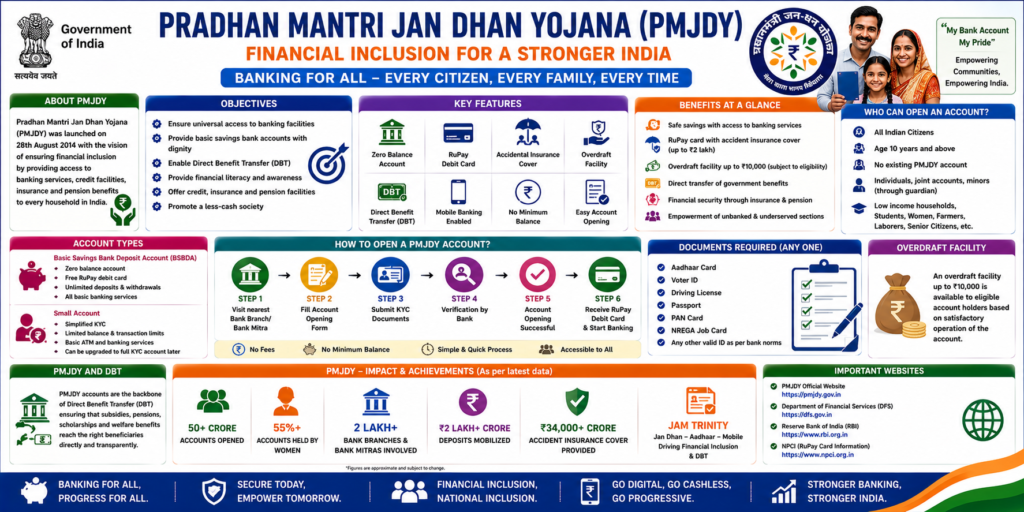
To address this challenge, the Government of India launched the Pradhan Mantri Jan Dhan Yojana (PMJDY) on 28 August 2014. The scheme is considered one of the world’s largest financial inclusion initiatives and aims to provide universal access to banking facilities for every household.

For UPSC, MPSC, SSC, Banking, RBI, NABARD, Railways, and other competitive examinations, PMJDY is an extremely important topic under Financial Inclusion, Social Welfare, Banking Reforms, and Economic Development.

PM Jan Dhan Yojana at a Glance

ParticularDetails
Scheme NamePradhan Mantri Jan Dhan Yojana (PMJDY)
Launch Date28 August 2014
Launched ByGovernment of India
MinistryMinistry of Finance
Implementing AgencyBanks & Financial Institutions
ObjectiveFinancial Inclusion
BeneficiariesIndian Citizens
Account TypeBasic Savings Bank Deposit Account
Application FeeFree
Official Websitepmjdy.gov.in

What is Pradhan Mantri Jan Dhan Yojana?

PMJDY is a national mission aimed at ensuring access to banking services such as:

  • Savings Accounts
  • Direct Benefit Transfer (DBT)
  • Insurance
  • Pension
  • Credit Facilities
  • Digital Banking

The scheme connects every citizen to the formal financial system.

Official Website- https://pmjdy.gov.in


Objectives of PMJDY

ObjectiveDescription
Universal Banking AccessBanking for all
Financial InclusionInclusion of unbanked citizens
Direct Benefit TransferTransparent subsidy delivery
Financial LiteracyAwareness about banking
Social SecurityInsurance & pension linkage
Digital EconomyPromote cashless transactions

Key Features of PMJDY

FeatureDetails
Zero Balance AccountAvailable
RuPay Debit CardProvided
Accident Insurance CoverAvailable
Overdraft FacilityAvailable
Direct Benefit TransferEnabled
Mobile BankingAvailable
Easy Account OpeningSimplified Process

You Can Also Read About Swachha Bharat Mission at- https://ecareerupdates.com/swachh-bharat-mission-sbm/

Why Was PMJDY Launched?

ChallengePMJDY Solution
No Bank AccountsUniversal Banking Access
Leakages in SubsidiesDirect Benefit Transfer
Financial ExclusionBanking Inclusion
Lack of InsuranceSocial Security Benefits
Informal SavingsFormal Banking System

Types of Accounts Under PMJDY

Basic Savings Bank Deposit Account (BSBDA)

FeatureDetails
Minimum BalanceNot Required
Account Opening FeeNil
Deposits AllowedYes
Withdrawals AllowedYes
RuPay CardAvailable

Small Account

FeatureDetails
Limited DocumentationYes
Simplified KYCAvailable
Basic Banking ServicesAvailable
Temporary Account FacilityYes

Who is Eligible?

General Eligibility

CriteriaRequirement
CitizenshipIndian Citizen
Age10 Years and Above
Bank Account StatusNo Existing PMJDY Account
KYC DocumentsRequired

Eligible Beneficiaries

CategoryEligible
Rural CitizensYes
Urban CitizensYes
FarmersYes
LaborersYes
WomenYes
StudentsYes
Senior CitizensYes
Self-Employed IndividualsYes

Who Can Open a Jan Dhan Account?

CategoryEligibility
AdultsYes
Minors Above 10 YearsYes
Low-Income HouseholdsYes
Unbanked IndividualsYes

Documents Required

Standard KYC Documents

DocumentRequired
Aadhaar CardPreferred
Voter IDAccepted
Driving LicenseAccepted
PassportAccepted
PAN CardAccepted
NREGA CardAccepted

If Aadhaar Is Available

BenefitAdvantage
Faster KYCEasy account opening
DBT LinkageQuick subsidy transfer
e-KYCSimplified process

Benefits of PMJDY

Banking Benefits

BenefitDetails
Savings AccountAvailable
Deposit FacilityYes
Withdrawal FacilityYes
Digital BankingAvailable

Insurance Benefits

BenefitCoverage
Accidental Insurance CoverAvailable with RuPay Card
Life Insurance BenefitsSubject to Scheme Conditions

Credit Benefits

BenefitDetails
Overdraft FacilityAvailable
Small Credit AccessAvailable
Financial EmpowermentImproved

Government Benefits

BenefitAdvantage
DBT TransfersDirect Government Payments
SubsidiesDirect Credit
Pension BenefitsEasy Access
Welfare SchemesSeamless Delivery

Overdraft Facility

FeatureDetails
EligibilitySatisfactory Account Operation
PurposeEmergency Financial Support
AvailabilitySubject to Bank Guidelines
Account HistoryRequired

PMJDY and Direct Benefit Transfer (DBT)

PMJDY serves as the foundation for many welfare schemes.

SchemeBenefit Transfer
PM-KISANDirect Transfer
LPG SubsidyDirect Transfer
Scholarship SchemesDirect Transfer
Pension SchemesDirect Transfer
MGNREGA PaymentsDirect Transfer

How to Apply?

Offline Application Process

StepProcess
Step 1Visit Nearby Bank
Step 2Obtain PMJDY Form
Step 3Submit Documents
Step 4Complete KYC
Step 5Account Opening
Step 6Receive RuPay Card

Online Information Access

StepProcess
Visit Official PortalInformation & Forms
Download FormsAvailable
Locate Bank BranchesAvailable

Application Process Flow

StageActivity
ApplicationForm Submission
VerificationKYC Check
ApprovalAccount Creation
Card IssuanceRuPay Card
ActivationBanking Services Start

Is There Any Application Fee?

ParticularFee
Registration FeeNil
Account Opening FeeNil
Processing FeeNil
Government ChargesFree

PMJDY vs Regular Savings Account

ParameterPMJDYRegular Savings Account
Minimum BalanceNot Required
Account Opening CostFree
Financial Inclusion FocusHigh
RuPay CardAvailable
Government Benefits LinkageStrong

PMJDY vs Small Finance Banking

ParameterPMJDYOther Banking Products
Target GroupUnbanked Population
Financial InclusionPrimary Goal
Social Security LinkageStrong
Zero Balance FacilityAvailable

Major Achievements of PMJDY

AchievementImpact
Millions of Accounts OpenedIncreased Financial Inclusion
Women ParticipationSignificant Growth
Rural Banking AccessImproved
DBT SuccessReduced Leakages
Digital Banking ExpansionEnhanced Financial Ecosystem

Importance for UPSC/MPSC Aspirants

Frequently Asked Topics

TopicImportance
Launch DateVery Important
Financial InclusionFrequently Asked
DBTGovernance Topic
RuPay CardBanking Awareness
JAM TrinityImportant
Social SecurityWelfare Schemes

PMJDY and JAM Trinity

A frequently asked examination topic.

ComponentMeaning
JJan Dhan
AAadhaar
MMobile

The JAM Trinity enables efficient transfer of government benefits.


Official Website

PortalPurpose
PM Jan Dhan Yojana Official PortalScheme Information
Ministry of Finance IndiaPolicy Updates
National Payments Corporation of India (NPCI)RuPay Information

Frequently Asked Questions (FAQs)

QuestionAnswer
What is PMJDY?Financial Inclusion Scheme
Is account opening free?Yes
Is minimum balance required?No
Is RuPay card provided?Yes
Can students open an account?Yes
Is Aadhaar mandatory?Preferred but alternative KYC documents may be accepted

Quick Revision Table for Aspirants

ParticularDetails
Scheme NamePM Jan Dhan Yojana
Launch Date28 August 2014
MinistryFinance Ministry
ObjectiveFinancial Inclusion
Account TypeZero Balance Account
RuPay CardAvailable
Insurance CoverAvailable
Overdraft FacilityAvailable
Official Portalpmjdy.gov.in
Exam ImportanceExtremely High

Comparison with Major Financial Inclusion Schemes

SchemeMain Objective
PMJDYBanking for All
Atal Pension YojanaPension Security
PMJJBYLife Insurance
PMSBYAccident Insurance
Stand-Up IndiaEntrepreneurship
Mudra YojanaSmall Business Loans

Conclusion

The Pradhan Mantri Jan Dhan Yojana (PMJDY) is one of India’s most successful financial inclusion initiatives, bringing millions of previously unbanked citizens into the formal banking system. Through zero-balance accounts, RuPay debit cards, insurance benefits, overdraft facilities, and Direct Benefit Transfer (DBT), the scheme has transformed the delivery of financial and welfare services across the country.

For citizens, PMJDY provides access to banking, savings, credit, insurance, and government benefits. For UPSC, MPSC, Banking, SSC, Railways, RBI, NABARD, and other competitive examination aspirants, PMJDY is a crucial topic under Financial Inclusion, Economic Development, Banking Reforms, and Governance, making it highly relevant for both objective and descriptive examinations.

Leave a Comment

Your email address will not be published. Required fields are marked *

Scroll to Top