
Introduction
Completing Class 12 is one of the most significant milestones in a student’s educational journey. It is the stage where students transition from school education to higher education, professional training, skill development, and eventually their careers.
However, many students face confusion after the 12th standard:
- Which course should I choose?
- Should I pursue a degree or a professional certification?
- What careers will be relevant in the future?
- Which skills should I develop during graduation?
- How can I make myself employable in a rapidly changing world?
In today’s era of Artificial Intelligence, Automation, Digital Transformation, and Global Competition, choosing the right path after 12th requires careful planning and awareness of future opportunities.
This guide will help students understand career options, higher education pathways, future-ready skills, industry trends, and the importance of continuous learning to build a successful career.
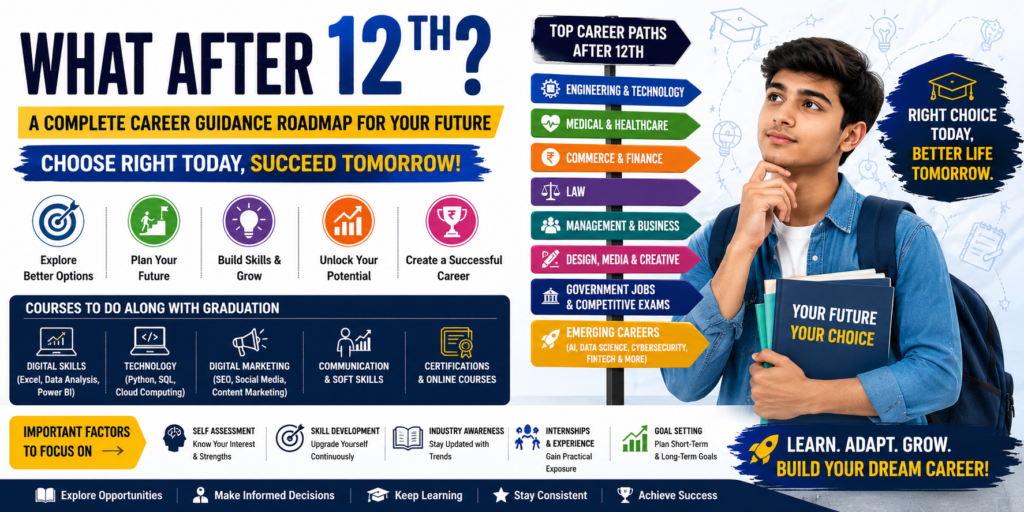
Why Career Planning After 12th is Important
The decisions made after Class 12 directly impact:
- Higher education opportunities
- Professional qualifications
- Employment prospects
- Career growth
- Financial stability
- Personal satisfaction
A well-informed decision can save years of uncertainty and help students align their education with future opportunities.
For Career Guidance Session Visit- https://betacloud.ncs.gov.in/
Before Choosing a Course: Know Yourself
Before selecting any degree or career path, students should evaluate:
| Area | Key Questions |
|---|---|
| Interests | What subjects genuinely excite me? |
| Strengths | What am I naturally good at? |
| Personality | Do I enjoy analytical, creative, social, or technical work? |
| Values | What kind of work-life balance do I want? |
| Goals | Where do I see myself in 10 years? |
Remember:
Career success comes from aligning your interests, skills, and opportunities—not from blindly following trends.
Major Career Pathways After 12th
1. Engineering and Technology
Popular Courses
- B.Tech
- B.E.
- Computer Science
- Artificial Intelligence
- Data Science
- Cybersecurity
- Electronics
- Mechanical Engineering
- Civil Engineering
Benefits
- Strong technical foundation
- High demand globally
- Opportunities in emerging technologies
Future Opportunities
- Software Engineer
- AI Engineer
- Data Scientist
- Cloud Architect
- Robotics Engineer
2. Medical and Healthcare Careers
Popular Courses
- MBBS
- BDS
- BAMS
- BHMS
- BPT
- B.Sc Nursing
- Pharmacy
Benefits
- Social impact
- Stable career opportunities
- Growing healthcare demand
Future Opportunities
- Doctor
- Healthcare Administrator
- Medical Researcher
- Public Health Specialist
3. Commerce and Finance
Popular Courses
- B.Com
- BBA
- CA
- CS
- CMA
- Economics
Benefits
- Strong financial career prospects
- Business and entrepreneurship opportunities
Future Opportunities
- Chartered Accountant
- Financial Analyst
- Investment Banker
- Business Consultant
4. Humanities and Social Sciences
Popular Courses
- BA
- Political Science
- Sociology
- Psychology
- Public Administration
- Economics
Benefits
- Excellent foundation for civil services
- Opportunities in governance and policy
Future Opportunities
- Civil Servant
- Policy Analyst
- Social Researcher
- Journalist
- Counselor
5. Law
Popular Courses
- BA LLB
- BBA LLB
- LLB
Benefits
- Diverse career opportunities
- Strong earning potential
Future Opportunities
- Advocate
- Legal Advisor
- Corporate Lawyer
- Judicial Services
6. Management and Business
Popular Courses
- BBA
- BBM
- BMS
Benefits
- Leadership skills
- Entrepreneurial opportunities
Future Opportunities
- Business Manager
- Marketing Specialist
- HR Professional
- Entrepreneur
7. Design, Media and Creative Careers
Popular Courses
- Graphic Design
- Animation
- Multimedia
- Fashion Design
- Interior Design
- Film and Media Studies
Future Opportunities
- UI/UX Designer
- Animator
- Creative Director
- Content Strategist
8. Government Sector Preparation
Many students start preparing for:
- UPSC
- MPSC
- SSC
- Banking
- Railway
- Defence
- Police Recruitment
during graduation itself.
Advantage
Graduation becomes both an academic qualification and preparation period.
Emerging Career Fields in 2026 and Beyond
The world of work is changing rapidly.
High-Growth Career Areas
| Career Field | Future Demand |
|---|---|
| Artificial Intelligence | Very High |
| Data Science | Very High |
| Cybersecurity | Very High |
| Cloud Computing | Very High |
| Renewable Energy | High |
| Robotics | High |
| Digital Marketing | High |
| Financial Technology (FinTech) | High |
| Biotechnology | High |
| Environmental Science | High |
Students should consider integrating these domains into their career planning.
Courses You Must Consider Alongside Graduation
A degree alone is no longer sufficient.
Employers increasingly seek practical skills and certifications.
Essential Certifications for All Students
Digital Skills
- Microsoft Excel
- Advanced Excel
- Power BI
- Google Workspace
Technology Skills
- Python
- SQL
- Artificial Intelligence Fundamentals
- Data Analytics
Professional Skills
- Communication Skills
- Public Speaking
- Presentation Skills
- Leadership Training
Digital Marketing
- SEO
- Social Media Marketing
- Content Marketing
Project Management
- Agile Basics
- Project Management Fundamentals
Financial Literacy
- Personal Finance
- Investment Basics
- Financial Planning
Best Certifications Based on Career Interests
| Career Goal | Recommended Certifications |
|---|---|
| IT Career | Python, Data Analytics, Cloud Computing |
| Government Exams | Computer Skills, Current Affairs Programs |
| Finance | NISM, Financial Modeling |
| Management | Excel, Power BI, Project Management |
| Digital Career | SEO, Digital Marketing, Content Writing |
| Design | UI/UX Design, Graphic Design |
Importance of Internships During Graduation
One of the biggest mistakes students make is waiting until graduation to gain experience.
Benefits of Internships
- Practical exposure
- Industry understanding
- Networking opportunities
- Resume building
- Better job prospects
Students should aim to complete at least 2–3 internships during graduation.
Building Your Personal Brand
Today’s employers evaluate more than degrees.
Students should build:
- LinkedIn profile
- Professional resume
- Portfolio website
- Personal projects
- Online certifications
A strong digital presence improves employability significantly.
Challenges Students Will Face in the Future
1. Artificial Intelligence and Automation
Many routine jobs may disappear.
Solution
Focus on creativity, critical thinking, and technology skills.
2. Skill-Based Hiring
Employers increasingly prioritize skills over degrees.
Solution
Develop practical skills and certifications.
3. Global Competition
Students compete with talent from across the world.
Solution
Develop communication skills and international awareness.
4. Continuous Learning
Learning cannot stop after graduation.
Solution
Adopt lifelong learning habits.
Skills Every Student Must Develop
Technical Skills
- Computer Literacy
- AI Awareness
- Data Analysis
- Digital Tools
Professional Skills
- Communication
- Leadership
- Problem Solving
- Teamwork
Personal Skills
- Adaptability
- Time Management
- Emotional Intelligence
- Resilience
Common Mistakes to Avoid After 12th
❌ Choosing a course solely based on salary
❌ Following friends blindly
❌ Ignoring future industry trends
❌ Neglecting internships
❌ Avoiding certifications
❌ Focusing only on academic marks
❌ Ignoring communication skills
Suggested Career Development Roadmap During Graduation
First Year
- Explore career options
- Improve communication skills
- Learn computer fundamentals
Second Year
- Complete certifications
- Start internships
- Build LinkedIn profile
Third Year
- Advanced skill development
- Competitive exam preparation
- Resume building
Final Year
- Placement preparation
- Networking
- Professional portfolio development
You Can Also Read- https://ecareerupdates.com/what-after-10th-a-complete-career-guidance/
Final Thoughts
Choosing the right path after Class 12 is not simply about selecting a degree. It is about building a future-ready career that combines education, skills, practical experience, adaptability, and continuous learning.
The future belongs to individuals who can learn, unlearn, and relearn. Whether you pursue Engineering, Medicine, Commerce, Arts, Law, Management, Government Services, or Entrepreneurship, your success will depend on your willingness to develop skills and adapt to a changing world.
Choose your path wisely, invest in learning, gain practical experience, and focus on becoming future-ready rather than degree-ready.
Your future is not determined by the course you choose—it is shaped by the skills, mindset, and efforts you develop throughout your journey.