
Introduction
Completing Class 10 is one of the most important milestones in a student’s life. It marks the beginning of a crucial phase where students must choose an educational pathway that aligns with their interests, strengths, career aspirations, and future opportunities.
Many students and parents often face confusion after the 10th standard. Questions such as:
- Which stream should I choose?
- Is Science the only option for a successful career?
- Should I pursue a diploma or continue with Class 11 and 12?
- How can I identify my strengths and interests?
- Which careers will be in demand in the future?
Choosing the right path after the 10th is not about following trends or peer pressure. It is about understanding yourself, exploring opportunities, and making an informed decision.
This comprehensive guide will help students understand all available options after the 10th, emerging career opportunities, psychometric assessments, future job market trends, and key factors to consider while planning their career journey.
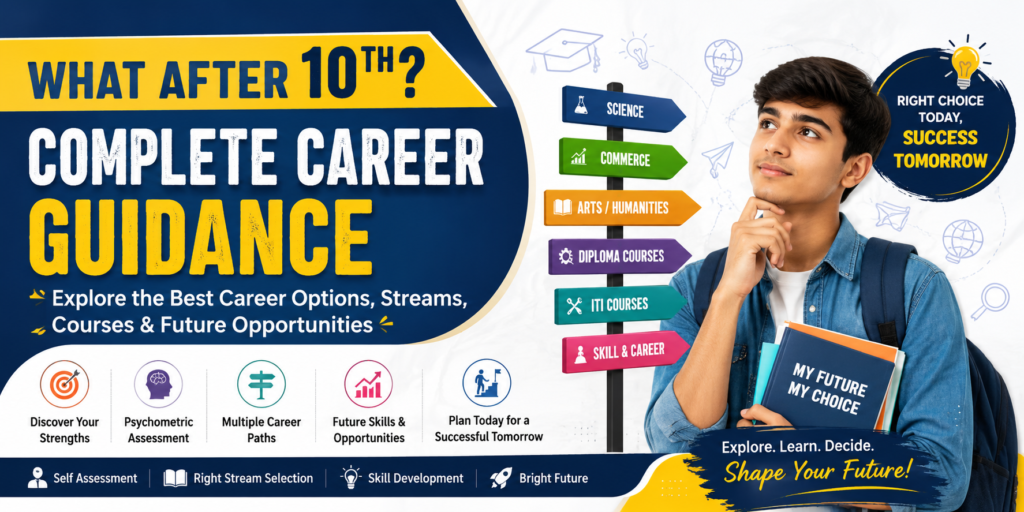
Why Career Planning After 10th is Important
The decisions made after Class 10 influence:
- Educational direction
- Skill development
- Higher education opportunities
- Professional growth
- Career satisfaction
- Future earning potential
A well-planned career path can save time, effort, and resources while helping students achieve long-term success.
Self-Assessment: The First Step Before Choosing Any Stream
Before selecting a stream or career path, students should understand:
| Area | Questions to Ask Yourself |
|---|---|
| Interests | What subjects do I enjoy studying? |
| Skills | What am I naturally good at? |
| Personality | Do I enjoy analytical, creative, social, or practical work? |
| Values | What kind of life and work environment do I want? |
| Goals | What are my long-term aspirations? |
Remember:
The best career choice is where your interests, abilities, and opportunities intersect.
Importance of Psychometric Assessment Tests
Many students choose streams based on marks, relatives’ opinions, or societal pressure. However, a psychometric assessment can provide scientific insights into a student’s strengths and career suitability.
What is a Psychometric Assessment?
A psychometric assessment is a structured evaluation that measures:
- Aptitude
- Personality
- Interests
- Learning style
- Career preferences
- Cognitive abilities
Book Your Career Guidance Session at National Career Centre at- https://betacloud.ncs.gov.in/
Benefits of Psychometric Assessments
| Benefit | Description |
|---|---|
| Career Clarity | Helps identify suitable career options |
| Strength Identification | Reveals natural talents |
| Better Decision-Making | Reduces confusion |
| Confidence Building | Helps students understand themselves better |
| Long-Term Planning | Provides guidance for future education |
Students are strongly encouraged to take a professional career assessment before finalizing their stream.
Major Educational Pathways After 10th
1. Science Stream
Subjects
- Physics
- Chemistry
- Mathematics
- Biology
- Computer Science
- Information Technology
Best For
Students interested in:
- Engineering
- Medicine
- Research
- Technology
- Artificial Intelligence
- Data Science
Career Opportunities
- Engineer
- Doctor
- Scientist
- Data Analyst
- AI Specialist
- Software Developer
- Architect
- Pharmacist
Advantages
- Wide career options
- Eligibility for most competitive examinations
- Strong foundation for emerging technologies
Challenges
- Higher academic workload
- Requires strong conceptual understanding
2. Commerce Stream
Subjects
- Accountancy
- Economics
- Business Studies
- Mathematics
- Entrepreneurship
Best For
Students interested in:
- Business
- Finance
- Economics
- Management
Career Opportunities
- Chartered Accountant (CA)
- Company Secretary (CS)
- Financial Analyst
- Investment Banker
- Business Consultant
- Entrepreneur
Advantages
- Strong career prospects
- Growing demand in financial sectors
- Entrepreneurial opportunities
3. Arts/Humanities Stream
Subjects
- Sociology
- Political Science
- History
- Geography
- Psychology
- Economics
- Public Administration
Best For
Students interested in:
- Social Sciences
- Public Policy
- Civil Services
- Media
- Law
Career Opportunities
- Civil Servant
- Lawyer
- Journalist
- Social Researcher
- Policy Analyst
- Psychologist
Advantages
- Diverse career opportunities
- Ideal for UPSC and State PSC aspirants
- Growing importance in governance and social sectors
4. Polytechnic Diploma Courses
Instead of Class 11 and 12, students can directly pursue diploma education.
Popular Diploma Courses
- Mechanical Engineering
- Civil Engineering
- Electrical Engineering
- Electronics Engineering
- Computer Engineering
Advantages
- Early technical specialization
- Industry-oriented learning
- Faster entry into employment
Duration
Typically 3 years after the 10th standard.
5. ITI (Industrial Training Institute)
ITI programs focus on vocational and technical skills.
Popular Trades
- Electrician
- Fitter
- Welder
- Mechanic
- COPA
- Draughtsman
Advantages
- Practical training
- Industry demand
- Early employment opportunities
Emerging Career Paths of the Future
The world is changing rapidly due to technology, automation, and globalization.
Students should also explore emerging careers such as:
| Future Career | Growth Potential |
|---|---|
| Artificial Intelligence | Very High |
| Data Science | Very High |
| Cybersecurity | Very High |
| Robotics | High |
| Cloud Computing | High |
| Digital Marketing | High |
| UI/UX Design | High |
| Renewable Energy | High |
| Biotechnology | High |
| Environmental Sciences | High |
Career Opportunities Beyond Traditional Streams
Success today is no longer limited to engineering, medicine, or government jobs.
Students can also build careers in:
- Content Creation
- Graphic Design
- Animation
- Gaming Industry
- Sports Management
- Photography
- Digital Entrepreneurship
- E-commerce
- Freelancing
- Financial Planning
Skills Every Student Must Develop
Regardless of the chosen stream, future success depends heavily on skills.
Essential Skills for 2030 and Beyond
Technical Skills
- Digital Literacy
- Computer Skills
- Artificial Intelligence Awareness
- Data Handling
Soft Skills
- Communication
- Problem Solving
- Critical Thinking
- Teamwork
- Leadership
Personal Skills
- Time Management
- Emotional Intelligence
- Adaptability
- Resilience
Challenges Students Will Face in the Future
The world of work is evolving rapidly.
Major Challenges
Automation
Many repetitive jobs will disappear.
Artificial Intelligence
AI will transform industries and job roles.
Global Competition
Students will compete in a global talent marketplace.
Continuous Learning
Degrees alone may not guarantee success.
Skill Obsolescence
Skills become outdated faster than before.
Therefore, students must adopt a mindset of lifelong learning.
Common Mistakes to Avoid After 10th
❌ Choosing a stream because friends selected it
❌ Following societal pressure
❌ Ignoring personal interests
❌ Choosing careers solely based on salary
❌ Avoiding career counseling
❌ Underestimating vocational education
❌ Ignoring emerging industries
How Parents Can Support Students
Parents play a critical role in career decision-making.
Parents Should
- Listen to their child
- Encourage exploration
- Avoid comparison
- Support aptitude assessments
- Focus on strengths rather than marks alone
A student’s passion combined with proper guidance often leads to greater success than forced choices.
Career Planning Framework After 10th
Step 1
Understand yourself.
Step 2
Take a psychometric assessment.
Step 3
Explore available streams.
Step 4
Research career opportunities.
Step 5
Consult teachers and career counselors.
Step 6
Create a long-term educational roadmap.
Step 7
Continuously develop future-ready skills.
You Can Also Read About Central government Jobs at https://ecareerupdates.com/central-government-jobs-guide-for-aspirants/
Final Thoughts
The period after Class 10 is not merely about choosing Science, Commerce, or Arts. It is about choosing a direction that aligns with your interests, abilities, personality, and future aspirations.
In today’s rapidly changing world, success belongs to those who remain adaptable, continuously learn new skills, and embrace emerging opportunities. Whether you choose Science, Commerce, Arts, Diploma, or ITI, the key to success lies in informed decision-making, skill development, and consistent effort.
Remember, there is no “best stream”—there is only the stream that is best for you.
Choose wisely, stay curious, keep learning, and build a future that reflects your true potential.
Your career journey begins with the choices you make today.
Pingback: What After 12th? A Complete Career Guidance - Ecareerupdates
Pingback: What After B.Com? Complete Career Guidance - Ecareerupdates