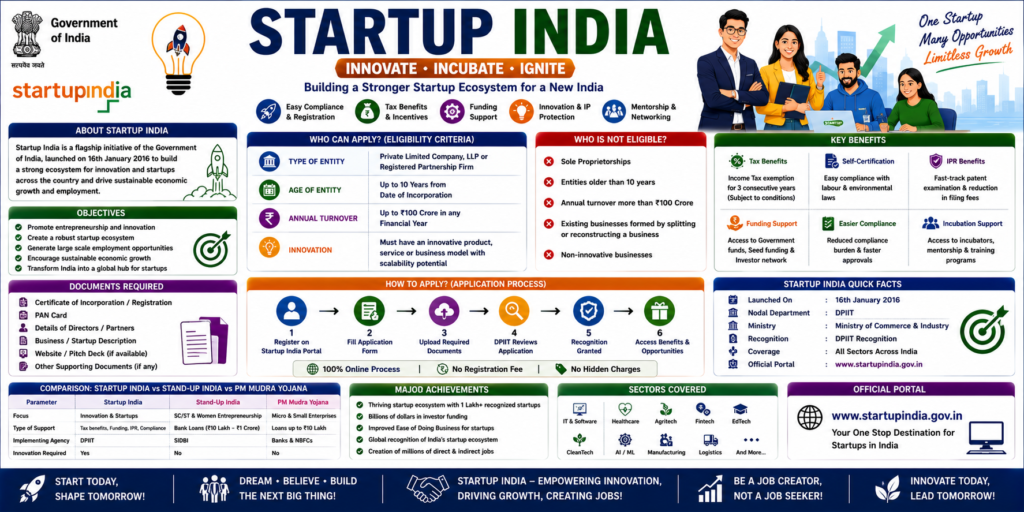
India has emerged as one of the world’s largest startup ecosystems. To encourage innovation, entrepreneurship, job creation, and economic growth, the Government of India launched the Startup India Initiative on 16 January 2016.
Startup India is not merely a scheme but a comprehensive ecosystem designed to support startups through tax benefits, funding support, easier compliance, intellectual property assistance, incubation support, and access to government procurement opportunities.
For UPSC, MPSC, Banking, SSC, NABARD, MBA, and Entrepreneurship-related examinations, Startup India is an important topic under Economic Development, Innovation, Employment Generation, MSMEs, and Government Schemes.
Startup India at a Glance
Particular
Details
Initiative Name
Startup India
Launch Date
16 January 2016
Launched By
Government of India
Ministry
Ministry of Commerce & Industry
Implementing Department
Department for Promotion of Industry and Internal Trade (DPIIT)
Objective
Promote startups and entrepreneurship
Coverage
Entire India
Registration Mode
Online
Official Portal
startupindia.gov.in
What is Startup India?
Startup India is a flagship initiative of the Government of India aimed at building a strong startup ecosystem and transforming India into a nation of job creators rather than job seekers.
The Startup India Initiative has played a transformative role in building India’s entrepreneurial ecosystem by encouraging innovation, supporting startups, improving ease of doing business, and creating employment opportunities. Through benefits such as DPIIT recognition, tax incentives, funding support, intellectual property assistance, and incubation facilities, the initiative has helped India become one of the world’s leading startup hubs.
For entrepreneurs, Startup India provides a platform to turn innovative ideas into successful businesses. For UPSC, MPSC, Banking, SSC, MBA, and other competitive examination aspirants, Startup India is a crucial topic related to entrepreneurship, economic development, innovation policy, employment generation, and governance, making it highly relevant for both prelims and mains examinations.

Pingback: PM Vishwakarma Yojana 2026: Complete Guide - Ecareerupdates