
The All India Bar Examination (AIBE XXI) was successfully conducted by the Bar Council of India on 7 June 2026 across various examination centers in India. Thousands of law graduates and enrolled advocates appeared for this crucial certification examination to obtain the Certificate of Practice (COP), which is mandatory for practicing law before courts and tribunals in India.
The immediate feedback from candidates indicated that AIBE XXI was moderate in difficulty, with a strong emphasis on Bare Acts, procedural laws, constitutional principles, and professional ethics. Unlike some previous editions that contained more direct theoretical questions, AIBE 2026 focused on conceptual understanding and practical legal application.
This detailed analysis covers:
- Difficulty level
- Subject-wise analysis
- Important focus areas
- Sources from which questions were asked
- Expected cut-off
- Answer key information
- Result expectations
- Preparation lessons for future candidates
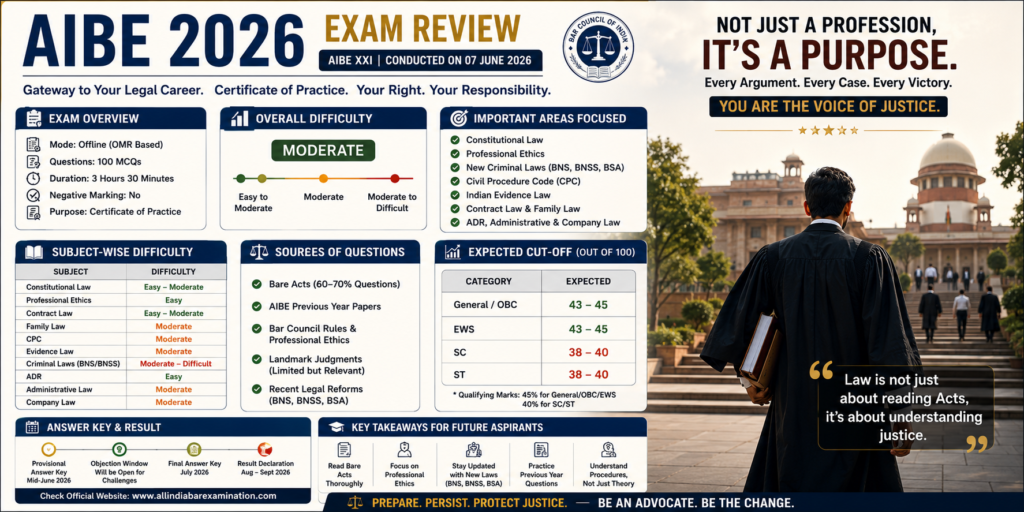
AIBE XXI 2026: Exam Overview
| Particular | Details |
|---|---|
| Exam Name | AIBE XXI (21) |
| Conducting Authority | Bar Council of India |
| Exam Date | 7 June 2026 |
| Mode | Offline (OMR Based) |
| Questions | 100 MCQs |
| Duration | 3 Hours 30 Minutes |
| Negative Marking | No |
| Purpose | Certificate of Practice (COP) |
Overall Difficulty Level
Difficulty Rating: Moderate
Most candidates reported that the examination was:
Easy to Moderate
- Professional Ethics
- Constitutional Law
- Contract Law
Moderate
- Evidence Law
- CPC
- Family Law
Moderate to Difficult
- Criminal Laws (BNS, BNSS)
- Procedural Laws
- Analytical Case-Based Questions
The paper was not excessively difficult, but candidates who depended solely on guidebooks and summary notes faced challenges because many questions were framed directly from legal provisions and statutory language.
Purchase Bare acts form here- https://amzn.to/4vqYh8U
Major Areas Focused by AIBE 2026
1. Constitutional Law
One of the highest-weightage areas.
Questions were asked from:
- Fundamental Rights
- DPSPs
- Constitutional Remedies
- Separation of Powers
- Judicial Review
- Federal Structure
Candidates with strong Bare Act preparation found this section highly scoring.
2. Professional Ethics
As expected, Professional Ethics remained one of the most important sections.
Questions covered:
- Duties of Advocates
- Professional Misconduct
- Bar Council Rules
- Advocate-Client Relationship
- Disciplinary Proceedings
This section helped candidates secure easy marks.
3. New Criminal Laws
A significant trend observed in AIBE XXI was the focus on India’s new criminal laws:
Bharatiya Nyaya Sanhita (BNS)
Bharatiya Nagarik Suraksha Sanhita (BNSS)
Bharatiya Sakshya Adhiniyam (BSA)
Candidates who updated their preparation according to recent legal reforms had a clear advantage.
4. Civil Procedure Code (CPC)
Important topics included:
- Jurisdiction
- Res Judicata
- Appeals
- Decrees
- Execution Proceedings
- Temporary Injunctions
Questions tested practical procedural understanding.
You Can Also Read About- https://ecareerupdates.com/aibe-guide-what-to-do-after-clearing-the-exam/
5. Evidence Law
Questions appeared from:
- Admissions
- Confessions
- Burden of Proof
- Presumptions
- Dying Declaration
- Documentary Evidence
Many questions were directly linked to statutory provisions.
Subject-Wise Analysis
| Subject | Difficulty |
|---|---|
| Constitutional Law | Easy-Moderate |
| Professional Ethics | Easy |
| Contract Law | Easy-Moderate |
| Family Law | Moderate |
| CPC | Moderate |
| Evidence Law | Moderate |
| Criminal Laws (BNS/BNSS) | Moderate-Difficult |
| ADR | Easy |
| Administrative Law | Moderate |
| Company Law | Moderate |
Sources From Which Questions Came
AIBE XXI once again reinforced that Bare Acts remain the most important source.
Major Sources
Bare Acts
Approximately 60–70% of questions appeared directly or indirectly from statutory provisions.
Important Acts included:
- Constitution of India
- BNS
- BNSS
- BSA
- CPC
- Contract Act
- Specific Relief Act
Previous Year AIBE Papers
Several questions followed:
- Similar legal concepts
- Repeated legal principles
- Familiar examination patterns
Professional Ethics Rules
Questions were asked directly from:
- Bar Council Rules
- Professional Conduct Guidelines
Landmark Judgments
Limited but noticeable influence from:
- Constitutional law judgments
- Criminal law developments
Biggest Trends Observed in AIBE 2026
Bare Acts Dominated
Candidates relying only on coaching notes struggled.
The exam clearly rewarded:
- Statutory reading
- Legal language familiarity
- Conceptual clarity
Shift Toward Application-Based Questions
Many questions required:
- Understanding legal principles
- Applying law to situations
- Practical legal reasoning
Focus on New Criminal Laws
The introduction of:
- BNS
- BNSS
- BSA
had a visible impact on the paper pattern. Candidates who ignored these reforms faced difficulties.
Professional Ethics Continues to Be a Game Changer
This section remained:
- Predictable
- Scoring
- High value
Expected Cut-Off for AIBE XXI 2026
AIBE is a qualifying examination rather than a competitive examination.
Official Qualifying Requirement
| Category | Passing Marks |
|---|---|
| General/OBC | 45% |
| SC/ST | 40% |
Expected Effective Cut-Off (Out of 100)
| Category | Expected |
|---|---|
| General/OBC | 43–45 |
| EWS | 43–45 |
| SC | 38–40 |
| ST | 38–40 |
Since the overall paper was moderate, major deviations from the prescribed qualifying benchmark are unlikely.
AIBE XXI 2026 Answer Key
Official Website for Answerkey- https://www.allindiabarexamination.com/
Provisional Answer Key
Expected: Mid-June 2026
Objection Window
Candidates will be able to:
- Challenge incorrect answers
- Submit supporting legal provisions
Final Answer Key
Expected: July 2026
Result Declaration
Expected: August–September 2026
Official Answer Key Reference
Candidates should regularly check:
Official AIBE Portal
All India Bar Examination Official Website
The provisional and final answer keys will be published there.
What Candidates Did Well
Successful candidates generally:
- Read Bare Acts thoroughly
- Revised Professional Ethics repeatedly
- Practiced previous year papers
- Focused on procedural laws
- Studied new criminal laws
Common Mistakes Observed
Ignoring BNS, BNSS & BSA
Many candidates prepared only IPC, CrPC and Evidence Act concepts without updating themselves.
Over-Reliance on Notes
Questions demanded statutory understanding rather than summary memorization.
Neglecting Professional Ethics
Candidates often underestimate this section despite its scoring potential.
Lessons for AIBE XXII (2027) Aspirants
Future aspirants should focus on:
Priority 1
Bare Acts
Priority 2
Professional Ethics
Priority 3
Constitutional Law
Priority 4
BNS, BNSS and BSA
Priority 5
Previous Year Questions
Priority 6
Procedural Laws (CPC & BNSS)
Final Verdict
AIBE XXI (2026) was a well-balanced examination that successfully tested the minimum professional competence expected from an advocate. The examination was neither exceptionally difficult nor overly easy. It rewarded candidates who possessed:
- Strong statutory knowledge
- Familiarity with Bare Acts
- Understanding of procedural law
- Awareness of recent criminal law reforms
- Professional ethics competence
The biggest takeaway from AIBE 2026 is clear:
“Bare Acts remain the heart of AIBE preparation, while Professional Ethics and new criminal laws continue to be decisive scoring areas.”
Candidates scoring around 45+ marks (General/OBC) and 40+ marks (SC/ST) after considering any withdrawn questions can remain reasonably optimistic about qualifying for the Certificate of Practice (COP), subject to the final answer key issued by the Bar Council of India.