
Same-Day Morning Edition | Prelims + Mains Integrated
Morning cut-off: 20 September 2026.
Important: This edition is deliberately focused on developments relevant to 20 September, including events taking place today and fresh overnight information. I have not reproduced the 19 September current-affairs digest.
Because 20 September is a Sunday, the volume of fresh Union-government releases is lighter than on working days. Therefore, today’s digest gives greater weight to officially confirmed observances, scheduled national programmes, weather/geography developments and high-value overnight international developments.
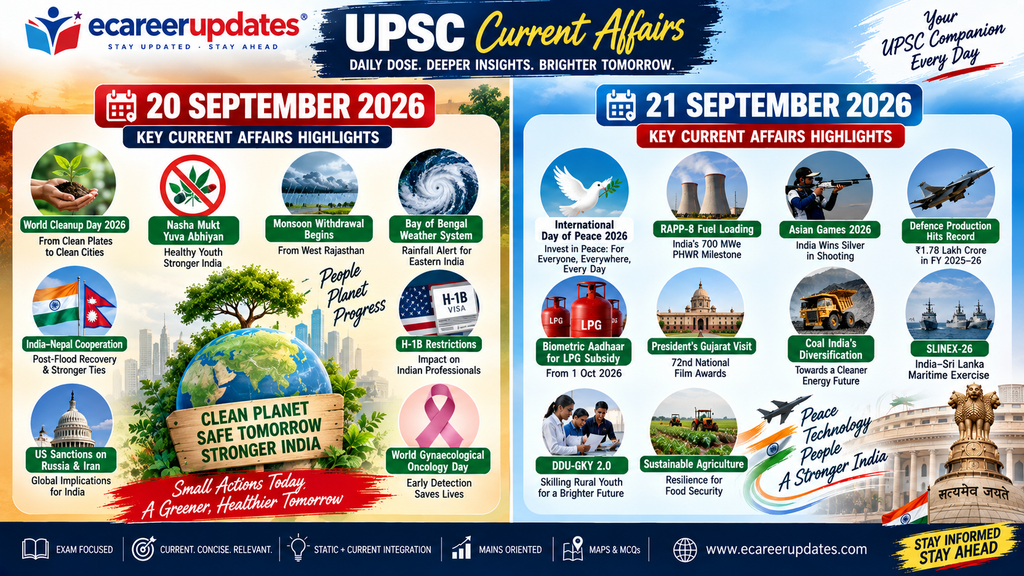
🔴 TODAY’S UPSC PRIORITY LIST
| Priority | Topic | UPSC relevance |
|---|---|---|
| 🔴 1 | World Cleanup Day 2026 | GS-III Environment |
| 🔴 2 | Nasha Mukt Yuva — nationwide activities today | GS-II Society |
| 🔴 3 | Southwest Monsoon withdrawal | GS-I Geography + GS-III |
| 🔴 4 | North Andaman Sea weather system | GS-I Geography + Disaster Management |
| 🔴 5 | India–Nepal post-flood cooperation | GS-II IR + Disaster Diplomacy |
| 🔴 6 | US Russia–Iran sanctions legislation | GS-II IR + GS-III Economy |
| 🟠 7 | H-1B restrictions and India | GS-II/III |
| 🟠 8 | Zero Emissions / climate themes | GS-III |
| 🟠 9 | World Gynaecological Oncology Day | GS-II Health |
| 🟠 10 | International Day of University Sport | Society/Education |
1. 🌍 ENVIRONMENT — WORLD CLEANUP DAY 2026
TODAY — 20 SEPTEMBER
The United Nations observes World Cleanup Day on 20 September 2026.
2026 theme
“From Clean Plates to Clean Cities”
The focus this year is particularly on food waste and the connection between consumption patterns, waste management and sustainable cities.
Why is this important?
Food waste is not simply a sanitation issue.
It represents wasted:
- Water
- Land
- Energy
- Labour
- Agricultural inputs
- Transport resources
When wasted food decomposes under anaerobic conditions, it can also contribute to methane emissions.
Important global figures
According to the UN/UNEP information:
- Around 1.05 billion tonnes of food were wasted in 2022.
- This represented approximately 19% of food available to consumers.
- About 60% of consumer food waste occurs at household level.
- Food loss and waste contribute roughly 8–10% of global greenhouse-gas emissions.
SDG Linkage
SDG 12 — Responsible Consumption and Production
Particularly:
SDG Target 12.3
Halve per-capita global food waste at the retail and consumer levels by 2030 and reduce food losses along production and supply chains.
UPSC Concept
Food loss vs Food waste
| Term | Meaning |
|---|---|
| Food loss | Loss occurring largely before retail |
| Food waste | Food discarded mainly at retail/consumer stages |
GS-III
Use this for:
- Circular economy
- Sustainable consumption
- Waste management
- Food security
- Climate change
- Sustainable cities
Possible Mains line
“Food-waste reduction is simultaneously a climate, food-security, resource-efficiency and urban-governance intervention.”
2. 👥 SOCIETY — NASHA MUKT YUVA ABHIYAN
TODAY — NATIONWIDE ACTIVITIES
The 100 Weeks Nasha Mukt Yuva for Viksit Bharat Abhiyan has entered its first Sunday activity cycle today, 20 September 2026.
Activities are being organised through MY Bharat units, educational institutions and partner organisations.
The campaign’s implementation structure includes the Department of Youth Affairs, MY Bharat and the National Service Scheme (NSS).
Four pillars
Prevent → Protect → Recover → Lead
Today’s activities
The first Sunday phase involves:
- Youth pledge
- Signature campaigns
- Awareness activities
- Street plays
- Youth discussions
- Community mobilisation
The initial Sunday activity is planned across 485 MY Bharat units, while the wider mobilisation involves a much larger network of partner organisations.
12-week activity structure
The September–December phase includes:
- My Health, My Pride
- Fit Youth, Addiction-Free Youth
- Life Skills Month
UPSC Linkage
Drug abuse should be treated as a multidimensional problem:
Health + Society + Economy + Internal Security
GS-II
- Youth development
- Public health
- Social empowerment
- Community participation
GS-III
- Drug trafficking
- Organised crime
- Border security
- Internal security
Static linkage
Revise:
NDPS Act, 1985
and the role of:
Narcotics Control Bureau
3. 🌧️ GEOGRAPHY — SOUTHWEST MONSOON BEGINS WITHDRAWAL
The India Meteorological Department (IMD) reported that the Southwest Monsoon withdrew from some parts of West Rajasthan on 19 September 2026.
This is the beginning of the annual withdrawal process.
Why is this important today?
The withdrawal of the monsoon is not simply a date on the calendar.
It represents a transition in:
- Wind circulation
- Moisture availability
- Pressure patterns
- Rainfall distribution
- Agricultural conditions
How does IMD determine withdrawal?
IMD identifies important atmospheric conditions including:
- Cessation of rainfall activity for about five continuous days
- Establishment of an anticyclone in the lower troposphere
- Significant reduction in atmospheric moisture.
Prelims Concept
The monsoon withdrawal is generally a gradual spatial process, not a single-day event.
Map
Trace:
West Rajasthan → Rajasthan → Gujarat/Madhya Pradesh → northern & central India → southern peninsula
GS-I
- Indian monsoon
- Atmospheric circulation
- Pressure belts
- Seasonal reversal of winds
GS-III
- Agriculture
- Water resources
- Disaster management
4. 🌊 GEOGRAPHY + DISASTER MANAGEMENT — BAY OF BENGAL WEATHER SYSTEM
A weather system over the North Andaman Sea is influencing rainfall prospects over eastern and peninsular India.
Current forecasts indicate potential intensification and movement towards the Odisha–Andhra Pradesh sector, with rainfall impacts extending across parts of eastern and central India.
UPSC relevance
This is a classic example of how:
Bay of Bengal disturbances → moisture transport → heavy rainfall → flood/cyclone risk
Map Work
Locate:
Andaman Sea
↓
Bay of Bengal
↓
Odisha
↓
Andhra Pradesh
↓
Chhattisgarh/Jharkhand/West Bengal
Concept
Not every low-pressure system becomes a cyclone.
A cyclone requires favourable conditions such as:
- Sufficient sea-surface temperature
- Moist atmospheric conditions
- Low vertical wind shear
- Appropriate atmospheric circulation
GS-I + GS-III
Cyclones + monsoon + disaster preparedness + early warning
5. 🇮🇳🇳🇵 INTERNATIONAL RELATIONS — INDIA–NEPAL DISASTER COOPERATION
Nepal’s Finance Minister Swarnim Wagle is in India during 18–20 September for high-level discussions.
The visit comes against the background of Nepal’s severe August 2026 floods and associated reconstruction needs.
The discussions include:
- Disaster recovery
- Energy
- Connectivity
- Investment
- Trade
- Infrastructure
India has also been supplying electricity to Nepal following damage to hydropower infrastructure.
Why important?
This is a useful UPSC example of:
Disaster diplomacy
Natural disasters can influence:
Humanitarian assistance → energy cooperation → reconstruction → bilateral relations
India–Nepal static linkage
Remember:
- Open border
- People-to-people ties
- Hydropower
- Electricity trade
- Rail/road connectivity
- Ganga basin
- Himalayan ecology
- Disaster management
Map
India → Bihar/Uttar Pradesh/Uttarakhand → Nepal Himalayas
Also locate:
Koshi | Gandaki | Karnali
6. 🇺🇸 INTERNATIONAL RELATIONS — US SANCTIONS ON RUSSIA & IRAN
The White House announced on 18 September 2026 that President Donald Trump signed the:
Lindsey O. Graham Sanctioning Russia and Iran Act of 2026
The law expands statutory sanctions, tariffs and prohibitions concerning Russia and extends sanctions relating to Iran.
Why important for India?
India’s strategic challenge lies in balancing:
India–US relations
with
India–Russia defence and energy relations
and
India’s energy-security requirements
UPSC concept
This is an example of:
Strategic autonomy
India may have to balance relationships with multiple major powers according to national interests.
GS-II
- India–US
- India–Russia
- Strategic autonomy
- Multipolarity
GS-III
- Energy security
- Oil imports
- External-sector vulnerability
Mains linkage
“India’s strategic autonomy increasingly requires diversification rather than dependence on any single major power.” Discuss.
7. 💻 INTERNATIONAL ECONOMY — H-1B POLICY AND INDIA
A U.S. presidential proclamation issued on 18 September extends restrictions affecting certain H-1B specialty-occupation workers.
The proclamation continues the restriction for another 12 months from 21 September 2026, with specified petitions subject to a $100,000 payment, subject to exceptions.
Why is this important for India?
India is a major source of highly skilled professionals working in:
- IT
- Software
- Engineering
- Research
- Technology services
Therefore, changes to H-1B policy can affect:
Indian professionals + IT services + outsourcing + remittances + global labour mobility
UPSC linkage
GS-II
- Diaspora
- India–US relations
GS-III
- Services exports
- IT industry
- Labour mobility
Important distinction
H-1B is a:
US non-immigrant work visa category
It is not equivalent to permanent immigration.
8. 🌱 ENVIRONMENT — ZERO-WASTE ECONOMY
World Cleanup Day gives an excellent opportunity to revise:
Linear vs Circular Economy
| Linear | Circular |
|---|---|
| Take | Reduce |
| Make | Reuse |
| Use | Repair |
| Dispose | Refurbish |
| — | Recycle |
| — | Recover |
India’s linkage
Connect with:
- Mission LiFE
- Extended Producer Responsibility
- Solid Waste Management Rules
- Plastic Waste Management
- Resource efficiency
- Circular economy
UPSC Mains
“Circular economy requires behavioural change as much as technological innovation.” Examine.
9. 🩺 SOCIETY + HEALTH — WORLD GYNAECOLOGICAL ONCOLOGY DAY
World Gynaecological Oncology Day is observed on 20 September.
UPSC relevance
It provides an opportunity to revise women’s cancer burden and preventive health.
Major gynaecological cancers include:
- Cervical cancer
- Ovarian cancer
- Endometrial/uterine cancer
- Vulvar cancer
- Vaginal cancer
Cervical cancer prevention
The key public-health approach includes:
HPV vaccination + screening + early diagnosis + treatment
Static linkage
India’s HPV vaccination programme for adolescent girls is relevant here.
GS-II
- Women’s health
- Preventive healthcare
- Universal Health Coverage
- Public-health infrastructure
10. 🎓 SOCIETY — INTERNATIONAL DAY OF UNIVERSITY SPORT
The International Day of University Sport is observed on 20 September.
UPSC linkage
University sport can be connected with:
- Youth health
- Mental health
- Physical fitness
- Social inclusion
- Education
- Human capital
Mains angle
India’s demographic dividend requires investment not only in education and employment but also in:
physical health + mental well-being + social participation.
11. 🏛️ POLITY & GOVERNANCE — TODAY’S STATIC REVISION
There is no fresh constitutional/legal development available this morning that merits replacing the higher-priority economic, environmental and IR topics.
Therefore, today’s Polity revision should focus on institutions appearing in current affairs:
| Institution | Static area |
|---|---|
| RBI | Monetary policy |
| IMD | Weather forecasting |
| MY Bharat | Youth development |
| NSS | Student/community service |
| NCB | Drug-control architecture |
| UN | Global governance |
| NDRF/SDMA | Disaster management |
Prelims Revision
Distinguish:
Constitutional body
vs
Statutory body
vs
Executive body
This is a frequent UPSC statement-question area.
12. 📚 HISTORY — STATIC LINKAGE
There is no high-priority fresh historical development for today’s morning edition.
Today’s 15-minute History revision
Revise the evolution of:
Indian Ocean trade
Ancient → Medieval → Colonial → Modern
Connect:
Indian Ocean trade routes
↓
Ports
↓
European maritime expansion
↓
Colonial trade networks
↓
Modern maritime security
This gives an excellent integrated GS-I + GS-II + GS-III approach.
13. 🌾 AGRICULTURE — TODAY’S STATIC REVISION
The monsoon withdrawal and Bay of Bengal weather system make agricultural climatology especially relevant.
Revise:
Monsoon → sowing → crop water availability → reservoirs → groundwater → food prices
Important crops
| Crop | Broad climatic relevance |
|---|---|
| Rice | High water requirement |
| Wheat | Cool-season crop |
| Millets | Generally more drought-resilient |
| Pulses | Important for nutrition + soil fertility |
| Oilseeds | Important for edible-oil security |
Mains linkage
Climate-resilient agriculture requires crop diversification, water-use efficiency, improved weather forecasting and risk-management instruments.
14. 💰 ECONOMY — GLOBAL MACRO LINKAGE
Today’s most useful economic revision is to connect:
US monetary policy
Energy sanctions
India’s imports
Rupee
Inflation
The chain:
Global interest rates / sanctions
↓
Capital flows + commodity prices
↓
Rupee + imported inflation
↓
Domestic monetary-policy challenge
This is a high-value GS-III integrated framework.
🗺️ IMPORTANT UPSC MAP WORK
Map 1 — MONSOON WITHDRAWAL
Locate:
West Rajasthan
Then trace the normal withdrawal pathway across northern and central India.
Remember
IMD does not declare withdrawal merely because rainfall decreases for one or two days; multiple atmospheric indicators are considered.
Map 2 — BAY OF BENGAL
Mark:
Andaman Sea → Bay of Bengal → Odisha → Andhra Pradesh
Then identify:
Mahanadi | Godavari | Krishna
These river basins are highly relevant to flood and cyclone questions.
Map 3 — INDIA–NEPAL
Mark:
Nepal Himalayas
↓
Koshi
Gandaki
Karnali
↓
Ganga Basin
Map 4 — INDIA–US–RUSSIA
Draw a simple strategic triangle:
India
↙︎ ↘︎
USA — Russia
Use it to revise:
Strategic autonomy + defence + energy + technology
🧠 15 UPSC-STYLE MCQs
Q1. World Cleanup Day 2026 is associated particularly with:
A. Ocean acidification
B. Food waste
C. Desertification
D. Plastic fishing
Answer: B
Q2. Consider the following statements:
- SDG 12 concerns responsible consumption and production.
- SDG Target 12.3 addresses food waste and food loss.
- Food waste has no significant climate implications.
Answer: 1 and 2 only
Q3. Which of the following is NOT a criterion used by IMD for declaring monsoon withdrawal?
A. Cessation of rainfall activity
B. Establishment of an anticyclone
C. Reduction in atmospheric moisture
D. Sudden fall in sea level
Answer: D
Q4. Consider the following:
- Territorial Sea — 12 nautical miles
- Contiguous Zone — 24 nautical miles
- EEZ — 200 nautical miles
Answer: All three correctly matched
Q5. The four pillars of Nasha Mukt Yuva Abhiyan include:
A. Prevent, Protect, Recover, Lead
B. Prevent, Punish, Recover, Export
C. Protect, Punish, Reform, Lead
D. Prevent, Prosecute, Recover, Govern
Answer: A
Q6. H-1B is primarily associated with:
A. Tourism visas
B. Specialty-occupation workers
C. Permanent citizenship
D. Diplomatic missions
Answer: B
Q7. Consider the following:
Food loss generally occurs earlier in the supply chain than food waste.
Answer: Correct
Q8. Which river system is NOT primarily associated with Nepal’s Himalayan river drainage?
A. Koshi
B. Gandaki
C. Karnali
D. Narmada
Answer: D
Q9. The Red Panda’s scientific name is:
A. Panthera pardus
B. Ailurus fulgens
C. Ursus arctos
D. Melursus ursinus
Answer: B
Q10. Consider:
- Circular economy promotes reuse.
- Circular economy can reduce resource extraction.
- Circular economy necessarily means zero economic activity.
Answer: 1 and 2 only
Q11. A rise in US interest rates can potentially:
- Increase attractiveness of dollar assets.
- Influence capital flows to emerging markets.
- Have no possible effect on emerging-market currencies.
Answer: 1 and 2 only
Q12. Which of the following is a key preventive intervention for cervical cancer?
A. HPV vaccination
B. Antibiotics
C. Antimalarial treatment
D. Insulin
Answer: A
Q13. The Bay of Bengal is particularly important for Indian climatology because it:
A. Is completely isolated from the monsoon system
B. Acts as an important source of moisture for monsoon systems
C. Has no tropical disturbances
D. Does not influence eastern India’s rainfall
Answer: B
Q14. The NCB is primarily associated with:
A. Narcotics control
B. Monetary policy
C. Space research
D. Election management
Answer: A
Q15. Which one best represents the circular-economy sequence?
A. Extract → Manufacture → Dispose
B. Extract → Consume → Dump
C. Reduce → Reuse → Repair → Recycle
D. Produce → Consume → Burn
Answer: C
✍️ MAINS ANSWER LINKAGES
GS-III — ENVIRONMENT
Question
“Food waste is both an environmental externality and a food-security challenge.” Discuss.
Framework
Introduction
Food waste represents inefficient utilisation of agricultural resources while contributing to environmental degradation.
Body
Environmental impact
- Methane
- Wasted water
- Wasted energy
- Land-use pressure
Economic impact
- Farmer/supply-chain losses
- Waste-management costs
- Resource inefficiency
Food-security impact
- Food availability
- Affordability
- Nutrition
Solutions
- Better cold chains
- Storage
- Consumer awareness
- Food redistribution
- Circular bioeconomy
- Composting
- Biogas
Conclusion
Reducing food waste can simultaneously improve food security, resource efficiency and climate resilience.
GS-I — GEOGRAPHY
Question
“The withdrawal of the Southwest Monsoon is a complex atmospheric process rather than merely the cessation of rainfall.” Explain.
Use:
Rainfall cessation + anticyclone + moisture reduction + circulation reversal
GS-II — INTERNATIONAL RELATIONS
Question
“India’s strategic autonomy requires balancing partnerships rather than choosing permanent geopolitical camps.” Discuss.
Use:
India–US + India–Russia + Global South + BRICS + SCO + Indo-Pacific
GS-II — SOCIETY
Question
“Drug abuse among youth requires a public-health and social-prevention approach alongside law enforcement.” Discuss.
Use:
Prevent → Protect → Recover → Lead
Then:
Education + counselling + rehabilitation + community participation + law enforcement
📄 ONE-PAGE REVISION SHEET
🇮🇳 20 SEPTEMBER 2026
🌍 WORLD CLEANUP DAY
20 September
→ Theme: From Clean Plates to Clean Cities
→ SDG 12
→ Food waste + circular economy
👥 NASHA MUKT YUVA
100-week campaign
→ Prevent
→ Protect
→ Recover
→ Lead
Today: MY Bharat activities
🌧️ MONSOON
Withdrawal began from parts of West Rajasthan
→ Rainfall cessation
→ Anticyclone
→ Moisture reduction
🌊 BAY OF BENGAL
North Andaman Sea system
→ Potential intensification
→ Odisha/Andhra focus
→ Heavy-rain/flood risk
🇳🇵 INDIA–NEPAL
Disaster diplomacy
→ Flood recovery
→ Energy
→ Connectivity
→ Reconstruction
🇺🇸 US SANCTIONS
Russia + Iran
→ Strategic autonomy
→ Energy security
→ India–US/Russia balancing
💻 H-1B
→ Specialty occupation
→ Indian IT professionals
→ Labour mobility
🩺 WOMEN’S HEALTH
World Gynaecological Oncology Day
→ HPV vaccination
→ Screening
→ Early diagnosis
🏙️ CIRCULAR ECONOMY
Reduce → Reuse → Repair → Recycle → Recover
🎯 TODAY’S UPSC PRIORITY ORDER
🔴 MUST STUDY
- World Cleanup Day + Food Waste + SDG 12
- Southwest Monsoon withdrawal
- Bay of Bengal weather system
- Nasha Mukt Yuva Abhiyan
- India–Nepal disaster/energy cooperation
- US sanctions and India’s strategic autonomy
🟠 IMPORTANT
- H-1B policy and Indian skilled migration
- Women’s cancer prevention
- Circular economy
- Drug-control architecture
🟢 STATIC REVISION
- Monsoon withdrawal criteria
- Maritime zones
- Bay of Bengal map
- Himalayan rivers
- SDGs
🔗 FINAL UPSC INTEGRATION
Today’s relatively lighter Sunday news cycle still gives us a very useful UPSC framework:
ENVIRONMENT
Food waste → Circular economy → SDG 12 → Climate mitigation
GEOGRAPHY
Monsoon withdrawal → Bay of Bengal disturbance → Rainfall → Agriculture
SOCIETY
Drug-free youth → Public health → Rehabilitation → Human capital
INTERNATIONAL RELATIONS
India–Nepal → Disaster diplomacy → Energy → Connectivity
STRATEGIC AFFAIRS
US sanctions → Russia/Iran → Energy security → Strategic autonomy
HEALTH
HPV → Screening → Cervical cancer prevention → Women’s health
For Prelims, focus today on SDG 12.3, monsoon withdrawal criteria, maritime zones, Bay of Bengal geography, H-1B, NCB, and the four pillars of Nasha Mukt Yuva. For Mains, the strongest answer themes are circular economy, climate-resilient agriculture, disaster diplomacy, strategic autonomy and public-health approaches to substance abuse.
Key authoritative sources
- United Nations — World Cleanup Day 2026
- India Meteorological Department — Monsoon Withdrawal Information
- IMD — 19 September 2026 monsoon withdrawal update
- Ministry of Youth Affairs — Nasha Mukt Yuva campaign information
- White House — Russia & Iran Sanctioning Act
- White House — H-1B proclamation
- UN — Global Goals/SDG resources