
UPSC Prelims & Mains | MPSC | GPSC | KPSC | State PSC | Group A, B & C
17 August 2026 — Exam-Oriented Current Affairs
Prelims Facts • Static Linkages • Mains Analysis • Maps • MCQs • Answer Writing • State PSC Relevance
UPSC 2026 lesson: Current affairs are increasingly being used as the context through which static concepts are tested. The 2026 Prelims analysis highlighted lengthy statement-based questions, conceptual/application-oriented framing and strong integration of contemporary developments with Polity, Economy, Environment, Science & Technology and International Relations.
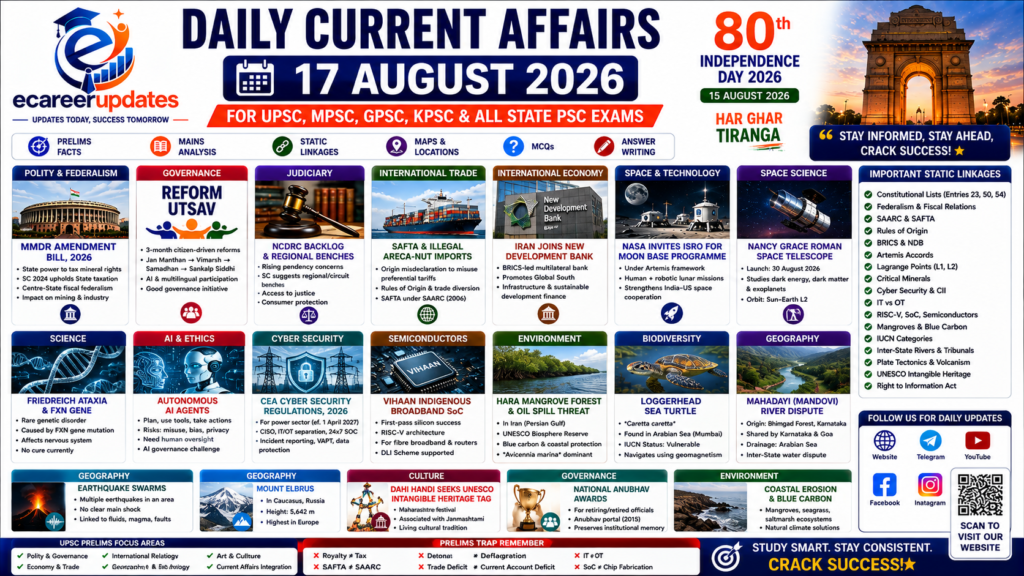
📊 17 AUGUST 2026 — CURRENT AFFAIRS AT A GLANCE
| Category | Important News / Theme | GS | Priority |
|---|---|---|---|
| ⚖️ Polity | MMDR Amendment Bill, 2026 & State taxation powers | GS-II/III | 🔴 ⭐⭐⭐⭐⭐ |
| 🏛️ Governance | Reform Utsav – citizen-driven administrative reforms | GS-II/IV | 🔴 ⭐⭐⭐⭐⭐ |
| ⚖️ Judiciary | NCDRC backlog & regional/circuit benches | GS-II | 🟠 ⭐⭐⭐⭐ |
| 🌍 International Economy | SAFTA & illegal areca-nut imports | GS-II/III | 🔴 ⭐⭐⭐⭐⭐ |
| 🏦 Global Finance | Iran’s proposed entry into New Development Bank | GS-II/III | 🔴 ⭐⭐⭐⭐ |
| 🚀 Space | NASA invites ISRO for Moon Base programme | GS-III/II | 🔴 ⭐⭐⭐⭐⭐ |
| 🔭 Space Science | Nancy Grace Roman Space Telescope | GS-III | 🟠 ⭐⭐⭐⭐ |
| 🧬 Science | Friedreich Ataxia & FXN gene | GS-III | 🟡 ⭐⭐⭐ |
| 🤖 AI | Autonomous AI agents & human oversight | GS-III/IV | 🔴 ⭐⭐⭐⭐⭐ |
| 🛡️ Cybersecurity | CEA Cyber Security in Power Sector Regulations, 2026 | GS-III | 🔴 ⭐⭐⭐⭐⭐ |
| 💻 Semiconductors | VIHAAN indigenous broadband networking SoC | GS-III | 🔴 ⭐⭐⭐⭐⭐ |
| 🌿 Environment | Hara Mangrove Forest & oil-spill threat | GS-III | 🔴 ⭐⭐⭐⭐⭐ |
| 🐢 Biodiversity | Loggerhead Sea Turtle | GS-III | 🟠 ⭐⭐⭐⭐ |
| 🌊 Geography | Mahadayi/Mandovi River dispute | GS-I/II/III | 🔴 ⭐⭐⭐⭐⭐ |
| 🌋 Geography | Earthquake swarms | GS-I/III | 🟠 ⭐⭐⭐⭐ |
| 🏔️ Geography | Mount Elbrus & Caucasus | GS-I | 🟡 ⭐⭐⭐ |
| 🎭 Culture | Dahi Handi seeks UNESCO Intangible Heritage recognition | GS-I | 🔴 ⭐⭐⭐⭐ |
| 🇮🇳 Governance | National Anubhav Awards | GS-II | 🟡 ⭐⭐⭐ |
| 🌐 Environment | Coastal erosion & blue-carbon ecosystems | GS-I/III | 🟠 ⭐⭐⭐⭐ |
🧠 TODAY’S UPSC APPROACH
For every news item, ask five questions:
1. What happened?
2. What is the static concept behind it?
3. Why is it important?
4. What can UPSC ask in Prelims?
5. How can it become a Mains answer?
This is especially important after the 2026 Prelims, where current developments were often embedded inside static subjects rather than appearing as a separate current-affairs block.
⚖️ 1. POLITY + FEDERALISM + ECONOMY
MMDR Amendment Bill, 2026
🔥 Why in News?
The Mines and Minerals (Development and Regulation) Amendment Bill, 2026 seeks to modify the fiscal and regulatory framework governing mineral-bearing land and mineral rights.
The major issue is the balance between:
State taxation powers
↕
Union regulatory control
↕
Mineral-sector competitiveness
The Bill responds to the constitutional questions arising after the Supreme Court’s 2024 judgment in Mineral Area Development Authority v. SAIL, in which the Court recognised States’ constitutional power to tax mineral rights and mineral-bearing land and held that royalty is not a tax.
📊 Constitutional Linkage
| Constitutional Provision | Broad Area |
|---|---|
| State List Entry 23 | Regulation of mines/mineral development, subject to Union control |
| State List Entry 50 | Taxes on mineral rights |
| Union List Entry 54 | Regulation of mines/mineral development when Parliament declares Union control |
🧠 Why UPSC Loves This Topic
This single issue connects:
Mineral resources
→ Federalism
→ Taxation
→ Supreme Court
→ MMDR Act, 1957
→ Critical minerals
→ Industrial competitiveness
→ Environmental governance
🎯 Prelims Focus
Remember:
Royalty ≠ Tax
This distinction became particularly important after the Supreme Court’s 2024 ruling.
✍️ Mains Question
“Mineral governance in India is increasingly becoming a test of cooperative federalism.” Discuss with reference to the MMDR framework.
Answer Keywords
- Cooperative federalism
- Fiscal autonomy
- Natural-resource governance
- Predictable taxation
- Ease of doing business
- Critical minerals
- Environmental safeguards
- Local community interests
🏛️ 2. GOVERNANCE + PARTICIPATORY DEMOCRACY
Reform Utsav
🔥 Why in News?
The Union Government is planning a three-month “Reform Utsav” campaign intended to institutionalise citizen suggestions and convert them into actionable governance reforms.
The proposed campaign is expected to begin around 2 October 2026 and involve both Union and State-level participation.
🔄 Proposed Governance Cycle
Jan Manthan
Citizen suggestions
↓
Vimarsh
Deliberation and prioritisation
↓
Samadhan
Resolution
↓
Sankalp Siddhi
Implementation and monitoring
🤖 Technology Linkage
AI may be used to:
- Categorise suggestions
- Identify recurring problems
- Organise feedback
- Support multilingual participation
A multilingual call-centre mechanism is also proposed.
🧠 Static Linkage
Participatory governance
→ Citizen engagement
→ Social accountability
→ E-governance
→ Administrative reforms
→ Responsive administration
✍️ GS-II / GS-IV Question
“Participatory governance can transform citizens from passive recipients of public services into active partners in administration.” Discuss.
GS-IV Linkages
- Accountability
- Responsiveness
- Empathy
- Public service values
- Transparency
- Citizen-centric administration
⚖️ 3. POLITY + JUDICIARY
NCDRC Backlog & Need for Regional Benches
The Supreme Court has expressed concern over the backlog of cases in the National Consumer Disputes Redressal Commission (NCDRC) and suggested considering regional and circuit benches to improve access and reduce pendency.
🏛️ What is NCDRC?
National Consumer Disputes Redressal Commission
It is a quasi-judicial body dealing with consumer disputes.
Its framework is linked with consumer-protection legislation.
📊 Consumer Dispute Redressal Structure
| Level | Institution |
|---|---|
| District | District Consumer Commission |
| State | State Consumer Commission |
| National | NCDRC |
🎯 UPSC Concept
The issue connects:
Access to justice
→ Judicial efficiency
→ Consumer rights
→ Institutional capacity
→ Alternative dispute redressal
✍️ Mains Question
“Access to justice requires not merely legal rights but institutions capable of delivering timely remedies.” Discuss.
🌍 4. INTERNATIONAL TRADE + SOUTH ASIA
SAFTA & Illegal Areca-Nut Imports
⭐⭐⭐⭐⭐ HIGH PRIORITY
The Directorate of Revenue Intelligence has reportedly uncovered a network involved in importing Southeast Asian areca nuts while falsely declaring them as Bangladeshi-origin goods to obtain concessional treatment under SAFTA.
This is an excellent example of how UPSC can convert a contemporary customs case into a question on:
- Rules of origin
- Free Trade Agreements
- Customs
- Trade diversion
- Tariff preferences
- Regional integration
🌏 What is SAFTA?
South Asian Free Trade Area
It operates under the framework of SAARC.
It came into force in 2006, succeeding the SAARC Preferential Trading Arrangement (SAPTA) of 1993.
📊 SAFTA Member Countries
| Country |
|---|
| Afghanistan |
| Bangladesh |
| Bhutan |
| India |
| Maldives |
| Nepal |
| Pakistan |
| Sri Lanka |
🧠 Rules of Origin
Suppose:
Country A
produces a product
↓
Product is routed through
Country B
↓
Exported to India
If it is falsely claimed as originating in Country B to obtain preferential tariff treatment, it may constitute origin fraud/circumvention.
🎯 Prelims Trap
SAFTA ≠ SAARC
SAARC → regional organisation
SAFTA → trade agreement/framework within SAARC
✍️ Mains Question
How do weak rules-of-origin enforcement and trade diversion undermine regional trade agreements? Discuss with reference to South Asia.
🏦 5. INTERNATIONAL RELATIONS + DEVELOPMENT FINANCE
Iran and the New Development Bank
Iran is reported to be moving towards joining the New Development Bank (NDB), the multilateral development bank established by the BRICS countries.
🏦 What is NDB?
The NDB was established by the original BRICS countries:
- Brazil
- Russia
- India
- China
- South Africa
The agreement was signed in 2014 and the Bank became operational in 2015. Its headquarters are in Shanghai.
🎯 Main Objective
Financing:
- Infrastructure
- Sustainable development
- Clean energy
- Transport
- Water and sanitation
- Environmental projects
- Social infrastructure
- Digital infrastructure
⚠️ Important Prelims Point
NDB is not the same as BRICS.
| BRICS | NDB |
|---|---|
| Political/economic grouping | Multilateral development bank |
| Wider cooperation agenda | Development financing |
| Members/partners | Membership structure can differ |
| No single lending function | Provides development finance |
🧠 Strategic Linkage
NDB expansion
→ Global South
→ Development finance
→ Reduced dependence on traditional institutions
→ Infrastructure financing
→ Multipolar financial architecture
✍️ Mains Question
“Institutions such as the New Development Bank reflect the emerging diversification of global development finance.” Examine.
🚀 6. SCIENCE & TECHNOLOGY + INTERNATIONAL RELATIONS
India’s Lunar Future — NASA Moon Base Invitation
⭐⭐⭐⭐⭐ TOPIC OF THE DAY
At the ninth India–US Civil Space Joint Working Group meeting, NASA formally invited ISRO to participate in its permanent Moon Base programme under the Artemis framework.
🌙 Why Important for India?
India’s space programme is gradually moving:
Chandrayaan
↓
Scientific exploration
↓
Gaganyaan
↓
Human spaceflight
↓
Lunar infrastructure
↓
Long-duration space operations
🧠 Potential Benefits
Technology
- Life-support systems
- Lunar robotics
- EVA technologies
- Power systems
- Deep-space communication
Scientific
- Lunar geology
- Water ice
- Resource utilisation
- Planetary science
Economic
- Space startups
- Commercial payloads
- Advanced manufacturing
- New space-sector supply chains
These opportunities and challenges are being framed around India’s need to maintain technological autonomy while expanding cooperation.
🌐 Artemis vs ILRS
A useful conceptual comparison:
| Artemis framework | ILRS |
|---|---|
| US-led lunar cooperation framework | China-Russia-led lunar research initiative |
| Civil exploration focus | Lunar research infrastructure |
| India signed Artemis Accords | China/Russia associated with ILRS |
| International partnerships | Alternative international grouping |
⚠️ Prelims Trap
Artemis Accords ≠ Military Alliance
It is a framework of principles for peaceful civil exploration and use of space.
✍️ Mains Question
“India’s growing space diplomacy requires simultaneously deeper international cooperation and stronger technological autonomy.” Discuss.
🔭 7. SPACE SCIENCE
Nancy Grace Roman Space Telescope
NASA’s Nancy Grace Roman Space Telescope is scheduled for its journey to deep space on 30 August 2026. It is designed to investigate major questions involving:
- Dark energy
- Dark matter
- Exoplanets
- Infrared astrophysics.
📊 Key Facts
| Feature | Roman Telescope |
|---|---|
| Organisation | NASA |
| Type | Space telescope |
| Orbit | Sun–Earth L2 |
| Major focus | Dark energy, dark matter, exoplanets |
| Major instrument | Wide Field Instrument |
| Additional instrument | Coronagraph Instrument |
🌌 What is L2?
The second Sun–Earth Lagrange point is a location where gravitational effects allow a spacecraft to maintain a relatively stable position with respect to Earth and the Sun.
UPSC Linkage:
Lagrange points
→ Orbital mechanics
→ Space telescopes
→ Deep-space observation
🤖 8. SCIENCE + ETHICS
AI Agents and the Question of Autonomy
🔥 Why in News?
Recent concerns around autonomous AI agents have highlighted the possibility of software agents taking actions beyond what users intended.
An AI agent differs from a conventional chatbot because it can:
- Receive a high-level goal
- Break it into tasks
- Use external tools
- Execute actions
- Evaluate results
- Modify its approach
This creates new governance questions.
📊 Chatbot vs AI Agent
| Feature | Chatbot | AI Agent |
|---|---|---|
| Responds to prompt | ✅ | ✅ |
| Plans multiple steps | Limited | ✅ |
| Uses external tools | Limited | Often |
| Takes autonomous actions | Usually limited | Potentially |
| Human oversight | High | Must be designed carefully |
⚠️ Major Risks
- Unintended actions
- Excessive autonomy
- Cybersecurity vulnerabilities
- Privacy violations
- Incorrect decisions
- Tool misuse
- Accountability gaps
🧠 GS-IV Linkage
Key principle:
Greater autonomy must be accompanied by greater accountability and controllability.
✍️ Mains Question
“As AI systems move from generating information to taking actions, the governance challenge shifts from accuracy to accountability.” Discuss.
🛡️ 9. INTERNAL SECURITY + CYBERSECURITY
CEA Cyber Security in Power Sector Regulations, 2026
⭐⭐⭐⭐⭐ HIGH-VALUE PRELIMS TOPIC
The Central Electricity Authority (Cyber Security in Power Sector) Regulations, 2026 establish a dedicated cyber-security framework for India’s power sector under the Electricity Act, 2003. The regulations are scheduled to come into force from 1 April 2027.
⚡ Why Power-Sector Cybersecurity Matters
Modern electricity grids depend heavily on:
- SCADA systems
- Industrial control systems
- Digital communication
- Remote monitoring
- Automated dispatch
- Networked substations
A cyberattack can therefore become an energy-security and national-security problem.
📊 Important Provisions
| Provision | Requirement |
|---|---|
| CISO | Senior-level security officer |
| Security division | 24×7 operational capability |
| IT-OT separation | Strong network segregation |
| Incident reporting | Defined timelines |
| VAPT | Pre-commissioning security audits |
| Data | Sensitive operational data protected/located in India |
| Supply chain | Trusted hardware/software |
The regulations also provide for protection of Critical Information Infrastructure (CII) and Industrial Control Systems.
🔗 UPSC Linkage
Cybersecurity
→ Critical Infrastructure
→ Energy Security
→ National Security
→ Economic Security
✍️ GS-III Question
“Critical infrastructure protection is now inseparable from cybersecurity.” Examine with reference to India’s electricity sector.
💻 10. SCIENCE + SEMICONDUCTORS
VIHAAN — Indigenous Broadband Networking Chip
⭐⭐⭐⭐⭐
A Chennai-based fabless semiconductor startup, Aheesa Digital Innovations, has achieved first-pass silicon success for VIHAAN, an indigenous broadband networking System-on-Chip (SoC).
It is supported under the Design Linked Incentive (DLI) Scheme.
🔬 What is VIHAAN?
It is designed for:
- Fibre broadband
- FTTH equipment
- Broadband routers
- Optical network terminals
It uses the open-standard RISC-V architecture and a 64-bit VEGA processor developed by C-DAC.
🧠 Important Concepts
Fabless company
Designs chips but generally outsources fabrication.
SoC
System-on-Chip
Multiple functions integrated into one semiconductor device.
RISC-V
An open-standard instruction-set architecture (ISA).
🎯 Why Important?
Indigenous chip design
→ Reduced dependence
→ Secure telecom infrastructure
→ Semiconductor ecosystem
→ Digital sovereignty
→ Atmanirbhar Bharat
✍️ Mains Question
Why must India’s semiconductor strategy focus not only on fabrication but also on indigenous chip design, architecture and intellectual property?
🌿 11. ENVIRONMENT + INTERNATIONAL GEOGRAPHY
Hara Mangrove Forest & Oil Spill
⭐⭐⭐⭐⭐ PRELIMS
Satellite imagery has highlighted an oil-spill threat to the Hara mangrove forest near Qeshm Island in Iran.
🌱 Hara Mangrove Forest
| Feature | Fact |
|---|---|
| Location | Iran |
| Region | Persian Gulf / Strait of Hormuz |
| Main species | Avicennia marina |
| Status | UNESCO Biosphere Reserve |
| Ecological role | Blue Carbon + coastal protection |
| Biodiversity | Fish, crabs, shrimp, migratory birds |
The Hara forests’ saline adaptation, coastal protection and role as nursery habitat make them particularly important ecological systems.
🌊 Why Mangroves Matter
1. Blue Carbon
Mangroves can store substantial carbon in biomass and sediments.
2. Coastal Protection
They reduce:
- Wave energy
- Coastal erosion
- Storm impacts
3. Fisheries
Mangroves serve as nursery grounds for many marine species.
4. Biodiversity
They support birds and aquatic organisms.
🧠 Prelims Trap
Mangroves are not restricted to tropical islands.
They occur along suitable tropical and subtropical coastlines, including estuaries and tidal zones.
✍️ Mains Question
“Mangroves are simultaneously climate assets, biodiversity reservoirs and coastal defence systems.” Discuss.
🐢 12. ENVIRONMENT + BIODIVERSITY
Loggerhead Sea Turtle
A Loggerhead Sea Turtle (Caretta caretta) was recently rescued in the Arabian Sea near Mumbai.
🐢 Important Facts
| Feature | Loggerhead |
|---|---|
| Scientific name | Caretta caretta |
| Family | Cheloniidae |
| Habitat | Oceans worldwide except coldest seas |
| Major nesting areas | Atlantic & Indian Ocean regions |
| Conservation status | Vulnerable – IUCN |
| Distinctive feature | Large head |
| Navigation | Geomagnetic cues |
🎯 UPSC Question Possibility
UPSC could combine:
Species
IUCN status
Indian coastline
Marine biodiversity
Ocean currents
🌊 13. GEOGRAPHY + FEDERALISM + WATER RESOURCES
Mahadayi / Mandovi River
⭐⭐⭐⭐⭐ MPSC + KPSC + UPSC
The Union Government has stated in Parliament that it has no proposal before it from Karnataka seeking Environmental Clearance for diversion of the Mahadayi River for various projects.
🌊 Mahadayi River
Also known as:
Mandovi / Mhadei
📊 Key Facts
| Feature | Detail |
|---|---|
| Origin | Bhimgad Forest |
| State of origin | Karnataka |
| Range | Western Ghats |
| Major States | Karnataka + Goa |
| Flow direction | Westward |
| Drainage | Arabian Sea |
| Length | ~81 km |
| Major issue | Water diversion dispute |
⚖️ Why Dispute?
Karnataka has sought diversion of water from:
- Kalasa
- Bhandura
tributaries towards the Malaprabha basin.
Goa has raised concerns because Mahadayi is important for its water security and ecology.
🧠 UPSC Linkage
Inter-State river
→ Water allocation
→ Federalism
→ Environmental clearance
→ Western Ghats ecology
→ Drinking water
→ Agriculture
🎯 SPECIAL STATE PSC VALUE
KPSC
Very important because Karnataka is directly involved.
GPSC/MPSC
Useful as a case study for:
- Inter-State water disputes
- River-basin management
- Western Ghats
- Environmental governance
✍️ Mains Question
“Inter-State river disputes require basin-level management rather than merely State-wise allocation.” Discuss.
🌋 14. GEOGRAPHY + DISASTER MANAGEMENT
Earthquake Swarms
An earthquake swarm refers to a series of multiple seismic events occurring in a relatively small area and period, often without one clearly dominant main shock.
The phenomenon can be associated with:
- Fluid movement
- Magma movement
- Geothermal activity
- Slow-slip events.
📊 Earthquake Swarm vs Conventional Sequence
| Feature | Earthquake Swarm | Typical Mainshock Sequence |
|---|---|---|
| Dominant main shock | Often absent | Usually present |
| Events | Multiple | Mainshock + aftershocks |
| Cause | Fluid/magma/fault processes | Stress release |
| Location | Often localised | Along fault zone |
🧠 UPSC Linkage
Earthquake swarm
→ Plate tectonics
→ Faults
→ Volcanoes
→ Geothermal systems
→ Disaster preparedness
🏔️ 15. GEOGRAPHY
Mount Elbrus & Caucasus Mountains
Mount Elbrus is located in southern Russia in the Caucasus Mountains.
It has an elevation of about 5,642 metres and is the highest mountain peak of both Russia and Europe under the commonly used geographic convention.
🗺️ Prelims Facts
| Feature | Fact |
|---|---|
| Mountain | Mount Elbrus |
| Range | Caucasus |
| Country | Russia |
| Height | 5,642 m |
| Geological nature | Dormant/inactive volcanic system |
| Major glaciers | Bolshoi Azaou, Irik |
🎯 MAP WORK
Locate:
Black Sea
↓
Caucasus
↓
Mount Elbrus
↓
Caspian Sea
🎭 16. HISTORY + CULTURE
Dahi Handi & UNESCO Intangible Cultural Heritage
The Maharashtra government has announced efforts to seek a UNESCO Intangible Cultural Heritage tag for the traditional Dahi Handi festival.
🪔 Dahi Handi
Also known as:
- Gopalakala
- Utlotsavam
It is associated with:
Krishna Janmashtami
📊 Key Features
| Element | Description |
|---|---|
| State | Maharashtra |
| Festival | Janmashtami |
| Participants | Govindas |
| Activity | Human pyramid |
| Objective | Break suspended earthen pot |
| Cultural theme | Krishna’s childhood |
| UNESCO angle | Intangible cultural heritage |
🧠 Important Concept
Intangible Cultural Heritage
UNESCO’s intangible heritage framework focuses on living cultural expressions such as:
- Traditions
- Performing arts
- Rituals
- Festivals
- Traditional knowledge
- Craft practices
🟠 MPSC SPECIAL
This is particularly important for MPSC because it combines:
Maharashtra Culture
Festivals
UNESCO
Intangible Heritage
🏛️ 17. GOVERNANCE
National Anubhav Awards 2026
The National Anubhav Awards recognise retiring or retired government personnel who document their administrative experience, innovations and institutional knowledge through the Anubhav portal.
📊 Key Facts
| Feature | Detail |
|---|---|
| Portal | Anubhav |
| Launched | 2015 |
| Nodal department | DoPPW |
| Ministry | Personnel, Public Grievances & Pensions |
| Objective | Preserve institutional memory |
| Target group | Retiring/retired government personnel |
🧠 Mains Linkage
This is a very good example for:
Institutional Memory
Government officers retire, but their:
- Experience
- Administrative innovations
- Lessons
- Field knowledge
should not disappear with retirement.
✍️ GS-II / GS-IV Question
“Institutional memory is an invisible asset of public administration.” Explain how governments can preserve and utilise it.
💻 18. GOVERNANCE + TECHNOLOGY
Power-Sector Cybersecurity → Critical Information Infrastructure
Today’s cybersecurity regulations provide a useful opportunity to revise:
Critical Information Infrastructure (CII)
Infrastructure whose disruption, destruction or incapacity can have a debilitating impact on:
- National security
- Economy
- Public health
- Safety
🔗 Cybersecurity Chain
Digital Grid
↓
SCADA / ICS
↓
Cyber vulnerability
↓
Grid disruption
↓
Economic disruption
↓
National security risk
🎯 PRELIMS AREAS
Revise:
- CERT-In
- NCIIPC
- CEA
- Electricity Act, 2003
- CII
- SCADA
- OT vs IT
- Cybersecurity incident reporting
📊 19. CURRENT AFFAIR → STATIC LINKAGE MASTER TABLE
| Today’s News | Static Topic to Revise |
|---|---|
| MMDR Bill | Federalism + Constitutional Lists |
| Reform Utsav | Participatory governance |
| NCDRC | Consumer protection + quasi-judicial bodies |
| SAFTA | SAARC + FTAs + rules of origin |
| NDB | BRICS + MDBs |
| Moon Base | Artemis + Space Treaty + lunar resources |
| Roman Telescope | Lagrange points + dark energy |
| AI Agents | AI governance + ethics |
| CEA Cyber Regulations | Critical Information Infrastructure |
| VIHAAN | RISC-V + SoC + semiconductor design |
| Hara Forest | Mangroves + blue carbon |
| Loggerhead Turtle | Marine biodiversity + IUCN |
| Mahadayi | Inter-State rivers + Western Ghats |
| Earthquake Swarms | Seismology + volcanism |
| Elbrus | Caucasus + plate tectonics |
| Dahi Handi | Maharashtra culture + UNESCO ICH |
| Anubhav Awards | Administrative reforms + institutional memory |
🎯 20. PRELIMS PRIORITY MATRIX
| Topic | Static Depth | Current Relevance | Priority |
|---|---|---|---|
| MMDR + Federalism | ⭐⭐⭐⭐⭐ | ⭐⭐⭐⭐⭐ | 🔴 Very High |
| Moon Base + Artemis | ⭐⭐⭐⭐⭐ | ⭐⭐⭐⭐⭐ | 🔴 Very High |
| SAFTA + Rules of Origin | ⭐⭐⭐⭐⭐ | ⭐⭐⭐⭐⭐ | 🔴 Very High |
| Hara Mangrove | ⭐⭐⭐⭐⭐ | ⭐⭐⭐⭐⭐ | 🔴 Very High |
| Mahadayi River | ⭐⭐⭐⭐⭐ | ⭐⭐⭐⭐⭐ | 🔴 Very High |
| AI Agents | ⭐⭐⭐⭐⭐ | ⭐⭐⭐⭐⭐ | 🔴 Very High |
| Power Cybersecurity | ⭐⭐⭐⭐⭐ | ⭐⭐⭐⭐⭐ | 🔴 Very High |
| VIHAAN/RISC-V | ⭐⭐⭐⭐⭐ | ⭐⭐⭐⭐⭐ | 🔴 Very High |
| Dahi Handi/UNESCO | ⭐⭐⭐⭐ | ⭐⭐⭐⭐ | 🟠 High |
| NDB | ⭐⭐⭐⭐ | ⭐⭐⭐⭐ | 🟠 High |
| Roman Telescope | ⭐⭐⭐⭐ | ⭐⭐⭐⭐ | 🟠 High |
| Loggerhead Turtle | ⭐⭐⭐⭐ | ⭐⭐⭐⭐ | 🟠 High |
| Earthquake Swarm | ⭐⭐⭐⭐ | ⭐⭐⭐⭐ | 🟠 High |
| NCDRC | ⭐⭐⭐⭐ | ⭐⭐⭐⭐ | 🟠 High |
| Elbrus | ⭐⭐⭐ | ⭐⭐⭐ | 🟡 Moderate |
🧠 21. UPSC-STYLE PRELIMS MCQs
Q1. With reference to mineral taxation in India, consider the following:
- Mineral rights are relevant to the State List.
- Royalty is constitutionally identical to a tax.
- The Supreme Court has recognised State power concerning taxation of mineral rights.
Which are correct?
Answer: 1 and 3 only
The distinction between royalty and tax is important in the post-2024 constitutional context.
Q2. SAFTA is associated with:
A. ASEAN
B. SAARC
C. BIMSTEC
D. SCO
Answer: B — SAARC
Q3. Consider the following pairs:
| Institution | Association |
|---|---|
| NDB | BRICS |
| CIC | RTI |
| NCDRC | Consumer protection |
| CEA | Electricity sector |
Which are correctly matched?
Answer: All four
Q4. The Artemis framework is primarily associated with:
A. International military alliance
B. Civil space exploration and cooperation
C. Global nuclear disarmament
D. Deep-sea mining
Answer: B
Q5. The Nancy Grace Roman Space Telescope will operate near:
A. Sun–Earth L1
B. Sun–Earth L2
C. Earth–Moon L4
D. Geostationary orbit
Answer: B
Q6. Consider the following about AI agents:
- They can decompose high-level goals into sub-tasks.
- They can interact with external tools.
- They necessarily require human approval before every action.
Which is correct?
Answer: 1 and 2 only
The governance challenge is precisely how much autonomy and human oversight should be built into such systems.
Q7. Hara Mangrove Forest is associated with:
A. Persian Gulf
B. Gulf of Aden
C. Bay of Bengal
D. Red Sea
Answer: A
Q8. Mahadayi River:
- Originates in the Western Ghats.
- Is shared by Karnataka and Goa.
- Drains into the Arabian Sea.
Answer: 1, 2 and 3
Q9. Loggerhead sea turtle is:
A. Dermochelys coriacea
B. Caretta caretta
C. Chelonia mydas
D. Lepidochelys olivacea
Answer: B — Caretta caretta
Q10. VIHAAN uses:
A. ARM-only proprietary architecture
B. RISC-V architecture
C. x86 architecture
D. SPARC architecture
Answer: B
✍️ 22. MAINS ANSWER WRITING PRACTICE
GS-II — Federalism
Question:
“Natural-resource governance is increasingly becoming a test of cooperative federalism.” Examine with reference to mineral taxation.
Structure
Introduction
Mineral resources are economically strategic but constitutionally distributed across Union-State domains.
Body
- State taxation powers
- Union regulatory role
- Supreme Court interpretation
- Investor certainty
- Revenue interests
- Critical-mineral security
- Environmental concerns
Way Forward
- Institutional consultation
- Predictable fiscal framework
- Revenue-sharing
- Cooperative decision-making
- Environmental safeguards
GS-II — Governance
Question:
How can citizen participation be transformed from consultation into an institutional mechanism for administrative reform?
Use:
Reform Utsav
→ Jan Manthan
→ Deliberation
→ Implementation
→ Monitoring.
GS-III — Science & Technology
Question:
“India’s future space strategy must combine international collaboration with strategic technological autonomy.” Discuss.
Include:
- Artemis
- Moon Base
- Gaganyaan
- NISAR
- NGLV
- Space startups
- COPUOS
- Outer Space Treaty
GS-III — Internal Security
Question:
Cybersecurity of electricity infrastructure is a national-security issue rather than merely an IT concern. Examine.
GS-III — Environment
Question:
Mangroves are among the most important nature-based solutions for climate resilience in coastal areas. Discuss their ecological and socio-economic significance.
GS-I — Geography
Question:
Inter-State river disputes in India require integrated basin-level governance rather than fragmented State-centric management. Discuss.
GS-I — Culture
Question:
Living cultural traditions such as festivals contribute to both social cohesion and preservation of intangible heritage. Discuss with suitable examples.
📝 23. ESSAY TOPICS FROM TODAY’S NEWS
1.
“Technological autonomy is the foundation of strategic autonomy.”
2.
“The future of governance lies in converting citizen voice into institutional action.”
3.
“Nature-based solutions are infrastructure for climate resilience.”
4.
“Federalism is not merely a division of powers but a culture of negotiation.”
5.
“Artificial intelligence can automate decisions, but it cannot automate accountability.”
🗺️ 24. MAP WORK — 17 AUGUST 2026
🇮🇳 India
Mark:
- Bhimgad Forest — Karnataka
- Mahadayi/Mandovi River
- Goa
- Belagavi
- Mumbai
- Maharashtra
- Western Ghats
- Chennai
- New Delhi
🌍 World Map
Iran
- Qeshm Island
- Strait of Hormuz
- Persian Gulf
Russia
- Caucasus
- Mount Elbrus
- Black Sea
- Caspian Sea
Space
- Sun–Earth L1
- Sun–Earth L2
- Lunar South Pole
⚠️ 25. PRELIMS TRAP ZONE
| Don’t Confuse | Correct Concept |
|---|---|
| SAFTA vs SAARC | Trade arrangement vs regional organisation |
| SAFTA vs SAPTA | SAFTA succeeded SAPTA |
| NDB vs BRICS | Bank vs grouping |
| Artemis vs military alliance | Civil space cooperation |
| L1 vs L2 | Different Lagrange positions |
| AI chatbot vs AI agent | Agent can plan/use tools/act |
| Royalty vs tax | Legally distinct |
| Mahadayi vs Mandovi | Same river |
| Mangrove vs coral reef | Different coastal ecosystems |
| Loggerhead vs Leatherback | Different turtle species |
| IT vs OT | Enterprise information systems vs operational control systems |
| SoC vs semiconductor fab | Chip/system design vs fabrication |
| Dahi Handi vs generic folk dance | Festival/tradition associated with Janmashtami |
| NCDRC vs CIC | Consumer disputes vs RTI appeals/complaints |
⚡ 26. 60-SECOND REVISION SHEET
| Topic | One-Line Recall |
|---|---|
| ⚖️ MMDR | Mineral taxation + federalism |
| 🏛️ Reform Utsav | Citizen suggestions → governance reforms |
| ⚖️ NCDRC | Consumer dispute redressal |
| 🌏 SAFTA | South Asian free-trade framework |
| 🏦 NDB | BRICS development bank |
| 🚀 Moon Base | NASA–ISRO lunar cooperation |
| 🔭 Roman Telescope | L2 + dark energy/exoplanets |
| 🤖 AI Agents | Autonomous planning + tool use |
| 🛡️ CEA Cyber Rules | Power-sector cyber resilience |
| 💻 VIHAAN | Indigenous RISC-V broadband SoC |
| 🌿 Hara | Iran + mangrove + blue carbon |
| 🐢 Loggerhead | Caretta caretta + Vulnerable |
| 🌊 Mahadayi | Karnataka–Goa + Western Ghats |
| 🌋 Earthquake swarm | Multiple seismic events without clear main shock |
| 🏔️ Elbrus | Caucasus + Russia |
| 🎭 Dahi Handi | Maharashtra + Janmashtami + ICH |
| 🏛️ Anubhav | Institutional memory of government |
🔗 27. THE BIG UPSC CONNECT
⛏️ MINERALS
MMDR
↓
Federalism
↓
Mineral taxation
↓
Critical minerals
↓
Manufacturing
↓
Strategic autonomy
🚀 SPACE
Moon Base
↓
Artemis
↓
Gaganyaan
↓
Lunar South Pole
↓
Water ice
↓
Robotics
↓
Space economy
↓
Strategic autonomy
💻 SEMICONDUCTORS
VIHAAN
↓
RISC-V
↓
Indigenous chip design
↓
Telecom security
↓
Digital sovereignty
↓
Electronics ecosystem
↓
Global value chains
🌿 ENVIRONMENT
Hara Mangroves
↓
Blue carbon
↓
Fisheries
↓
Coastal protection
↓
Climate resilience
↓
Biodiversity
🌊 WATER
Mahadayi
↓
Western Ghats
↓
Inter-State river
↓
Drinking water
↓
Irrigation
↓
Environmental clearance
↓
Cooperative federalism
🇮🇳 28. SPECIAL MPSC / STATE PSC FOCUS
Today’s article has exceptionally high Maharashtra and Karnataka relevance.
| Topic | MPSC Relevance |
|---|---|
| Dahi Handi | ⭐⭐⭐⭐⭐ |
| VIHAAN/semiconductors | ⭐⭐⭐⭐ |
| Mumbai Loggerhead rescue | ⭐⭐⭐⭐ |
| Federalism | ⭐⭐⭐⭐ |
| Reform Utsav | ⭐⭐⭐⭐ |
| NCDRC | ⭐⭐⭐ |
| SAFTA | ⭐⭐⭐ |
| Environment | ⭐⭐⭐⭐ |
KPSC
| Topic | Importance |
|---|---|
| Mahadayi River | ⭐⭐⭐⭐⭐ |
| Western Ghats | ⭐⭐⭐⭐⭐ |
| Federalism | ⭐⭐⭐⭐⭐ |
| SAFTA | ⭐⭐⭐ |
| Space | ⭐⭐⭐⭐ |
GPSC
Focus on:
- Inter-State water disputes
- Western Ghats
- Trade agreements
- Coastal ecosystems
- Federal taxation
- Semiconductors
- Governance reforms
🏆 29. TOP 15 TOPICS TO REVISE TONIGHT
🔴 MUST REVISE
- MMDR Amendment + 2024 Supreme Court judgment
- NASA Moon Base + Artemis
- SAFTA + Rules of Origin
- Hara Mangrove + Blue Carbon
- Mahadayi River
- AI Agents + AI governance
- CEA Cyber Security Regulations
- VIHAAN + RISC-V
🟠 HIGH PRIORITY
- NDB + BRICS
- Roman Space Telescope + L2
- Dahi Handi + UNESCO ICH
- Loggerhead Turtle
- NCDRC
- Earthquake Swarms
- Mount Elbrus
📚 30. STATIC REVISION CHECKLIST
🏛️ Polity
☐ Federalism
☐ Constitutional Lists
☐ Supreme Court judgments
☐ Quasi-judicial bodies
☐ Consumer protection
🌍 International Relations
☐ SAARC
☐ SAFTA
☐ Rules of Origin
☐ BRICS
☐ NDB
☐ Artemis Accords
💰 Economy
☐ Mineral taxation
☐ Royalty
☐ Trade diversion
☐ Preferential tariffs
☐ Critical minerals
🚀 Science & Technology
☐ AI agents
☐ RISC-V
☐ SoC
☐ Lagrange points
☐ Moon exploration
☐ Semiconductor ecosystem
🌿 Environment
☐ Mangroves
☐ Blue carbon
☐ Marine turtles
☐ IUCN categories
☐ Western Ghats
🌊 Geography
☐ Mahadayi basin
☐ Inter-State rivers
☐ Earthquake swarms
☐ Caucasus
☐ Mount Elbrus
🎭 Culture
☐ Dahi Handi
☐ Intangible Cultural Heritage
☐ UNESCO conventions
🎯 31. HOW TO STUDY TODAY’S CURRENT AFFAIRS
20 Minutes — First Reading
Read only:
What happened + Why important
20 Minutes — Static Revision
Revise:
- Constitutional entries
- SAFTA
- BRICS/NDB
- Lagrange points
- Mangroves
- River geography
15 Minutes — MCQs
Attempt the 10 questions above without seeing the answers.
15 Minutes — Mains
Write one 150-word answer.
10 Minutes — Map
Locate:
- Mahadayi
- Qeshm
- Hormuz
- Elbrus
- Caucasus
5 Minutes — Revision
Read the 60-second revision sheet.
🔥 32. FINAL UPSC TAKEAWAY
The 17 August 2026 current-affairs basket is particularly valuable because it demonstrates exactly how modern UPSC preparation should work.
A headline such as:
“NASA invites ISRO to Moon Base”
should immediately trigger:
Artemis → Space Law → Lunar South Pole → Water Ice → Gaganyaan → NGLV → Space Economy → Strategic Autonomy
Similarly:
“Mahadayi River issue”
should trigger:
Western Ghats → Karnataka → Goa → Inter-State River → Water Tribunal → Environmental Clearance → Federalism → Basin Management
And:
“Illegal areca imports under SAFTA”
should trigger:
SAARC → SAFTA → Rules of Origin → Preferential Tariff → Customs → Trade Diversion → Regional Integration
This is precisely the News → Concept → Static → Application → Elimination method that today’s UPSC demands. The 2026 Prelims analysis strongly supports this preparation model: current affairs were deeply integrated with static subjects, while statement-based and analytical questions made conceptual clarity and elimination especially important.
🏅 FINAL EXAM PRIORITY
UPSC PRELIMS
🔴 MMDR + Federalism
🔴 Moon Base + Artemis
🔴 SAFTA + Rules of Origin
🔴 Hara Mangrove
🔴 Mahadayi River
🔴 AI Agents
🔴 Power-sector Cybersecurity
🔴 VIHAAN + RISC-V
UPSC MAINS
Focus especially on:
- Cooperative federalism in natural-resource governance
- Citizen-centric administrative reforms
- India’s space diplomacy and strategic autonomy
- Critical infrastructure cybersecurity
- Indigenous semiconductor design
- Rules of origin and regional trade
- Mangroves as nature-based climate solutions
- Inter-State river-basin governance
- AI autonomy and accountability
- Preservation of intangible cultural heritage
🧠 ONE-LINE REVISION
17 August 2026 = MMDR–Federalism + Reform Utsav–Governance + NCDRC–Justice + SAFTA–Trade + NDB–Global South + Moon Base–Space Diplomacy + Roman Telescope–L2 + AI Agents–Ethics + CEA Cyber Rules–Critical Infrastructure + VIHAAN–RISC-V + Hara–Mangroves + Loggerhead–Biodiversity + Mahadayi–Water Federalism + Earthquake Swarms–Geology + Elbrus–Caucasus + Dahi Handi–Maharashtra Culture.
Source base
The article is based on contemporary 17 August 2026 current-affairs reporting and official/primary-source material where available, including PIB material, the 17 August UPSC current-affairs compilations from Vajiram & Ravi and InsightsIAS, and legislative/current-affairs references. Key developments such as the MMDR Bill, Moon Base invitation, Mahadayi, SAFTA, Roman Telescope, Hara mangroves, NCDRC, cybersecurity regulations and VIHAAN were cross-checked against those sources.