
UPSC CSE Prelims & Mains | MPSC | GPSC | KPSC | State PSC | Group A, B & C
Exam-Oriented Current Affairs | Prelims Facts | Mains Analysis | Static Linkages | Mapping | MCQs | Answer Writing
Today’s preparation principle: Do not memorise current affairs as isolated headlines. Convert every important news item into Current Event → Static Concept → Constitutional/Institutional Linkage → Prelims Trap → Mains Dimension → Possible Question. Recent UPSC-preparation analysis also emphasises structured, examination-oriented current affairs rather than information overload.
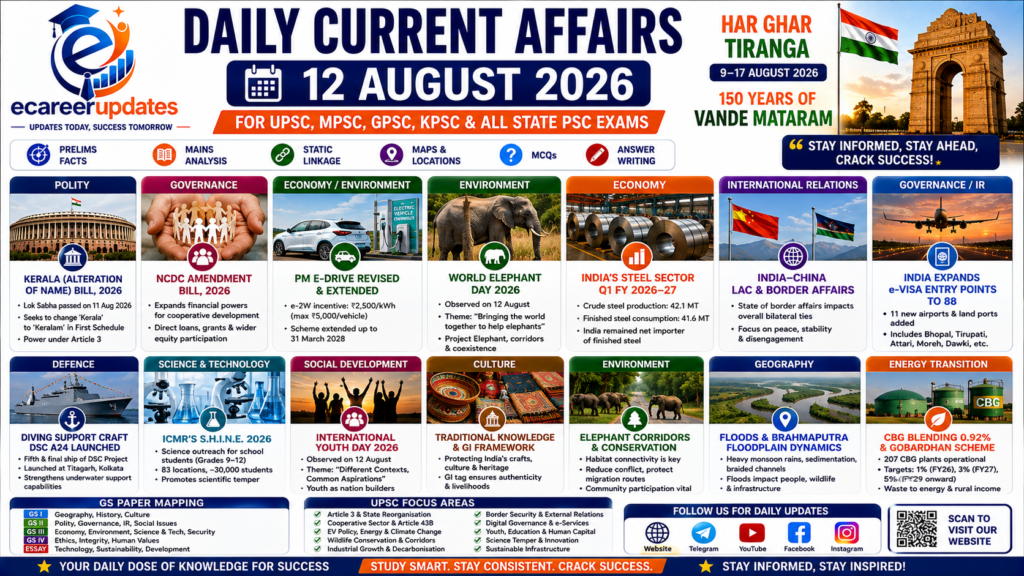
📊 12 AUGUST 2026 – CURRENT AFFAIRS AT A GLANCE
| Category | Important Development | GS Paper | Priority |
|---|---|---|---|
| 🏛️ Polity | Kerala (Alteration of Name) Bill, 2026 | GS II | ⭐⭐⭐⭐⭐ |
| 🤝 Governance | NCDC Amendment Bill, 2026 | GS II/III | ⭐⭐⭐⭐⭐ |
| 🚗 Economy/Environment | PM E-DRIVE revised & extended | GS III | ⭐⭐⭐⭐⭐ |
| 🐘 Environment | World Elephant Day 2026 | GS III | ⭐⭐⭐⭐⭐ |
| 🏭 Economy | India’s steel sector – Q1 FY 2026–27 | GS III | ⭐⭐⭐⭐ |
| 🌐 International Relations | India–China LAC & border affairs | GS II | ⭐⭐⭐⭐⭐ |
| 🛂 Governance/IR | India’s e-Visa entry points expanded to 88 | GS II | ⭐⭐⭐⭐ |
| ⚓ Defence | Diving Support Craft DSC A24 | GS III | ⭐⭐⭐⭐ |
| 🧪 Science & Technology | ICMR S.H.I.N.E. 2026 | GS III | ⭐⭐⭐ |
| 👥 Social Development | International Youth Day | GS II | ⭐⭐⭐⭐ |
| 🧵 Culture | Traditional knowledge, crafts & GI framework | GS I/III | ⭐⭐⭐ |
| 🌱 Environment | Elephant corridors, human-elephant conflict | GS III | ⭐⭐⭐⭐⭐ |
🏛️ 1. POLITY & CONSTITUTION
Kerala (Alteration of Name) Bill, 2026
🔥 Why in News?
The Kerala (Alteration of Name) Bill, 2026 was introduced in the Lok Sabha on 10 August and passed by the Lok Sabha on 11 August 2026. It seeks to change the constitutional name of the State from “Kerala” to “Keralam” by amending the First Schedule of the Constitution. The Kerala Legislative Assembly had earlier passed a resolution supporting the change in June 2024.
This is an excellent UPSC topic because the headline leads directly to Article 3, constitutional procedure and Parliament’s power over the boundaries/names of States.
📜 How Can a State’s Name Be Changed?
Article 3 of the Constitution
Parliament can by law:
- Form a new State
- Increase the area of a State
- Diminish the area of a State
- Alter boundaries
- Alter the name of a State
🧠 Procedure
The process broadly involves:
Bill introduced in Parliament
↓
President’s recommendation required
↓
President refers it to concerned State Legislature for its views
↓
State Legislature gives its views
↓
Parliament considers and passes the Bill
↓
President’s assent
↓
Constitutional/administrative change
⚠️ Important UPSC Point
The State Legislature’s consent is not binding on Parliament.
It is given an opportunity to express its views.
📊 Article 3 – Prelims Table
| Provision | Power |
|---|---|
| Article 2 | Admission/establishment of new States |
| Article 3 | Formation/alteration of States |
| Article 4 | Supplemental provisions and consequential changes |
| First Schedule | Names and territories of States/UTs |
🔗 Static Linkage
Kerala → Keralam
→ Article 3
→ First Schedule
→ Federalism
→ Parliament’s territorial powers
→ State reorganisation
🎯 Possible Prelims Question
With reference to alteration of the name of an Indian State, consider the following statements:
- Such a change requires a constitutional amendment under Article 368.
- Parliament can alter the name of a State under Article 3.
- The views of the concerned State Legislature are binding on Parliament.
Answer: 2 only
✍️ Mains Question
“Article 3 gives Parliament significant flexibility in reorganising India’s territorial structure.” Discuss its constitutional significance and federal implications.
Keywords for Mains
- Cooperative federalism
- Territorial integrity
- Linguistic identity
- Constitutional flexibility
- Parliament’s constituent powers
- State aspirations
🤝 2. POLITY + COOPERATIVE SECTOR
National Co-operative Development Corporation Amendment Bill, 2026
🔥 Why in News?
The National Co-operative Development Corporation (Amendment) Bill, 2026 seeks to expand the financial and developmental role of NCDC.
The Bill was passed by the Lok Sabha amid disruptions and proposes wider financing powers for cooperative development.
What is NCDC?
National Co-operative Development Corporation
NCDC is a statutory corporation associated with the development and financing of cooperative activities.
Its broad purpose is to support cooperative institutions and activities in areas such as:
- Agriculture
- Rural industries
- Food processing
- Storage
- Marketing
- Allied sectors
📊 Major Proposed Changes
| Existing Framework | Proposed Expansion |
|---|---|
| Funding through specified channels | Wider direct funding |
| Focus on cooperative societies | Wider cooperative-development entities |
| Limited equity participation | Wider equity participation |
| Rural industrial-goods framework | Removal of certain rural-location restrictions |
| Information functions | Credit/information-sharing powers |
The Bill would allow NCDC to provide loans and grants directly to cooperative societies and entities engaged in cooperative development, and permits wider participation in share capital subject to Central Government approval.
It also proposes that NCDC may collect and share credit or other information with the Central Government, RBI, banks and notified financial institutions for efficient discharge of its functions.
🧠 Why is this important?
India’s cooperative sector is increasingly viewed as a tool for:
Aggregation
→
Bargaining power
→
Access to credit
→
Value addition
→
Rural entrepreneurship
→
Inclusive development
🔗 Constitutional Linkage
Article 43B
The Constitution directs the State to promote:
Voluntary formation, autonomous functioning, democratic control and professional management of cooperative societies.
97th Constitutional Amendment
The cooperative movement received constitutional recognition through the 97th Constitutional Amendment Act, 2011.
🎯 Prelims Trap
Do not confuse:
Cooperative society
with
Cooperative bank
with
NCDC
They have different institutional roles.
✍️ Mains Question
Cooperatives can become instruments of inclusive economic development only when autonomy, professional management and access to finance are strengthened. Discuss.
🚗 3. ECONOMY + ENVIRONMENT
PM E-DRIVE: Electric Mobility Policy Revised
⭐⭐⭐⭐⭐ HIGH PRIORITY
The PM Electric Drive Revolution in Innovative Vehicle Enhancement (PM E-DRIVE) scheme has been revised, with the government extending the overall scheme up to 31 March 2028 while changing the incentive framework for electric two-wheelers.
Recent reports indicate that the revised e-2W incentive is ₹2,500 per kWh, capped at ₹5,000 per vehicle, with the scheme continuing to support the broader EV ecosystem.
The official government material records the broader PM E-DRIVE framework, including incentives for e-2Ws, e-3Ws, e-buses, e-trucks and e-ambulances.
📊 PM E-DRIVE – Important Facts
| Parameter | Details |
|---|---|
| Ministry | Ministry of Heavy Industries |
| Scheme notified | 29 September 2024 |
| Broad objective | Faster EV adoption |
| Focus | Demand incentives + charging infrastructure + EV ecosystem |
| Overall implementation | Up to 31 March 2028 |
| e-2W incentive | ₹2,500/kWh |
| e-2W maximum | ₹5,000/vehicle under the applicable framework |
| Other categories | e-3W, e-bus, e-truck, e-ambulance |
The official government response states that PM E-DRIVE aims at faster EV adoption, charging infrastructure and development of the domestic EV manufacturing ecosystem.
🔋 Why is this important for UPSC?
EV policy is not simply an automobile issue.
It connects:
Transport
Energy
Climate change
Manufacturing
Critical minerals
Battery technology
Urban pollution
🔗 Current → Static Linkage
PM E-DRIVE
↓
EV adoption
↓
Reduced oil dependence
↓
Energy security
↓
Battery demand
↓
Critical minerals
↓
Domestic manufacturing
↓
Atmanirbhar Bharat
⚠️ Mains Dimension
EVs reduce tailpipe emissions, but their overall environmental benefit depends partly on:
- Electricity generation mix
- Battery manufacturing
- Mineral extraction
- Battery recycling
- Charging infrastructure
- Vehicle lifecycle
Possible GS III Question
“Electric mobility is an energy-transition strategy rather than merely a transport policy.” Examine.
🏭 4. ECONOMY – STEEL SECTOR
India’s Steel Production: Q1 FY 2026–27
Why in News?
India’s steel sector maintained growth momentum in the first quarter of FY 2026–27.
According to Ministry of Steel data:
- Crude steel production: 42.1 million tonnes
- Growth: 3.0% year-on-year
- Finished steel production: 40.6 million tonnes
- Finished steel consumption: 41.6 million tonnes
The data also shows India remained a net importer of finished steel by quantity during April–June 2026.
📊 Steel Sector Snapshot
| Indicator | Q1 FY 2026–27 |
|---|---|
| Crude steel production | 42.1 MT |
| Finished steel production | 40.6 MT |
| Finished steel consumption | 41.6 MT |
| Crude steel YoY growth | 3.0% |
| Finished steel consumption growth | 8.3% |
| Finished steel imports | 2.064 MT |
| Finished steel exports | 1.593 MT |
| Net position | Importer by quantity |
🌏 Import Sources
Among major sources of India’s finished-steel imports during Q1:
| Country | Share of imports |
|---|---|
| China | 32.0% |
| South Korea | 29.1% |
| Japan | 16.3% |
| Vietnam | 5.2% |
| Indonesia | 4.1% |
Why Steel Matters to UPSC
Steel is a core industry.
It influences:
- Infrastructure
- Construction
- Railways
- Defence
- Automobile sector
- Capital goods
- Employment
- Industrialisation
🔗 Mains Linkage
Steel demand
→
Infrastructure spending
→
Capital formation
→
Industrial growth
→
Employment
→
Economic development
🌱 Environmental Dimension
Steel is also a major source of industrial emissions.
Therefore, future competitiveness requires:
- Energy efficiency
- Scrap recycling
- Green hydrogen
- Renewable electricity
- Carbon capture where appropriate
- Low-carbon steelmaking
Mains Question
India’s steel industry must simultaneously pursue capacity expansion, competitiveness and decarbonisation. Discuss.
🐘 5. ENVIRONMENT
World Elephant Day 2026
⭐⭐⭐⭐⭐ MUST READ
World Elephant Day is observed every year on 12 August.
The day focuses on elephant conservation, habitat protection, human-elephant conflict and international cooperation. The global campaign was launched in 2012.
The reported 2026 theme is:
“Bringing the world together to help elephants.”
🐘 Asian Elephant – Prelims Fact Sheet
| Feature | Asian Elephant |
|---|---|
| Scientific name | Elephas maximus |
| IUCN status | Endangered |
| Distribution | South & Southeast Asia |
| India | Major global population |
| Major threats | Habitat loss, fragmentation, poaching, conflict |
| Conservation programme | Project Elephant |
| Main conservation challenge | Habitat connectivity |
India supports nearly 60% of the global wild Asian elephant population, and Project Elephant is the flagship national programme for conserving elephants, habitats and migration corridors. A recent government note reported an estimate of 22,446 wild elephants from the first DNA-based Synchronous All India Elephant Estimation framework for 2021–25.
🌳 Project Elephant
Launched:
1992
Major objectives:
- Protect elephant populations
- Protect habitats
- Maintain migration corridors
- Reduce human-elephant conflict
- Improve scientific management
- Support local communities
🛣️ Human-Elephant Conflict
One of the most important Mains issues.
Causal Chain
Habitat fragmentation
↓
Loss of corridors
↓
Elephants move through human settlements
↓
Crop damage
↓
Retaliatory conflict
↓
Human + elephant deaths
Possible Solutions
| Problem | Solution |
|---|---|
| Habitat fragmentation | Landscape conservation |
| Railway collisions | Speed regulation + warning systems |
| Crop damage | Early warning + barriers |
| Corridor encroachment | Legal protection |
| Retaliatory killing | Compensation + community participation |
| Infrastructure fragmentation | Wildlife crossings |
🎯 Prelims Trap
Asian Elephant vs African Elephant
| Asian Elephant | African Elephant |
|---|---|
| Smaller ears | Larger ears |
| Elephas maximus | Loxodonta spp. |
| Endangered | African savanna elephant: Endangered; African forest elephant: Critically Endangered |
| India has major population | Primarily Africa |
✍️ Mains Question
“Elephant conservation is fundamentally a landscape-management problem rather than merely a species-protection problem.” Discuss.
🌐 6. INTERNATIONAL RELATIONS + SECURITY
India–China: LAC and Border Affairs
Why in News?
India has reiterated that the state of affairs along the India–China border, particularly the Line of Actual Control (LAC), has implications for the broader bilateral relationship. The issue remains important for India’s security and diplomatic engagement with China.
🗺️ LAC – Prelims Revision
Line of Actual Control
The LAC is the de facto line separating areas of Indian and Chinese control in the border regions.
It is not the same as an internationally agreed international boundary.
Three Broad Sectors
| Sector | Major Area |
|---|---|
| Western | Ladakh |
| Middle | Himachal Pradesh + Uttarakhand |
| Eastern | Arunachal Pradesh + Sikkim |
Why Important?
India–China relations involve:
- Border security
- Trade
- Infrastructure
- Military deployment
- Water/river systems
- Multilateral forums
- Supply chains
- Indo-Pacific strategy
🔗 Mains Linkage
Border dispute
Military infrastructure
Economic interdependence
Strategic competition
↓
Complex bilateral relationship
Possible GS-II Question
India-China relations require simultaneous management of border security, economic interests and strategic competition. Discuss.
🛂 7. INTERNATIONAL RELATIONS + GOVERNANCE
India Expands e-Visa Entry Points to 88
Why in News?
India has added 11 international entry points for foreign nationals holding e-Visas, taking the total number of designated e-Visa entry points to 88. The additions include airports and land ports.
Reportedly, the expanded network includes Bhopal and Tirupati airports and several land ports such as Attari, Moreh and Dawki.
Why UPSC Relevant?
This connects:
Tourism
Border management
Digital governance
Soft power
Ease of travel
Neighbourhood connectivity
📍 Important Land Ports to Map
| Port | State | Border |
|---|---|---|
| Attari | Punjab | Pakistan |
| Moreh | Manipur | Myanmar |
| Dawki | Meghalaya | Bangladesh |
Prelims Angle
UPSC can ask:
Which of the following land ports are associated with India’s international borders?
This makes map work more important than memorising the number 88.
⚓ 8. DEFENCE & MARITIME SECURITY
Diving Support Craft – DSC A24
Why in News?
The Indian Navy launched DSC A24, the fifth and final vessel of the five-ship Diving Support Craft Project, at Titagarh, Kolkata, on 1 August 2026. The official Indian Navy release confirms that DSC A24 is the fifth ship of the project.
What is a Diving Support Craft?
These vessels support underwater naval operations including:
- Diving operations
- Underwater inspection
- Maintenance
- Salvage
- Harbour support
- Clearance-diving activities
📊 Prelims Facts
| Feature | Detail |
|---|---|
| Project | Diving Support Craft |
| Total vessels | 5 |
| Latest vessel | DSC A24 |
| Builder | Titagarh |
| Location of launch | Kolkata |
| User | Indian Navy |
| Broad role | Underwater/diving support |
🔗 Strategic Linkage
Indigenisation
→
Shipbuilding
→
Underwater capability
→
Maritime security
→
Atmanirbhar Bharat
🧪 9. SCIENCE & TECHNOLOGY
ICMR S.H.I.N.E. 2026
Why in News?
The Department of Health Research and Indian Council of Medical Research (ICMR) are conducting the second edition of S.H.I.N.E. – Science, Health and Innovation for NextGen Explorers.
The 2026 programme is being organised across 83 locations, with around 30,000 students from Grades 9–12 expected to interact with scientists, laboratories and research institutions.
📊 S.H.I.N.E. 2026
| Feature | Detail |
|---|---|
| Full form | Science, Health and Innovation for NextGen Explorers |
| Organisation | ICMR/DHR |
| Target group | Grades 9–12 |
| Locations | 83 |
| Expected students | ~30,000 |
| Focus | Science, health & innovation |
| Objective | Scientific exposure |
🔗 Constitutional Linkage
Article 51A(h)
Fundamental Duty:
Develop scientific temper, humanism and the spirit of inquiry and reform.
Why Important for Mains?
It can be used in essays on:
- Scientific temper
- Innovation
- STEM education
- Research culture
- Human capital
- Youth
- Knowledge economy
👥 10. SOCIAL ISSUES
International Youth Day 2026
Why in News?
12 August is also observed as International Youth Day.
The 2026 theme is reported as:
“Different Contexts, Common Aspirations”
The theme highlights the diverse social, economic and geographical circumstances of young people while recognising common aspirations.
🇮🇳 Indian Context
India’s youth population creates both:
Opportunity
- Demographic dividend
- Workforce
- Entrepreneurship
- Innovation
- Digital economy
Challenge
- Unemployment
- Skill mismatch
- Informal employment
- Mental well-being
- Regional disparities
- Gender gap in labour force participation
🔗 Demographic Dividend Equation
Large working-age population
Education
Skills
Employment
Health
=
Demographic Dividend
Without adequate employment and skills:
Demographic dividend → demographic burden
✍️ Mains Question
India’s demographic dividend depends more on the quality of human capital than on the size of its youth population. Discuss.
🏭 11. INDUSTRY + ENVIRONMENT
Green Steel – Emerging UPSC Theme
The latest steel production data should be studied together with India’s industrial decarbonisation challenge.
Steel production is growing, but steelmaking remains energy-intensive.
Conventional Steelmaking
Iron ore
↓
Coking coal
↓
Blast furnace
↓
Iron
↓
Steel
This creates significant carbon emissions.
Green Steel Pathways
Route 1
Renewable electricity + Electric Arc Furnace
Route 2
Green hydrogen-based direct reduced iron
Route 3
Higher scrap utilisation
Route 4
Energy efficiency
UPSC Linkage
Industrialisation
Energy transition
Green hydrogen
Circular economy
Carbon neutrality
🧭 12. GEOGRAPHY + MAP WORK
Today’s important locations should be marked on an India map.
| Location | Why Important |
|---|---|
| Kerala | State name-change Bill |
| Bhopal | New e-Visa airport |
| Tirupati | New e-Visa airport |
| Attari | India–Pakistan border |
| Moreh | India–Myanmar border |
| Dawki | India–Bangladesh border |
| Kolkata | DSC A24 launch |
| Ladakh | Western LAC |
| Arunachal Pradesh | Eastern LAC |
| Gujarat | Asian elephant comparison / biodiversity context |
🌍 WORLD MAP REVISION
Also revise:
- China
- Myanmar
- Bangladesh
- Pakistan
- Indian Ocean
- South China Sea
- Indo-Pacific
📚 13. STATIC + CURRENT AFFAIRS MASTER TABLE
| Current Event | Static Topic to Revise |
|---|---|
| Kerala name change | Articles 3 & 4 + First Schedule |
| NCDC Amendment Bill | Cooperatives + Article 43B + 97th Amendment |
| PM E-DRIVE | EVs + batteries + critical minerals |
| World Elephant Day | Project Elephant + wildlife corridors |
| Steel production | Core industries + industrial policy |
| India-China LAC | Border management + strategic geography |
| e-Visa expansion | Border infrastructure + soft power |
| DSC A24 | Naval indigenisation + maritime security |
| S.H.I.N.E. | Article 51A(h) + scientific temper |
| International Youth Day | Demographic dividend |
| Green steel | Industrial decarbonisation |
🎯 14. UPSC PRELIMS HIGH-PRIORITY MATRIX
| Topic | Static Depth | Current Relevance | Priority |
|---|---|---|---|
| Kerala Name Change / Article 3 | ⭐⭐⭐⭐⭐ | ⭐⭐⭐⭐⭐ | 🔴 Very High |
| NCDC Amendment | ⭐⭐⭐⭐⭐ | ⭐⭐⭐⭐⭐ | 🔴 Very High |
| PM E-DRIVE | ⭐⭐⭐⭐⭐ | ⭐⭐⭐⭐⭐ | 🔴 Very High |
| World Elephant Day | ⭐⭐⭐⭐⭐ | ⭐⭐⭐⭐⭐ | 🔴 Very High |
| India-China LAC | ⭐⭐⭐⭐⭐ | ⭐⭐⭐⭐⭐ | 🔴 Very High |
| Steel Sector | ⭐⭐⭐⭐ | ⭐⭐⭐⭐ | 🟠 High |
| e-Visa Entry Points | ⭐⭐⭐⭐ | ⭐⭐⭐⭐ | 🟠 High |
| Diving Support Craft | ⭐⭐⭐⭐ | ⭐⭐⭐⭐ | 🟠 High |
| International Youth Day | ⭐⭐⭐⭐ | ⭐⭐⭐⭐ | 🟠 High |
| ICMR S.H.I.N.E. | ⭐⭐⭐ | ⭐⭐⭐ | 🟡 Moderate |
🧠 15. UPSC-STYLE PRELIMS MCQs
Q1. With reference to alteration of the name of an Indian State, consider the following statements:
- Parliament has the power to alter the name of a State.
- The power is associated with Article 3.
- The consent of the concerned State Legislature is mandatory.
Which of the above are correct?
Answer: 1 and 2 only
Q2. Consider the following statements regarding NCDC:
- It is associated with cooperative development.
- The 2026 amendment seeks to expand its financing powers.
- The proposed framework allows wider direct financial assistance to cooperative societies.
Which of the above are correct?
Answer: 1, 2 and 3
The proposed changes expand direct lending/grant powers and participation in cooperative development.
Q3. With reference to PM E-DRIVE, consider the following:
- It aims to accelerate electric vehicle adoption.
- It supports development of charging infrastructure.
- It covers only electric two-wheelers.
Answer: 1 and 2 only
The scheme covers multiple EV categories including e-2Ws, e-3Ws, e-buses, e-trucks and e-ambulances.
Q4. Consider the following statements about Asian elephants:
- Their scientific name is Elephas maximus.
- Habitat fragmentation can disrupt elephant corridors.
- Project Elephant is India’s flagship elephant conservation programme.
Answer: 1, 2 and 3
Q5. Which of the following is correctly matched?
| Location | Border |
|---|---|
| Attari | Pakistan |
| Moreh | Myanmar |
| Dawki | Bangladesh |
Answer: All three
Q6. India’s Q1 FY 2026–27 steel data showed:
A. India was a net exporter of finished steel by quantity
B. Crude steel production declined
C. Finished steel consumption grew faster than crude steel production
D. Steel imports completely stopped
Answer: C
Finished steel consumption rose 8.3% year-on-year, while crude steel production rose 3.0%; India remained a net importer of finished steel by quantity.
Q7. Article 51A(h) relates to:
A. Environmental protection
B. Scientific temper
C. Protection of public property
D. National service
Answer: B
✍️ 16. MAINS ANSWER WRITING PRACTICE
GS II – Polity
“The power of Parliament under Article 3 provides constitutional flexibility while creating an important federal question.” Discuss with reference to alteration of State names and boundaries.
Suggested Structure
Introduction
→ Article 3
Body
→ Parliamentary power
→ State Legislature’s role
→ Historical state reorganisation
→ Federal concerns
→ Linguistic/cultural identity
Conclusion
→ Constitutional flexibility with cooperative federalism.
GS II – Cooperative Sector
Can strengthening cooperative institutions help India achieve more inclusive rural development? Examine the role of financial access, professional management and autonomy.
GS II – International Relations
India-China relations remain strongly influenced by the unresolved boundary question. Examine the challenges and opportunities for stabilising bilateral relations.
GS III – Environment
Elephant conservation requires protection of corridors and coexistence with local communities rather than isolated protected-area management. Discuss.
GS III – Economy
Evaluate India’s electric mobility strategy in the context of energy security, environmental sustainability and industrial competitiveness.
GS III – Industry
India’s growing steel demand must be accompanied by accelerated decarbonisation of the steel industry. Discuss the technological and policy options.
📝 17. ESSAY TOPICS FROM TODAY’S NEWS
1.
“Conservation begins where human development meets ecological limits.”
2.
“Federalism is strengthened when constitutional flexibility is matched by political consultation.”
3.
“The demographic dividend is a possibility, not a guarantee.”
4.
“Energy transition is ultimately an industrial transformation.”
5.
“Scientific temper is not merely an educational objective; it is a foundation of modern democracy.”
⚠️ 18. PRELIMS TRAP ZONE
| Don’t Confuse | Correct Concept |
|---|---|
| Article 2 vs Article 3 | Article 2 concerns admission/establishment; Article 3 concerns internal reorganisation |
| State Legislature’s views vs consent | Views are sought; consent is not binding |
| NCDC vs NABARD | Different institutional mandates |
| PM E-DRIVE vs FAME | PM E-DRIVE is the current EV-support framework |
| CBG vs EV | CBG is a gaseous biofuel; EV uses electricity |
| Asian elephant vs African elephant | Different species/genus |
| LAC vs International Boundary | LAC is a de facto line of control |
| Project Elephant vs Project Tiger | Separate species-focused programmes |
| Steel production vs steel consumption | Production is output; consumption is domestic use |
| Scientific temper vs scientific literacy | Article 51A(h) specifically mentions scientific temper |
⚡ 19. 60-SECOND REVISION SHEET
| Topic | One-Line Recall |
|---|---|
| 🏛️ Kerala | Bill seeks Kerala → Keralam; Article 3 |
| 🤝 NCDC | Wider direct funding powers for cooperatives |
| 🚗 PM E-DRIVE | EV adoption + charging + manufacturing ecosystem |
| 🐘 Elephant Day | 12 August; elephant conservation |
| 🏭 Steel | Q1 crude steel = 42.1 MT |
| 🇨🇳 LAC | Border security remains central to India-China ties |
| 🛂 e-Visa | Entry points expanded to 88 |
| ⚓ DSC A24 | Fifth/final Diving Support Craft |
| 🧪 S.H.I.N.E. | ICMR science outreach for school students |
| 👥 Youth Day | 12 August; youth aspirations & development |
| 🌱 Green Steel | Decarbonising heavy industry |
🔗 20. THE UPSC CONNECT – TODAY’S MOST IMPORTANT LINKAGES
🏛️ POLITY
Kerala Name Change
→ Article 3
→ First Schedule
→ State Reorganisation
→ Federalism
→ Linguistic/Cultural Identity
🤝 COOPERATIVES
NCDC Amendment
→ Cooperative financing
→ Rural economy
→ Collective bargaining
→ Agricultural value chains
→ Inclusive growth
🚗 ENERGY
PM E-DRIVE
→ EV adoption
→ Battery demand
→ Critical minerals
→ Renewable electricity
→ Energy security
→ Decarbonisation
🐘 ENVIRONMENT
World Elephant Day
→ Project Elephant
→ Corridors
→ Habitat fragmentation
→ Human-wildlife conflict
→ Landscape conservation
🏭 INDUSTRY
Steel growth
→ Infrastructure
→ Manufacturing
→ Trade
→ Industrial policy
→ Green steel
🇨🇳 INTERNATIONAL RELATIONS
India-China LAC
→ Border infrastructure
→ Military preparedness
→ Diplomacy
→ Trade
→ Indo-Pacific
🗺️ 21. TODAY’S MAP WORK
🇮🇳 India Map
Must Mark:
- Kerala
- Ladakh
- Arunachal Pradesh
- Sikkim
- Uttarakhand
- Himachal Pradesh
- Punjab
- Manipur
- Meghalaya
- West Bengal
- Kolkata
- Bhopal
- Tirupati
Border Points
Attari → Pakistan
Moreh → Myanmar
Dawki → Bangladesh
🌏 WORLD MAP
Revise:
- China
- Myanmar
- Bangladesh
- Pakistan
- Indian Ocean
- South China Sea
- Indo-Pacific
🏆 22. TOP 10 TOPICS TO REVISE TODAY
🔴 Tier 1 – Must Read
- Kerala (Alteration of Name) Bill + Article 3
- NCDC Amendment Bill + Cooperative Sector
- PM E-DRIVE + EV Policy
- World Elephant Day + Project Elephant
- India-China LAC
🟠 Tier 2 – High Value
- Steel Sector + Green Steel
- e-Visa Entry Points + Border Geography
- Diving Support Craft + Naval Indigenisation
- International Youth Day + Demographic Dividend
- ICMR S.H.I.N.E. + Scientific Temper
🇮🇳 23. SPECIAL MPSC / STATE PSC FOCUS
For MPSC, today’s national current affairs should be supplemented with Maharashtra-specific static linkages.
| Topic | MPSC Linkage |
|---|---|
| PM E-DRIVE | Maharashtra EV manufacturing + urban transport |
| Steel | Maharashtra industrial corridors + manufacturing |
| Cooperatives | Maharashtra’s strong cooperative movement |
| e-Visa | Border/airport infrastructure + tourism |
| Elephants | Maharashtra wildlife + human-wildlife conflict |
| Youth | Maharashtra employment + skill development |
| Defence | Maharashtra defence-industrial ecosystem |
| Green industry | Maharashtra climate/industrial policy |
⭐ Special Maharashtra Static Revision
Because the NCDC Bill is particularly relevant to cooperative development, MPSC aspirants should revise:
- Cooperative movement in Maharashtra
- Sugar cooperatives
- Cooperative credit structure
- District Central Cooperative Banks
- Maharashtra State Cooperative Bank
- PACS
- Multi-State Cooperative Societies
- 97th Constitutional Amendment
- Article 43B
🎯 24. FINAL UPSC TAKEAWAY
The 12 August 2026 current-affairs set is highly useful for both Prelims and Mains because several headlines directly connect to core static subjects.
Remember these master chains:
Kerala → Article 3 → State Reorganisation → Federalism
NCDC → Cooperatives → Rural Economy → Inclusive Growth
PM E-DRIVE → EVs → Critical Minerals → Energy Security → Climate Change
Elephant Day → Project Elephant → Corridors → Human-Wildlife Conflict
Steel → Manufacturing → Infrastructure → Trade → Green Industry
LAC → India-China → Border Security → Diplomacy → Indo-Pacific
e-Visa → Border Infrastructure → Tourism → Soft Power
S.H.I.N.E. → Scientific Temper → Human Capital → Innovation
🔥 FINAL PRIORITY ORDER
For UPSC Prelims
1. Article 3 & Kerala Name Change ⭐⭐⭐⭐⭐
2. NCDC Amendment Bill ⭐⭐⭐⭐⭐
3. PM E-DRIVE ⭐⭐⭐⭐⭐
4. World Elephant Day / Project Elephant ⭐⭐⭐⭐⭐
5. India-China LAC ⭐⭐⭐⭐⭐
6. Steel Sector Data ⭐⭐⭐⭐
7. e-Visa Entry Points ⭐⭐⭐⭐
8. Diving Support Craft ⭐⭐⭐⭐
9. International Youth Day ⭐⭐⭐⭐
10. ICMR S.H.I.N.E. ⭐⭐⭐
For UPSC Mains
Focus particularly on:
- Federalism and State reorganisation
- Cooperative sector as an instrument of inclusive growth
- EV transition and energy security
- Landscape-level elephant conservation
- India-China border management
- Industrial decarbonisation and green steel
- Demographic dividend and youth employment
- Scientific temper and innovation ecosystem
📌 One-Line Revision
12 August 2026 = Kerala–Article 3 + NCDC–Cooperatives + PM E-DRIVE–EVs + Elephant Day–Project Elephant + Steel–Industrialisation + LAC–China + e-Visa–Border Connectivity + S.H.I.N.E.–Scientific Temper.
This edition is designed to work as a daily UPSC/MPSC current-affairs study sheet: first read the Quick Table, then study the high-priority topics, revise the Static Linkage Table, attempt the MCQs, and finally practise one Mains question.
📚 Sources & Verification
Key factual claims have been cross-checked against PIB/official government sources, PRS Legislative Research, Indian Navy and contemporary reporting. Particularly important primary-source references include the Kerala Bill, NCDC Bill, PM E-DRIVE, steel-sector data, Indian Navy’s DSC A24 release and ICMR’s S.H.I.N.E. programme.

Also Read PIB