UPSC CSE Prelims & Mains | MPSC | GPSC | KPSC | State PSC | Group A, B & C
Exam-Oriented Edition | Current + Static Linkages | Prelims Traps | Mains Analysis | Maps | MCQs
UPSC Strategy: The latest Prelims trend strongly favours statement-based, conceptual questions in which current events act as a gateway to static knowledge. Current affairs should therefore be studied through the chain:
NEWS → STATIC CONCEPT → INSTITUTION/LAW → PRELIMS TRAP → MAINS DIMENSION → POSSIBLE QUESTION.
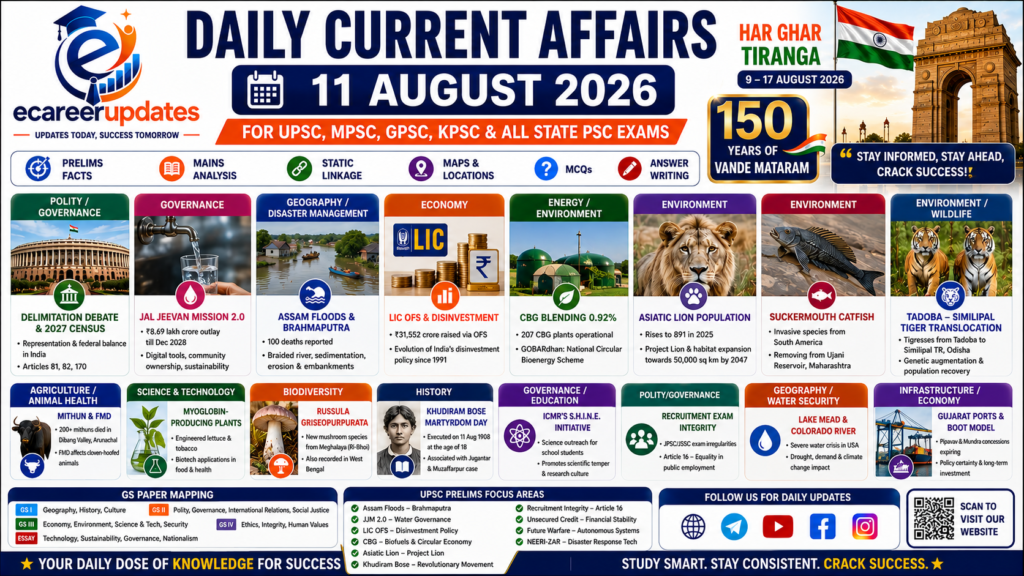
📊 11 AUGUST 2026 — QUICK REVISION TABLE
| Category | Today’s Important Issue | GS | Priority |
|---|---|---|---|
| 🏛️ Governance | Jal Jeevan Mission 2.0 – digital & community-led water governance | GS II/III | ⭐⭐⭐⭐⭐ |
| 🌊 Geography | Assam floods, Brahmaputra floodplain & sedimentation | GS I/III | ⭐⭐⭐⭐⭐ |
| 💰 Economy | LIC OFS & evolution of India’s disinvestment policy | GS III | ⭐⭐⭐⭐⭐ |
| 🌱 Energy | CBG blending reaches 0.92%; GOBARdhan linkage | GS III | ⭐⭐⭐⭐⭐ |
| 🦁 Environment | Asiatic lion habitat expansion & Project Lion | GS III | ⭐⭐⭐⭐⭐ |
| 👨🎓 Governance | Recruitment-exam integrity & JPSC/JSSC controversy | GS II | ⭐⭐⭐⭐ |
| 🧪 Science | ICMR’s S.H.I.N.E. science outreach initiative | GS III | ⭐⭐⭐ |
| 🛡️ Defence/IR | NATO–Ukraine airfield-denial innovation challenge | GS II/III | ⭐⭐⭐ |
| 🇮🇳 History | Khudiram Bose Martyrdom Day | GS I | ⭐⭐⭐⭐⭐ |
| 🧭 Geography | Brahmaputra basin & flood vulnerability | GS I | ⭐⭐⭐⭐⭐ |
| 🏞️ Maharashtra | JJM 2.0 + Maharashtra’s rural water infrastructure | GS II/III | ⭐⭐⭐⭐ |
| 🐘 Environment | World Elephant Day – 12 August preview | GS III | ⭐⭐⭐⭐ |
🏛️ 1. POLITY & GOVERNANCE
Jal Jeevan Mission 2.0: From Tap Connections to Sustainable Water Services
Why in News?
The implementation of Jal Jeevan Mission (JJM) 2.0 is currently under review through state-specific interactions. A meeting with Members of Parliament from Madhya Pradesh is scheduled for 11 August 2026, while Maharashtra’s interaction is scheduled for 12 August.
This is important because JJM 2.0 represents a shift from simply creating infrastructure to ensuring long-term drinking-water service delivery.
📌 JJM 2.0 – Important Facts
| Feature | Details |
|---|---|
| Original JJM | Launched in 2019 |
| Target | Rural drinking-water supply |
| JJM 2.0 approved | March 2026 |
| Extended up to | December 2028 |
| Total outlay | ₹8.69 lakh crore |
| Central assistance | ₹3.59 lakh crore |
| Focus | Sustainable service delivery |
| Key approach | Community ownership + digital governance |
The government says JJM 2.0 introduces Jal Arpan, Sujalam Bharat IDs, geo-tagging of water assets through PM Gati Shakti, and community-led assessment through Jal Seva Aankalan.
💻 Digital Governance Component
Sujalam Bharat ID
Each drinking-water asset can be digitally identified.
Geo-tagging
Water infrastructure is mapped using digital technologies and linked with the PM Gati Shakti framework.
SNA SPARSH
The scheme uses a scheme-based payment and fund-release mechanism designed to improve:
- Transparency
- Auditability
- Expenditure tracking
- Real-time monitoring
- Financial efficiency
🔗 UPSC STATIC LINKAGE
Jal Jeevan Mission
↓
Drinking Water
↓
Article 21 – Right to Life
↓
Public Health
↓
Local Governance
↓
Gram Panchayat + VWSC
↓
Water Security
This makes JJM relevant to GS II + GS III + Essay.
🧠 PRELIMS TRAP
Do not assume that JJM 2.0 is merely a tap-connection programme.
The newer approach focuses on:
Infrastructure + functionality + water quality + sustainability + community ownership
🇮🇳 Maharashtra Angle – MPSC
The Centre has reimbursed ₹594.44 crore to Maharashtra during FY 2026–27 as part of the central share for JJM implementation.
MPSC Linkage
Revise:
- Rural drinking water
- Gram Panchayat
- Village Water & Sanitation Committee
- Maharashtra water governance
- Groundwater
- Watershed management
- Inter-basin water issues
also read about various Government Schemes
✍️ MAINS QUESTION
Jal Jeevan Mission 2.0 represents a transition from infrastructure creation to service-delivery governance. Discuss.
Answer Keywords
- Last-mile delivery
- Water quality
- Community ownership
- O&M
- Source sustainability
- Digital monitoring
- Local governance
- Behavioural change
🌊 2. GEOGRAPHY + DISASTER MANAGEMENT
Assam Floods: The Brahmaputra as a Geographical and Governance Challenge
Why in News?
Assam is facing one of its severe flood episodes of 2026. A report published on 11 August cited the Assam State Disaster Management Authority’s toll at 100 deaths, with large populations continuing to face the consequences even as floodwaters recede.
This should not be studied simply as a disaster headline.
It is a major UPSC topic involving:
Physical Geography + River Dynamics + Climate Change + Disaster Management + Ecology + Development
Also Read at PIB
🗺️ Why is Assam so Flood-Prone?
1. Brahmaputra’s morphology
The Brahmaputra is characterised by a highly dynamic channel system with:
- Braided channels
- Heavy sediment load
- Bank erosion
- Channel migration
- Large floodplain
2. Monsoon rainfall
A very large share of Assam’s annual rainfall occurs during the southwest monsoon.
3. Upstream catchments
Rainfall in the Himalayan and northeastern catchments can rapidly increase river discharge.
4. Sedimentation
High sediment loads can alter channel capacity and river morphology.
5. Embankment dependence
Embankments provide protection but can also create complex flood-management challenges when breached or overtopped.
📊 ASSAM FLOOD – CAUSAL CHAIN
Heavy Monsoon Rainfall
↓
High Upstream Discharge
↓
Brahmaputra + Tributary Flooding
↓
Sediment Deposition + Channel Changes
↓
Embankment Pressure
↓
Flooding + Erosion
↓
Displacement + Agricultural Loss
↓
Wildlife Impact
↓
Long-term Developmental Loss
🌏 Geography Concepts to Revise
| Concept | Meaning |
|---|---|
| Braided river | Multiple interconnected channels |
| Floodplain | Flat area periodically inundated |
| Avulsion | River shifts to a new channel |
| Bank erosion | Lateral removal of river banks |
| Sedimentation | Deposition of transported material |
| Flash flood | Sudden rapid flooding |
| Riverine flood | Flood caused by river overflow |
The NDMA’s technical work on the Brahmaputra highlights the river’s enormous geographical scale and its importance to northeastern India.
🐘 Flood + Wildlife Linkage
Assam’s flood problem also affects:
- Kaziranga
- Pobitora
- Orang
- Dibru-Saikhowa
- Other floodplain ecosystems
Flooding can have both destructive and ecological functions.
Important UPSC Concept
Floods are not inherently unnatural in floodplain ecosystems.
The problem emerges when:
Natural flood processes + human settlement + infrastructure + climate extremes = disaster risk
📝 MAINS QUESTION
Why do floods in Assam repeatedly become large-scale disasters despite the region’s natural adaptation to seasonal flooding? Discuss.
Include:
- Brahmaputra morphology
- Sediment load
- Encroachment
- Wetland degradation
- Embankments
- Deforestation
- Climate variability
- Catchment management
- Early warning
- Basin-level planning
💧 3. SCIENCE + ENVIRONMENT + DISASTER MANAGEMENT
NEERI-ZAR: Safe Drinking Water During Assam Floods
The CSIR-National Environmental Engineering Research Institute (CSIR-NEERI) has deployed its indigenous NEERI-ZAR water filters in flood-hit Assam to help provide safer drinking water to affected communities.
Why is this UPSC-Relevant?
Floods create a second disaster:
Water contamination
Floodwater can contaminate sources with:
- Pathogens
- Sewage
- Chemicals
- Organic matter
- Sediments
Therefore:
Flood
→
Unsafe water
→
Waterborne disease
→
Public-health emergency
🔗 Static Linkage
Disaster Management
Public Health
Water Purification
Indigenous Technology
=
Resilient Disaster Response
This is an excellent example for GS III answers on technology-led disaster management.
💰 4. ECONOMY
LIC OFS and the Changing Nature of Disinvestment
⭐⭐⭐⭐⭐ HIGH PRIORITY
The Union government concluded its Offer for Sale (OFS) of Life Insurance Corporation of India (LIC) last week, raising around ₹31,552 crore. The government offered a base 2.5% stake with a green-shoe option taking the total offer to 6.5%.
This is much more important for UPSC than the amount itself.
The real question is:
How has India’s disinvestment policy evolved since 1991?
📊 Disinvestment – Evolution
| Period | Broad Approach |
|---|---|
| Pre-1991 | Strong public-sector dominance |
| 1991 reforms | Minority stake sales |
| Early 2000s | Strategic privatisation |
| 2010s | IPOs + ETFs + market-based sales |
| Recent period | OFS + selective strategic disinvestment |
Business Standard notes that India’s approach has increasingly shifted from transfer of management control towards gradual market-based stake dilution.
🏦 What is OFS?
Offer for Sale
Existing shareholders—such as the government—sell shares through the stock exchange mechanism.
Important:
OFS does not create new shares.
Instead:
Existing shares change ownership.
OFS vs IPO vs FPO
| Feature | OFS | IPO | FPO |
|---|---|---|---|
| Existing/New shares | Existing | Usually new +/or existing | New/existing |
| Typical use | Stake sale | Listing/capital raising | Additional capital |
| Government disinvestment | Common | Can be used for listing | Less typical |
| Management control | Usually unchanged | Depends | Depends |
🏛️ DIPAM
Department of Investment and Public Asset Management
DIPAM deals with:
- Strategic disinvestment
- Minority stake sales
- Capital management
- Government equity sales
It is under the Ministry of Finance.
🔗 UPSC ECONOMY LINKAGE
Disinvestment
↓
Non-Debt Capital Receipts
↓
Fiscal Management
↓
Public Sector Efficiency
↓
Capital Market Development
↓
Government’s role in economy
Mains Question
India’s disinvestment policy has gradually shifted from privatisation to calibrated stake dilution. Examine the implications of this approach for fiscal consolidation and public-sector reform.
🌱 5. ECONOMY + ENERGY + ENVIRONMENT
Compressed Biogas: Blending Reaches 0.92%
A major current development in India’s clean-energy transition is the growing use of Compressed Biogas (CBG).
According to data reported on 11 August, India’s CBG blending ratio reached 0.92% in 2025–26, close to the then-applicable 1% mandate. India had 207 functional CBG plants.
📊 CBG – Important Facts
| Parameter | Detail |
|---|---|
| Full form | Compressed Biogas |
| Feedstock | Organic waste/biomass |
| Product | Methane-rich gas |
| Uses | CNG vehicles/PNG systems |
| Benefit | Waste-to-energy |
| Linkage | Circular economy |
Current Blending Path
| Financial Year | Target |
|---|---|
| 2025–26 | 1% |
| 2026–27 | 3% |
| 2027–28 | 4% |
| 2028–29 onward | 5% |
GOBARdhan Linkage
The Cabinet recently approved GOBARdhan as the National Circular Bioenergy Scheme, with an outlay of ₹23,731 crore.
The chain:
Cattle dung
Agricultural residue
Organic waste
↓
Biogas
↓
Purification
↓
CBG
↓
Transport fuel + energy security
Why Important?
Environment
- Reduces organic waste
- Can reduce open burning
- Supports circular economy
Economy
- Rural entrepreneurship
- Local employment
- Additional income
Energy
- Domestic gas production
- Reduced import dependence
Mains Question
CBG can simultaneously address India’s waste-management, rural-income and energy-security challenges. Examine.
🦁 6. ENVIRONMENT & ECOLOGY
Asiatic Lion: Habitat Expansion Towards a Landscape-Level Conservation Model
Why in News?
Recent reporting indicates that Gujarat’s Asiatic lion landscape could potentially expand to around 50,000 sq km by 2047, reflecting continuing dispersal from the traditional Gir landscape.
The development should be studied alongside the established conservation data: India’s Asiatic lion population increased from 674 in 2020 to 891 in 2025, while the species’ distribution has expanded into new forest areas, river corridors and revenue wastelands.
🦁 Asiatic Lion – Prelims Fact Box
| Feature | Fact |
|---|---|
| Scientific name | Panthera leo persica |
| Natural wild population | India |
| Main landscape | Greater Gir |
| State | Gujarat |
| IUCN | Endangered |
| CITES | Appendix I |
| Wildlife Protection Act | Schedule I |
| Project Lion | Launched/announced 2020 |
The Asiatic lion receives the highest level of legal protection under India’s wildlife law and is listed in CITES Appendix I.
🌳 Why Habitat Expansion Matters
A species concentrated in a single landscape faces single-population risk.
Potential threats include:
- Epidemic disease
- Natural disasters
- Genetic bottlenecks
- Habitat degradation
- Human-wildlife conflict
Therefore:
Population expansion ≠ conservation completed
The next challenge is:
Creating a connected, resilient and geographically distributed lion population.
🛰️ Technology in Lion Conservation
Satellite telemetry has been used to understand:
- Lion movement
- Corridor use
- Spatial distribution
- Seasonal patterns
- Land-use preferences
🔗 UPSC LINKAGE
Project Lion
→
Landscape ecology
→
Wildlife corridors
→
Satellite telemetry
→
Disease surveillance
→
Community participation
→
Human-wildlife coexistence
✍️ MAINS QUESTION
Species recovery must be followed by landscape-level conservation and risk diversification. Discuss with reference to the Asiatic lion.
🎓 7. POLITY + GOVERNANCE + EDUCATION
Recruitment Examination Integrity: JPSC/JSSC Issue
Why in News?
A statewide shutdown in Jharkhand on 11 August has been called in connection with protests over alleged irregularities in recruitment examinations conducted by the Jharkhand Public Service Commission (JPSC) and Jharkhand Staff Selection Commission (JSSC). The issue has generated debate over examination transparency and the handling of aspirants’ grievances.
For UPSC, the important point is not the political bandh itself.
The important issue is:
Integrity of public recruitment
Why Does It Matter?
Government recruitment examinations are directly connected to:
- Equality of opportunity
- Merit
- Transparency
- Administrative legitimacy
- Youth employment
- Public trust
Constitutional Linkage
| Provision | Relevance |
|---|---|
| Article 14 | Equality before law |
| Article 16 | Equality of opportunity in public employment |
| Article 21 | Fair procedure dimensions |
| Public Service Commissions | Constitutional recruitment institutions |
State PSC vs UPSC
| UPSC | State PSC |
|---|---|
| Article 315 framework | Article 315 framework |
| Union-level recruitment | State-level recruitment |
| Constitutional body | Constitutional body |
| UPSC conducts CSE | State PSC conducts state civil services |
Mains Question
Frequent examination irregularities can undermine both youth confidence and the credibility of public administration. Suggest institutional reforms to strengthen recruitment integrity.
Reforms:
- Secure question-paper generation
- Encrypted digital transmission
- Stronger exam-centre protocols
- Independent audits
- Fast grievance redressal
- Time-bound judicial mechanisms
- Transparent result publication
- Whistleblower protection
🇮🇳 8. HISTORY
Khudiram Bose Martyrdom Day – 11 August
Why in News?
11 August 2026 marks the 118th anniversary of the martyrdom of Khudiram Bose, who was executed by the British on 11 August 1908 at the age of 18.
This is highly relevant for UPSC + WBCS + MPSC + State PSC History because it provides an entry point into the revolutionary nationalist movement.
📚 Khudiram Bose – Quick Facts
| Topic | Fact |
|---|---|
| Born | 3 December 1889 |
| Birth region | Midnapore, Bengal |
| Revolutionary organisation | Jugantar |
| Influences | Partition of Bengal + nationalism |
| Executed | 11 August 1908 |
| Age | 18 |
| Associated case | Muzaffarpur bomb case |
Khudiram was associated with the revolutionary movement that developed in Bengal following the Partition of Bengal, 1905.
🔗 HISTORY LINKAGE
Partition of Bengal – 1905
↓
Swadeshi Movement
↓
Revolutionary nationalism
↓
Anushilan/Jugantar
↓
Khudiram Bose
↓
Muzaffarpur action
↓
British repression
⚠️ PRELIMS TRAP
Do not place revolutionary nationalism and Gandhian mass movements into the same phase or organisational structure.
Revolutionary nationalism involved:
- Secret societies
- Armed resistance
- Political assassinations/attempts
- Bomb-making
- Underground networks
Whereas Gandhian movements relied primarily on:
- Mass mobilisation
- Satyagraha
- Non-violence
- Civil disobedience
✍️ Mains Value Addition
Khudiram Bose can be used as an example of:
- Youth participation in nationalism
- Revolutionary nationalism
- Colonial repression
- Sacrifice
- Political radicalisation after 1905
🧪 9. SCIENCE & TECHNOLOGY
ICMR’s S.H.I.N.E. Initiative
The Department of Health Research/ICMR is launching S.H.I.N.E. as a nationwide science-outreach initiative inviting school students to spend a day with scientists.
Although not a high-probability factual Prelims question by itself, the initiative is useful for understanding India’s broader effort to strengthen:
- Scientific temper
- STEM exposure
- Research culture
- Young innovators
- Scientist–student interaction
🔗 Constitutional Linkage
Article 51A(h)
One of the Fundamental Duties is to develop:
Scientific temper, humanism and the spirit of inquiry and reform.
This is an excellent GS II + GS IV + Essay connection.
🛰️ 10. DEFENCE + INTERNATIONAL RELATIONS
NATO–Ukraine Innovation Challenge: Persistent Airfield Denial
A NATO Allied Command Transformation initiative with Ukraine focuses on technologies capable of restricting an adversary’s use of airfield infrastructure and aviation assets. Finalists were scheduled to be announced on 11 August 2026.
Why Relevant to India?
The important UPSC theme is:
Future Warfare
Traditional warfare
↓
Network-centric warfare
↓
Drones
↓
Autonomous systems
↓
AI-enabled targeting
↓
Electronic warfare
↓
Counter-UAS systems
Technologies in Focus
- Autonomous systems
- Uncrewed aerial systems
- Loitering systems
- Swarming
- Electronic warfare resilience
- GPS-denied operations
Mains Linkage
Modern warfare is increasingly determined by the integration of AI, autonomous systems, electronic warfare and resilient communications. Discuss India’s preparedness.
🌍 11. INTERNATIONAL RELATIONS
India’s Maritime & Energy Security – Strategic Chokepoints
Recent developments around global energy security continue to make maritime chokepoints extremely important for India.
The key locations to revise are:
| Chokepoint | Connects |
|---|---|
| Strait of Hormuz | Persian Gulf ↔ Gulf of Oman |
| Bab-el-Mandeb | Red Sea ↔ Gulf of Aden |
| Suez Canal | Mediterranean ↔ Red Sea |
| Strait of Malacca | Indian Ocean ↔ Pacific |
| Lombok Strait | Indian Ocean ↔ Pacific |
Why India?
India is heavily dependent on maritime routes for:
- Crude oil
- LNG
- Trade
- Fertiliser imports
- Industrial inputs
Thus:
Maritime security = Energy security + Trade security + National security
This theme is especially useful for GS II, GS III and Essay.
💰 12. ECONOMY – CONSUMPTION & CREDIT
Rising Unsecured Borrowing Among Young Consumers
Current economic reporting has highlighted concerns about rising reliance on credit cards, personal loans and buy-now-pay-later products, particularly among younger consumers. The issue has drawn attention from the RBI and financial-sector observers.
Why UPSC-Relevant?
This is an opportunity to revise:
Household Debt
Consumption
↓
Credit expansion
↓
Household leverage
↓
Repayment risk
↓
Financial stability
Secured vs Unsecured Credit
| Secured Loan | Unsecured Loan |
|---|---|
| Collateral-backed | No specific collateral |
| Lower lender risk | Higher lender risk |
| Home loan | Credit card |
| Vehicle loan | Personal loan |
| Usually lower interest | Usually higher risk premium |
Mains Linkage
Rapid expansion of unsecured household credit can support consumption in the short term but create financial-stability risks. Examine.
🏗️ 13. INFRASTRUCTURE + DIGITAL GOVERNANCE
Data-Driven Infrastructure Monitoring
India increasingly uses digital platforms, dashboards and API-based systems for infrastructure monitoring.
PAIMANA, for example, is used to monitor major Central Sector infrastructure projects and integrates project information for monitoring and analytics.
This is linked with the broader transition:
Traditional Monitoring
Periodic report → Physical review → Delayed intervention
Digital Monitoring
Live data → Dashboard → Analytics → Early warning → Intervention
UPSC Governance Linkage
Digital Public Infrastructure
Data analytics
Transparency
Outcome-based governance
🐘 14. ENVIRONMENT – WORLD ELEPHANT DAY PREVIEW
12 August – World Elephant Day
Although World Elephant Day falls tomorrow, aspirants should revise it today because it connects directly with India’s biodiversity preparation.
India Focus
Revise:
- Asian Elephant
- Elephant Reserves
- Elephant Corridors
- Human-elephant conflict
- Railway/road mortality
- Habitat fragmentation
- Project Elephant
- Interstate elephant movement
📊 STATIC + CURRENT AFFAIRS MASTER TABLE
| Current News | Static Topic to Revise |
|---|---|
| JJM 2.0 | Article 21 + local governance + water security |
| Assam floods | Brahmaputra + braided rivers + floodplains |
| NEERI-ZAR | Water purification + disaster health |
| LIC OFS | Disinvestment + DIPAM + capital receipts |
| CBG | Biofuels + circular economy + GOBARdhan |
| Asiatic lion | Project Lion + Gir + wildlife corridors |
| JPSC/JSSC | Article 16 + Public Service Commissions |
| Khudiram Bose | Revolutionary nationalism + Swadeshi |
| S.H.I.N.E. | Article 51A(h) + scientific temper |
| NATO innovation | AI + drones + future warfare |
| Unsecured credit | RBI + household debt + financial stability |
| World Elephant Day | Project Elephant + corridors |
🎯 PRELIMS HIGH-PRIORITY MATRIX
| Topic | Static Depth | Current Relevance | Priority |
|---|---|---|---|
| Assam Floods/Brahmaputra | ⭐⭐⭐⭐⭐ | ⭐⭐⭐⭐⭐ | 🔴 Very High |
| JJM 2.0 | ⭐⭐⭐⭐⭐ | ⭐⭐⭐⭐⭐ | 🔴 Very High |
| LIC OFS/Disinvestment | ⭐⭐⭐⭐⭐ | ⭐⭐⭐⭐⭐ | 🔴 Very High |
| CBG/GOBARdhan | ⭐⭐⭐⭐⭐ | ⭐⭐⭐⭐⭐ | 🔴 Very High |
| Asiatic Lion | ⭐⭐⭐⭐⭐ | ⭐⭐⭐⭐⭐ | 🔴 Very High |
| Khudiram Bose | ⭐⭐⭐⭐⭐ | ⭐⭐⭐⭐ | 🔴 Very High |
| Recruitment integrity | ⭐⭐⭐⭐⭐ | ⭐⭐⭐⭐ | 🟠 High |
| Unsecured credit | ⭐⭐⭐⭐ | ⭐⭐⭐⭐ | 🟠 High |
| Future warfare | ⭐⭐⭐⭐ | ⭐⭐⭐⭐ | 🟠 High |
| NEERI-ZAR | ⭐⭐⭐ | ⭐⭐⭐⭐ | 🟡 Moderate |
| S.H.I.N.E. | ⭐⭐⭐ | ⭐⭐⭐ | 🟡 Moderate |
🧠 UPSC-STYLE PRELIMS MCQs
Q1. With reference to Jal Jeevan Mission 2.0, consider the following:
- It focuses only on creating new tap-water connections.
- It introduces digital identification of drinking-water assets.
- Geo-tagging of water infrastructure can be linked with PM Gati Shakti.
- Community participation is part of its implementation approach.
Which of the above are correct?
Answer: 2, 3 and 4 only
Q2. Consider the following statements about OFS:
- OFS generally involves sale of existing shares.
- It necessarily results in creation of new equity capital for the company.
- Governments can use OFS for minority stake sales.
Answer: 1 and 3 only
Q3. Which of the following is correctly associated with CBG?
A. Production exclusively from crude oil
B. Methane-rich gas produced from organic feedstocks
C. Nuclear fuel used in transport
D. Hydrogen obtained only through electrolysis
Answer: B
Q4. Consider the following statements:
- The Asiatic lion’s natural wild population in India is associated with Gujarat.
- Project Lion follows a landscape-level conservation approach.
- The Asiatic lion is listed in CITES Appendix I.
Answer: 1, 2 and 3
Q5. Khudiram Bose is most appropriately associated with:
A. Home Rule Movement
B. Revolutionary nationalism
C. Individual Satyagraha
D. Quit India Movement
Answer: B
Q6. Which of the following constitutional provisions is most directly associated with equality of opportunity in public employment?
A. Article 14
B. Article 16
C. Article 19
D. Article 21
Answer: B
Q7. The Brahmaputra is particularly associated with which of the following?
- High sediment load
- Braided channels
- Dynamic bank erosion
- Extensive floodplains
Answer: 1, 2, 3 and 4
✍️ MAINS ANSWER WRITING PRACTICE
GS I – Geography
Assam’s recurring floods are a product of both physical geography and human intervention. Examine.
Suggested framework:
Introduction
→ Brahmaputra basin
Body
→ Rainfall
→ Sediment
→ Braided channels
→ Erosion
→ Wetland loss
→ Embankments
→ Encroachment
→ Climate change
Way Forward
→ Basin-level management
→ Wetland restoration
→ Early warning
→ Room-for-river approach
→ Resilient infrastructure
GS II – Governance
Jal Jeevan Mission 2.0 illustrates the transition from infrastructure-led welfare delivery to service-oriented governance. Discuss.
GS III – Economy
India’s increasing reliance on market-based disinvestment requires a balance between fiscal objectives and long-term public-sector strategy. Examine.
GS III – Environment
The recovery of the Asiatic lion demonstrates the benefits of landscape-level conservation, but also highlights the risks of concentrating a species in a limited geographical range. Discuss.
GS III – Energy
CBG can become an important bridge between India’s waste-management challenge and its clean-energy transition. Explain.
GS IV – Ethics
Examination integrity is a prerequisite for public trust in state institutions. Discuss the ethical responsibilities of bodies conducting public recruitment examinations.
📝 ESSAY TOPICS FROM TODAY
1.
“Water security is ultimately a governance challenge.”
2.
“A resilient India must learn to live with its rivers rather than merely control them.”
3.
“Economic reform is successful only when efficiency and public purpose move together.”
4.
“Conservation succeeds when wildlife and communities are treated as part of the same landscape.”
5.
“Technology can strengthen institutions, but institutional integrity determines whether technology delivers public value.”
🗺️ MAP WORK – 11 AUGUST
🇮🇳 India
Mark:
- Assam
- Brahmaputra
- Dibang
- Lohit
- Subansiri
- Kaziranga
- Gir
- Barda Wildlife Sanctuary
- Gujarat
- Madhya Pradesh
- Maharashtra
- Arunachal Pradesh
🌍 World
Revise:
- Persian Gulf
- Strait of Hormuz
- Gulf of Oman
- Red Sea
- Bab-el-Mandeb
- Gulf of Aden
- Suez Canal
- Strait of Malacca
- Indo-Pacific
⚠️ PRELIMS TRAP ZONE
| Don’t Confuse | Correct Concept |
|---|---|
| OFS vs IPO | OFS generally sells existing shares |
| Strategic disinvestment vs minority sale | Strategic sale involves transfer/control dimension |
| JJM vs PMKSY | Drinking water vs irrigation/agriculture |
| CBG vs CNG | CBG is produced from biomass; CNG is conventional natural gas |
| FMD vs HFMD | Completely different diseases |
| Asiatic lion vs African lion | Indian wild population is the Asiatic subspecies |
| Gir vs Barda | Both Gujarat landscapes, but distinct protected areas |
| Brahmaputra flood vs flash flood | Riverine flooding has different dynamics |
| Article 14 vs Article 16 | General equality vs public-employment opportunity |
| Khudiram Bose vs Bhagat Singh | Different generations/phases of revolutionary nationalism |
⚡ 60-SECOND REVISION SHEET
| Topic | One-Line Recall |
|---|---|
| 💧 JJM 2.0 | Sustainable rural drinking-water services |
| 🌊 Assam | Brahmaputra + sediment + erosion + floodplain |
| 🧪 NEERI-ZAR | Safe drinking water in flood response |
| 💰 LIC OFS | ₹31,552 crore; market-based disinvestment |
| 🏦 DIPAM | Government investment & disinvestment management |
| 🌱 CBG | 0.92% blending in FY26; target rises |
| 🦁 Lion | 891 in 2025; landscape expansion |
| 🎓 Recruitment | Article 16 + institutional integrity |
| 🇮🇳 Khudiram | Revolutionary nationalism; executed 1908 |
| 🧪 S.H.I.N.E. | ICMR science outreach |
| 🛡️ NATO Challenge | Autonomous/AI-enabled future warfare |
| 💳 Credit | Unsecured household borrowing & financial stability |
| 🐘 12 Aug | World Elephant Day |
🔗 THE “UPSC CONNECT” OF 11 AUGUST
Today’s news becomes much easier when converted into conceptual chains.
💧 WATER
JJM 2.0
→ Digital governance
→ Panchayati Raj
→ Water quality
→ Community ownership
→ Article 21
→ Sustainable development
🌊 ASSAM
Brahmaputra
→ Himalayan rainfall
→ Sediment
→ Braided channel
→ Erosion
→ Floodplain
→ Disaster management
→ Climate resilience
💰 ECONOMY
LIC OFS
→ Disinvestment
→ DIPAM
→ Non-debt capital receipts
→ Fiscal management
→ Public-sector policy
→ Capital markets
🌱 ENERGY
GOBARdhan
→ Organic waste
→ Biogas
→ CBG
→ Circular economy
→ Rural income
→ Energy security
🦁 ENVIRONMENT
Asiatic Lion
→ Gir
→ Project Lion
→ Corridors
→ Satellite telemetry
→ Disease management
→ Human-wildlife coexistence
🇮🇳 HISTORY
Khudiram Bose
→ Partition of Bengal
→ Swadeshi
→ Revolutionary nationalism
→ Jugantar
→ Colonial repression
🏆 TOP 10 TOPICS TO REVISE TODAY
🔴 Tier 1 – Must Read
- Assam Floods + Brahmaputra Geography
- Jal Jeevan Mission 2.0
- LIC OFS + Disinvestment
- CBG + GOBARdhan
- Asiatic Lion + Project Lion
🟠 Tier 2 – High Value
- Khudiram Bose + Revolutionary Nationalism
- Public Recruitment Integrity + Article 16
- Unsecured Credit + Financial Stability
- Future Warfare + Autonomous Systems
- Water Purification + Disaster Response
🎯 SPECIAL FOCUS FOR MPSC / STATE PSC
For MPSC, today’s most useful areas are:
| Maharashtra Linkage | Why Important |
|---|---|
| JJM 2.0 | Maharashtra received ₹594.44 crore central reimbursement |
| CBG | MNGL is among India’s major city-gas distributors |
| Disinvestment | LIC/OFS + public finance |
| Flood management | Krishna, Godavari, Tapi basin comparison |
| Biodiversity | Compare Gir with Tadoba, Melghat, Pench |
| Recruitment | State PSC institutional framework |
| Water governance | Maharashtra’s rural water-management challenges |
The JJM data specifically records ₹594.44 crore reimbursed to Maharashtra during FY 2026–27, making the topic particularly useful for Maharashtra-specific current affairs.
📌 FINAL UPSC TAKEAWAY
The 11 August 2026 current-affairs set is particularly strong for UPSC because several apparently unrelated headlines converge on core static concepts.
Remember these six master linkages:
1. Flood → River Geography + Disaster Governance
2. JJM → Water Security + Local Governance
3. LIC OFS → Disinvestment + Public Finance
4. CBG → Circular Economy + Energy Security
5. Lion → Landscape Conservation + Biodiversity
6. Khudiram → Revolutionary Nationalism + Freedom Struggle
The strongest preparation strategy is therefore not to memorise today’s 20 headlines. Instead, master these conceptual clusters and be prepared for UPSC to change the wording, location, institution or statement.
⭐ Today’s final priority:
Assam Floods → JJM 2.0 → LIC OFS → CBG/GOBARdhan → Asiatic Lion → Khudiram Bose → Article 16/Recruitment Integrity → Unsecured Credit → Future Warfare → Disaster-technology response.
This makes the edition useful not only for UPSC CSE, but also for MPSC Rajyaseva, GPSC, KPSC Group A/B/C and other State PSC examinations, where the same current event can be tested through a more state-specific or factual angle.
Source base: Government of India/PIB, IMD, NDMA and contemporary reporting were cross-checked, with priority given to official material wherever available.