UPSC CSE Prelims & Mains | MPSC | GPSC | KPSC | State PSC | Group A, B & C
Exam-Oriented Current Affairs | Static + Current Linkages | Prelims Traps | Mains Analysis | Mapping | MCQs
Today’s approach: Do not study current affairs as isolated headlines. For every important event, connect NEWS → STATIC CONCEPT → INSTITUTION/LAW → PRELIMS TRAP → MAINS DIMENSION → POSSIBLE QUESTION.
The 10 August 2026 current-affairs cycle has particularly useful material on delimitation, digital evidence, maritime governance, biofuels, Asiatic lion conservation, invasive species, tribal communities, tiger translocation, water stress and cultural heritage. Contemporary UPSC-oriented coverage also identifies several of these as high-value Prelims areas.
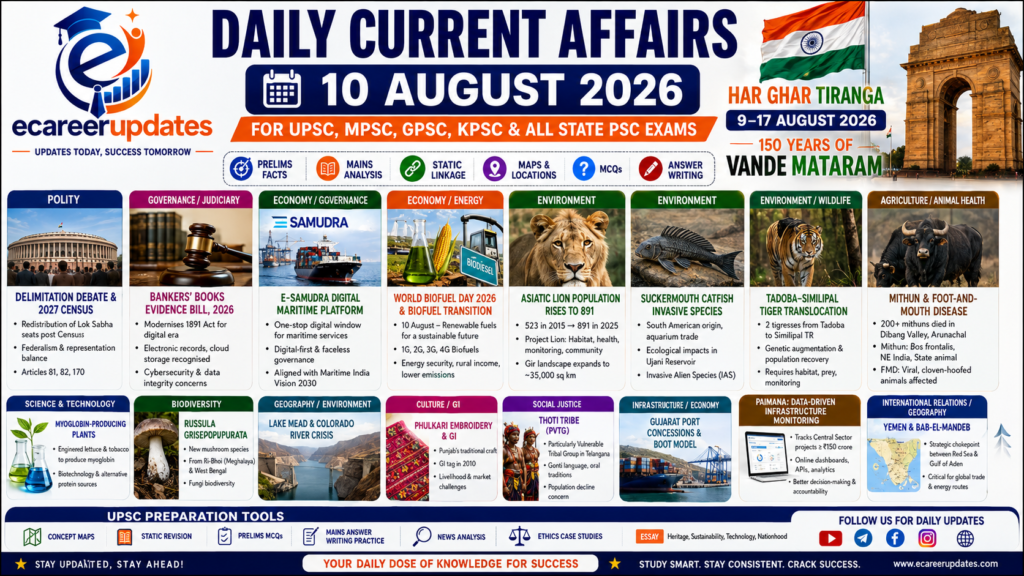
📊 TODAY’S CURRENT AFFAIRS – AT A GLANCE
| Category | Important Development | GS | Priority |
|---|---|---|---|
| 🏛️ Polity | Delimitation debate & 2027 Census | GS II | ⭐⭐⭐⭐⭐ |
| ⚖️ Governance/Judiciary | Bankers’ Books Evidence Bill, 2026 | GS II/III | ⭐⭐⭐⭐⭐ |
| 🚢 Economy/Governance | E-SAMUDRA digital maritime platform | GS II/III | ⭐⭐⭐⭐⭐ |
| 💰 Economy/Energy | World Biofuel Day & biofuel transition | GS III | ⭐⭐⭐⭐⭐ |
| 🌱 Environment | Asiatic Lion population rises to 891 | GS III | ⭐⭐⭐⭐⭐ |
| 🐟 Environment | Suckermouth catfish as invasive species | GS III | ⭐⭐⭐⭐⭐ |
| 🐅 Environment | Tadoba–Similipal tiger translocation | GS III | ⭐⭐⭐⭐⭐ |
| 🐃 Agriculture/Animal Health | Mithun & Foot-and-Mouth Disease | GS III | ⭐⭐⭐⭐ |
| 💧 Geography | Lake Mead & Colorado River water crisis | GS I/III | ⭐⭐⭐⭐ |
| 🧬 Science | Myoglobin-producing plants | GS III | ⭐⭐⭐⭐ |
| 🍄 Biodiversity | Russula griseopurpurata | GS III | ⭐⭐⭐⭐ |
| 🧵 Culture | Phulkari & GI | GS I/III | ⭐⭐⭐⭐ |
| 👥 Social Justice | Thoti PVTG | GS II | ⭐⭐⭐⭐⭐ |
| 🏗️ Infrastructure | Gujarat port concessions & BOOT model | GS III | ⭐⭐⭐⭐⭐ |
| 📊 Governance | PAIMANA & data-driven infrastructure monitoring | GS II/III | ⭐⭐⭐⭐ |
🏛️ 1. POLITY & CONSTITUTION
Delimitation Debate – Representation, Federalism & 2027 Census
Why in News?
The debate over the future delimitation of Lok Sabha constituencies has intensified as India moves towards the next Census cycle. The issue combines constitutional provisions, population distribution, federalism, women’s reservation and the political representation of States.
The present constitutional framework provides for readjustment of seats after Census-based population data, while the redistribution of seats among States has been frozen for decades. Current UPSC-oriented analysis highlights the possibility of major changes in the relative representation of States once the freeze is revisited.
📌 What is Delimitation?
Delimitation = fixing the number of seats + redrawing territorial constituencies.
It has two dimensions:
| Dimension | Meaning |
|---|---|
| Inter-State | Allocation of Lok Sabha seats among States |
| Intra-State | Redrawing constituency boundaries within a State |
Constitutional Linkage
| Article | Relevance |
|---|---|
| Article 81 | Composition/allocation of Lok Sabha seats |
| Article 82 | Readjustment after Census |
| Article 170 | Composition of State Legislative Assemblies |
| Article 327 | Parliament’s power regarding elections |
| Article 330 | Reservation for SCs/STs in Lok Sabha |
| Article 243D/243T | Local-body reservation |
The Delimitation Commission is an independent body and its orders have statutory force.
🧩 Why is it controversial?
Population vs Performance
States that achieved early population stabilisation argue that a pure population-based redistribution could reduce their relative parliamentary representation despite having successfully implemented:
- Family planning
- Education
- Health programmes
- Lower fertility
- Better demographic transition
Meanwhile, States with larger populations could gain representation.
Federalism Question
The issue therefore becomes:
Should parliamentary representation depend primarily on population, or should India’s federal structure also reward demographic responsibility?
🔥 UPSC Prelims Trap
Do not confuse:
| Delimitation | Census |
|---|---|
| Redraws constituencies | Collects demographic/statistical information |
| Conducted by Delimitation Commission | Census conducted under Census framework |
| Political representation | Population data |
| Constitutional/statutory linkage | Administrative/statistical exercise |
Mains Perspective
Possible GS-II Question
Population-based delimitation is constitutionally logical but politically sensitive in a federal democracy. Discuss.
Dimensions to include:
Advantages
- Equal representation
- One person, one vote
- Updated population basis
- Correct demographic representation
Concerns
- Southern States’ representation
- Federal balance
- Demographic performance
- Regional inequality
- Political polarisation
Way Forward
- Broad political consensus
- Transparent criteria
- Independent Delimitation Commission
- Consideration of demographic performance
- Strengthening Rajya Sabha’s federal role
- Greater fiscal incentives for demographic responsibility
⚖️ 2. POLITY + JUDICIARY + TECHNOLOGY
Bankers’ Books Evidence Bill, 2026
Why in News?
The Lok Sabha passed the Bankers’ Books Evidence Bill, 2026, intended to replace the colonial-era Bankers’ Books Evidence Act, 1891 and modernise the legal treatment of banking records in courts.
The key issue is that banking records have moved from physical ledgers to electronic, digital and cloud-based systems.
🏦 Why was a new law needed?
The 1891 law was designed for an era of:
- Paper ledgers
- Physical bank records
- Manual certification
Modern banking involves:
- Cloud storage
- Digital banking
- Electronic databases
- Centralised systems
- Digital transaction records
📊 Major Changes
| Earlier Framework | 2026 Bill |
|---|---|
| Paper-centric | Digital-centric |
| Physical/microfilm records | Electronic/cloud records |
| Old evidence procedures | Standardised digital certification |
| “Special cause” not clearly defined | More specific circumstances |
| Colonial framework | Technology-oriented framework |
The Bill recognises electronic records stored onsite, offsite or in virtual/cloud locations as bankers’ books.
⚠️ Major Concern: Digital Evidence Integrity
The key question is:
How can courts establish that a digital banking record has not been altered?
Experts have raised concerns regarding:
- Hash-value verification
- Cybersecurity
- Data protection
- Cloud security
- Certification responsibility
- Digital tampering
🔗 Static Linkage
Digital Banking
↓
Electronic Evidence
↓
Bharatiya Sakshya Adhiniyam
↓
Cybersecurity
↓
Data Protection
↓
Judicial Reliability
Mains Question
The digitisation of banking requires not only technological modernisation but also corresponding reform in evidentiary law. Discuss.
🚢 3. ECONOMY + GOVERNANCE
E-SAMUDRA – Digital Transformation of Maritime Governance
Why in News?
The Union Minister for Ports, Shipping and Waterways inaugurated the E-SAMUDRA platform, a comprehensive digital platform intended to simplify maritime governance and provide a unified interface for seafarers, shipping companies and other stakeholders.
📊 E-SAMUDRA
| Feature | Detail |
|---|---|
| Sector | Maritime governance |
| Nodal Ministry | Ministry of Ports, Shipping & Waterways |
| Implementing agency | Directorate General of Shipping |
| Nature | Digital governance platform |
| Approach | Digital-first & faceless |
| Services | Shipping + seafarer services |
| Vision linkage | Maritime India Vision 2030 |
What does it provide?
One Digital Window
Applications
→
Payments
→
Compliance
→
Certificates
→
Real-time tracking
→
Stakeholder services
This represents a shift from physical, office-based administration towards integrated digital maritime governance.
Why Important for India?
India’s maritime sector is critical for:
- International trade
- Energy imports
- Port-led development
- Seafarer employment
- Blue economy
- Supply-chain resilience
Mains Linkage
Digital India + Maritime India Vision 2030 + Ease of Doing Business + Blue Economy
💰 4. ECONOMY + ENERGY + ENVIRONMENT
World Biofuel Day 2026
Why in News?
10 August is observed as World Biofuel Day, highlighting renewable fuels, cleaner transport, energy security and reduced dependence on fossil fuels. India first observed the day in 2015 through the Ministry of Petroleum and Natural Gas.
The observance is associated with Rudolf Diesel’s demonstration of an engine using peanut oil in 1893.
🌱 What are Biofuels?
Biofuels are fuels derived from biomass and organic material.
Generational Classification
| Generation | Feedstock | Key Issue |
|---|---|---|
| 1G | Food crops, sugar, starch, vegetable oils | Food vs fuel |
| 2G | Agricultural/forest residues, waste | Less food competition |
| 3G | Algae | High productivity potential |
| 4G | Advanced biotechnology | Greater technological complexity |
Major Biofuels
| Biofuel | Basic Source |
|---|---|
| Bioethanol | Sugar/starch/biomass |
| Biodiesel | Vegetable oils/animal fats/UCO |
| Bio-CNG | Biogas purified to methane-rich fuel |
| Advanced biofuel | Waste/residues/non-food biomass |
🇮🇳 India’s Biofuel Policy Linkage
| Initiative | Purpose |
|---|---|
| National Policy on Biofuels | Overall biofuel framework |
| Ethanol Blending Programme | Ethanol + petrol |
| PM JI-VAN | Advanced/2G ethanol |
| GOBARdhan | Organic waste → useful products/biogas |
| RUCO | Used cooking oil → biodiesel |
The National Policy on Biofuels includes targets for ethanol and biodiesel blending and promotes diversified feedstocks and advanced biofuels.
⚠️ UPSC Mains Dimension
Biofuels are not automatically environmentally perfect.
Challenges
- Water consumption
- Food-versus-fuel debate
- Feedstock availability
- Land-use concerns
- Lower energy density of ethanol
- Vehicle compatibility
- Infrastructure requirements
Possible GS-III Question
Can biofuels simultaneously strengthen India’s energy security, rural economy and climate commitments? Examine the opportunities and limitations.
🦁 5. ENVIRONMENT & ECOLOGY
Asiatic Lion Population Rises to 891
⭐⭐⭐⭐⭐ Very High Priority
On World Lion Day 2026, the Ministry of Environment highlighted the increase in India’s Asiatic lion population from 523 in 2015 to 891 in 2025. The government linked the improvement to habitat protection, conservation programmes, scientific monitoring and community participation.
📊 Key Facts
| Feature | Asiatic Lion |
|---|---|
| Scientific name | Panthera leo persica |
| Natural population in India | Gujarat |
| Major landscape | Gir |
| IUCN status | Endangered |
| Major conservation programme | Project Lion |
Project Lion
Announced in 2020, Project Lion adopts a landscape-level approach involving:
- Habitat improvement
- Disease surveillance
- Veterinary support
- Scientific population monitoring
- Technology-assisted conservation
- Biodiversity protection
- Community participation
The government reports that the lion landscape has expanded from roughly 30,000 sq km to about 35,000 sq km since 2020.
🔗 UPSC Concept
Species recovery
≠
Conservation completed
Long-term concerns remain around:
- Disease outbreaks
- Genetic diversity
- Habitat concentration
- Human-wildlife interactions
- Climate stress
- Need for additional suitable habitat
Prelims Trap
Lion vs Tiger
| Asiatic Lion | Tiger |
|---|---|
| Gujarat | Several Indian States |
| Gir landscape | Multiple tiger landscapes |
| Panthera leo | Panthera tigris |
| Pride/social behaviour | Generally solitary |
🐟 6. ENVIRONMENT – INVASIVE SPECIES
Suckermouth Catfish in Ujani Reservoir
Why in News?
The Bombay Natural History Society (BNHS) has begun active removal of invasive fish such as the suckermouth catfish from Maharashtra’s Ujani Reservoir.
📌 Prelims Facts
| Feature | Detail |
|---|---|
| Family | Loricariidae |
| Native region | South America |
| Entry into India | Aquarium trade |
| Common name | Suckermouth catfish / “Helicopter fish” |
| Diet | Opportunistic omnivore |
| Problem | Invasive ecological impacts |
Why is it invasive?
The species is highly adaptable and can:
- Compete with native species
- Consume fish eggs
- Disturb river banks
- Burrow into earthen structures
- Survive difficult environmental conditions
UPSC Concept: Invasive Alien Species
Non-native introduction
↓
Establishment
↓
Rapid spread
↓
Competition/predation/habitat alteration
↓
Native biodiversity impact
Mains Angle
Invasive alien species represent a silent threat to India’s freshwater biodiversity. Discuss the challenges of controlling them.
🐅 7. ENVIRONMENT + WILDLIFE MANAGEMENT
Tadoba–Similipal Tiger Translocation
Why in News?
Odisha has initiated the next phase of tiger translocation into Similipal Tiger Reserve after receiving two tigresses from Maharashtra’s Tadoba-Andhari Tiger Reserve.
Tadoba-Andhari – Prelims Box
| Feature | Detail |
|---|---|
| State | Maharashtra |
| District | Chandrapur |
| Established | 1955 as Tadoba National Park |
| Tiger Reserve | Tadoba + Andhari landscape |
| Forest type | Tropical dry deciduous |
| Important river | Andhari |
| Linkages | Nagzira-Navegaon, Pench |
Why Translocate Tigers?
Possible objectives
- Genetic augmentation
- Population recovery
- Recolonisation
- Improving breeding population
- Restoring ecological balance
But Translocation Requires
| Requirement | Why? |
|---|---|
| Suitable prey | Food availability |
| Habitat | Adequate territory |
| Genetic assessment | Avoid inbreeding/outbreeding issues |
| Disease screening | Prevent disease spread |
| Community participation | Reduce conflict |
| Post-release monitoring | Evaluate survival |
Mains Question
Wildlife translocation can restore declining populations but is not a substitute for habitat protection. Discuss.
🐃 8. AGRICULTURE + ANIMAL HEALTH
Mithun and Foot-and-Mouth Disease
Why in News?
More than 200 mithuns reportedly died in a Foot-and-Mouth Disease (FMD) outbreak in Dibang Valley, Arunachal Pradesh.
🐃 What is Mithun?
Mithun, or gayal, is a semi-domesticated bovine associated strongly with Northeast India.
| Feature | Detail |
|---|---|
| Scientific name | Bos frontalis |
| Common name | Mithun/Gayal |
| Highest concentration | Northeast India |
| Highest Indian population | Arunachal Pradesh |
| State animal | Arunachal Pradesh & Nagaland |
| IUCN | Vulnerable |
Foot-and-Mouth Disease
FMD is a highly contagious viral disease affecting cloven-hoofed animals.
Affected
- Cattle
- Sheep
- Goats
- Pigs
- Deer
- Other susceptible cloven-hoofed animals
Not affected
- Horses
- Zebras
The disease is caused by an Aphthovirus of the family Picornaviridae.
⚠️ UPSC Trap
Foot-and-Mouth Disease ≠ Hand, Foot and Mouth Disease
They are entirely different diseases.
🧬 9. SCIENCE & TECHNOLOGY
Myoglobin-Producing Plants
Why in News?
Scientists have engineered lettuce and tobacco plants to produce myoglobin, bringing together plant biotechnology, protein engineering and food/science applications.
What is Myoglobin?
Myoglobin is an oxygen-binding protein found predominantly in skeletal and cardiac muscle.
| Myoglobin | Haemoglobin |
|---|---|
| Mainly muscle | Blood |
| Oxygen reservoir in muscle | Oxygen transport in blood |
| One oxygen-binding site | Multiple oxygen-binding sites |
| Intracellular | Circulating protein |
Why Engineer Plants?
Potential applications include:
- Alternative protein products
- Food biotechnology
- Biomaterial production
- Synthetic biology
- Reduced dependence on animal-derived inputs
UPSC Linkage
Genetic engineering → Recombinant proteins → Synthetic biology → Alternative foods → Bioeconomy
🍄 10. BIODIVERSITY
Russula griseopurpurata
A new mushroom species, Russula griseopurpurata, has been identified from specimens collected beneath sal trees in Meghalaya’s Ri-Bhoi district. It has also been recorded in West Bengal.
Prelims Fact Box
| Feature | Detail |
|---|---|
| Kingdom | Fungi |
| Genus | Russula |
| Habitat | Beneath sal trees |
| Current Indian records | Meghalaya & West Bengal |
| Appearance | Greyish-purple cap |
| Food safety | Not established as edible |
The genus Russula is large and diverse, with many species globally and numerous species documented in India.
Why Important?
This connects:
Biodiversity documentation → Eastern Himalayas/Northeast → Fungi → Forest ecosystems → Taxonomy
🌍 11. GEOGRAPHY + CLIMATE CHANGE + WATER SECURITY
Lake Mead & Colorado River Crisis
Why in News?
Lake Mead, the major reservoir formed by the Hoover Dam on the Colorado River, has fallen to an exceptionally low level amid a prolonged water crisis in the Colorado River system.
📍 Mapping
| Feature | Location |
|---|---|
| Lake Mead | Nevada–Arizona, USA |
| River | Colorado River |
| Dam | Hoover Dam |
| Source region | Rocky Mountains |
| Outflow | Gulf of California |
| Major issue | Drought + water demand |
Lake Mead receives much of its water from Rocky Mountain snowmelt and runoff and supplies water to millions of people.
Why UPSC Relevant?
This is an excellent example of:
Water Stress = Climate + Population + Governance
Climate variability
Drought
Population growth
Agricultural demand
Urban demand
↓
Water insecurity
India Linkage
Compare with:
- Groundwater depletion
- Inter-State river disputes
- Urban water stress
- Himalayan snowmelt
- Reservoir management
- Climate-resilient agriculture
Possible GS-I/III Question
Water security in the 21st century will depend as much on demand management and governance as on physical availability. Discuss.
🧵 12. HISTORY + ART & CULTURE
Phulkari – Punjab’s Traditional Embroidery
Why in News?
Punjab’s traditional embroidery Phulkari continues to face livelihood and market challenges despite having received a GI tag in 2010.
📊 Prelims Facts
| Feature | Detail |
|---|---|
| Region | Punjab |
| Meaning | “Flower work” |
| Technique | Embroidery |
| Base cloth | Traditionally cotton |
| Thread | Silk |
| GI | 2010 |
| Cultural linkage | Women, marriage, family traditions |
Mains Linkage
Phulkari represents:
Culture
→
Women’s traditional knowledge
→
Craft economy
→
GI protection
→
Rural livelihoods
→
Cultural tourism
Possible Mains Question
GI protection alone cannot guarantee sustainable livelihoods for traditional artisans. Discuss.
Way Forward
- GI enforcement
- Branding
- Digital marketplaces
- Artisan cooperatives
- Design innovation
- Skill transmission
- Tourism linkage
- Direct-to-consumer models
👥 13. SOCIAL JUSTICE & TRIBAL ISSUES
Thoti Tribe – A PVTG in Telangana
Why in News?
The Thoti tribe of Telangana is facing demographic and cultural challenges, bringing attention to the vulnerability of small tribal communities. The community is classified as a Particularly Vulnerable Tribal Group (PVTG).
Prelims Facts
| Feature | Detail |
|---|---|
| State | Telangana |
| Category | PVTG |
| Language | Gonti |
| Traditional role | Messengers, storytellers, folk artists |
| Cultural practice | Oral traditions |
| Social concern | Population decline |
PVTG – Static Revision
PVTGs are particularly vulnerable tribal communities requiring focused developmental intervention.
Key dimensions:
- Small population
- Geographic isolation
- Socio-economic vulnerability
- Low literacy in many communities
- Dependence on traditional livelihoods
- Cultural vulnerability
Mains Linkage
Tribal development should move beyond welfare delivery towards cultural preservation, livelihood security and community-led development. Discuss.
Connect with:
- PESA
- Forest Rights Act, 2006
- Fifth Schedule
- Tribal Sub-Plan
- PM-JANMAN
- Traditional knowledge
🏗️ 14. ECONOMY + INFRASTRUCTURE
Gujarat Port Concessions & BOOT Model
Why in News?
Gujarat’s first-generation privately developed ports, including Pipavav and Mundra, are approaching the end of their original concession periods. This has revived debate over policy certainty, concession duration and infrastructure investment.
What is BOOT?
Build – Own – Operate – Transfer
| Stage | Private Developer |
|---|---|
| Build | Constructs infrastructure |
| Own | Holds ownership during concession |
| Operate | Runs the asset |
| Transfer | Returns asset to government |
Why Concession Period Matters
Ports require huge long-term investment in:
- Dredging
- Mechanisation
- Berths
- Rail connectivity
- Cargo-handling systems
- Digital infrastructure
Therefore:
Short/uncertain concession
→
Lower investment incentive
while:
Long-term certainty
→
Higher capital commitment
The current Gujarat debate is therefore about more than contracts; it concerns infrastructure investment policy and PPP design.
Comparative Perspective
| Project | Broad concession structure |
|---|---|
| Gujarat legacy model | Around 30 years |
| Gangavaram/Krishnapatnam | Up to ~50 years with extension |
| Vizhinjam | Up to ~60 years |
| New Gujarat policy | Waterfront concessions up to 50 years |
Mains Question
Policy certainty is as important as financial capital for infrastructure development. Discuss in the context of India’s port sector.
📊 15. GOVERNANCE + DATA
PAIMANA – Data-Driven Infrastructure Governance
The government uses PAIMANA (Project Assessment, Infrastructure Monitoring & Analytics for Nation-Building) to monitor Central Sector infrastructure projects costing ₹150 crore and above.
Why Important?
PAIMANA uses:
- Online monitoring
- APIs
- Dashboards
- Project-level data
- Analytics
- Performance tracking
This is a classic example of:
Data → Monitoring → Accountability → Faster Decision-Making
UPSC Governance Linkage
| Traditional Governance | Data-driven Governance |
|---|---|
| Periodic reports | Real-time/online monitoring |
| Manual entry | API integration |
| Fragmented data | Integrated dashboards |
| Reactive | Predictive/analytical |
🌱 16. ENVIRONMENT – CURRENT VALUE ADDITION
India’s Asiatic Lion Success Story
Today’s lion-conservation update provides a useful case study for Mains:
Problem
Small natural distribution + disease + habitat concentration.
Intervention
Project Lion
↓
Habitat management
↓
Scientific monitoring
↓
Disease surveillance
↓
Community participation
↓
Landscape conservation
↓
Population recovery
The reported population rose from 523 in 2015 to 891 in 2025.
📚 STATIC + CURRENT AFFAIRS MASTER TABLE
| Current News | Static Topic to Revise |
|---|---|
| Delimitation | Articles 81, 82, 170 + Federalism |
| Bankers’ Books Bill | Digital evidence + Bharatiya Sakshya Adhiniyam |
| E-SAMUDRA | Maritime governance + Blue Economy |
| Biofuel Day | National Policy on Biofuels + EBP |
| Asiatic Lion | Gir + Project Lion + Wildlife conservation |
| Suckermouth Catfish | Invasive Alien Species |
| Tiger Translocation | Wildlife corridors + metapopulation |
| Mithun | Northeast tribes + livestock diseases |
| Myoglobin | Biotechnology + recombinant proteins |
| Russula griseopurpurata | Fungi + biodiversity |
| Lake Mead | Water stress + river basin management |
| Phulkari | GI + handicrafts + cultural heritage |
| Thoti | PVTG + tribal policy |
| Gujarat Ports | PPP + BOOT + infrastructure |
| PAIMANA | Digital governance + infrastructure monitoring |
🎯 UPSC PRELIMS – HIGH PRIORITY MATRIX
| Topic | Static | Current | Probability |
|---|---|---|---|
| Delimitation | ⭐⭐⭐⭐⭐ | ⭐⭐⭐⭐⭐ | 🔴 Very High |
| Asiatic Lion | ⭐⭐⭐⭐⭐ | ⭐⭐⭐⭐⭐ | 🔴 Very High |
| Biofuels | ⭐⭐⭐⭐⭐ | ⭐⭐⭐⭐⭐ | 🔴 Very High |
| Invasive Catfish | ⭐⭐⭐⭐⭐ | ⭐⭐⭐⭐ | 🔴 Very High |
| E-SAMUDRA | ⭐⭐⭐⭐ | ⭐⭐⭐⭐⭐ | 🟠 High |
| Tiger Translocation | ⭐⭐⭐⭐⭐ | ⭐⭐⭐⭐ | 🟠 High |
| Mithun + FMD | ⭐⭐⭐⭐⭐ | ⭐⭐⭐⭐ | 🟠 High |
| Bankers’ Books Bill | ⭐⭐⭐⭐⭐ | ⭐⭐⭐⭐⭐ | 🔴 Very High |
| Thoti PVTG | ⭐⭐⭐⭐ | ⭐⭐⭐⭐ | 🟠 High |
| Lake Mead | ⭐⭐⭐⭐⭐ | ⭐⭐⭐⭐ | 🟠 High |
| Phulkari | ⭐⭐⭐⭐ | ⭐⭐⭐⭐ | 🟠 High |
| Myoglobin | ⭐⭐⭐⭐ | ⭐⭐⭐⭐ | 🟡 Moderate |
| Russula | ⭐⭐⭐⭐ | ⭐⭐⭐⭐ | 🟡 Moderate |
🧠 UPSC-STYLE PRELIMS MCQs
Q1. Consider the following statements regarding delimitation:
- Delimitation involves redrawing territorial constituencies.
- Article 82 deals with readjustment of seats after Census.
- Delimitation Commission’s orders have the force of law.
Which of the above are correct?
Answer: 1, 2 and 3
Q2. With reference to BOOT model, consider the following:
- The private developer builds the infrastructure.
- The developer operates the asset for a concession period.
- Ownership necessarily remains permanently with the private developer.
Answer: 1 and 2 only
Q3. Which of the following is an example of a second-generation biofuel feedstock?
A. Sugarcane juice
B. Corn starch
C. Agricultural residue
D. Edible vegetable oil
Answer: C
Q4. Consider the following pairs:
| Species/Entity | Association |
|---|---|
| Asiatic Lion | Gir |
| Mithun | Northeast India |
| Suckermouth Catfish | South American origin |
Which of the above are correctly matched?
Answer: All three
Q5. Foot-and-Mouth Disease:
- Is caused by a virus.
- Affects cloven-hoofed animals.
- Is the same disease as Hand, Foot and Mouth Disease in children.
Which is correct?
Answer: 1 and 2 only
Q6. E-SAMUDRA is primarily associated with:
A. Inland waterways only
B. Maritime governance
C. Fisheries subsidies
D. Coastal disaster management
Answer: B
Q7. Consider the following:
- Lake Mead
- Colorado River
- Hoover Dam
These are associated with:
A. United States
B. Canada
C. Mexico only
D. Brazil
Answer: A
✍️ MAINS ANSWER WRITING PRACTICE
GS II – Polity
“Delimitation is not merely an electoral exercise; it is a question of federal representation.” Discuss.
Suggested structure:
Introduction → Constitutional basis → Need → Federal concerns → Demographic responsibility → Way forward → Conclusion
GS II – Governance
Digitalisation of public institutions can improve efficiency but may also create new accountability and privacy challenges. Discuss with reference to digital evidence and e-governance.
GS III – Economy
Evaluate the BOOT model as an instrument for mobilising private capital for long-gestation infrastructure projects.
GS III – Environment
Invasive alien species pose a growing threat to India’s freshwater ecosystems. Examine the ecological and institutional challenges in controlling them.
GS III – Energy
Biofuels can contribute to India’s energy security, but their sustainability depends on feedstock choice, water use and technological efficiency. Discuss.
GS III – Wildlife
Species recovery programmes must combine population augmentation with habitat connectivity, disease surveillance and community participation. Explain.
📝 ESSAY TOPICS FROM TODAY’S NEWS
1.
“Democracy is not only about equal votes, but also about equitable representation.”
2.
“Energy security is increasingly becoming a question of ecological sustainability.”
3.
“Technology can modernise institutions, but it cannot replace institutional accountability.”
4.
“The conservation of biodiversity is ultimately the conservation of ecological resilience.”
5.
“Infrastructure development requires long-term policy certainty more than short-term incentives.”
🗺️ MAP WORK – 10 AUGUST 2026
Mark these on a blank map:
🇮🇳 India
- Gir
- Gujarat
- Tadoba-Andhari
- Chandrapur
- Similipal
- Odisha
- Ujani Reservoir
- Maharashtra
- Dibang Valley
- Arunachal Pradesh
- Ri-Bhoi, Meghalaya
🌎 World
- Colorado River
- Lake Mead
- Hoover Dam
- Rocky Mountains
- Gulf of California
⚠️ PRELIMS TRAP ZONE
| Don’t Confuse | Correct Understanding |
|---|---|
| Delimitation vs Census | Delimitation uses population data but is not Census |
| BOOT vs BOT | BOOT explicitly includes an ownership phase |
| Biofuel vs renewable electricity | Biofuel is fuel derived from biomass |
| FMD vs HFMD | Completely different diseases |
| Lion vs Tiger | Different species and conservation landscapes |
| Invasive vs Endemic | Invasive is introduced and harmful; endemic is native/restricted |
| GI vs Patent | GI identifies geographical origin; patent protects inventions |
| Mithun vs Gaur | Closely related but not identical |
| Myoglobin vs Haemoglobin | Muscle oxygen reservoir vs blood oxygen transport |
| Lake Mead vs Colorado River | Lake = reservoir; Colorado = river |
⚡ 60-SECOND REVISION SHEET
| Topic | One-Line Recall |
|---|---|
| 🏛️ Delimitation | Articles 81 & 82; representation + federalism |
| ⚖️ Bankers’ Books Bill | Modernises banking evidence for digital records |
| 🚢 E-SAMUDRA | Digital maritime governance |
| 🌱 Biofuel Day | 10 August; renewable fuels + energy security |
| 🦁 Asiatic Lion | 523 → 891 between 2015–2025 |
| 🐟 Suckermouth Catfish | South American invasive fish |
| 🐅 Tadoba | Maharashtra; tiger translocation source |
| 🐃 Mithun | Bos frontalis; NE India |
| 🦠 FMD | Viral disease of cloven-hoofed animals |
| 🧬 Myoglobin | Oxygen-binding muscle protein |
| 🍄 Russula griseopurpurata | New mushroom species |
| 💧 Lake Mead | Colorado River system |
| 🧵 Phulkari | Punjab + GI 2010 |
| 👥 Thoti | Telangana PVTG |
| 🏗️ BOOT | Build–Own–Operate–Transfer |
| 📊 PAIMANA | Data-driven infrastructure monitoring |
🏆 HOW UPSC CAN CONNECT TODAY’S NEWS
Today’s most valuable feature is the cross-subject linkage.
1. Delimitation
Census → Population → Representation → Federalism → Women Reservation → Political Equality
2. Biofuels
Agricultural waste → Biofuel → Energy security → Rural income → Climate change → Circular economy
3. Asiatic Lion
Species recovery → Habitat → Disease surveillance → Community participation → Landscape conservation
4. Invasive Fish
Aquarium trade → Non-native species → Establishment → Ecological competition → Biodiversity loss
5. Banking Evidence
Digital banking → Electronic records → Evidence law → Cybersecurity → Data privacy → Judicial process
6. Ports
PPP → BOOT → Concession → Private capital → Policy certainty → Maritime economy
7. Mithun
Tribal economy → Indigenous livestock → Biodiversity → Animal disease → Northeast development
🔥 FINAL EXAM PRIORITY
Revise First
- Delimitation & Federalism ⭐⭐⭐⭐⭐
- Asiatic Lion & Project Lion ⭐⭐⭐⭐⭐
- World Biofuel Day + Biofuel Policy ⭐⭐⭐⭐⭐
- Bankers’ Books Evidence Bill ⭐⭐⭐⭐⭐
- Invasive Alien Species – Suckermouth Catfish ⭐⭐⭐⭐⭐
- E-SAMUDRA & Maritime Governance ⭐⭐⭐⭐⭐
- Tiger Translocation ⭐⭐⭐⭐
- Mithun + FMD ⭐⭐⭐⭐
- Gujarat Port BOOT Model ⭐⭐⭐⭐
- Lake Mead + Water Security ⭐⭐⭐⭐
For MPSC specifically
Give additional attention to:
Tadoba-Andhari → Ujani Reservoir → Maharashtra’s biodiversity → Gujarat ports/Western coast → Phulkari as GI comparison → Federalism & delimitation.
📚 Source Note
This edition has been compiled by cross-checking 10 August 2026 contemporary UPSC-oriented current-affairs coverage with Government of India/PIB material, particularly for the Asiatic lion, E-SAMUDRA, youth-parliament/governance developments and infrastructure monitoring.
The central preparation principle remains:
Current Affairs + Static Knowledge + Conceptual Understanding + Mapping + Analytical Answer Writing = UPSC-ready preparation.
For ECareerUpdates, this format can work especially well as a daily series because each edition gives aspirants a quick revision table, detailed explanation, Prelims traps, Mains questions and one-page revision sheet rather than simply reproducing news headlines.