UPSC CSE | MPSC | GPSC | KPSC | State PSC | Group A, B & C Services
Complete Exam-Oriented Current Affairs Magazine
Theme of the Day: Economy • International Relations • Environment • Governance • Agriculture • Science & Technology
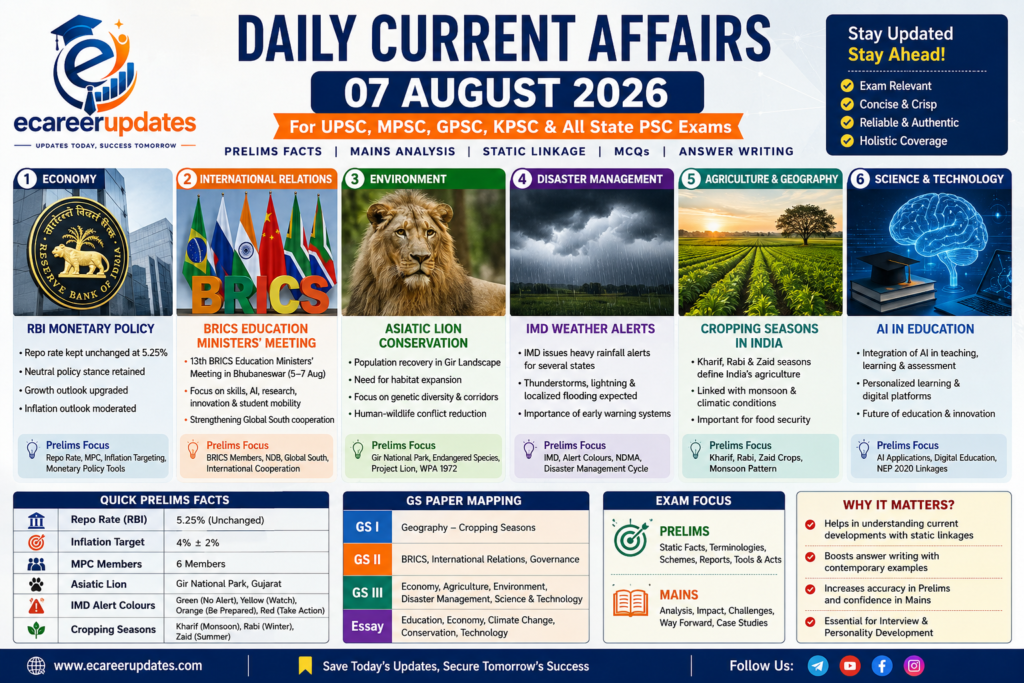
📑 Table of Contents
| GS Paper | Topic | UPSC Importance |
|---|---|---|
| GS III | RBI Monetary Policy & Inflation | ⭐⭐⭐⭐⭐ |
| GS II | BRICS Education Cooperation | ⭐⭐⭐⭐☆ |
| GS III | Asiatic Lion Conservation | ⭐⭐⭐⭐⭐ |
| GS III | IMD Weather Alerts & Disaster Management | ⭐⭐⭐⭐☆ |
| GS III | Agriculture – Cropping Seasons | ⭐⭐⭐⭐⭐ |
| GS III | Economy & Global Markets | ⭐⭐⭐⭐☆ |
| GS II | Governance & Editorial Issues | ⭐⭐⭐⭐☆ |
📌 Daily Exam Focus
| Prelims | Mains |
|---|---|
| Static Concepts + Current Affairs Integration | Analytical Issues + Way Forward |
1. ECONOMY
RBI Monetary Policy: Repo Rate Unchanged at 5.25%
Why in News?
The Reserve Bank of India (RBI) kept the repo rate unchanged at 5.25%, retained a neutral monetary policy stance, upgraded the growth outlook, and projected easing inflation while cautioning against global uncertainties.
News Snapshot
| Particular | Details |
|---|---|
| Institution | RBI |
| Repo Rate | 5.25% |
| Policy Stance | Neutral |
| Inflation Outlook | Moderating |
| GDP Outlook | Positive |
Static Portion (UPSC Favourite)
Monetary Policy Tools
| Tool | Purpose |
|---|---|
| Repo Rate | RBI lends to Banks |
| Reverse Repo | RBI absorbs liquidity |
| CRR | Cash with RBI |
| SLR | Liquid Assets maintained by banks |
| MSF | Emergency Borrowing |
Why is it Important?
Impact on Economy
| Sector | Impact |
|---|---|
| Home Loans | Stable |
| Business Credit | Predictable |
| Inflation | Controlled |
| GDP | Supported |
UPSC Prelims Focus
Remember
- Inflation Target = 4% ± 2%
- MPC Members = 6
- Repo Rate ≠ Bank Rate
- CRR has no interest payment
Mains Perspective
Discuss
“Monetary policy must strike a balance between inflation and growth.”
Use keywords:
- Inflation Targeting
- Liquidity
- Financial Stability
- Inclusive Growth
2. INTERNATIONAL RELATIONS
BRICS Education Ministers’ Meeting
Why in News?
India, as the 2026 BRICS Chair, hosted the 13th BRICS Education Ministers’ Meeting in Bhubaneswar to strengthen cooperation in higher education, AI, research, innovation, and skills.
Important Points
| Topic | Importance |
|---|---|
| Student Mobility | Global Education |
| AI in Education | Future Skills |
| Research | Innovation |
| Digital Learning | Knowledge Economy |
BRICS Members
| Original | Expanded Members |
|---|---|
| Brazil | Egypt |
| Russia | Ethiopia |
| India | Iran |
| China | UAE |
| South Africa | Indonesia |
Mains Linkage
GS II
- Education
- International Relations
- Soft Power Diplomacy
Possible UPSC Question
Discuss the importance of educational cooperation in strengthening Global South partnerships.
3. ENVIRONMENT
Asiatic Lion Conservation
Why in News?
Recent assessments highlighted achievements in Asiatic Lion conservation while emphasizing habitat expansion, genetic diversity, and long-term ecological sustainability.
Static Facts
| Particular | Information |
|---|---|
| Scientific Name | Panthera leo persica |
| IUCN Status | Endangered |
| Distribution | Gujarat |
| Major Habitat | Gir Landscape |
Threats
| Threat | Effect |
|---|---|
| Disease | Population Risk |
| Habitat Fragmentation | Reduced Genetic Diversity |
| Human-Wildlife Conflict | Mortality |
| Climate Change | Habitat Stress |
Conservation Measures
| Initiative | Objective |
|---|---|
| Project Lion | Habitat Expansion |
| Protected Areas | Conservation |
| Wildlife Corridors | Connectivity |
UPSC Prelims
Know
- Gir National Park
- Wildlife Protection Act
- Schedule I Species
- National Board for Wildlife
Mains Value Addition
Mention
- Landscape-based conservation
- Community participation
- Eco-sensitive zones
4. ENVIRONMENT & DISASTER MANAGEMENT
IMD Heavy Rainfall Warning
Why in News?
The India Meteorological Department (IMD) issued heavy rainfall alerts for several regions, warning of thunderstorms, lightning, and localized flooding.
Disaster Management Cycle
| Stage | Institution |
|---|---|
| Forecast | IMD |
| Warning | NDMA |
| Rescue | NDRF |
| Relief | State Administration |
Alert Colours
| Colour | Meaning |
|---|---|
| Green | No Alert |
| Yellow | Watch |
| Orange | Be Prepared |
| Red | Take Action |
GS III
Topics
- Disaster Management
- Climate Change
- Flood Management
5. AGRICULTURE
Cropping Seasons in India (High UPSC Relevance)
Recent discussions have again highlighted India’s agricultural calendar and its link with the southwest monsoon, food security, and rural economy.
Cropping Seasons
| Season | Sowing | Harvesting | Crops |
|---|---|---|---|
| Kharif | June–July | Sept–Oct | Rice, Maize, Cotton |
| Rabi | Oct–Dec | Mar–Apr | Wheat, Mustard |
| Zaid | Mar–June | Summer | Watermelon, Cucumber |
UPSC Prelims Facts
| Topic | Remember |
|---|---|
| Kharif | Monsoon Crop |
| Rabi | Winter Crop |
| Zaid | Short Summer Crop |
Mains Linkage
Discuss
- Climate Change
- Monsoon Dependency
- Food Security
- MSP
6. SCIENCE & TECHNOLOGY
AI in Education
Current discussions within BRICS and national education initiatives continue to focus on integrating AI into teaching, research, and skill development.
Applications
| Area | Example |
|---|---|
| Personalized Learning | Adaptive Platforms |
| Research | AI Analytics |
| Assessment | Automated Evaluation |
| Translation | Multilingual Education |
7. GOVERNANCE
Editorial Theme
Inclusive Governance through Evidence-Based Policy
Major editorials today emphasized:
- Better public policy
- Education reforms
- Institutional capacity
- Economic resilience
- Sustainable development
GS PAPER MAPPING
| GS Paper | Today’s Topics |
|---|---|
| GS I | Geography (Cropping Seasons) |
| GS II | BRICS, Governance |
| GS III | Economy, Environment, Agriculture, Disaster Management |
| Essay | Education, Economy, Climate |
PRELIMS FACT BOX
| Topic | Important Fact |
|---|---|
| Repo Rate | 5.25% |
| Inflation Target | 4 ±2 % |
| BRICS | Expanded Membership |
| Asiatic Lion | Endangered |
| Gir NP | Gujarat |
| Yellow Alert | Watch |
| Orange Alert | Preparedness |
| Red Alert | Action |
STATIC + CURRENT AFFAIRS LINKAGE
| Current News | Static Topic |
|---|---|
| RBI Policy | Monetary Policy |
| BRICS Meeting | International Organizations |
| Lion Conservation | National Parks |
| IMD Alert | Disaster Management |
| Agriculture | Cropping Patterns |
UPSC PRELIMS PRACTICE MCQs
Q1. The Monetary Policy Committee consists of:
A. 5 Members
B. 6 Members
C. 7 Members
D. 9 Members
Answer: B
Q2. Asiatic Lion is naturally found in
A. Rajasthan
B. Madhya Pradesh
C. Gujarat
D. Karnataka
Answer: C
Q3. Which crop belongs to Zaid season?
A. Wheat
B. Rice
C. Cotton
D. Watermelon
Answer: D
Q4. Orange Alert issued by IMD signifies
A. Normal
B. Watch
C. Be Prepared
D. Evacuate
Answer: C
Q5. BRICS New Development Bank is headquartered in
A. New Delhi
B. Beijing
C. Shanghai
D. Moscow
Answer: C
MAINS ANSWER WRITING
GS II
Q. Discuss the role of educational cooperation in India’s engagement with the Global South through BRICS.
GS III
Q. Evaluate the role of the RBI’s monetary policy in balancing inflation and economic growth.
GS III
Q. Explain the importance of landscape-based conservation for the long-term survival of the Asiatic Lion.
ESSAY THEMES
- Education as India’s Soft Power
- Growth with Stability: India’s Monetary Policy
- Climate Resilience and Sustainable Agriculture
- Wildlife Conservation and Sustainable Development
- Technology for Inclusive Learning
30-SECOND REVISION SHEET
| Topic | Keywords |
|---|---|
| RBI | Repo 5.25%, Neutral Stance |
| BRICS | Education, AI, Skills |
| Asiatic Lion | Gir, Endangered, Project Lion |
| IMD | Yellow–Orange–Red Alerts |
| Agriculture | Kharif, Rabi, Zaid |
| Governance | Evidence-Based Policymaking |
Exam Prediction (High Probability)
| Topic | Prelims | Mains |
|---|---|---|
| Monetary Policy & MPC | ⭐⭐⭐⭐⭐ | ⭐⭐⭐⭐⭐ |
| BRICS & Global South | ⭐⭐⭐⭐☆ | ⭐⭐⭐⭐⭐ |
| Asiatic Lion Conservation | ⭐⭐⭐⭐⭐ | ⭐⭐⭐⭐☆ |
| Disaster Management & IMD | ⭐⭐⭐⭐☆ | ⭐⭐⭐⭐☆ |
| Cropping Seasons & Agriculture | ⭐⭐⭐⭐⭐ | ⭐⭐⭐⭐☆ |
| AI in Education | ⭐⭐⭐⭐☆ | ⭐⭐⭐⭐☆ |
This edition follows the recent UPSC trend of integrating current affairs with static concepts, emphasizing conceptual understanding, governance linkages, and analytical depth rather than isolated news memorization.