Prelims + Mains Oriented Analysis | Based on Recent UPSC & State PSC Examination Trends
Ecareerupdates | Daily Current Affairs | UPSC | MPSC | KPSC | UPPSC | BPSC | GPSC | RPSC
The UPSC Civil Services Examination and State PSCs increasingly assess a candidate’s ability to integrate current affairs with static concepts. This edition covers the most important developments of 27 July 2026, with exam-oriented explanations, Prelims facts, Mains perspectives, revision tables, MCQs, and answer-writing practice.
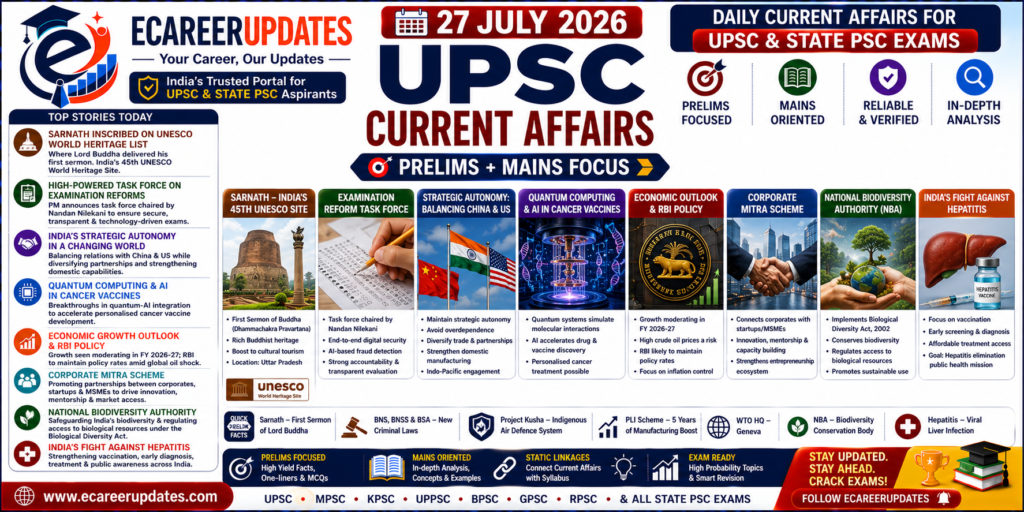
🔥 Top Current Affairs Themes – 27 July 2026
| Topic | GS Paper | Exam Importance |
|---|---|---|
| Sarnath Inscribed on UNESCO World Heritage List | GS-I | ⭐⭐⭐⭐⭐ |
| High-Powered Task Force on Examination Reforms | GS-II | ⭐⭐⭐⭐⭐ |
| India’s Strategic Autonomy: China–US Balance | GS-II | ⭐⭐⭐⭐⭐ |
| Quantum Computing & AI in Cancer Vaccines | GS-III | ⭐⭐⭐⭐⭐ |
| Economic Growth Outlook & RBI Policy | GS-III | ⭐⭐⭐⭐☆ |
| Corporate Mitra Scheme | GS-III | ⭐⭐⭐⭐☆ |
| National Biodiversity Authority (NBA) | GS-III | ⭐⭐⭐⭐☆ |
| India’s Fight Against Hepatitis | GS-II | ⭐⭐⭐⭐☆ |
🏛️ POLITY & GOVERNANCE
High-Powered Task Force on Examination Reforms
The Prime Minister announced a high-powered task force chaired by Nandan Nilekani to recommend reforms for making public examinations more secure, transparent, technology-driven, and resistant to paper leaks. The initiative aims to strengthen recruitment examinations and restore public confidence.
Why Important for UPSC?
This topic links with:
- Good Governance
- Digital Governance
- Public Recruitment
- Administrative Reforms
- Use of Technology in Governance
Static Linkage
| Institution | Role |
|---|---|
| UPSC | Constitutional Recruitment Body |
| NTA | National Entrance Examinations |
| Article 315 | Public Service Commissions |
Expected Recommendations
- End-to-end digital monitoring
- AI-based fraud detection
- Secure examination logistics
- Stronger accountability
- Transparent evaluation systems
UPSC Mains Question
Discuss how technology can improve the transparency, integrity, and efficiency of public examinations in India.
🏛️ HISTORY & CULTURE
Sarnath Becomes India’s 45th UNESCO World Heritage Site
Sarnath, where Lord Buddha delivered his first sermon (Dhammachakra Pravartana) after attaining enlightenment, has been inscribed on the UNESCO World Heritage List. The recognition highlights India’s rich Buddhist heritage and strengthens cultural tourism.
Why Important?
Frequently asked in UPSC:
- Buddhism
- UNESCO World Heritage Sites
- Ancient Indian History
- Art & Culture
Static Revision
| Place | Importance |
|---|---|
| Lumbini | Birth of Buddha |
| Bodh Gaya | Enlightenment |
| Sarnath | First Sermon |
| Kushinagar | Mahaparinirvana |
Buddhist Symbols
- Dharmachakra
- Ashokan Pillar
- Lion Capital
- Stupa Architecture
Mains Question
Explain the significance of Buddhist heritage in promoting India’s cultural diplomacy and tourism.
🌍 INTERNATIONAL RELATIONS
India’s Strategic Autonomy: Balancing China and the United States
Strategic policy discussions emphasised that India should maintain strategic autonomy, avoid excessive economic dependence on China, and avoid strategic dependence on any single power, while diversifying trade and strengthening domestic manufacturing.
Why Important?
Connected with:
- Strategic Autonomy
- Indo-Pacific
- QUAD
- Supply Chain Resilience
- Atmanirbhar Bharat
Static Concepts
| Policy | Objective |
|---|---|
| Strategic Autonomy | Independent Foreign Policy |
| Act East Policy | Indo-Pacific Engagement |
| SAGAR | Maritime Security |
| Make in India | Domestic Manufacturing |
Mains Question
Evaluate the importance of strategic autonomy in India’s evolving foreign policy.
💰 ECONOMY
India’s Economic Growth Outlook
Recent assessments indicate that India’s growth is expected to moderate in FY 2026–27 because of weak private investment and higher international crude oil prices. Economists expect the Reserve Bank of India (RBI) to maintain policy rates while balancing inflation and growth concerns.
Why Important?
Links with:
- Monetary Policy
- Inflation
- GDP Growth
- Fiscal Policy
- Energy Security
Factors Affecting Growth
| Factor | Impact |
|---|---|
| High Oil Prices | Inflation |
| Weak Private Investment | Lower Growth |
| Stable Interest Rates | Growth Support |
| Global Uncertainty | Export Pressure |
Static Revision
| Indicator | Meaning |
|---|---|
| GDP | Economic Growth |
| CPI | Inflation |
| Repo Rate | RBI Policy Rate |
| Fiscal Deficit | Government Borrowing Gap |
Mains Question
Discuss the challenges before the Reserve Bank of India in balancing inflation control with economic growth.
🧬 SCIENCE & TECHNOLOGY
Quantum Computing & AI for Cancer Vaccines
Researchers highlighted the growing role of Quantum Computing integrated with Artificial Intelligence in designing personalised cancer vaccines. Quantum systems can process complex molecular interactions much faster, potentially accelerating precision medicine.
Why Important?
UPSC Themes:
- Emerging Technologies
- Artificial Intelligence
- Biotechnology
- Healthcare Innovation
Static Revision
| Technology | Application |
|---|---|
| AI | Data Analysis |
| Quantum Computing | Complex Simulations |
| Genomics | Personalised Medicine |
| Machine Learning | Drug Discovery |
Mains Question
Explain how emerging technologies such as Artificial Intelligence and Quantum Computing can transform the healthcare sector.
💼 ECONOMY & MSME
Corporate Mitra Scheme
The Corporate Mitra Scheme seeks to encourage stronger partnerships between corporate entities and startups/MSMEs by promoting mentorship, innovation, capacity building, and market linkages. It aims to strengthen India’s entrepreneurship ecosystem.
Importance
- Startup Growth
- Skill Development
- Innovation
- Employment Generation
- Ease of Doing Business
🌱 ENVIRONMENT
National Biodiversity Authority (NBA)
The National Biodiversity Authority (NBA) remains an important institution for conserving biodiversity, ensuring sustainable use of biological resources, and regulating access to biological resources under the Biological Diversity Act.
Static Revision
| Institution | Function |
|---|---|
| NBA | Biodiversity Conservation |
| State Biodiversity Boards | State-level Implementation |
| Biodiversity Management Committees | Local Conservation |
Biodiversity Importance
- Conservation
- Sustainable Development
- Traditional Knowledge Protection
- Ecological Balance
Mains Question
Explain the role of the National Biodiversity Authority in conserving India’s biological resources.
🩺 HEALTH
India’s Fight Against Hepatitis
Recent government outreach highlighted efforts to strengthen hepatitis prevention through vaccination, early diagnosis, improved treatment, and public awareness. These initiatives support India’s goal of reducing the disease burden under the broader public health framework.
Important Programmes
| Programme | Objective |
|---|---|
| National Viral Hepatitis Control Programme | Hepatitis Elimination |
| Universal Immunisation Programme | Vaccination |
| Ayushman Bharat | Health Coverage |
🌍 GEOGRAPHY
Monsoon & Agriculture
The southwest monsoon continues to influence:
- Kharif Sowing
- Reservoir Storage
- Water Availability
- Flood Risk
- Landslides
Static Revision
| Concept | Importance |
|---|---|
| ITCZ | Monsoon Formation |
| ENSO | Monsoon Variability |
| El Niño | Weak Monsoon |
| La Niña | Strong Monsoon |
🌱 ENVIRONMENT & CLIMATE
Nature-Based Solutions
Climate adaptation continues through:
- Wetland Conservation
- River Restoration
- Agroforestry
- Urban Green Spaces
- Floodplain Management
Frameworks to Revise
| Framework | Objective |
|---|---|
| CBD | Biodiversity Conservation |
| Sendai Framework | Disaster Risk Reduction |
| NAPCC | Climate Strategy |
📚 STATIC REVISION BOX
UNESCO Related Sites
| Site | Importance |
|---|---|
| Sarnath | First Sermon of Buddha |
| Bodh Gaya | Enlightenment |
| Ajanta | Buddhist Cave Paintings |
| Nalanda | Ancient University |
Organisations
| Organisation | Role |
|---|---|
| UNESCO | Culture & Education |
| NBA | Biodiversity |
| RBI | Monetary Policy |
| NTA | National Entrance Examinations |
🎯 PRELIMS RAPID REVISION
| Topic | One-Liner |
|---|---|
| Sarnath | India’s 45th UNESCO World Heritage Site |
| Nandan Nilekani | Heads Examination Reform Task Force |
| Strategic Autonomy | Independent Foreign Policy |
| Quantum Computing | High-Speed Complex Computing |
| NBA | Biodiversity Conservation |
| UNESCO | Headquarters – Paris |
| Hepatitis | Viral Liver Disease |
| Repo Rate | RBI Monetary Policy Tool |
| Corporate Mitra Scheme | Industry–Startup Collaboration |
| Bodh Gaya | Enlightenment of Buddha |
📝 MAINS VALUE ADDITION
GS-I
- Buddhism
- UNESCO Heritage
- Indian Culture
GS-II
- Governance
- Examination Reforms
- Strategic Autonomy
GS-III
- Economy
- AI & Quantum Computing
- Biodiversity
- Healthcare
GS-IV
- Transparency
- Accountability
- Ethical Governance
⭐ High Probability Topics
| Topic | Probability |
|---|---|
| Sarnath UNESCO Listing | ⭐⭐⭐⭐⭐ |
| Examination Reform Task Force | ⭐⭐⭐⭐⭐ |
| Strategic Autonomy | ⭐⭐⭐⭐⭐ |
| Quantum Computing & AI | ⭐⭐⭐⭐⭐ |
| RBI & Growth Outlook | ⭐⭐⭐⭐☆ |
| National Biodiversity Authority | ⭐⭐⭐⭐☆ |
| Corporate Mitra Scheme | ⭐⭐⭐⭐☆ |
| Hepatitis Elimination | ⭐⭐⭐⭐☆ |
✍️ Practice Questions
Prelims MCQ 1
Q. Sarnath is associated with which event in the life of Gautama Buddha?
A. Birth
B. Enlightenment
C. First Sermon
D. Mahaparinirvana
✅ Answer: C
Prelims MCQ 2
Q. The National Biodiversity Authority functions under which Act?
A. Environment Protection Act, 1986
B. Wildlife Protection Act, 1972
C. Biological Diversity Act, 2002
D. Forest Conservation Act, 1980
✅ Answer: C
📝 UPSC Mains Practice
GS-II (10 Marks)
Examine the importance of strategic autonomy in India’s foreign policy in the context of changing global geopolitics.
GS-III (15 Marks)
Discuss how Artificial Intelligence and Quantum Computing can transform healthcare while highlighting the challenges associated with their adoption.
📖 Revision Corner
| Topic | Must Revise |
|---|---|
| Sarnath | Buddhist history, UNESCO significance |
| Strategic Autonomy | India–US–China relations |
| RBI | Monetary policy and inflation |
| Quantum Computing | Applications and challenges |
| National Biodiversity Authority | Structure and functions |
| Examination Reforms | Technology and governance |
| Hepatitis Control | Public health programmes |
| Corporate Mitra Scheme | MSME and startup ecosystem |
📌 Final UPSC / State PSC Takeaway – 27 July 2026
The most important examination themes from today’s current affairs are:
- Sarnath’s UNESCO World Heritage inscription
- High-Powered Task Force on Examination Reforms
- India’s Strategic Autonomy in a changing global order
- Quantum Computing and AI in healthcare
- India’s economic growth outlook and RBI policy
- Corporate Mitra Scheme for startups and MSMEs
- National Biodiversity Authority and biodiversity conservation
- India’s efforts to combat hepatitis
These topics are highly relevant for UPSC CSE, MPSC, KPSC, UPPSC, BPSC, GPSC, RPSC, and other State PSC examinations because they integrate Polity, Governance, International Relations, Economy, Science & Technology, Environment, Health, and Art & Culture, reflecting the interdisciplinary approach adopted in recent Prelims and Mains.